
Culture fit vs skill fit: how to weigh both when you hire
Skill fit shows a candidate can do the job; culture fit shows how they will do it with you. Learn which matters more and how to judge both.

Culture fit is how well a candidate's values and ways of working match the ones your organization has agreed to matter. Skill fit is whether the candidate can do the job to the standard the role needs. Strong hiring teams treat skill fit as the gate and culture fit, defined as shared values rather than shared personality, as the tiebreaker between qualified people. This blog explains the importance of culture fit vs skill fit.
 ChatGPT
 Gemini
 Claude
 Grok
 Perplexity
TL;DR
- Skill fit shows whether a candidate can do the job, while culture fit assesses how they align with the organization's values.
- Prioritize skill fit first, then use values fit to distinguish between qualified candidates.
- Culture add brings new perspectives and skills, while vague culture fit criteria can introduce bias and limit diversity.
- Assess both fairly using job-related skills tests, structured behavioral interviews, and consistent scorecards. Adjust the weighting by role, giving greater importance to skills for technical roles and values for people managers.
- Testlify helps hiring teams assess technical skills, soft skills, and working styles using structured assessments.

What is culture fit?
Culture fit is the match between a candidate's values, behaviors, and working style and the values and norms of the team they would join. Done well, culture fit asks whether someone will act on what the organization has agreed matters, such as owning mistakes, sharing information, or putting customers first.
A useful test: if an interviewer cannot name the specific value a candidate failed to show, and the answer that showed it, "not a culture fit" is a feeling, not an assessment. Our guide to culture fit assessments covers how teams turn values into something they can measure.
What is skill fit?
Skill fit is how well a candidate's abilities match what the role needs on day one and within the first few months. Skill fit covers three layers: hard skills such as Excel, Python, or accounting rules; soft skills such as communication, teamwork, and judgment; and the ability to learn the skills the role will need next.
Skill fit is easier to define than culture fit, because the job itself sets the standard. Hiring teams know it matters. In LinkedIn's Future of Recruiting 2025, 93% of talent acquisition professionals said accurately assessing a candidate's skills is crucial to improving quality of hire, yet only 25% felt highly confident they can measure quality of hire at all.
That gap is why skills-based hiring has moved from a trend to a default for many teams: test the skills directly instead of guessing from job titles and degrees.
What is the difference between culture fit vs skill fit?
Culture fit and skill fit answer different questions. Skill fit asks, "Can this person do the work?" Culture fit asks, "Will this person do the work in the way our team has agreed matters?" Skill fit is measured against the job; culture fit is measured against the organization's values.
Skill fit | Culture fit (done well) | Culture fit (done badly) | |
|---|---|---|---|
Question it answers | Can they do the job? | Will they act on our values? | Do we like them? |
Measured against | The role's tasks and standards | 3 to 5 written values | The interviewer's own taste |
Best evidence | Skills tests, work samples, coding tasks | Same behavioral questions, scored per value | Small talk, "gut feel" |
How easy to teach later | Often trainable | Hard to change | Not relevant |
Main risk | Ignoring how people work together | Vague values that hide bias | Homogeneous teams, legal exposure |
When to assess | First, early in the funnel | After the skills bar is met | Never |
Which matters more: Culture fit vs skill fit?
Skill fit should usually come first, because a candidate who cannot do the job is not a good hire however well they fit in. Culture fit, measured as values fit, then decides between candidates who have all cleared the same skills bar. The order matters as much as the weighting.
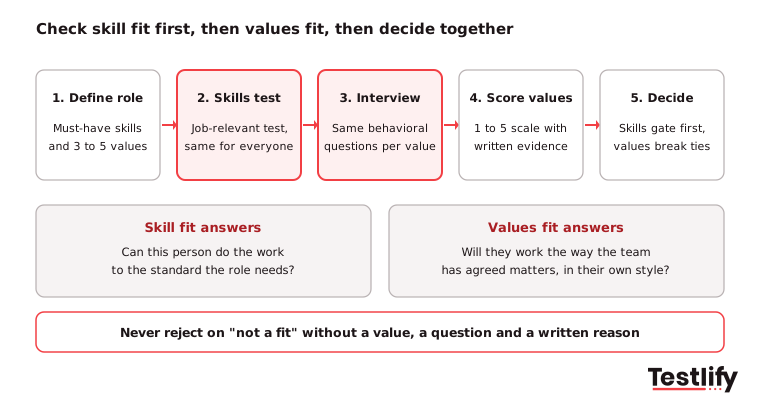
Putting skills first does two useful things. It stops a likeable but underqualified candidate from winning on rapport, and it widens the pool before anyone forms an impression. LinkedIn's Economic Graph research from March 2025 found that a skills-based approach could expand talent pools 6.1 times globally, and 15.9 times in the United States, compared with hiring only people who held the same job title before.
There are exceptions. For a first hire in a new team or a people manager who will shape how others work, values carry more weight. For a specialist technical role, skills carry more. The section on weighting by role below gives starting points.
Pro tip: Write the skills bar and the values before you open the role. If you decide them after meeting candidates, you will quietly define them around the person you already like.
What is culture add, and how is it different from culture fit?
Culture add is the idea of hiring people who bring skills, experiences, and viewpoints the team does not yet have, instead of people who blend in. Culture fit asks, "Will they fit in?" Culture add asks, "What will they bring that we lack?" Many teams now use a third term, "values fit," to keep the useful part of culture fit without the sameness.
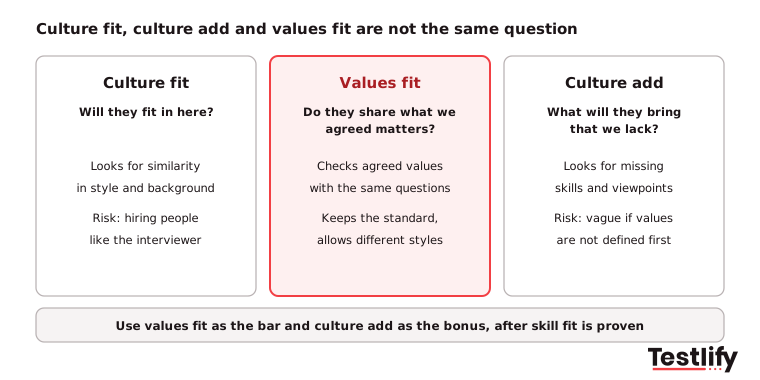
Culture fit | Values fit | Culture add | |
|---|---|---|---|
Core question | Will they fit in here? | Do they share what we agreed matters? | What will they bring that we lack? |
Looks for | Similarity | Agreed values, any style | Missing skills and viewpoints |
Works best when | Values are written and specific | Always, as the bar | Values fit is already checked |
Main risk | Hiring people like the interviewer | Values written too vaguely | Becomes a vague "diversity" label |
In practice, the strongest approach combines them: values fit is the bar every hire must clear, and culture add is a plus that helps you choose between qualified people. A candidate who disagrees with how the team does things, but shares its values, is often exactly the person a team needs.
What goes wrong when you over-weight culture fit?
Overweighting culture fit leads to teams that look, think, and talk alike, and to hiring decisions that are hard to explain or defend. The four most common problems are bias, groupthink, weak documentation, and lost talent.
- Similarity bias. Interviewers tend to rate people like themselves higher. Unstructured "fit" conversations give that bias room to decide the outcome. See how cognitive bias harms hiring for the patterns to watch.
- Groupthink. A team of similar people spots fewer risks and generates fewer ideas, which hurts most when the market changes.
- Legal exposure. In the US, the EEOC states that an employer may not base hiring decisions on stereotypes and assumptions about a person's race or other protected traits. "Not a culture fit," with no documented value behind it, is a weak reason to give if a decision is challenged.
- Lost talent. Strong candidates from different backgrounds, career paths, or countries get filtered out for reasons that have nothing to do with the job.
The ethics of these tools matter too. Our piece on ethical considerations in culture fit assessments covers consent, transparency, and fair use.
What goes wrong when you hire on skills alone?
Hiring on skills alone can bring in people who do strong individual work but clash with how the team operates, which costs time, morale, and retention. Skill fit tells you someone can do the work; it does not tell you whether they will share information, take feedback, or follow through on commitments.
- Team friction. A highly skilled hire who ignores team norms can slow everyone else down.
- Lower engagement. People who do not connect with how the organization works are less likely to stay. Engagement is already low: Gallup's State of the Global Workplace reports that global employee engagement fell to 20% in 2025, at an estimated cost of $10 trillion in lost productivity.
- Missed soft skills. Communication, teamwork, and judgment are skills too. A skills process that tests only technical ability misses half of what most roles need.
The fix is not to drop skills testing. Add soft skills to the skills bar, and assess values with the same structure you use for skills.
How do you assess culture fit and skill fit fairly?
Assessing culture fit and skill fit fairly means using the same evidence, the same questions, and the same scoring for every candidate, in a fixed order. The six steps below work for a single critical hire and for high-volume hiring.
- Define the role in two lists: Write the must-have skills for day one and 3 to 5 values, each with the behavior that shows it. "Ownership" becomes "flags a problem early and proposes a fix."
- Test skill fit first: Use a job-relevant skills test that every applicant takes, so the shortlist is based on ability, not on resumes or first impressions.
- Add soft skills to the test: Include communication, teamwork, or situational judgment where the role needs them.
- Run a structured values interview: Ask every candidate the same behavioral questions, one or two per value. Our guide to structured interviews shows how to set them up.
- Score each value on a written scale: Use a 1 to 5 scale with an example of what a 1, 3, and 5 answer looks like, and require a note for every score.
- Decide as a panel: Each interviewer scores alone first, then the panel compares. Skills set the shortlist; values break ties.
Hiring teams are under pressure to get this right. SHRM's 2025 Talent Trends found that nearly 70% of organizations still struggle to recruit for full-time roles, and 28% now require new skills for full-time roles. A clear, repeatable process lets teams move fast without lowering the bar. For a deeper walk-through, see how to build your own culture fit assessment.
Which culture-fit interview questions work best?
Culture fit interview questions work best when each one is tied to a named value and asks about past behavior, not opinions or hobbies. Ask every candidate the same questions and score the answers against the behavior you wrote down for that value.
Value | Question to ask | What a strong answer shows |
|---|---|---|
Ownership | Tell me about a time something you were responsible for went wrong. What did you do? | Owns the mistake, acts early, explains the fix |
Collaboration | Describe a project where you disagreed with a teammate. How was it resolved? | Listens, argues with evidence, commits to the decision |
Learning | What is something you had to learn quickly for work? How did you approach it? | A clear method, asks for help, applies it fast |
Customer focus | Tell me about a time you pushed back on a request because it was wrong for the customer. | Puts the customer outcome ahead of the easy answer |
Candor | When did you last give feedback someone did not want to hear? | Specific, kind and direct, follows up |
Avoid questions that test similarity, such as "what do you do at weekends?" or "which team do you support?". They add nothing to the decision and invite bias.
How should you weight culture fit and skill fit by role?
The weighting of culture fit and skill fit should change with the role, but only after every candidate has passed the same must-have skills bar. Specialist roles lean on skills; roles that shape how others work lean on values. Agree the split before the first interview and write it into the scorecard.
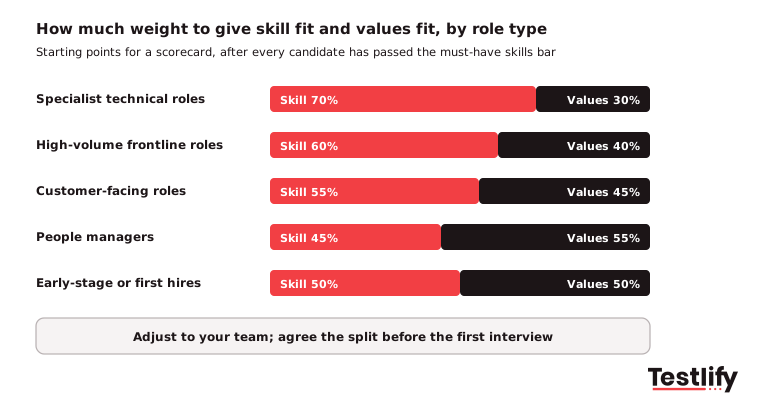
These are starting points, not rules. Adjust them to your team, and review them after each hiring round by checking how hires from each role performed.
Key takeaway: Culture fit vs skill fit is not a choice between the two. Test skill fit first, define culture fit as a short list of observable values, score both the same way for every candidate, and let values decide between people who can already do the job.
How does Testlify help you assess culture and skills fit?
Testlify lets hiring teams test skill fit and values fit in one assessment, so every candidate is scored on the same evidence before the interview. Teams can choose from 3,500+ tests, including role-specific skills tests and personality and culture tests, and combine them with 25+ question types.
- Skill fit. Role-specific, software, coding and cognitive tests, plus soft skills tests such as communication and teamwork.
- Values and working style. Personality and culture tests such as the Big Five (BFI) and DISC give structured data on working style to discuss in the values interview, not to reject on.
- Fair, comparable results. Automated scoring, weighted scoring and 20+ proctoring checks keep results consistent and trustworthy, and assessments run in 15+ languages.
Browse the Testlify test library to build a skills-first assessment for your next role.
Frequently asked questions (FAQs)

Related resources
View all
HR & recruitment
Instant benefits of using time-tracking software
HR & recruitment
How to choose the right cognitive ability test for hiring top talent

HR & recruitment
How to integrate cognitive ability tests into your hiring process

HR & recruitment
Culture fit assessments for hiring remote teams

HR & recruitment
Real-world examples of how SJTs predict job performance
HR & recruitment
How Situational Judgement Tests (SJTs) find the best fits
Get started.
Hire on proof, not resumes.
Run your first skills-based assessment free — no credit card required.