
QA test for hiring: what to measure and how to run one
How to use a QA test for hiring: the skills to measure, the right format for each level, where it fits in your process and how to score it.

A QA test for hiring is a pre-employment assessment that asks candidates to do quality assurance work instead of describing it: read a requirement, design test cases, find a defect, judge its severity and explain the risk to an engineer. It gives every applicant the same task and a score you can compare, before anyone spends time on interviews.
A QA hire can look strong on paper and still pass builds that should have been blocked. You usually find out a quarter later, when a customer does the testing for you. A short, role-specific test catches that gap at the start of the process, when it is cheap to act on.
TL;DR:
- A QA test for hiring measures demonstrated skill (test design, defect detection, severity judgment), not claimed experience, and most run 20 to 40 minutes.
- Send it to every applicant right after they apply and before the first interview. A Testlify and SHRM Labs study found only 6.9% of HR teams assess before the first interview.
- Match the test to the level: junior hires need bug finding and test case writing, senior hires need test planning, regression strategy and automation judgment.
- Set the pass mark before you see any scores, then track the pass rate. If 90% of candidates pass, the test is too easy to tell anyone apart.
- Follow the test with a structured interview, same questions and same rubric for everyone, so the two signals add up instead of overlapping.
- The QA talent pool is growing slower than the teams that need it: BLS projects 6% growth for QA analysts and testers to 2035, against 10% for software developers.
 ChatGPT
 Gemini
 Claude
 Grok
 Perplexity
What is a QA test for hiring?
A QA test for hiring is a timed assessment that checks whether a candidate can do the core work of a quality assurance role: turn a requirement into test cases, spot and reproduce a defect, rank issues by severity, and know which testing method fits which risk. The score reflects what the candidate can do, so it can be compared across every applicant for the role.
Most QA tests combine two parts. A knowledge section uses multiple-choice or short-answer questions on testing methods, the software development life cycle and tools. A practical section gives the candidate a requirement or a build with faults planted in it and scores the test cases or bug reports they produce.

Why use a QA test for hiring instead of resumes?
A QA test for hiring shows how a candidate actually tests, which a resume cannot. Two candidates with the same title, the same tools listed and the same years of experience can differ widely in how many defects they catch and how clearly they report them. The test makes that difference visible before the interview stage.
The market makes the case sharper. The US Bureau of Labor Statistics puts software quality assurance analysts and testers at about 187,600 jobs in 2025, with a median wage of $104,300 and projected growth of 6% from 2025 to 2035.
Software developers are projected to grow 10% over the same period, so engineering teams are growing faster than the QA pool that supports them. Many older posts quote $134,040 and 10%, but those are the combined figures for developers and testers, not QA alone.
The main benefits of a QA test in the recruitment process:
- Measures practical QA skills: Scores test case design, defect identification and quality analysis, not the ability to recite definitions.
- Improves screening accuracy: Moves only candidates who meet the required level to interviews, so hiring managers stop reading resumes that look alike.
- Shows attention to detail: Finds the candidates who notice small inconsistencies before they turn into product issues.
- Tests problem-solving: Shows how a candidate investigates an issue, works out its likely cause and decides how to confirm it.
- Supports skills-based hiring: Judges candidates on what they can do, which opens the pool to self-taught testers and career changers.
- Creates a consistent evaluation: Gives every candidate the same task and the same scoring criteria, so comparisons are fair.
- Reduces hiring risk: Adds hard evidence for the candidate who interviews well but struggles with real QA tasks.
- Speeds up screening: Lets recruiters screen large applicant pools without reviewing every application by hand.
Few teams use this yet. The Testlify and SHRM Labs Skills Assessments Research Study of 131 HR and talent leaders found that 32.8% use no skills assessment at any stage of hiring, and 47.4% take more than a week to produce a first shortlist.
What should a QA test for hiring measure?
A good QA tester needs more than theoretical knowledge of software testing. They should be able to identify defects, design effective test cases, prioritize issues and understand how different testing methods fit into the development cycle.
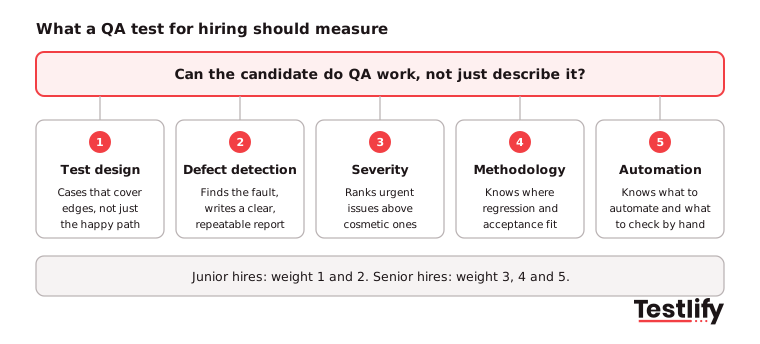
Here are five key skills to evaluate:
- Test design: Given a requirement, can the candidate write cases that cover edge conditions and negative paths, not only the happy path?
- Defect detection: Shown a broken build, does the candidate find the fault and describe it so a developer can reproduce it?
- Severity judgment: Can the candidate rank what is urgent against what is merely cosmetic?
- Methodology knowledge: Does the candidate know where regression, acceptance and non-functional testing each belong?
- Automation reasoning: Does the candidate know what is worth automating and what is cheaper to check by hand?
A first QA hire at a 30-person product company needs test design and severity judgment most, because that person will make those calls alone. A fifth QA hire on an established team may need automation depth instead. Testlify's guide to screening QA testers goes deeper on matching the screen to the seniority of the role.
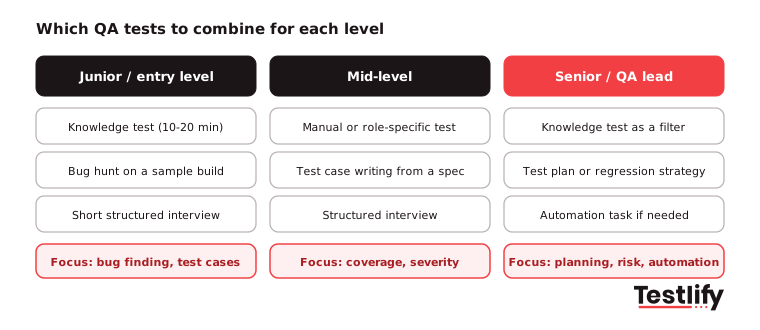
Which QA test format fits each role?
The right QA test format depends on the level of the hire and on how much candidate time you can ask for. Short knowledge tests suit early screening at volume. Practical tasks and test-planning exercises suit later stages and senior roles, where you need to see judgment, not recall.
Format | What it shows | Typical length | Best for |
|---|---|---|---|
Knowledge test (multiple choice) | Testing methods, SDLC, tools, terminology | 10 to 20 minutes | First screen for every applicant |
Bug hunt on a sample build | Defect detection, bug report quality, severity ranking | 30 to 60 minutes | Junior and mid-level testers |
Test case writing from a spec | Coverage of positive, negative and boundary cases | 30 to 60 minutes | Manual and functional testers |
Automation coding task | Framework use, script structure, what to automate | 30 to 60 minutes | QA automation engineers, SDETs |
Test plan or regression strategy | Scope, risk, priorities, entry and exit criteria | 60 to 90 minutes | QA leads and senior hires |
Structured interview | Communication, reasoning, team fit | 45 to 60 minutes | Shortlisted candidates |
Work-sample guidance from Yardstick suggests keeping most QA exercises to 45 to 60 minutes, with up to 90 minutes only for senior test planning. The same guidance makes a useful scoring point: a few detailed, well-prioritized bug reports are worth more than a long list of vague ones.
Which testing methods should QA candidates know?
QA candidates should recognise the main testing methods, and your test should cover the ones your product actually depends on. A candidate who cannot say where each method belongs will struggle to plan coverage for a release.
- Non-functional testing: Checks how the system behaves, such as load, response time and stability under stress. A candidate who never mentions performance may let a slow release through.
- Security testing: Looks for weaknesses an attacker could use. Not every QA role needs depth here, but every QA hire should know when to escalate.
- System testing: Checks the assembled product from start to finish, which is where integration faults surface.
- Acceptance testing: Confirms the build does what the business asked for. It means reading a requirement the way a customer would.
- Regression testing: Re-checks what already worked after a change. Teams often cut it first under deadline pressure, and it is where many escaped defects come from.
- Practical evaluation: A hands-on task using real artifacts of the job, such as a requirements document and a build with planted faults.
How do you add a QA test to your hiring process?
Hiring QA testers requires a structured process that evaluates both technical knowledge and practical testing abilities. Recruiters need to understand the role's requirements, choose relevant assessments and establish consistent evaluation criteria before screening candidates.
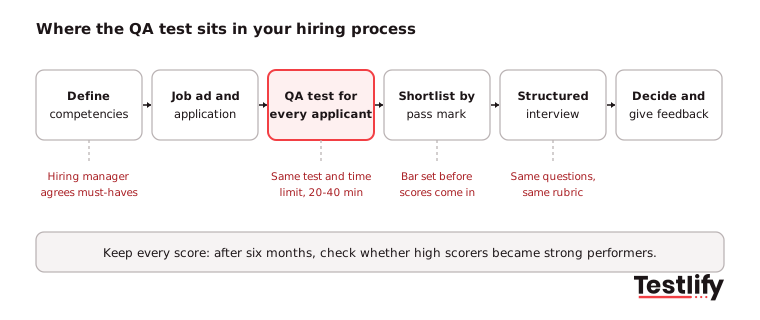
You add a QA test to your hiring process by placing it right after the application and before the first interview, then using the scores to decide who moves on. Here are nine steps to build an effective QA tester hiring process:
- Meet the hiring manager: Agree on what this hire must be able to do in the first six months. Manual or automation? Web, mobile or API? Leading a team or joining one?
- Define the competencies: Write down the four or five skills this hire needs, in plain words, before you look at a single test.
- Pick or build the assessment: A role-specific QA test from a library covers most cases. Add a practical task only where the role really needs one.
- Tell candidates what to expect: State in the job ad or invite email that a QA test is part of the process, how long it takes and what tools they need. Share a sample question if you can.
- Send it to every applicant: Screening after a human filter brings back the bias the test exists to remove.
- Set the bar before you see scores: Decide the passing threshold in advance, or you will move it to fit whoever you already like.
- Interview the top scorers: Use a structured interview with the same questions, in the same order, scored on the same rubric. Testlify's QA engineer interview questions are a good starting set.
- Review with the hiring manager and give feedback: Decide together, then tell every candidate the outcome, including where they did well. Clear feedback protects your employer brand.
- Keep the scores: Six months later they are the only way to check whether the test predicted on-the-job performance.
Pro tip: Put the test before the phone screen, not after it. Recruiters then spend screening calls only on candidates who have already shown they can do the work.
How do you set the pass mark and read QA test scores?
The pass mark for a QA test should come from the role's needs, not from the scores you happen to receive. Agree it with the hiring manager before the first invite goes out, and keep it fixed for the whole hiring round so every candidate meets the same bar.
- Start from the must-haves: Weight the competencies the role cannot do without, such as defect detection for a manual tester, more heavily than the nice-to-haves.
- Read section scores, not only the total: A candidate with a high total but a low severity-judgment score may flood developers with low-priority tickets.
- Track the pass rate at each stage: If 90% of candidates clear the test, it is too easy to be doing any work. If 5% clear it, check the level and the instructions before blaming the pool.
- Compare against your current team: Ask two strong QA team members to take the same test. Their scores show what good looks like in your context.
- Review after each hiring round: Check whether high scorers became strong performers and adjust the weighting if they did not.
Key takeaway: A QA test only adds information when the bar is set in advance and the pass rate shows it separates candidates.
How do you keep a QA test fair for candidates?
A QA test stays fair when every candidate for a role gets the same test, the same time limit, the same instructions and the same scoring rubric. Practical tasks help here: the US Office of Personnel Management notes that applicants often see work samples as very fair, and that performance differences between men and women or applicants of different races are generally small or absent.
- Keep it short: Ask for 60 minutes at most before the interview stage. Longer take-home tasks lose strong candidates who have other offers.
- Test the job, not trivia: Use the tools and artifacts of the real role, and avoid questions that reward memorized definitions.
- Judge method over tool brand: Score the approach to testing, not familiarity with one specific bug tracker.
- Offer accommodations: Allow extra time or alternative formats when a candidate asks for them.
- Protect integrity without friction: Use proctoring such as full-screen mode and copy-paste tracking, and explain it upfront so honest candidates are not surprised.
Should you outsource QA testing or hire in-house?
Outsourcing QA testing makes sense for a short burst of work, a one-off certification push or a specialty you will not need again. An in-house QA hire is the better choice when quality work is continuous, when the tester needs product context that takes months to build, and when you want someone who improves the process instead of only running test cases.
A simple rule helps: if you would need to explain your product from scratch at every engagement, hire. Testlify's QA engineer hiring guide walks through the full sequence for a first in-house hire.
How do you quality-check your own hiring process?
Quality assurance in the recruitment process means applying the same discipline to hiring that QA applies to a product: a written standard, repeatable checks and a record you can audit. Most teams test their product carefully and their hiring not at all.
Structure is the main lever. The Office of Personnel Management reports that interviews with more structure show higher reliability, better agreement between interviewers and less adverse impact. The Testlify and SHRM Labs study found that 44.5% of HR leaders say no one formally checks their assessments, and 45.8% say results vary by hiring manager or role.
Run three checks on your own process:
- Does every candidate for a role face the same assessment and the same interview questions?
- Is the scoring rubric written down before interviews start?
- Can you explain, six months later, why a rejected candidate was rejected?
A "no" to any of these means your hiring has no quality control, whatever your product does.
How does Testlify help you run a QA test for hiring?
Testlify offers several features that help recruiters assess QA candidates, evaluate practical testing skills and streamline the hiring process. From ready-made assessments to automated scoring and ATS integrations, the platform supports different stages of QA recruitment. Key features include:
The key features of the platform include:
- Ready-made QA tests: The Testlify test library holds 3,500+ tests, including several built for QA roles. The Quality Assurance Aptitude test covers SDLC, testing tools, test management and testing methods in 10 minutes. The QA Engineer test covers test case design, automation basics, API testing and bug reporting for entry-level hires, and the Manual Testing test covers requirement analysis, test execution and defect identification. For automation roles, add the Selenium test.
- Custom practical tasks: 25+ question types, including coding, file upload and practical tasks, let you add a bug hunt or test-case exercise of your own.
- AI test builder: Generates a custom assessment from your job description in under a minute.
- Automatic scoring and benchmarking: Every response is scored, with per-skill breakdowns and weighted scoring, so you can rank candidates on the competencies you chose.
- Anti-cheating: 20+ proctoring checks, including full-screen enforcement, copy-paste tracking and AI assistance detection.
- ATS fit: 100+ ATS and HRIS integrations, including Greenhouse, Lever and Workday, sync invites and scores both ways.
Ready to hire your next QA tester?
Score every applicant on the same QA test before anyone books an interview. Browse the QA tests in the Testlify test library and start a 7-day free trial, no credit card needed. If you would rather see it run against your own role, book a demo.
Frequently asked questions (FAQs)

People and Talent Partner
Arushi Shah runs day-to-day talent acquisition and candidate experience at Testlify. She writes on interviewing, structured hiring, and giving candidates a fair, fast process.
LinkedInRelated resources
View all
HR & recruitment
How to incorporate Big Five personality test into your recruitment strategy

HR & recruitment
Screening candidates with QA test results: a guide for hiring teams

HR & recruitment
How aptitude assessment helps you screen candidates

HR & recruitment
Big Five personality tests for candidate screening: a 2026 guide

HR & recruitment
How to simplify candidate screening with aptitude assessment
HR & recruitment
Big Five personality traits in recruitment: how to hire top talent
Get started.
Hire on proof, not resumes.
Run your first skills-based assessment free — no credit card required.