
10 types of pre-employment tests for hiring top talent
Pre-employment tests, including cognitive, technical, and behavioral assessments, help evaluate candidates’ suitability for specific roles.
Hiring based on resumes is outdated. It’s a broken method to find top-quality candidates.
A 2024 study by Standout CV found that 64.2% of employees admitted to lying about their experience, skills, or references. That means over half of your applicants might not be as qualified as they claim.
This is where pre-employment testing makes a difference. Employers can test candidates based on real on-the-job tasks in real time. This article will explore 10 different types of pre-employment tests and how they can improve your candidate selection process.
 ChatGPT
 Gemini
 Claude
 Grok
Grok Perplexity
What is a pre-employment test?
Pre-employment test is a standardized assessment used by employers during the hiring process to evaluate a candidate’s knowledge, skills, personality, and other traits. It is used to gather and document information about candidates to determine if the applicant is suited for the position.
Pre-employment tests help predict how well candidates will perform on the job. Some assessments measure soft skills, while others test hard skills. Notably, the SHRM report shows that 55% of companies already use pre-employment tests, and many are seeing positive results.
Note: The pre-employment test focuses more on testing an applicant’s practical ability than their educational knowledge.
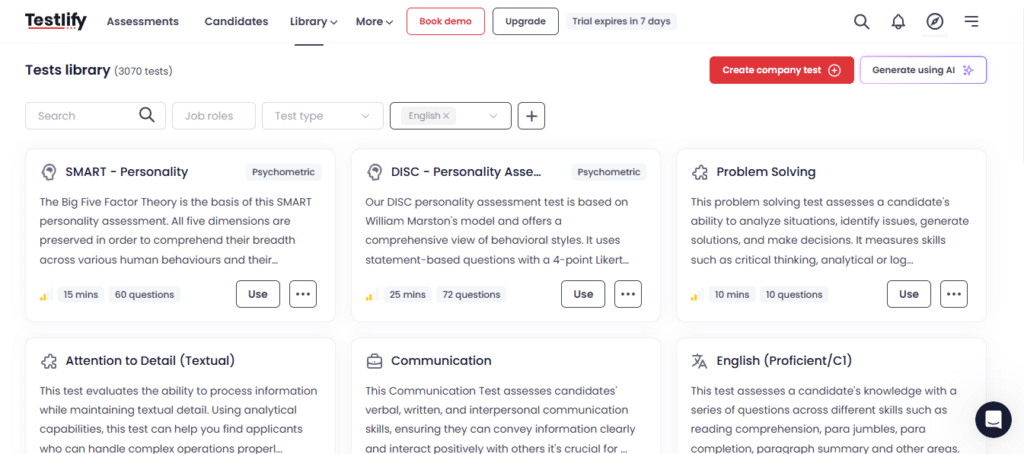
At Testlify, our pre-employment assessments are designed to help you make data-driven hiring decisions with three key components:
- Ready-to-use test templates: Choose from 3,500+ pre-built test library to assess candidates on job-specific and cognitive abilities, ensuring a skills-first hiring approach.
- Customizable assessments: Add your own questions in multiple-choice, open-ended, or media formats like audio and video interviewing tools to tailor tests to your company’s unique hiring needs.
- Reporting and analytics: Get detailed performance scores and benchmarking data to compare candidates against your internal talent pool and the global workforce.

Are pre-employment tests and talent assessments the same?
Pre-employment tests and talent assessments both help identify the right candidate but serve different purposes. Pre-employment tests focus on job-specific skills, evaluating 3-4 key abilities (hard and soft) through text and media-based questions, such as MS Office tasks. Talent assessments take a broader approach, measuring skills, personality, cognitive abilities, and growth potential. While pre-employment tests address immediate job needs, talent assessments determine long-term fit. Both methods objectively measure a candidate’s capabilities, and combining them ensures you hire skilled candidates who fit both the role and company culture while having long-term potential.
When running pre-employment tests for global teams, it’s worth reviewing your approach to language fairness in assessments to ensure you’re measuring skills rather than English fluency.
10 types of pre-employment tests to identify top candidates
The most widely used assessments include cognitive, psychometric, behavioral, cultural fit, and chat simulation tests. In addition, other common types of pre-employment tests are used in hiring.
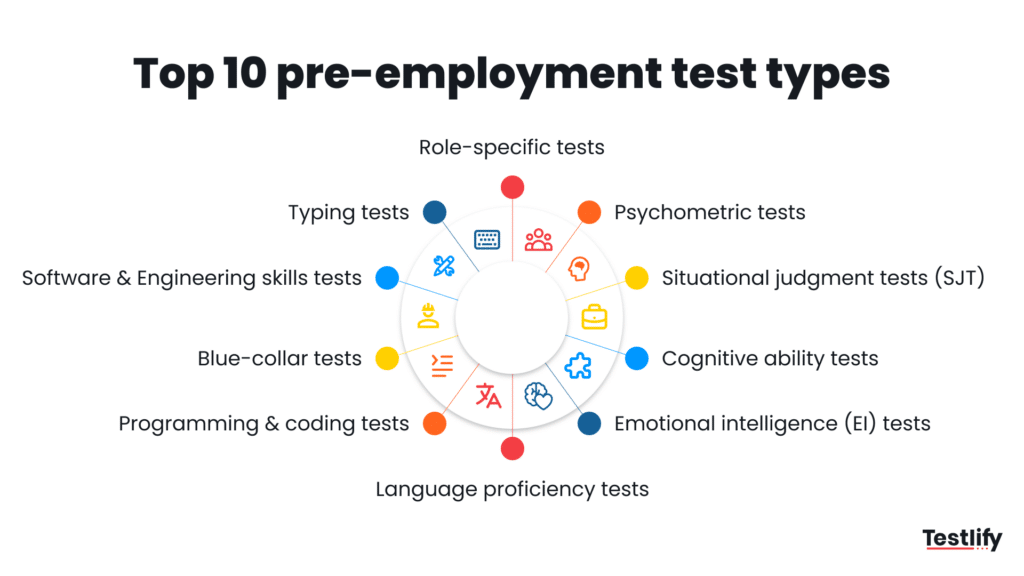
Role-specific tests
Role-specific tests help recruiters understand how well a candidate will perform in a job role. It is useful when assessing their knowledge as you see the concepts or frameworks they’re familiar with and how far back their academic knowledge goes.
Simply put, such tests help employers see how well the candidates can understand the role of the specific job they’re applying for.
One example from our test library is:
Project manager test: This test evaluates a candidate’s ability to plan, execute, and manage projects effectively while ensuring timely delivery and stakeholder alignment.
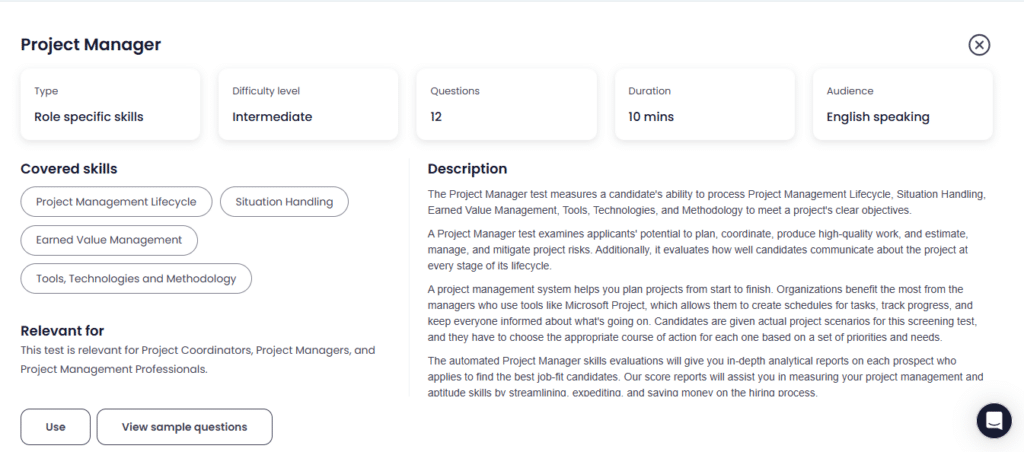
It assesses expertise in project management methodologies (Agile, Scrum, Waterfall), time and resource management, risk assessment, budgeting, and stakeholder communication.
Recruiters can customize the duration and difficulty level to fit their hiring needs.
Psychometric tests
Psychometric tests help employers evaluate a candidate’s personality, behavior, and work ethic. These tests go beyond technical skills to assess how a candidate thinks, reacts, and fits into a company’s culture.
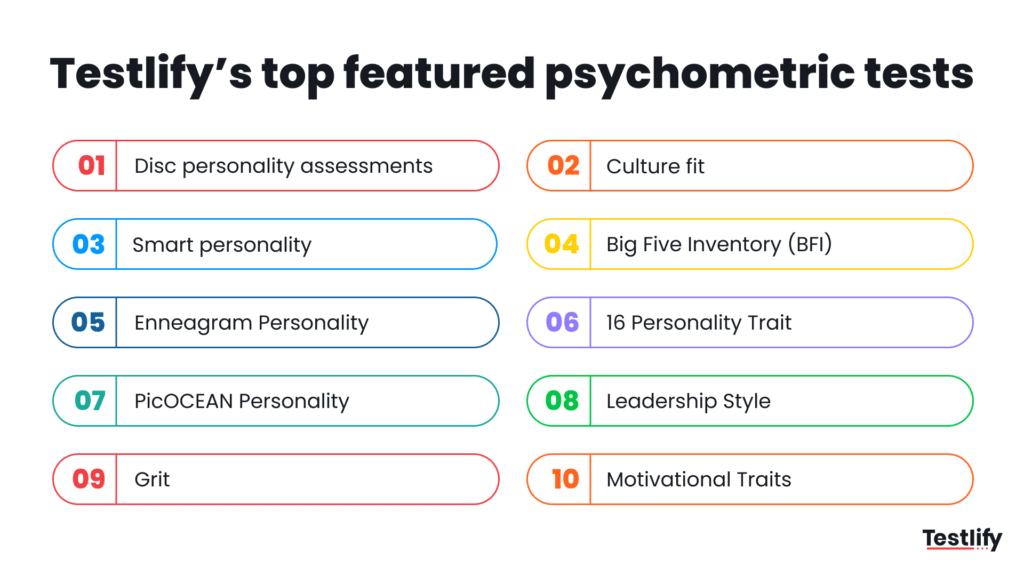
Key types of psychometric tests used in hiring include:
- Big Five Personality Test: Measures openness, conscientiousness, extraversion, agreeableness, and neuroticism to predict workplace behavior.
- DISC test: Categorizes candidates into Dominance, Influence, Steadiness, and Compliance types to assess communication and leadership styles.
- 16 personality factor test (16PF): Analyzes deeper personality traits that impact work habits, stress management, and interpersonal relationships.
- SMART personality test: Evaluates situational judgment and work-related behavior to determine job fit.
Using psychometric tests, employers can make informed hiring decisions, reduce bias, select candidates with the right skills, and align with the company’s values and work environment.
Situational judgment tests (SJT)
Situational Judgment Tests (SJTs) are behavioral assessments that help employers evaluate how candidates handle real-world job situations. These tests measure decision-making, problem-solving, and critical-thinking skills by presenting workplace scenarios with multiple-choice responses.
Candidates are assessed on how well they manage risk, handle ethical dilemmas, work under pressure, and make business decisions.
Testlify offers 88 situational judgment tests designed for different industries and job roles.
Employers can use these tests to see how candidates react to challenges like managing conflicts in customer service, handling high-stakes financial decisions, or staying calm under pressure in leadership roles.
These insights help hiring managers go beyond resumes and understand how well candidates can apply their skills in real work situations.
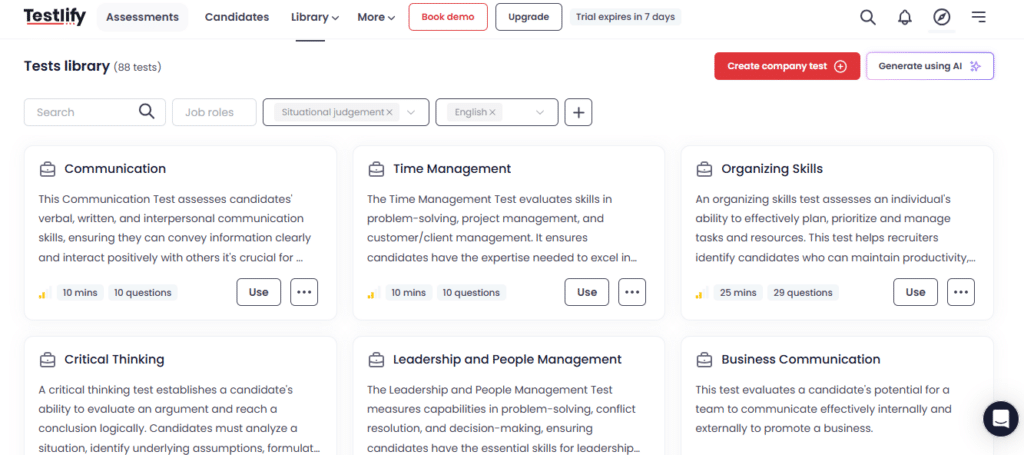
Two notable situational judgment test examples are:
- Business communication assesses a candidate’s ability to convey ideas, handle workplace interactions, and adapt communication styles effectively.
- Time management evaluates how well a candidate prioritizes tasks, meets deadlines, and manages workload efficiently under pressure.
By simulating actual job situations, SJTs help employers gauge whether candidates can apply their knowledge and expertise in practical settings.
Cognitive ability tests
Cognitive ability tests are used to assess the mental strength of a candidate. This means how well they can deal with workplace problems (if they arise). Though this test doesn’t tell you anything about technical expertise, it is meant to test the thinking abilities of a candidate.
A recent Gallup survey found that two-thirds of employees experience burnout in some form due to challenges they face at work. Hence, including cognitive ability traits in your pre-employment assessment can help you understand a candidate’s capacity when dealing with challenging situations.
Related: The ultimate guide to cognitive ability tests
Such tests are especially useful in industries that require quick and critical thinking. Testlify offers 69 cognitive ability tests. Some of them include:
Emotional intelligence (EI) tests
Emotional Intelligence (EI) tests offer insight into a candidate’s ability to recognize, understand, and manage their own emotions, as well as their ability to perceive and influence the emotions of others. These tests help employers evaluate key soft skills like empathy, self-awareness, social skills, and emotional regulation.
EI tests are particularly useful for roles that require strong interpersonal skills, such as management, customer service, and team collaboration.
By assessing a candidate’s emotional intelligence, employers can predict how well they will navigate workplace relationships, resolve conflicts, and contribute to a positive work culture.
Language tests
A language test measures a job seeker’s fluency in using a language in different situations to communicate with others. For instance, you’ll be assessing their written and verbal language skills.
This is especially important for roles where good communication is required, e.g. emailing stakeholders or key managers.
Testlify provides language assessments in eight languages: English, Spanish, Dutch, Portuguese, Japanese, Italian, and French.
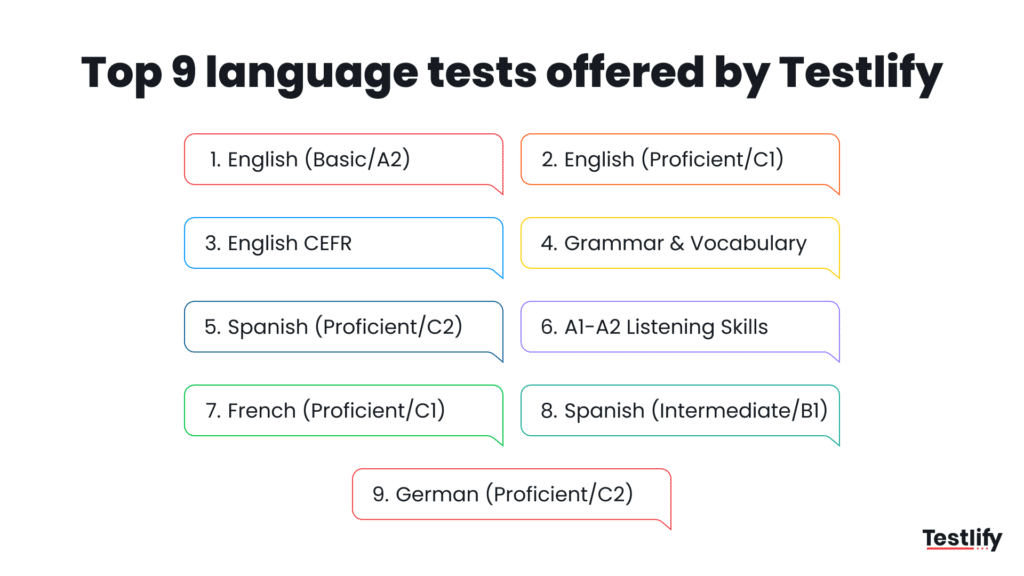
Two examples of language tests offered by Testlify include:
CEFR Tests is a type of language test that follows the Common European Framework of Reference for Languages (CEFR), categorizing language proficiency into six levels (A1 to C2). They measure reading, writing, listening, and speaking skills based on a global standard.
Swedish (beginnerA1) test gauges basic Swedish language proficiency, including fundamental vocabulary, grammar, and simple conversational skills.
Checking language skills in pre-employment tests ensures candidates meet the required grammar, business terminology, and communication proficiency before proceeding with interviews.
Programming and coding tests
The programming skills test evaluates a candidate’s coding proficiency, problem-solving ability, and knowledge of programming languages through real-world coding challenges.
Testlify offers live coding tests in over 45 programming languages for assessing Frontend Developers, Backend Developers, DevOps Engineers, Cloud Engineers, and Data Scientists.
Our platform supports both single-file and multi-file coding challenges, offering the flexibility to evaluate real-world problem-solving abilities.
Recruiters can either select a predefined test duration (30, 60, or 90 minutes) or customize the duration.
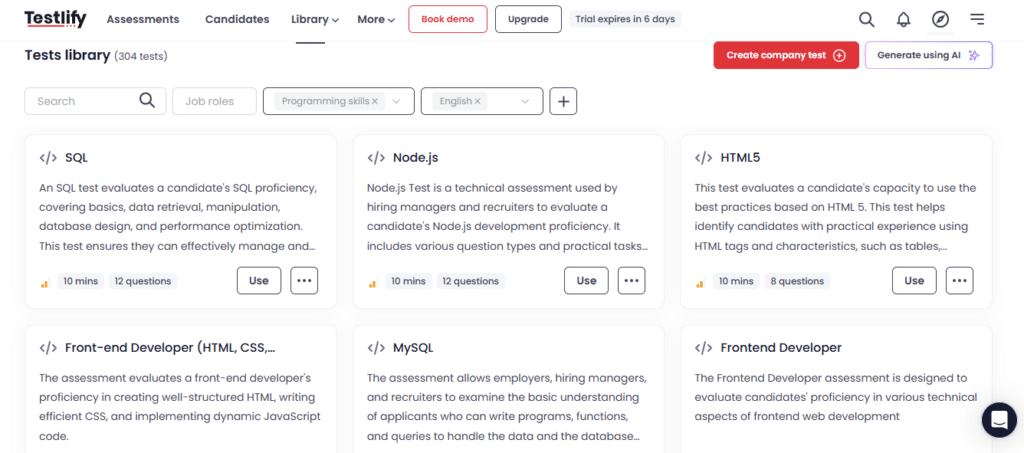
Such a real-time programming evaluation allows candidates to demonstrate their coding skills in a simulated real-world environment.
Blue collar tests
Blue-collar tests are used to assess blue-collar workers. This involves manual laborers, often in the manufacturing or construction sectors. Although they are confined to these niches, they could also include cooks, assemblers, repair technicians, etc. Testlify offers 87 blue-collar tests to assess your candidate’s skills.
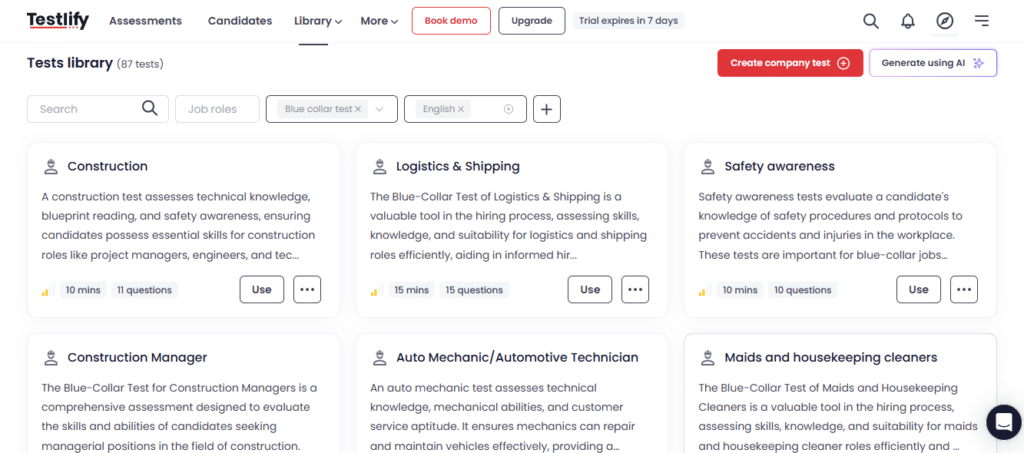
Related: White-collar vs blue-collar jobs: Differences and pay scale
Software and Engineering skills tests
Software and engineering skills tests assess a candidate’s technical expertise, problem-solving ability, and practical knowledge to ensure they meet job requirements.
Testlify’s software and engineering skills tests provide a detailed understanding of a candidate’s knowledge through:
- Coding simulations: Real-world scenarios where candidates write and execute code.
- Multiple-choice & conceptual questions: Testing theoretical knowledge of frameworks, tools, and methodologies.
- Interactive assignments: Tasks like designing circuits (for engineers) or building APIs (for developers).
Two notable examples of engineering tests offered by Testlify are: Linux Operating System Basics are used to assess individuals understanding of Linus OS. Natural Language Processing (NLP) is used to identify candidates who are well-versed in different types of analysis, such as semantic and pragmatic analysis.
Typing tests
A typing test evaluates a candidate’s typing speed (words per minute) and accuracy, which is crucial for roles requiring fast and error-free data entry, transcription, or written communication.
Employers can use typing tests in pre-hire assessments to evaluate candidates’ keyboard skills and ensure they can handle high-volume typing tasks quickly and precisely.
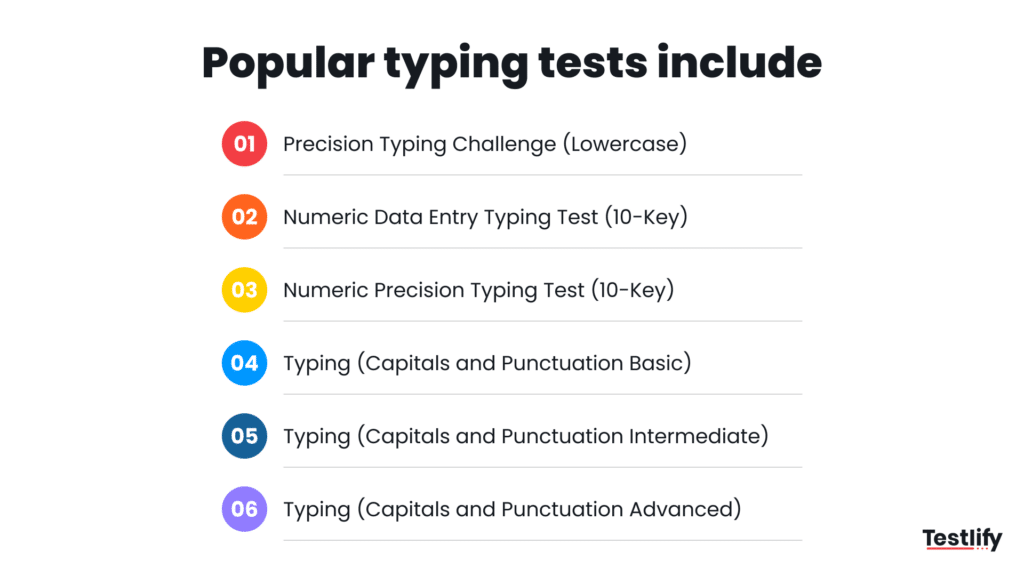
Testlify has six different typing tests available. Recruiters can choose the required difficulty level, ranging from easy to hard. Also, you can add your own custom paragraph or use AI-generated content. Two of the most popular examples of typing tests are:
- Precision Typing Challenge (Lowercase) measures accuracy and speed in typing lowercase text, assessing attention to detail.
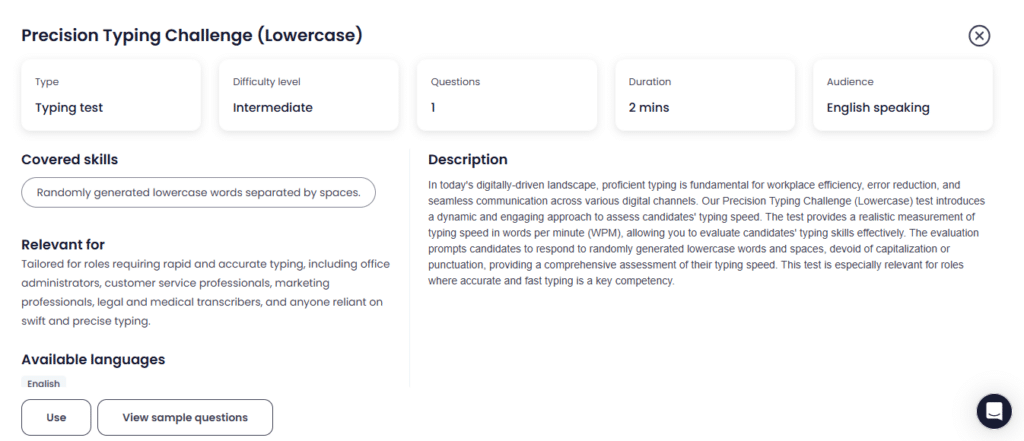
- Numeric Data Entry Typing Test (10-Key) evaluates proficiency in numeric keypad data entry, which is essential for finance and data roles.
Note: While we have focused on common assessments in this article, visit our test library to explore specific test types and select your preferred option from the dropdown menu in the top-right corner.
Why should companies use pre-employment testing?
There are numerous reasons why companies should use pre-employment testing in the recruitment process.
Research shows that companies using pre-employment assessments see a 24% higher chance of employees exceeding performance goals and a 39% lower turnover rate, proving their impact on retention and productivity. Some other key benefits are as follows:
Speeding up hiring
These tests help employers quickly filter out unqualified candidates, especially when there are too many resumes to review.
A recruiter spends an average of 23 hours screening a single candidate. Using different types of pre-employment tests, recruiters can quickly narrow down the search without going through resume screening or conducting interviews.
Checking skills
Employers use these tests to see if candidates have the right skills for the job. This includes both hard and soft skills. Hard skills are quantified and can be measured, while soft skills like communication, agility, adaptability, etc, are quite hard to test in a normal interview setting.
This is why assessments are an excellent way to bridge the gap, as they show exactly what a candidate is capable of. This is extremely helpful when you’re hiring for leadership roles.
Improving interview quality
Test results give employers useful data, allowing them to ask better, more relevant interview questions. This objective approach helps reduce bias in hiring.
Recruiters can use real-time data to pinpoint key focus areas, making interviews more targeted and insightful. This leads to more productive interviews and better hiring decisions.
Customize your pre-employment test to minimize the probability of mis-hire
Fortunately, all the mentioned tests can be accessed in one place via Testlify’s test library. We’ve covered you with various assessment tools to hire the best technical talent.
Moreover, you can customize each test to make it your own. So, rather than simply using a ready-to-use assessment, you can test for certain skills or qualities to find your ideal employee.
Sign up here for free to build a talent pool of skilled professionals!
Takeaway
Using a mix of different types of pre-employment tests is always a great way to find your ideal candidate. Although you can’t always expect purple squirrels in recruitment, having a balanced pre-employment testing strategy helps you find the top 1%.
With advanced proctoring features like anti-cheating measures, screen recording, snapshot capture, and full-screen enforcement, Testlify ensures a secure and fair assessment environment, helping you identify truly qualified candidates.
For further reading, explore California Employment And Labor Laws, Delaware Employment And Labor Laws, Pennsylvania Employment And Labor Laws & Pre Employment Emotional Intelligence Test A Must Have Tool For Hiring.
Frequently asked questions (FAQs)

Founder and CEO, Testlify
Abhishek Shah is the Founder and CEO of Testlify, a pre-employment assessment platform used by 1,500+ companies globally to hire fairly and at scale. He focuses on skills-based, bias-free hiring technology. Testlify is part of the SHRM Labs 2026 WorkplaceTech Accelerator.
LinkedInRelated resources
View all
Candidate assessment
Advantages and Disadvantages of Aptitude Tests in Hiring

Candidate assessment
What are talent assessments?

Candidate assessment
Candidate Skills Testing: The 2026 Guide for HR Leaders

Candidate assessment
How to assess technical skills effectively for job positions in tech
Candidate assessment
How to Hire Technical Talent: A 2026 Guide for Enterprise Hiring Teams

Candidate assessment
What tools support voice responses for language proficiency testing?
Get started.
Hire on proof, not resumes.
Run your first skills-based assessment free — no credit card required.