
I made a bad hire at work how do I fix it? A manager's guide
A six-step plan for managers who hired the wrong person: diagnose the gap, set a 30-day plan, then coach, move or exit, and fix your hiring.

"I made a bad hire at work how do I fix it" is a question most managers ask at least once, usually four to eight weeks into a new role. Fixing a bad hire means finding out what is really going wrong, giving the person one clear and time-boxed chance to close the gap, and then deciding on evidence to coach, move or exit. Done well, it takes about 30 to 60 days and protects both the team and the person.
TL;DR:
- Fix a bad hire in six steps: check your own setup, name the gap, talk within a week, agree a written 30-day plan, decide to coach, move or exit, then fix the hiring step that missed it.
- Many early failures are setup problems: unclear goals, thin onboarding or a manager who is rarely available. Rule those out first.
- A skill gap can usually be coached. A will gap (missed commitments, defensiveness) rarely improves and needs a fast, firm reset.
- Give a fair plan 30 days with two or three measurable goals and weekly check-ins. Extend it once only when progress is clear.
- Waiting is the expensive option: the team absorbs the work and your best people notice.
- Exit fairly: document dates and examples, involve HR, and never let a protected characteristic or a recent complaint play any part.
- Close the loop with a post-mortem and measure new hire quality, so the next hire is judged on skills and evidence, not interview confidence.
 ChatGPT
 Gemini
 Claude
 Grok
 Perplexity
I made a bad hire at work how do I fix it, step by step?
Fixing a bad hire works best as six steps in a fixed order: check the setup you gave the person, name the gap in one factual sentence, talk within a week, agree a written 30-day plan, decide to coach, move or exit on the evidence, and fix the hiring step that let the gap through.
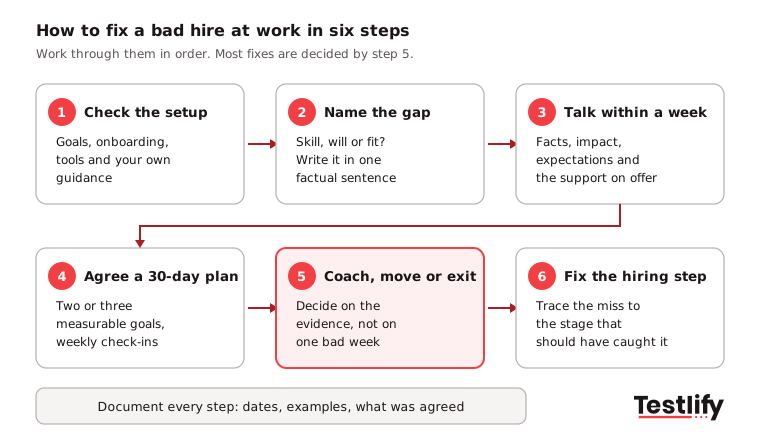
- Check the setup: Confirm the role, goals, tools and onboarding were clear before you judge the person.
- Name the gap: Decide whether it is a skill gap, a will gap or a fit gap, and write it down with two or three dated examples.
- Talk within a week: Hold one direct, private conversation about facts, impact and expectations.
- Agree a 30-day plan: Set two or three measurable goals, the support you will give and a weekly check-in.
- Coach, move or exit: Decide on the results of the plan, not on a single bad week.
- Fix the hiring step: Trace the miss back to the stage of your process that should have caught it.
The order matters. Managers who jump straight to step 5 often fire someone who was set up to fail, and then make the same mistake with the next hire.

How do you know it is the hire and not the setup?
A hire is the problem only when the setup was sound: the person had clear goals, the right access and tools, a real onboarding plan and regular time with you, and still falls short. If any of those were missing, fix them first and give the person a fair restart before you judge new hire performance.
Be honest here. In a busy quarter, new people often get a laptop, a backlog and very little else. Use this quick check:
Question to ask yourself | If the answer is no | What it points to |
|---|---|---|
Did they get written goals for the first 30, 60 and 90 days? | Write them now and restart the clock | Setup problem |
Did the role change after the offer? | Reset scope and expectations together | Setup problem |
Do they have the access, tools and training they need? | Fix access this week | Setup problem |
Have you met one to one at least weekly? | Book a standing check-in | Manager problem |
Do peers with the same setup perform well? | Look at team-wide blockers first | Process problem |
All of the above are yes and the gap remains | Move to the next step | Likely a hire problem |
An onboarding checklist helps you check what the person actually received in their first weeks, not what you meant to give them.
Pro tip: Ask the new hire's peers one neutral question: "What would help them ramp up faster?" The answers often reveal a missing handover or an unwritten rule nobody explained.
What kind of gap are you dealing with?
Most bad hires fall into one of three gaps: a skill gap (they cannot yet do the work), a will gap (they can but do not, through missed commitments or poor behavior) or a fit gap (they are strong in some areas but weak in the core of this role). Each gap needs a different response and a different time box.
Gap | What you see | Usual response | Fair time box |
|---|---|---|---|
Skill gap | Work below standard, repeated errors, slow output, but effort is there | Training, pairing with a strong peer, smaller tasks first | 30 to 60 days |
Will gap | Missed deadlines with excuses, defensiveness, behavior that affects others | One clear reset with firm expectations | 2 to 4 weeks |
Fit gap | Strong in parts of the job, weak in its core; struggles with how the team works | Change scope or move to a role that uses their strengths | 2 to 6 weeks |
Hire for fit means hiring for the role's real work and the way the team operates, not for "someone we would get a beer with". A fit gap is often a sign the job description and the interview tested different things. Our guide to culture fit vs skill fit covers how to weigh the two before the offer.
A will gap is the hardest to fix and the most damaging to keep. Attitude spreads, and colleagues watch closely to see whether you tolerate it.
What should you say in the first conversation?
The first conversation should cover four things in under 30 minutes: the facts you have seen, the impact on the work or team, what good looks like by a set date, and the support you will give. Keep it private, specific and calm, and end by agreeing the next check-in.
A simple structure you can adapt:
- Open with the purpose: "I want to talk about how the first weeks have gone, because some things are not where we need them to be."
- Share the facts: Give two or three dated examples. "The client report was due on the 4th and the 12th and arrived late both times."
- Explain the impact: "That meant the account team had to rework it overnight."
- Ask and listen: "What is getting in the way?" You may hear about unclear priorities, a personal issue or a skill nobody trained.
- Agree what good looks like: Name the standard and the date it must be met.
- Offer support and close: Say what you will provide, then confirm it all in a short email the same day.
Write down what was said and agreed. That record protects the person as much as the company, because it shows they were told clearly and given a fair chance.
How long should you give a new hire to improve?
A new hire who is struggling should usually get about 30 days on a written plan with two or three measurable goals and weekly check-ins. Extend once, by up to 30 days, only when progress is clear. Most new hire performance problems are either improving or obviously stuck by then.
Use a light version of a performance improvement plan: each goal needs a number or a clear output, a deadline and the support you will give. "Improve quality" is not a goal. "Ship the weekly report by Friday noon with no more than one round of edits" is.
Line the plan up with the probation period if you have one. A well-run probation period gives both sides a planned point to decide, so the conversation is expected rather than a shock.
Timing also has a legal side in some countries. In the UK, Acas guidance on probation periods says that from 1 January 2027 protection from unfair dismissal will start after 6 months in a job, under the Employment Rights Act 2025. Acas also notes employers may want probation to end before that point. UK managers who wait too long now face a fuller dismissal process than before.
Do not let the plan drift. Every extra month adds salary, management time, rework and the hidden cost of a frustrated team. For the full breakdown in money, see our guide to the cost of a bad hire.
Should you coach, move or let the person go?
The right choice depends on what the 30-day plan showed: coach when the gap is a skill gap that is clearly closing, move the person when they have real strengths that another open role needs, and exit when goals were missed despite real support or the same behavior keeps coming back.
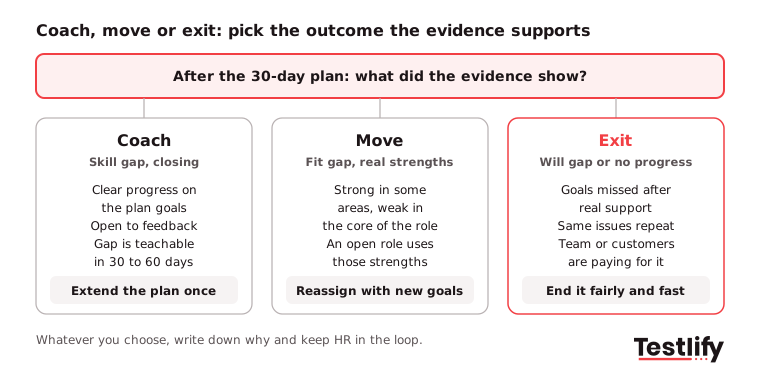
Option | Choose it when | Evidence you need | Watch out for |
|---|---|---|---|
Coach | Progress on most plan goals, open to feedback | Goal results, check-in notes | Endless extensions with no end date |
Move | Clear strengths that suit an open role | Output in the areas they do well, a manager willing to take them | Moving a will problem to another team |
Exit | Goals missed after real support, or repeated conduct issues | Dated examples, the plan, check-in notes, HR review | Acting before the setup was fixed |
Reassigning is underused. A sales hire who struggles to close but builds great proposals may be an excellent sales operations analyst. Only move someone when both managers agree and the new role has its own clear goals.
Key takeaway: Decide on the evidence from the plan, not on how the last meeting felt. If you cannot point to dated examples and plan results, you are not ready to make the call either way.
How do you let a new hire go fairly?
Letting a new hire go fairly means following your company's process, involving HR early, relying on documented examples and the plan results, and holding a short, respectful conversation that explains the decision and the next steps. Fair exits protect the company legally and protect your standing with the people who stay.
Before the meeting, check four things:
- The record: Dates, examples, the 30-day plan and check-in notes are complete and consistent.
- The law and the contract: In the US, at-will employment is not a free pass. Contracts, company policy and discrimination law still apply, and a weak record invites a wrongful termination claim.
- No protected factors: The EEOC states that employers may not take race, color, religion, sex and other protected characteristics into account in decisions about discipline or discharge, and may not retaliate against someone who complained about discrimination.
- The logistics: Final pay, benefits, equipment return, system access and a handover plan for their work.
In the meeting itself, be brief and clear. State the decision in the first minute, give the main reason in one or two sentences, explain what happens next and let the person speak. Do not reopen the debate. Offer a reference for the strengths you saw, if your policy allows, and consider a short exit conversation later using standard exit interview questions to learn what the process missed.
How do you protect the team while you fix it?
Protecting the team means stopping your strongest people from quietly absorbing the struggling hire's work, being open about the fact that you are acting without sharing private details, and keeping workload and deadlines realistic until the situation is resolved.
- Cap the overflow: Write down which tasks others are covering and set an end date. Silent overtime is how a mis-hire turns into a resignation from someone you wanted to keep.
- Say you are on it: "I know this has been hard, and I am dealing with it" is enough. Never discuss the plan or the person's performance with peers.
- Reset priorities: Drop or delay lower-value work so the team is not running at full load plus the gap.
- Check in one to one: Ask your top performers directly how they are doing.
Engagement is fragile right now. The Gallup State of the Global Workplace report found global employee engagement fell to 20%, down from 23% in 2022, with manager engagement down nine points over the same period. Gallup puts the cost of low engagement at about $10 trillion in lost productivity, or 9% of global GDP. Letting a known problem run unchecked is one of the quickest ways to add to it.
How do you stop it happening again?
Stopping the next bad hire starts with a short post-mortem: trace the gap back to the hiring stage that should have caught it, change that stage, and then measure new hire quality for every hire so you can see whether the change worked.
Ask three questions about the hire you just fixed:
- Which stage missed it: The job description, the screen, the interviews, the reference checks or onboarding?
- What evidence would have caught it: A skills test, a work sample, a structured interview question or a sharper reference question?
- What will we change: One concrete change to that stage, with an owner and a date.
Common fixes include scoring every candidate on the same criteria with an interview scorecard, running structured interviews instead of free-form chats, adding a short skills test before the interview rounds, and asking references about patterns, not compliments. Our guide to reference checks lists the questions that surface them.
Then track new hire quality: ramp time, 90-day manager rating, first-year retention and early hire performance against goals. The LinkedIn Future of Recruiting 2025 report found that 89% of talent acquisition professionals say measuring quality of hire will become more important, yet only 25% feel highly confident they can do it well.
LinkedIn also found that companies making the most skills-based searches are 12% more likely to make a quality hire. A quality of hire calculator is a simple place to start, and our guide on how to improve quality of hire covers the rest.
The pressure to fill roles fast is not going away. According to SHRM's 2025 Talent Trends survey of 2,040 HR professionals, 69% of organizations still struggle to fill full-time roles. That pressure is exactly when teams skip the evidence and hire on interview confidence.
How does Testlify help you hire on evidence next time?
Testlify helps hiring teams judge candidates on skills and evidence before the offer, so fewer gaps show up after day one. Teams build a role-specific assessment from a job description, add structured AI interviews, and compare every candidate on the same scored criteria.
- Skills tests for the real job: 3,500+ tests across technical, role-specific, cognitive, situational judgment, language and personality areas, with 25+ question types including coding, typing and practical tasks. Browse the test library.
- Structured AI interviews: Video AI, Voice AI and Chat AI interviews ask every candidate the same role-based questions and score each answer, so a confident talker does not outscore a stronger performer. See how AI interviews work.
- Evidence for the decision: Reports show a per-skill breakdown, AI-written strengths and gaps, and suggested follow-up questions for the human interview.
- Fair and secure: 20+ proctoring checks help confirm the answers are the candidate's own, and assessments run in 15+ languages.
Results sync to 100+ ATS and HRIS tools, so scores sit next to the rest of the candidate record. To see it on one of your roles, book a demo.
Ready to make your next hire on evidence?
Fix the hire you have, then fix the step that let it through. Browse the Testlify test library or start a 7-day free trial, no credit card required, and build your next assessment from your own job description.
FAQs: I made a bad hire at work how do I fix it

Content Writer
Yashika Khandelwal is a Content Writer with 3+ years of experience creating research-backed content on hiring, talent assessment, and HR technology. She is a registered Organizational Psychologist and subject matter expert who combines behavioral science with practical recruitment insights to produce accurate, evidence-based content.
LinkedInRelated resources
View all
HR & recruitment
How to use data to drive talent management decisions

HR & recruitment
7 strategies recruiters use to recognize top talent

HR & recruitment
How to discover top talent beyond the resume?

HR & recruitment
How to Build a User-Friendly Application Process for a Better Candidate Experience

HR & recruitment
The future of hiring: 8 shifts TA teams must plan for

HR & recruitment
How to build stronger teams with role-specific tests?
Get started.
Hire on proof, not resumes.
Run your first skills-based assessment free — no credit card required.