
How to simplify candidate screening with English proficiency test
A practical guide to screening candidates with English tests: CEFR levels by role, skills to test, when to test and how to stay fair.

Candidate screening with an English proficiency test means checking every applicant's reading, writing, listening, and speaking against the level the job needs before anyone spends time on interviews. Instead of guessing from a resume line like "fluent English" or a friendly phone call, the hiring team gets a score on a shared scale, usually CEFR A1 to C2, for every candidate.
 ChatGPT
 Gemini
 Claude
 Grok
 Perplexity
TL;DR
- An English proficiency test gives every candidate a comparable score, usually on the CEFR scale from A1 to C2, so you screen on evidence instead of resume claims.
- Set the required level per role: A2 to B1 is usually enough for frontline and back-of-house work, B2 for support, sales, and technical roles, and C1 or higher for senior client-facing jobs.
- Test the skills the job uses. Voice support needs listening and speaking, chat support needs reading and writing, and client-facing managers need all four.
- Put the test right after the application or resume screen, and confirm spoken English later in a structured interview.
- In the US, the EEOC allows an English requirement only when the job really needs it, so tie each level to real tasks and apply it to everyone in the same role.
- Some roles carry a legal English requirement, such as US commercial truck drivers under federal motor carrier rules.
- Proctoring, question randomization, and speech checks keep online results trustworthy at volume.

What is candidate screening with English proficiency tests?
Candidate screening with English proficiency tests is an early hiring step where applicants take a standardized English assessment and the hiring team filters or ranks them on the result. The test measures how well a person can use English at work, not how much grammar they memorized, and reports a level that maps to the tasks in the job.
Most employer tests report on the Common European Framework of Reference for Languages (CEFR), a six-level scale the Council of Europe published in 2001. The six levels are grouped into Basic User (A1, A2), Independent User (B1, B2), and Proficient User (C1, C2). Because the scale is shared, a B2 means the same thing whether the candidate applied in Manila, Krakow, or Toronto.
Why does English proficiency matter in hiring?
English proficiency matters in hiring because it is the working language of most global teams, clients, and tools, and weak English shows up as errors, rework, and unhappy customers long after the offer is signed. Employers already weigh communication heavily. According to NACE's Job Outlook 2025 survey, at least 70% of employers said they look for written communication skills on a resume, and more than two-thirds look for verbal communication skills.
The business case usually rests on six outcomes:
- Clear communication: People who read and write English well make fewer mistakes in emails, tickets, reports, and handovers.
- Better team collaboration: Distributed teams across time zones can share ideas, review work, and run meetings without a translator in the loop.
- Happier clients and customers: Support and account teams that understand a customer the first time resolve issues faster and build trust.
- Lower risk: A misread instruction can cause project delays, financial loss, safety incidents, or a compliance breach. Testing English up front lowers that risk.
- A stronger employer and company image: Clients notice when every person they deal with communicates clearly, and so do candidates.
- Room to grow: Roles change. A developer who only wrote code may later present to clients or join international projects, and English is a skill that stays in demand across industries.
Why are resumes and interviews not enough to judge English skills?
Resumes and interviews are not enough to judge English skills because both rely on what candidates say about themselves and on the interviewer's impression, and neither gives you a comparable number. "Fluent," "professional working proficiency," and "advanced" mean different things to different people, and some candidates overstate them.
Interviews have their own blind spots:
- Nerves and context: A strong communicator can freeze in a high-stakes call, while a confident talker can hide weak reading or writing.
- Interviewer bias: Accents, small talk, and cultural style sway impressions even when they have nothing to do with job performance. Our guide to common types of hiring bias covers how this creeps in.
- No written evidence: A 30-minute conversation tells you little about how someone writes an incident report or reads a contract.
- No scale: Two interviewers rarely agree on whether a candidate is "good enough," so decisions vary by who ran the call.
A standardized English test fixes the comparison problem: every candidate answers the same kind of questions, scored the same way, and the hiring team sees one level per person.
What English level does each role need?
English level requirements depend on the tasks in the job, so the right level for a warehouse associate is very different from the right level for an account manager. Start from what the person must read, write, hear, and say in a normal week, then pick the CEFR level that covers those tasks without going higher than needed.
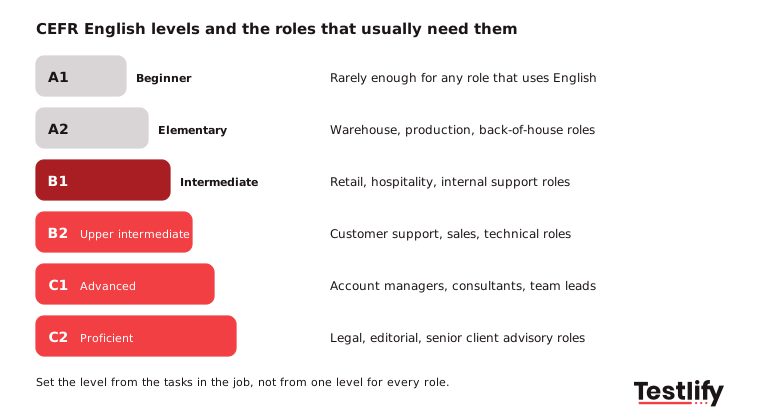
CEFR level | What the person can do at work | Typical roles |
|---|---|---|
A1 Beginner | Understand familiar everyday phrases and fill in simple forms | Rarely enough where English is used on the job |
A2 Elementary | Handle routine, direct exchanges on familiar matters | Warehouse, production, cleaning, back-of-house |
B1 Intermediate | Follow clear standard input on familiar work topics and write simple connected text | Retail, hospitality, internal support, field technicians |
B2 Upper intermediate | Understand complex text and technical discussion in their field, and talk with fluency and spontaneity | Customer support, inside sales, developers, analysts |
C1 Advanced | Use English flexibly for professional purposes, write clear, well-structured detail and catch implied meaning | Account managers, consultants, team leads, escalation support |
C2 Proficient | Understand virtually everything and express fine shades of meaning | Legal, editorial, senior client advisory, executive roles |
Pro tip: Pick the minimum level per role and write down the tasks that justify it, for example "reads customer contracts" or "handles voice calls with US customers". That note makes the level easy to defend and keeps teams from asking for C1 by default.
Which English skills should you test for each role?
English skills should be tested in proportion to how the role uses them, because a single overall score can hide a gap that matters. A chat agent with strong writing and weak listening is a good hire for chat and a poor one for voice.
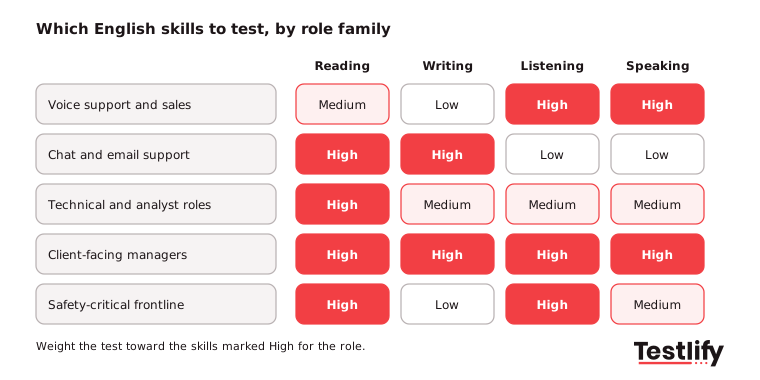
- Reading: Manuals, tickets, contracts, policies, and safety notices. Test with workplace passages and comprehension questions.
- Writing: Emails, chat replies, reports, and documentation. Test with short written tasks scored on clarity, grammar, and tone.
- Listening: Calls, meetings, and spoken instructions. Test with audio clips in the accents the person will hear on the job.
- Speaking: Calls, presentations, and client meetings. Test with recorded audio or video answers or an AI voice interview.
- Grammar and vocabulary: Useful as a quick first filter, especially for industry terms in technical, medical, or financial roles, but never the only measure.
For industry roles, tailor the content. A technical team cares about specialized vocabulary and documentation, while a customer service team cares about conversational fluency and empathy on a call.
Which type of English proficiency test should you use?
English proficiency tests for hiring fall into three groups: academic certificates, employer screening tests, and custom work-sample tasks. Academic certificates are built for university and visa decisions, while employer tests are built to screen many applicants quickly against job tasks.
Test type | Examples | Best for | Watch out for |
|---|---|---|---|
Academic or immigration certificates | TOEFL, IELTS, Cambridge English exams | Roles where a regulator or visa process asks for a named certificate | Cost and booking time for candidates; general academic content |
Employer screening tests on the CEFR scale | Online CEFR English tests, level tests such as A1 to A2, B1 to B2 and C1 to C2 | Screening every applicant early, at volume, with comparable scores | Pick tests that cover the skills the role needs, not grammar only |
Custom work-sample tasks | Write a reply to a real customer email, record an answer to a common call | Checking the exact task the person will do | Needs a clear scoring rubric so results stay consistent |
Most hiring teams combine the second and third: a CEFR-aligned test for every applicant, plus one short task that mirrors the job. Ask for a named certificate only when a regulator, licensing body or visa rule requires it.
When you compare English tests, check five things: the test was reviewed and validated before release, and it matches the job's skills and level.
Candidates should be able to take it online on any device without friction. Results should arrive with a per-skill breakdown, and the test should connect to your applicant tracking system so scores land in the candidate record.
How do you set up candidate screening with English proficiency tests?
Setting up candidate screening with English proficiency tests takes six steps, from defining the level to confirming spoken English in the interview. The order matters: decide what "good enough" means before the first candidate takes the test.
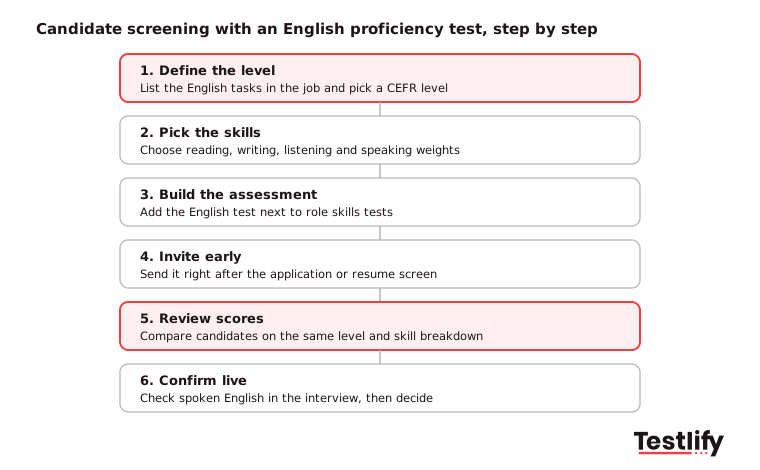
- Define the level: List the English tasks in the job and choose the minimum CEFR level for each role, as in the table above.
- Pick the skills: Decide how much reading, writing, listening, and speaking each role needs and weight the assessment that way.
- Build the assessment: Add the English test next to the role's skills tests, so one invite covers both. Keep the whole assessment short enough to finish in one sitting.
- Tell candidates up front: State the language requirement in the job ad and the invite, explain the format and time limit, and share sample questions so people can prepare.
- Invite early and review scores: Send the test right after the application or resume screen. Compare candidates on the same level and skill breakdown, and set a clear pass level or ranking rule.
- Confirm live and give feedback: Check spoken English in a structured interview, then decide. Share results or short feedback with candidates, which helps them improve and makes the process feel fair.
Key takeaway: The test does the sorting, the interview does the confirming. Use the score to decide who moves forward, then use the conversation to check the spoken English the job really needs.
Where should the English test sit in your hiring process?
The English test usually sits right after the application or resume screen, before any interview. Testing early saves recruiter and hiring manager time, because only candidates who meet the language bar reach a call, and it gives every applicant the same chance instead of filtering on accent in a phone screen.
There are three common placements:
- Before the first interview: Best for high-volume and client-facing roles, where language is a must-have and applicant numbers are large.
- Alongside the first interview: Useful when speaking matters most. A one-way video or AI voice interview can score spoken English and role answers in the same step.
- After the interview: Fits roles where English is a plus rather than a must, or senior roles where you test only the shortlist.
If you already use an AI resume screener, send the English test automatically to candidates who pass that first filter so there is no manual handoff.
How do you keep English proficiency testing fair and legal?
English proficiency testing stays fair and legal when the required level is tied to real job tasks, applied the same way to everyone in the role, and backed by a standardized test rather than an interviewer's impression. A blanket "fluent English" rule for every job is where most risk sits.
In the US, the EEOC's guidance on national origin discrimination says an English fluency or proficiency requirement is permissible only if it is required for effective performance of the job, and that employers should assess the level needed case by case rather than set one level for unrelated positions. The same guidance says an accent can justify a decision only when it materially interferes with job performance.
Practical ways to stay on the right side of that line:
- Document the reason: Keep the task list behind each role's level.
- Test everyone in the role: Do not test only candidates whose name or accent made someone curious.
- Separate accent from clarity: Score whether the person is understood, not whether they sound like a native speaker.
- Reduce test anxiety: Share sample questions, explain the format and offer a quiet, flexible time window.
- Check cultural bias: Use workplace scenarios that do not depend on local idioms, sports or pop culture, and offer accommodations or an alternative assessment where needed.
- Balance language with other skills: A strong English score does not make someone right for the job. Weigh it with role skills, and do not confuse English fluency with cultural fit.
Treated this way, English testing supports diversity and inclusion: it gives candidates from many linguistic backgrounds an objective way to show they can do the job, instead of being screened out on assumptions.
Which roles have a legal English requirement?
Roles with a legal English requirement are mostly safety-critical jobs where misunderstanding an instruction can hurt people. For these, English testing is a compliance step, not a preference.
- Commercial truck and bus drivers (US): Federal motor carrier rules in 49 CFR 391.11 require drivers to read and speak English well enough to converse with the general public, understand highway signs, respond to official questions and make entries on reports. According to Transport Topics in August 2026, FMCSA has proposed making its English proficiency out-of-service standard permanent, and estimates that about 9,000 commercial drivers a year could be placed out of service under it. Fleets can screen with an FMCSA English proficiency assessment before a driver ever reaches a roadside inspection.
- Aviation: Pilots and air traffic controllers on international operations must meet ICAO language proficiency requirements in English.
- Healthcare: Nurses and doctors trained abroad often need a recognized English test score to register with a licensing body.
In other sectors, such as finance and technology, there is rarely a law, but client contracts and internal standards can set a required level that recruiting must check.
How do you stop cheating on online English tests?
Cheating on online English tests is stopped with proctoring, randomized questions and checks that confirm the person speaking is the person applying. Without them, a translation tool, a second screen or a friend on the call can inflate a score.
Controls worth switching on for English assessments:
- Webcam snapshots and face detection: Confirm the same person takes the whole test.
- Tab and copy-paste tracking: Flag candidates who leave the test or paste in text from a translator or AI tool.
- Full-screen mode and question randomization: Make it harder to look up or share answers.
- Speech authenticity checks: Flag spoken answers that are read from a script or generated by a tool.
- Time limits: Leave less room to look up reading and listening answers.
Testlify includes 20+ proctoring checks in every plan, with options such as photo ID verification and live video proctoring for higher-stakes roles.
How do you measure whether English testing improves hiring?
English testing should be measured with a few hiring and on-the-job metrics, tracked before and after you add the test. Pick a baseline from the last two or three hiring cycles, then compare.
- Time-to-hire: Did screening get faster once interviews went only to candidates who met the level?
- Interview-to-offer ratio: Fewer interviews per offer means the test is filtering well.
- Early performance and quality of hire: Compare test scores with quality scores, customer satisfaction or ramp time in the first 90 days. A clear link suggests the level is set right.
- Communication-related errors and escalations: Track rework, customer complaints or escalations tied to misunderstanding.
- Candidate satisfaction: Ask candidates whether the test felt fair, clear and relevant. Positive feedback protects your employer brand.
If scores and performance do not line up, revisit the level or the skill weights before blaming the test.
How does Testlify help with English proficiency screening?
Testlify helps hiring teams screen English at scale by combining CEFR-aligned language tests, role skills tests, AI interviews and proctoring in one assessment, with results synced to the ATS. Testlify's test library has 3,500+ validated tests, including language tests from CEFR A1 to C2.
- CEFR English tests: The CEFR English test reports one of six levels from A1 to C2 in about 30 minutes, and candidates need no account to take it. Level tests such as English A2, English B1 to B2 and English C1 to C2 fit specific roles.
- Skill-specific tests: Add business English, speaking skills, listening or reading comprehension tests to weight the skills the role needs.
- Spoken English in interviews: Audio and video questions, plus Voice AI and Video AI interviews, score spoken answers, with speech authenticity detection.
- Custom questions: 25+ question types, including typing, audio, video and file upload, let you add a short work-sample task.
- Scoring and ranking: Automated scoring, weighted scores, benchmarking and a per-skill breakdown let you compare candidates on the same scale.
- Candidate experience: Testlify supports 15+ languages, which helps when the rest of the assessment does not need to be in English.
- ATS sync: Connect 100+ ATS and HRIS tools through integrations so English scores sit in the candidate record.
Ready to add an English proficiency test to your screening?
Pick the roles where English matters most, set a CEFR level for each, and send your next applicants a test instead of a phone screen. Testlify is credit-based, so you pay only when a candidate starts an assessment, and you can start a 7-day free trial with no credit card. Browse the Testlify test library or book a demo to see English screening set up for your roles.
Frequently asked questions (FAQs)

Content Writer
Yashika Khandelwal is a Content Writer with 3+ years of experience creating research-backed content on hiring, talent assessment, and HR technology. She is a registered Organizational Psychologist and subject matter expert who combines behavioral science with practical recruitment insights to produce accurate, evidence-based content.
LinkedInRelated resources
View all
HR & recruitment
How English proficiency test help you screen candidates

HR & recruitment
How to hire top talent using English proficiency test

HR & recruitment
Leadership assessment: types, methods and how to use it in hiring

HR & recruitment
Key components of a comprehensive technical aptitude test

HR & recruitment
Recruitment tests for successful recruitment process: types, stages and setup

HR & recruitment
Pre-Employment Screening: What It Is, Why It Matters, and How to Do It Right in 2026
Get started.
Hire on proof, not resumes.
Run your first skills-based assessment free — no credit card required.