
What is motivational fit and its importance in hiring?
Motivational fit in hiring ensures candidates align with role expectations, fostering engagement and commitment, which builds a stronger, more successful organization.

Your best technical hire just resigned. The skills were flawless. The motivation never matched the role. This story repeats inside companies every week, and it carries a brutal price tag.
Motivational fit measures how well a candidate’s personal drivers align with what a job actually offers day to day. The concept looks past the resume and asks a sharper question.
Will this person want to do this work, in this environment, for the long run? That single question predicts tenure better than most credentials on the page.
Skills win the interview. Motivation wins the retention. This guide defines motivational fit, proves why it now sits at the center of smart hiring, and shows you how to assess it with confidence.
 ChatGPT
 Gemini
 Claude
 Grok
Grok Perplexity
What is motivational fit?
Motivational fit is the degree of alignment between an individual’s personal motivations, values, and career aspirations and what a job or organization actually offers. Strong motivational fit produces engagement and loyalty, whereas weak motivational fit produces disengagement and early exits.
Recruiters often confuse skill with desire. A candidate can ace a skills assessment and still dread the day-to-day reality of the job. That gap is exactly what motivational fit exposes before the offer goes out.
Motivational fit vs cultural fit vs job fit
Organizations often focus on cultural fit and job fit, but motivational fit is equally important. While all three influence hiring success, they measure different aspects of employee performance and retention.
- Cultural fit evaluates how well a candidate aligns with the company’s values, work environment, and ways of collaborating.
- Job fit assesses whether a candidate has the skills, knowledge, and capabilities required to perform the role successfully.
- Motivational fit examines whether the work itself matches what naturally drives and energizes the candidate.
A candidate may have the right skills and fit well within the team, but if the role does not align with their intrinsic motivations, engagement and retention can suffer over time. High-performing hiring teams evaluate all three dimensions to build stronger, longer-lasting hires.
The strongest hires typically score well across all three areas. They can do the job, work effectively with the team, and remain motivated by the work itself.
Types of motivation: intrinsic vs extrinsic
Motivational fit rests on two underlying categories of drive, and knowing which one a candidate leans on helps you read their answers more accurately. Intrinsic motivation is engaging in work for its own inherent satisfaction, such as a sense of accomplishment, personal growth, or passion for the task, rather than for an outside reward. Extrinsic motivation is performing work to earn a reward or avoid a negative consequence, driven by factors such as salary, bonuses, promotions, or recognition. Most candidates are a blend of both, but the dominant type shapes which roles and reward structures will sustain their engagement long term.

Why motivational fit matters more than ever in hiring
Organizations today face a costly combination of low engagement, rising turnover, and increasing hiring expenses. In many cases, these challenges stem from the same root cause: hiring people who can do the job but are not genuinely motivated by the work itself.
When employees are energized by the responsibilities, goals, and environment of a role, they are more likely to stay engaged and remain with the organization for the long term.
When that alignment is missing, even highly skilled hires can quickly become disengaged.
The consequences are significant. Employee engagement has fallen to some of its lowest levels in recent years, while the cost of replacing employees continues to rise.
The gap shows up directly in the numbers. Research from McKinsey found that companies with highly engaged employees achieve 21% greater profitability, underscoring how much is riding on getting motivational fit right at the point of hire, not after it.
Every preventable resignation creates disruption, drains productivity, and forces organizations back into the hiring cycle.
By understanding what drives candidates and matching those motivations to the realities of the role, employers can identify people who are more likely to thrive, contribute, and stay.
How to assess motivational fit during interviews
Direct answer: Combine open-ended motivation questions, scenario-based questions, and a validated motivation assessment. Interviews surface stated motives, while assessments verify them with structured data.
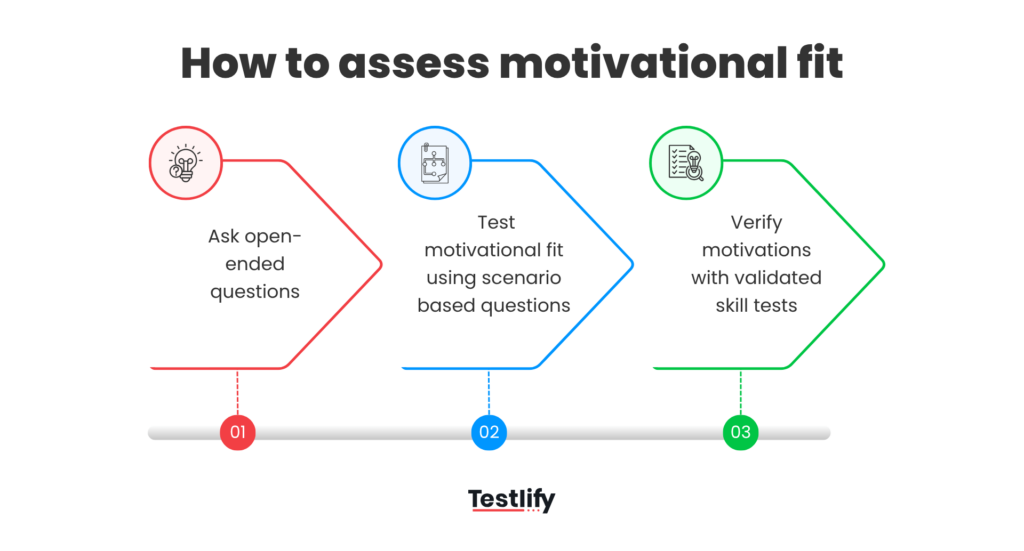
Ask open-ended questions that reveal real performance drivers
Open-ended questions help you understand what drives a candidate beyond their skills and experience. Ask candidates what they found most rewarding in previous roles and the type of work they hope to do next.
Their responses often reveal the factors that fuel engagement, such as growth opportunities, autonomy, meaningful impact, collaboration, recognition, or continuous learning.
Pay attention to recurring themes throughout the conversation. Consistent patterns provide valuable insight into whether the role aligns with what motivates the candidate.
Use scenario-based questions to test motivational fit
Scenario-based questions help you evaluate how candidates would respond to the challenges they will actually face on the job. Present a realistic situation that comes with the role and ask them to walk through how they would approach it.
Their answers reveal more than problem-solving ability. They show what type of work environment motivates the candidate, how they make decisions under pressure, and whether their natural working style aligns with the role’s expectations.
These conversations can also uncover potential gaps between what the candidate enjoys and what the job requires every day. A candidate may be highly capable, but if the role’s demands conflict with their preferred way of working, long-term engagement can suffer.
Situational judgment tests scale this technique across every applicant, ensuring hiring decisions are based on demonstrated judgment rather than subjective impressions.
Verify motivation with validated assessments
Self-reported motivations only tell part of the story. Use a validated motivation test to measure what truly drives a candidate, providing objective insights and reducing the risk of unconscious bias.
Pair this with a personality test and culture fit test to get a fuller picture. For roles that involve complex decision-making, add cognitive ability tests to the process. Together, these tests give you a more complete picture of candidate fit.
Build the assessment into your hiring workflow, not just the interview
A motivation test only pays off if it is designed and rolled out well. Work with an industrial-organizational psychologist or an experienced assessment designer so the questions are relevant, unbiased, and tailored to what each specific role actually rewards. Train recruiters and hiring managers to read the results correctly and fold them into the decision alongside skills tests, personality assessments, and interviews, rather than treating any single input as the full picture. Tell candidates plainly why they are being asked to take the test and how the results will be used. That transparency builds trust and tends to produce more honest, useful responses.
What strong motivational fit looks like in practice
Direct answer: A strong motivational fit pairs a candidate’s dominant driver with a role that rewards it daily. The result is sustained engagement, higher output, and longer tenure.
Picture a developer hired purely for technical range. The work satisfies the skill, yet the person craves mentorship and leadership.
A motivation-aware team spots that driver early. They route the candidate toward a lead track that rewards influence and coaching. The outcome speaks for itself. Engagement rises, the team performs, and the hire stays.
Now picture the opposite. A growth-driven marketer lands in a repetitive, rule-bound role with no room to experiment. The skills hold up, but the motivation drains away. The exit arrives within a year, and the hiring process restarts at full cost.
The difference between these two stories is not talent. The difference is fit.
What motivation-driven hiring has produced in practice
A technology firm with high turnover in its sales team traced the pattern back to a mismatch: its best salespeople were driven by intrinsic factors like passion for the product and personal achievement, not just commission. Hiring for that driver going forward cut turnover and lifted sales performance. A global consulting firm wanted a more collaborative culture and found its top performers were motivated by teamwork and collective success; prioritizing that motivator in hiring produced a more cohesive team and better project outcomes. A retail chain fixing inconsistent customer service found its best-performing reps were driven by helping others and getting positive feedback, and hiring for that motivator raised customer loyalty. In each case, motivation testing did not replace skills screening, it pointed hiring at the driver that actually predicted who would stay and perform.
The same data has a second life after the offer is signed. The motivators a test surfaces during hiring can also guide career development conversations, recognition programs, and retention planning, so the assessment keeps paying off well past the first ninety days.
Final thoughts
Motivational fit has moved from a soft concept to a hard advantage. Engagement sits near record lows, replacement costs keep climbing, and most quits never had to happen.
You cannot interview your way past a motivational mismatch after the hire. You can only design it out before the offer.
Treat motivation as a measurable hiring criterion, not an afterthought. Define the drivers your role rewards, screen for them early, and verify them with structured data.
The payoff compounds across every metric that matters. You gain higher engagement, stronger job satisfaction, better performance, and durable retention.
Testlify helps you measure motivation with the same rigor you apply to skills. The platform combines validated motivation assessments, video interviewing, and a deep test library inside one hiring workflow.
Ready to hire people who are motivated to succeed, not just qualified on paper?
Book a demo with Testlify to identify candidates who are genuinely driven by the work.
Frequently asked questions (FAQs)
Related resources
View all
Hiring Guide
5 ways to improve the legal base of your hiring process

Hiring Guide
5 Creative ways to find blue-collar workers in a competitive market

Hiring Guide
How to use data and analytics to improve recruitment outcomes (in 5 steps)

Hiring Guide
How to build a successful data science team

Hiring Guide
How to build a successful finance management team

Hiring Guide
How to screen candidates for AI developer
Get started.
Hire on proof, not resumes.
Run your first skills-based assessment free — no credit card required.