
AI in employee monitoring: how it works and what’s legal
AI in employee monitoring enhances productivity, ensures compliance, supports remote work, and provides actionable insights for workforce management.

TL;DR
- “AI employee monitoring” covers two things: using AI to track employee productivity and activity, and using monitoring software to track which AI tools employees use
- According to ActivTrak’s 2026 State of the Workplace report, 80% of employees now use AI tools at work — shadow AI (unapproved tools processing company data) is a live compliance risk
- Six types of AI-powered monitoring: productivity tracking, communication monitoring, video surveillance, time and attendance, network security, and keylogging
- In the EU and several US states (CT, DE, NY), written disclosure to employees before monitoring begins is a legal requirement
- Biggest implementation risk: trust erosion — over-monitoring increases turnover, especially among high performers
Remote work made a question permanent that was previously occasional: how do you know what employees are doing? AI monitoring tools now automate the answer — productivity scores, communication patterns, security alerts, all generated without manual review. The problem is that most organizations deploying these tools do not have a written monitoring policy, and in the EU and several US states, that omission is a compliance failure, not just a culture gap.
This guide covers how AI employee monitoring works, what each type tracks, what the law requires, how to handle the newer problem of employees using unsanctioned AI tools, and how to implement monitoring without creating a retention problem.
 ChatGPT
 Gemini
 Claude
 Grok
Grok Perplexity
What is AI employee monitoring?
AI employee monitoring uses machine learning to collect, analyze, and report on employee work activity. Unlike earlier monitoring tools that required manual log review, AI systems process continuous data streams and surface patterns automatically: who is active, when, for how long, and whether behavior has shifted from baseline.
The output is typically a dashboard: productivity scores, activity timelines, and alerts for anomalies. A manager sees aggregated insights rather than raw logs. Some systems flag specific events automatically — an employee downloading unusual file volumes, or a significant drop in activity from someone who was previously high-output.
What separates AI monitoring from earlier software is the inference layer. The system does not just record; it interprets. That interpretation creates most of the legal and ethical complexity covered below.

Types of AI employee monitoring
AI monitoring tools fall into six categories, each capturing different data types and carrying different legal risk profiles. Understanding the distinction matters before you buy: the category determines your disclosure obligations, your GDPR lawful basis, and the employee trust cost.
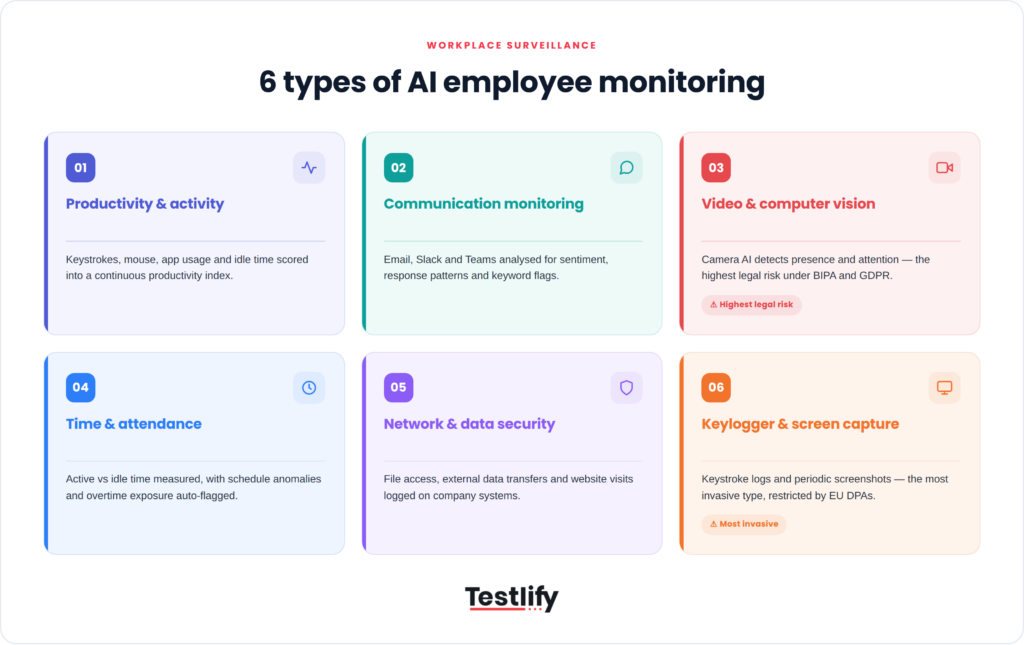
Productivity and activity
These tools measure keyboard activity, mouse movement, application usage, and idle time to generate a productivity score. They are the most widely deployed category and the one that generates the most employee friction when workers discover how scores are calculated — particularly when scores penalize multitasking or background activity unrelated to actual output.
Communication monitoring
Email, Slack, Microsoft Teams, and other platforms can be analyzed for sentiment, response time, and keyword frequency. Some systems flag messages referencing competitors, job boards, or financially sensitive terms. US law (ECPA) and GDPR both place conditions on when this category is permitted.
Video and computer vision
Camera-based systems can use AI to detect presence, attention levels, and behavior patterns. Computer vision can flag when an employee is away from their desk or on their phone. This category carries the highest legal and ethical risk, particularly in jurisdictions with biometric data laws — Illinois BIPA and Texas CUBI regulate collection of facial geometry data.
Time and attendance
AI-enhanced time tracking goes beyond clocking in and out to measure active versus idle work time, flag schedule anomalies, and project overtime risk. Less invasive than communication or video monitoring, but still subject to written disclosure requirements in multiple US states.
Network and data security
IT security monitoring tracks which files are accessed, what data is transferred externally, and what external sites are visited on company systems. This is typically the easiest category to justify under GDPR’s legitimate interests basis and US law, provided scope is limited to company-owned devices and networks.
Keylogger and screen capture
The most granular category. Keystroke loggers record every key pressed; screen capture tools take periodic screenshots. Several European data protection authorities — including the UK ICO and German supervisory authorities — have found continuous keylogging disproportionate for standard office roles under GDPR. Use is typically limited to high-security industries.
Is AI employee monitoring legal?
The short answer is yes, with conditions. The conditions vary by country, US state, and the specific type of monitoring. There is no single comprehensive federal US law on employee monitoring, but several frameworks apply simultaneously.
US federal baseline
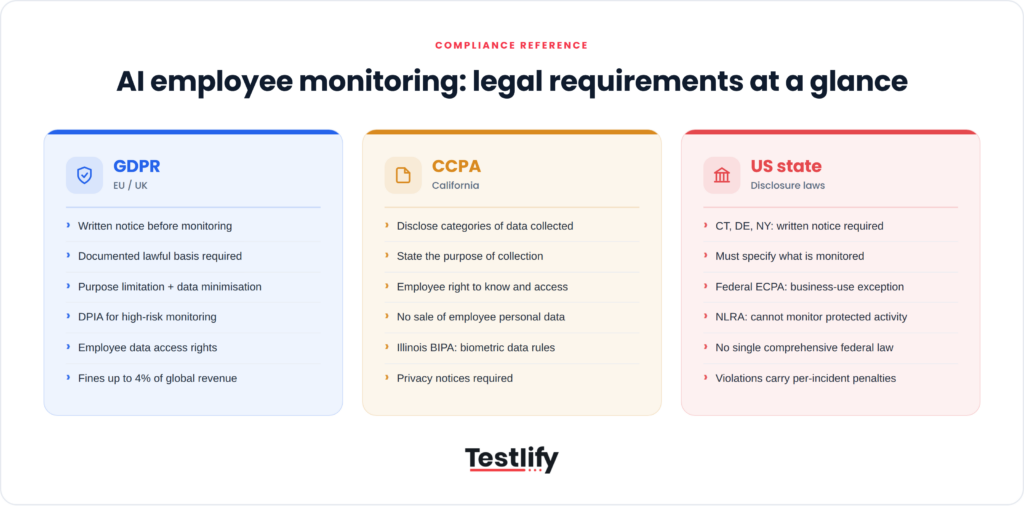
The Electronic Communications Privacy Act (ECPA) prohibits intercepting private electronic communications but includes a business-use exception for employer-owned systems with employee notice. NLRA Section 7 protects employees’ right to discuss wages, working conditions, and collective action — monitoring that captures or chills this activity creates unfair labor practice exposure regardless of what technology is used.
GDPR (EU / UK) requirements
Under GDPR Article 5, monitoring must be purpose-limited, data-minimized, and transparent. Article 6 requires a lawful basis — typically legitimate interests, which requires a documented balancing test showing business interests outweigh employee privacy rights. Article 13 requires informing employees what is collected, why, and for how long before collection begins. For high-risk monitoring (biometric data, continuous video), a Data Protection Impact Assessment (DPIA) is mandatory prior to deployment.
US state disclosure laws
Connecticut, Delaware, and New York require employers to provide written notice before monitoring employee electronic communications or computer activity. California’s CCPA gives employees rights over personal information collected in employment contexts, including the right to know what data is collected and how it is used. Illinois BIPA regulates collection of biometric identifiers including facial geometry — relevant to any camera-based AI monitoring.
What every employer must do
Before deploying any monitoring tool, you need:
- Draft a written monitoring policy and have employees acknowledge it in writing
- Define scope: which systems, what data types, what business justification for each category
- Set retention limits: how long data is stored and who has access
- Get legal review across all jurisdictions where employees are located
- Establish a process for employee data access requests (required under GDPR) — see the guide to developing workplace compliance policies for a policy framework
Benefits of AI employee monitoring
When scoped correctly and communicated transparently, AI monitoring provides operational value that manual management cannot replicate at scale.
Productivity data at the team level identifies workflow bottlenecks rather than just individual underperformers. If a team’s activity consistently drops during a specific time window, that may reflect a process problem or a tool failure — not individual motivation. AI monitoring surfaces these patterns; a manager acting on individual scores without investigating root causes misuses the data.
Security monitoring catches insider threats and accidental data leaks before they become incidents. For regulated industries including finance and healthcare, this monitoring category is often required rather than optional. For more on how monitoring fits into broader workforce management, see the role of employee monitoring in the remote work era.
Risks and concerns
AI employee monitoring introduces three categories of risk that compound each other. Trust damage reduces retention. Legal non-compliance creates financial exposure. Algorithmic bias amplifies both. Each is avoidable with proper governance — none resolves itself.
Trust and retention: Employees who discover they are being monitored without prior disclosure report significantly lower engagement and higher intent to leave. Higher-performing employees — who have the most external options — are most likely to exit when they feel surveilled rather than managed. The monitoring paradox: the people you least want to lose are the ones most likely to leave over invasive monitoring.
Legal liability: Non-compliant monitoring creates exposure that extends beyond the monitoring itself. GDPR fines can reach 4% of global annual revenue. US state-level violations carry per-violation penalties. Deploying monitoring without legal review does not reduce risk; it creates it.
Algorithmic bias: Productivity scoring models trained on historical data can embed existing biases — penalizing caregiving-related schedule patterns or communication styles correlated with specific demographics. Review vendor methodology before signing a contract. For a deeper look at behavioral analysis post-hire, see post-hire employee monitoring and behavioral analysis.
Best practices for AI employee monitoring
Most legal and trust problems with employee monitoring stem from deployment without governance. These five practices address both. Apply them in order: policy first, then scope, then communication.
Write the policy before deploying
Your monitoring policy should define what is monitored, why, who can access the data, how long it is retained, and how employees can request their own data. Have employees sign an acknowledgment. Without a written policy, monitoring data may be inadmissible and deployment may be non-compliant in disclosure-required states.
Match scope to a specific business need
Security monitoring on company networks is straightforward to justify. Continuous keystroke logging for a customer-facing role is not. For each monitoring category you consider, document the specific business risk it addresses. Remove categories that cannot be clearly justified — they add liability without adding insight.
Communicate before you monitor
Tell employees what you track, why, and what you do with the data — before monitoring begins. Organizations that communicate monitoring policies proactively report less employee resistance than those where workers discover monitoring after the fact. Transparency is both a legal requirement in most jurisdictions and the approach most likely to preserve trust.
Use aggregate data for management decisions
Avoid relying on individual productivity scores as the primary basis for performance decisions. Scores are noisy and context-dependent. Use aggregate team patterns to identify systemic issues; use direct observation, output review, and structured check-ins for individual performance management.
Pro Tip: If you find yourself checking an individual’s activity score daily to assess their performance, that is a management problem — not a monitoring problem. Fix the feedback loop, not the dashboard.
Audit your monitoring scope quarterly
Review what you are collecting and why on a regular cadence. Data minimization is a GDPR requirement and good operational practice. Business needs that justified a monitoring category previously may no longer apply.
Monitoring employee AI tool usage
There is a second, distinct meaning of “AI employee monitoring” that is increasingly relevant in 2026: using monitoring software to track which AI tools your employees are using, how often, and whether those tools create compliance or data security risk.
ActivTrak’s 2026 State of the Workplace report found that 80% of employees now use AI tools at work — up from 53% two years ago. Organizations that started with two AI tools in 2023 now manage seven or more. Most IT and HR teams do not have full visibility into which tools employees have adopted without authorization.
Shadow AI — employees using unapproved AI tools to process company data — creates two specific risks. First, data exposure: prompts containing confidential information sent to external AI systems may be stored, used for model training, or subject to data breach. Second, compliance exposure: GDPR, HIPAA, and SOC 2 all have implications when company data is processed by third-party AI systems outside approved vendor agreements.
What monitoring for AI tool usage looks like in practice:
- Tracking which AI tools and websites employees access on company networks or devices
- Logging prompts and responses sent to AI systems (where legally permitted with written disclosure)
- Flagging use of unapproved AI tools before sensitive data is shared externally
- Reporting on AI tool adoption rates by team to inform governance decisions
This is distinct from traditional productivity monitoring and is emerging as a standalone compliance use case for IT security teams. If your organization has data classification requirements, approved vendor lists, or confidentiality obligations to clients, AI tool usage monitoring is no longer optional — it is risk management. For more on identifying performance signals post-hire, see how employee monitoring can identify top performers.
What to look for in AI monitoring software
If you are evaluating tools, prioritize these capabilities:
- Compliance reporting: built-in GDPR, CCPA, and state-law audit logs
- Role-based access controls (RBAC): managers should see their team’s data only
- Configurable data retention: automatic deletion after defined periods
- Employee transparency portal: some tools let employees view their own data, reducing conflict
- Data residency options: required for EU data under GDPR Chapter V transfers
- AI tool classification: visibility into which AI apps employees access, for shadow AI governance
For a ranked comparison of current tools, see top employee monitoring tools.
One note on the broader picture: monitoring is partly a hiring problem. When you hire people for demonstrated competence using skills-based assessments, the correlation between activity data and actual output tends to be higher — and the case for invasive surveillance tends to be weaker. Assess upstream; monitor downstream.
Frequently asked questions

Content Writer
Yashika Khandelwal is a Content Writer with 3+ years of experience creating research-backed content on hiring, talent assessment, and HR technology. She is a registered Organizational Psychologist and subject matter expert who combines behavioral science with practical recruitment insights to produce accurate, evidence-based content.
LinkedInRelated resources
View all
HR & recruitment
5 common mistakes to avoid when using skill assessments
HR & recruitment
Top 7 recruitment trends in brand manager hiring
HR & recruitment
How to start an HR business — Step-by-step
HR & recruitment
The role of employee monitoring in the remote work era

HR & recruitment
How employee monitoring can help you identify top performers
HR & recruitment
How to Attract Top Talent From Job Search Sites
Get started.
Hire on proof, not resumes.
Run your first skills-based assessment free — no credit card required.