
Top 4 talent assessment tools available in French
French talent assessment tools enable recruiters to assess language proficiency and cultural fit for roles requiring French fluency.

A talent assessment tool is genuinely available in French only when three separate layers speak French: the recruiter interface your team works in, the test content a candidate answers, and the instructions, error messages and result pages wrapped around that content. Most vendors localize the first layer, translate part of the second, and quietly skip the third.
That third layer is where bilingual hiring breaks. A candidate in Lyon or Laval can sit a perfectly translated question set and still abandon the assessment because the timer warning, the accommodation request and the "your session has expired" notice all arrived in English. So the useful question is not which vendor lists French on a pricing page. It is which layers of the product actually change language, and how you verify that before you sign.
 ChatGPT
 Gemini
 Claude
 Grok
Grok Perplexity
TL;DR
- "Available in French" splits into three layers: recruiter interface, test content, and the candidate-facing wrapper. Check the third one first, because it is the one vendors skip.
- Hiring in French is not the same as hiring someone who speaks only French. In Quebec 46.4% of people can hold a conversation in both official languages; outside Quebec that drops to 9.5%.
- Quebec law gives this real weight. Businesses employing 25 or more people in Quebec across a six-month period must register with the Office québécois de la langue française, and workers hold a fundamental right to carry out their work in French.
- French is far bigger than France. The OIF counts 396 million speakers, and 65% of them are in Africa, so "French support" that assumes a European candidate pool is already too narrow.
- Map the role to competencies and evidence before you shop for a test. A language score on its own does not tell you whether someone can de-escalate an angry customer in French.
- Ask for a trial in French, then take the assessment yourself as a candidate. Ten minutes of that beats any feature matrix.

What does it mean for a talent assessment tool to be available in French?
It means French works at three independent layers: the employer-side interface, the question content, and everything the candidate reads around the questions. A vendor can ship any one of these without the others, and the marketing word "French" covers all three equally well. Treat them as three separate checks.
Here is the part buyers get wrong. The recruiter interface is the easiest layer to localize and the least important one for hiring quality, because your recruiters are the people you can train around a translation gap. The candidate wrapper is the hardest to localize and the most consequential, because a confused candidate drops out and you never learn why. Vendors demo the easy layer.
Layer | What "available in French" has to mean here | How to verify it in a trial | What it costs you when it is missing |
|---|---|---|---|
Recruiter interface | Menus, assessment builder, scoring views and exported reports render in French for the hiring team | Switch the account language and walk the full build-to-shortlist path | Slower setup and reviewer errors, but trainable |
Test content | Questions, answer options and scoring rubrics exist in French, not machine-passed through it at run time | Open three questions in the French version and read them as a native speaker would | You measure reading comprehension of bad French instead of the skill you wanted |
Candidate wrapper | Invitations, consent, timers, section rules, accommodation requests, errors and result pages | Send yourself a real invitation and complete the assessment end to end in French | Silent drop-off, and a fairness problem you cannot see in the scores |
Best talent assessment tools and recruitment assessment platforms in French
Search this query and you will meet the same handful of names: Testlify, TestGorilla, Test Candidates and Isograd Testing Services. Collecting names is the easy part, and a ranked list of them is worth less than it looks, because the ranking never tells you which layers speak French for the roles you hire. So the rest of this page is the checks rather than the leaderboard.
Shortlist on evidence of the three layers above, not on a language count. Six checks separate a platform that genuinely runs in French from one that merely offers it, and every one of them is answerable inside a free trial in under an hour.
- Coverage per layer. Ask the vendor to confirm French at each of the three layers separately, in writing. A single yes means nothing.
- Native versus translated content. Machine translation at run time is useful for breadth and risky for scoring. Find out which one you are buying.
- Spoken French, not just written. If the role talks to customers, a written test measures the wrong thing. You need voice or video evidence.
- Proficiency mapping. A raw percentage is not portable across your hiring managers. A recognised scale is.
- Fairness controls in language. Accommodation requests and DEI questions have to work in the candidate's language, or they do not work at all.
- Compliance posture. Ask where candidate data lives and which certifications the vendor holds before French even comes up.
One trap worth naming. Teams often buy the platform with the longest language list, then discover the French tests are thin in exactly the role families they hire for. Breadth across dozens of languages is worth less than depth in the two you actually recruit in. Check the French test inventory for your specific roles before you compare totals.
TestGorilla localization: languages, countries and regions supported, and is French available?
TestGorilla is the name most often attached to this question, and that is why the query exists at all. The honest answer for any vendor, us included, is that language and region coverage is a moving number: it changes with each release, so a count printed in a blog post ages badly and should not be the basis of a purchase.
So do this instead of trusting a list. Pull the vendor's current documentation on the day you evaluate, then confirm it in a trial at all three layers. Coverage claims are cheap; a completed assessment in French is proof. For a feature-level view of how Testlify lines up against that particular rival, read our TestGorilla comparison page.
On countries and regions, one clarification saves a lot of wasted evaluation time. Assessment platforms are generally sold globally rather than country by country, so "supported countries" is rarely a real product boundary. What is real: the languages available at each layer, where candidate data is stored and processed, and which compliance regimes the vendor can evidence. Testlify holds SOC 2 Type II, ISO 27001, GDPR and CCPA compliance, and those are the questions your legal team will ask, not a country count.
HR assessment tools vs talent assessment software: what is the difference?
HR assessment tools measure people you already employ: engagement surveys, 360 feedback, performance reviews, leadership diagnostics. Talent assessment software measures people you are deciding whether to hire. Same word, opposite job, and the distinction matters when you are buying for French-language hiring.
The reason it matters is language stakes. An engagement survey in imperfect French is awkward. A pre-hire assessment in imperfect French is a selection decision made on a measurement error, and in Quebec it sits close to a legal question about the language of work. Buy pre-hire tooling for pre-hire decisions, and hold it to a higher translation standard than an internal survey.
Both categories overlap on personality and cognitive instruments, which is where the confusion starts. A psychometric instrument can serve either purpose, but the norms, the consent language and the defensibility requirements differ. Pre-hire use needs job-relatedness you can defend.
What does a talent assessment test measure in French?
For a French-language role it should measure two things separately: proficiency in French, and the job skill exercised in French. Those are different measurements, and collapsing them produces a score nobody can act on. A candidate can be C1 in French and still terrible at handling a billing dispute.
For the proficiency half, the Common European Framework of Reference is the scale worth anchoring to. The CEFR self-assessment grid defines six levels from A1 to C2 across five competences: listening, reading, spoken interaction, spoken production and writing. Two of those five are spoken, which is exactly the half a written-only assessment cannot reach. Write the target level into the job description before you test, so "good French" stops being a matter of opinion between two interviewers.
For the job-skill half, test the task in French rather than testing French. A support hire should answer a real customer message in French. A finance hire should read a French invoice and find the error. That is the difference between a language certificate and evidence that someone can do the work.
How does Testlify handle French language assessment?
Testlify is a pre-hire assessment and interviewing platform, and French shows up across several parts of it rather than as a single language add-on. What follows is scoped to what the product actually ships, with the gaps named.
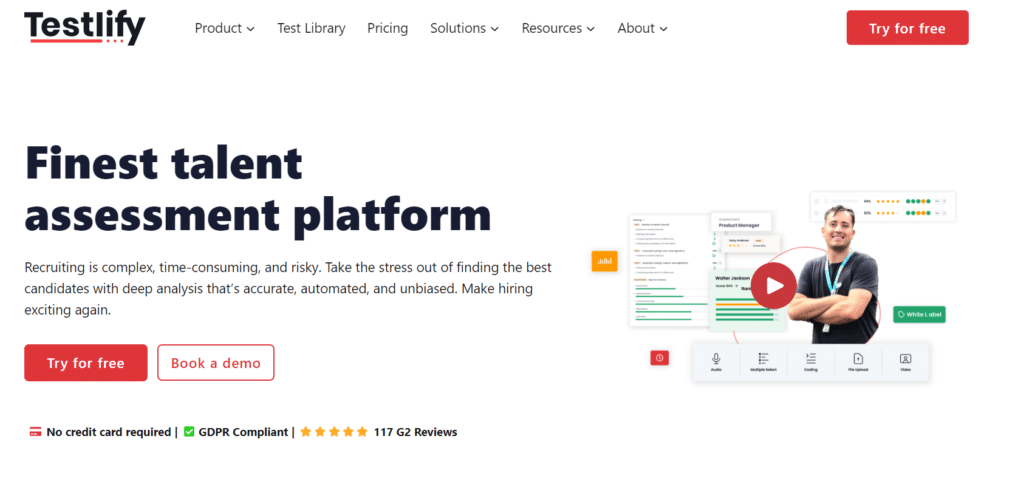
Key features for French-language hiring
- A Language test category in the test library, alongside role-specific skills, cognitive ability, psychometric, situational judgement and coding, so proficiency and job skill can sit in one assessment.
- CEFR reporting. CEFR is one of the available report types, which is what makes a proficiency result portable between hiring managers instead of a bare percentage.
- Real-time translation of tests and custom questions into a candidate's preferred language. The product states plainly that quality may vary slightly depending on the language pair, which is the honest caveat to weigh against the breadth it buys you.
- Spoken evidence. One-way and two-way conversational AI interviews, plus audio and voice questions, with a configurable recording language, selectable AI avatars and voices, preparation time before recording, and attempt and duration limits.
- Multilingual transcripts. Spoken language is auto-detected and transcribed for recordings of at least 30 seconds, so a French interview is reviewable by someone who was not in the room.
- Pronunciation insights across accuracy, fluency and prosody, which is closer to what a customer actually hears than a written score.
- Human override. AI auto-scoring on open responses, with reviewer override, plus per-question item statistics such as difficulty and discrimination so a badly translated question is visible in the data.
- Fairness controls in the candidate's flow. A structured accommodation request, aimed in part at candidates with limited language proficiency, routed to an administrator rather than granted automatically.
Best for
Teams under a couple of hundred people hiring bilingual client-facing staff, where the same shortlist needs a language signal and a job-skill signal and nobody has a dedicated assessment specialist. Agencies and professional-services firms hiring French-speaking account and support staff are the clearest fit. It also suits Canadian employers who need French evidence on file for roles where the language of work question is live.
Limitations worth knowing before a trial
- Assessments run on Chromium desktop browsers, Chrome or Edge. The mobile app is a capture fallback for audio and video, not a way to sit a full assessment on a phone.
- Real-time translation quality varies by language pair, so for a high-stakes French role, review the French rendering of every question you plan to score.
- Testlify does not schedule live human interview panels. Assessment and AI interviewing are in the product; calendar coordination for a panel of people is not.
- Session recording is not captured on mobile for voice and video questions.
Pricing
Annual billing starts at $139 a month on Starter with 100 credits, $279 on Basic with 300, and $699 on Business with 1,000, with higher tiers on contact-sales. Monthly billing carries different numbers for the same tier names. There is a seven-day free trial and a 30-day money-back window. Single sign-on, white labeling and ATS integrations are priced as add-ons on the self-serve tiers rather than bundled, so price the configuration you need, not the headline. Confirm against the current pricing page, which is the source of truth.
Why French hiring deserves more care
Start with scale, because it is routinely underestimated. The Organisation internationale de la Francophonie's 2026 report counts 396 million French speakers worldwide with 65% of them in Africa, and nearly 170 million people learning the language. A French hiring strategy built around Paris is aimed at a small slice of that.
Canada is where the compliance edge lives. The 2021 Census recorded more than 7.8 million Canadians whose first official language spoken is French, 21.4% of the population. And bilingualism is concentrated: 18.0% of Canadians, about 6.6 million people, can hold a conversation in both official languages, but that splits into 46.4% inside Quebec against 9.5% outside it.
Read those two numbers together and a common hiring assumption falls apart. Outside Quebec, a role advertised as bilingual is competing for roughly one in ten people, which is why those searches take so long and why an assessment that screens on French before a recruiter call saves real weeks. Inside Quebec, nearly half the workforce is bilingual, so screening hard on English can shrink your pool without improving the hire.
Then there is the law. Enterprises employing 25 or more people in Quebec over a six-month period must register with the Office québécois de la langue française to begin a francization process, and every business carries obligations on the language of work, including respecting workers' fundamental right to carry out their activities in French. Employers validating a job offer for a permanent foreign worker have to supply proof of francization compliance, such as a registration certificate issued within the last three months. None of that is a reason to buy an assessment tool. It is a reason to keep defensible evidence of how you evaluated language, which an ad-hoc phone screen does not produce.
A worked example: mapping a bilingual support hire
The Testlify Competency-to-Evidence Matrix maps every role to the competencies that matter, then connects each competency to measurable evidence through assessments, simulations, interviews, references and structured feedback. Do not start with a test. Start with the role, and work outward to the evidence.
Take a hypothetical bilingual customer support hire at a 90-person software company in Montreal, handling tickets in French and English. Filled out, the matrix looks like this.
Competency | Evidence source | Assessment method | Benchmark |
|---|---|---|---|
Written French | Language test, CEFR-reported | Reading and writing items | B2 minimum |
Spoken French under pressure | Voice or video response | One-way recorded answer to an escalating complaint, with pronunciation insights | Understandable at pace, no scripted read |
De-escalation judgement | Situational judgement items | Ranked responses to a billing dispute, posed in French | Top quartile of the role benchmark |
Product reasoning | Role-specific skills test | Troubleshooting sequence, language-neutral | Pass at intermediate difficulty |
Consistency of the shortlist | Multi-reviewer scoring | Two reviewers, AI score visible, override logged | Disagreements resolved before the offer |
Notice the third row. Posing the judgement question in French rather than translating an English one is the whole point, because the skill being measured is handling a French-speaking customer, not translating a scenario. And notice the fourth: troubleshooting does not need to be in French at all, so testing it in French would add noise to a signal you already have. Deciding which competencies carry the language load, and which do not, is most of the value of writing the matrix down.
There is decades-old evidence behind combining these signals mechanically rather than by feel. A meta-analysis by Kuncel, Klieger, Connelly and Ones, published in the Journal of Applied Psychology in 2013, found that mechanically combining assessment information generally predicts outcomes as well as or better than experts recombining the same information holistically. It is evidence against letting intuition rework the numbers at the end, not a rule about who signs off.
Pro tip: before you compare vendors, send yourself a real candidate invitation in French and complete the whole assessment on a phone and a laptop. Most French-support gaps show up in the first two screens, long before the questions start, and no demo will surface them because the demo runs in English.
Put a French assessment in front of your next shortlist
Pick one open bilingual role, write its competency matrix on a single page, then build an assessment that produces evidence for each row. Start with a French language proficiency test, add the job-skill test for the role, and switch on multilingual delivery so candidates work in the language they will actually use. Start a free trial, or book a demo and bring the role you are struggling to fill.
FAQs

Wordpress Developer
Yash Patel is a Wordpress and SEO Specialist at Testlify with 3+ years of experience in technical SEO, on-page optimization, and content strategy. He works on improving Testlify's organic presence and produces content focused on hiring, talent assessment, and HR technology.
LinkedInRelated resources
View all
HR & recruitment
Top 4 talent assessment tools available in Dutch

HR & recruitment
Top 8 Employee Recognition tools

HR & recruitment
Top 10 Compensation Management Tools for Enterprise HR Teams (2026)

HR & recruitment
Top 5 Employee Engagement tools

HR & recruitment
10 Best Performance Management Tools for Enterprise HR Teams (2026)

HR & recruitment
Top 10 Employee Monitoring Tools in 2026 (Ranked and Compared)
Get started.
Hire on proof, not resumes.
Run your first skills-based assessment free — no credit card required.