
Effective teamwork: what it looks like and how HR builds it
What effective teamwork really means, what it looks like on a real team, the four ways it breaks, and the levers HR can pull this quarter.

Effective teamwork is a group of people reaching a shared goal faster and more reliably than they could alone, because the goal is clear, information moves without being chased, people trust each other enough to disagree, and someone decides when the team cannot agree. It shows up in output and retention, not in how friendly the team looks from the outside.
TL;DR / Key Takeaways
- Effective teamwork means a group reaches a shared goal faster than its members could alone, with a clear goal, clear owners, open disagreement and a decision rule.
- Gallup put global engagement at 20% in 2025 and manager engagement at 22%, and estimated low engagement costs about $10 trillion.
- Most struggling teams have one of four failure modes: drifted goal, blurred ownership, broken information flow or low trust. Fix the first one you find.
- Away days rarely help. They apply a trust fix to what is usually a goal or ownership problem.
- Test teamwork before the offer with situational judgment, teamwork and collaboration tests, not by asking candidates to describe their style.
- Decision latency, the days from a question being raised to a decision, is the most useful teamwork metric because it moves within weeks of a real fix.
- Goal and ownership problems often improve within 30 days. Trust problems take a quarter or more.
 ChatGPT
 Gemini
 Claude
 Grok
 Perplexity
What is effective teamwork?
Effective teamwork is the point at which a group produces better work together than its members would produce separately, and keeps doing so without exhausting anyone. The test is practical rather than emotional: the team knows what it is for, who owns what, how decisions get made, and what to do when two people disagree.
That definition matters because teamwork is often confused with two other things.
- Collaboration is the activity. Two people editing the same document are collaborating. Whether that produces anything useful is a separate question.
- Team spirit is the feeling. A team can enjoy each other's company and still miss every deadline, and a team under real pressure can be effective while being visibly tense.
Effective teamwork sits in between. It is a set of working conditions, and conditions can be designed, measured and fixed. For the wider vocabulary, see the team building glossary entry.

Why does effective teamwork matter to the business?
Weak teamwork is expensive, and the cost shows up in numbers HR already reports. Engagement is the clearest signal. Gallup's State of the Global Workplace put global engagement at 20% in 2025, the lowest since 2020, with manager engagement at 22%, down nine points since 2022, and estimated the productivity cost of low engagement at roughly $10 trillion, or 9% of global GDP.
Managers are the link between the two. A disengaged manager stops running the team rituals that make teamwork work: the goal update, the decision log, the check-in where someone can say the plan is wrong. The team then looks fine on paper and slows down in practice.
The second cost is friction between people. SHRM's Civility Index work counted over 81 million acts of incivility a day in US workplaces, with workers losing an average of 37 minutes of productivity for each one. Multiply that across a 200-person business and the cost is a full-time role's worth of output a week.
Key takeaway: effective teamwork is not a soft goal. It moves delivery speed, rework and attrition, which are the three numbers an HR leader is usually asked about.
What are the characteristics of effective teamwork?
Effective teams share six characteristics. Each one has a tell, which is the useful part: a trait you cannot check is a slogan, and a trait with a tell is a diagnostic.
Characteristic | What it looks like | What it looks like when missing |
|---|---|---|
A goal the team can repeat | Any three members give the same answer to "what is this team for" | Every member describes a different priority |
Roles with clear edges | Every task has one named owner, and no task has two | Work is done twice, or not at all, and nobody is surprised |
Information that moves | Decisions reach the people affected without being chased | People find out in the next meeting, or from a customer |
Trust to disagree | Someone challenged the plan in the last two weeks | Meetings end in fast agreement and slow delivery |
A decision rule | The team knows who decides when it cannot agree | Decisions reopen weekly and nothing is final |
Reflection on a cadence | The team reviews how it works, not only what it shipped | Problems repeat with new names |
That list lines up with the research. CIPD's evidence review on high-performing teams points managers at team dynamics, cohesion, shared thinking, information sharing, team reflection and planned interventions such as teamwork training, debriefs and goal setting. McKinsey's work on team health lands in the same place, naming trust, communication, how a team generates ideas and how it makes decisions as the behaviours that separate strong teams from weak ones.
The review adds a point worth keeping: team dynamics matter most for people who work virtually, for teams with little history of working together, and for teams whose work is highly interdependent. A newly formed, distributed, cross-functional team is the hardest case on all three counts.
What about the 5 C's?
The 5 C's of teamwork are communication, collaboration, coordination, cooperation and commitment. Treat them as a memory aid rather than a model. They name the behaviours but not the conditions, so a team can score well on all five and still fail because nobody owns the decision.
What does effective teamwork look like in practice?
Abstract traits are easy to agree with and hard to use, so here are three teams where the same conditions show up differently.
A cross-functional launch team: Product, marketing, support and legal have one launch date and one owner per workstream. Open questions sit in a shared decision log with a named owner and a due date. When legal and marketing disagree on a claim, the product lead decides within 48 hours and the decision is written down. The tell is that nobody has to ask what was agreed. The cross-functional team glossary entry covers how these teams are normally set up.
A distributed support team across three time zones: The handover note is the product. Each shift ends with a written summary of open tickets, what was tried, and what the next shift should pick up first. Nobody waits for a meeting to start working. One weekly call exists for the things that need a conversation, and it is 25 minutes long.
A shift-based operations team: Two supervisors run the same line on different shifts and share one quality target. They swap one page at handover and meet monthly to look at the same chart. Effective teamwork here is almost entirely process: the people barely overlap, so the system has to carry the trust.
Across the teams we work with, the pattern repeats. Effective teamwork in a distributed setting is written down; in a co-located setting it can survive on conversation. Teams that move from one to the other without rewriting the rituals are the ones that break. If your teams are mostly remote, the practical side is covered in virtual team building.
Why does teamwork break down, and which failure mode is yours?
Most teamwork advice assumes every struggling team has the same problem. They do not. Four failure modes cover almost everything, and the fix for one makes another worse. Run the questions in order and stop at the first no.
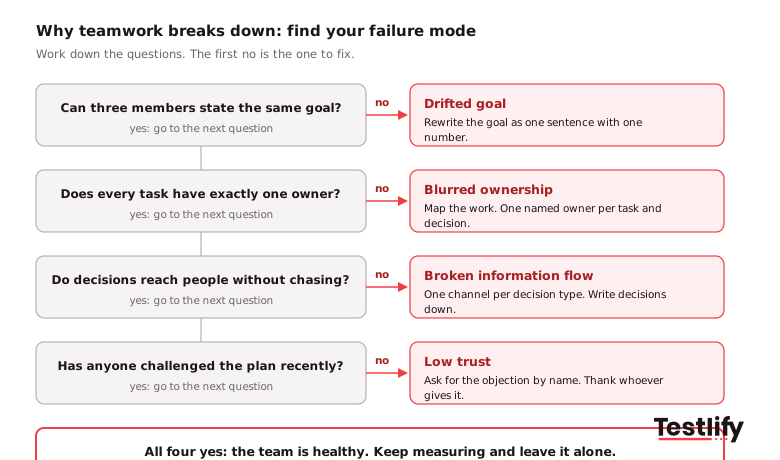
- Drifted goal: Three members cannot state the same goal. The fix is to rewrite the goal as one sentence with one number in it, then repeat it at the top of every update. More team-building activities will not help a team that does not know what it is for.
- Blurred ownership: A task has two owners, or none. Map the work and give every task one named owner and one named decision. Teams in this mode often look collaborative, because everyone is in every conversation.
- Broken information flow: Decisions exist but do not travel. Pick one channel per decision type and write decisions where the team actually reads. This is the most common mode on hybrid teams and the easiest to fix.
- Low trust: Nobody has challenged the plan in weeks. Ask for the objection by name in the meeting, and thank the first person who gives one. The University of California, Berkeley's guide for managers goes further and tells supervisors to probe when a team agrees too quickly, because fast agreement is often silence rather than consensus.
Pro tip: run the four questions with the team in the room, not about them in a leadership meeting. The answers are the intervention.
What is HR's role in building effective teamwork?
HR's role is to own the conditions that no single manager can set alone. Six levers do most of the work.
- Hiring: Collaboration signals get tested before the offer, not discovered in month three.
- Team design: HR challenges structures where a task has two owners or a team has nine people and no decision rule. This is an org design conversation, and HR is usually the only function holding the whole map.
- Manager capability: Given that manager engagement is now the weak link, the highest-return training is the boring kind: how to run a decision log, how to give the goal update, how to ask for disagreement.
- Performance and reward: If every goal is individual, teamwork is a volunteer activity. At least one shared goal per team, visible in the review, changes behaviour faster than a workshop.
- Conflict handling: HR sets the route a disagreement takes before it becomes a grievance, and trains managers to use it.
- Measurement: HR runs the instruments: the survey, the 360, the team review cadence. The CIPD review backs planned interventions such as teamwork training, debriefs and goal setting, which all need someone to schedule and protect them.
What HR should stop doing is also clear. Away days booked in response to a bad engagement score are the classic wrong move: they are a trust intervention applied to a goal problem. Build the diagnostic first. For the culture layer around all of this, see how to build a high performance culture.
How do you hire for effective teamwork?
Teamwork is a hiring problem before it is a training problem, and the live version of this advice is usually too weak to use. Asking a candidate to describe their communication style tests how well they talk about themselves.
Four signals are worth testing directly.
- Handling disagreement: Put the candidate in a scenario where a teammate is wrong and a deadline is close. situational judgment tests are built for exactly this.
- Reading other people: An emotional intelligence test gives a far more consistent read than a panel's gut feeling.
- Written clarity: On a distributed team, writing is the collaboration. A short written task shows it in minutes.
- Collaboration habits: A teamwork test and a collaboration test put every candidate through the same situations, which is the only way to compare them fairly.
One warning on culture fit. Hiring people who feel easy to work with narrows a team fast, and a team of similar people reaches agreement quickly and badly. Test for the behaviour, which is how someone handles difference, not for the resemblance. culture fit vs skill fit covers the trade-off, and assessing teamwork skills in recruitment goes deeper on the assessment design.
How should HR handle conflict inside a team?
Conflict is not the problem. Unresolved conflict is, and the cost is measurable. SHRM's work on the cost of incivility found that workers lose an average of 37 minutes of productivity per incident, took an average of 1.9 days off in a month in response to it, and that 26% of US workers said they were likely to leave their job in 2025 over incivility they had experienced or witnessed.
Three rules keep it cheap.
- Set the route before you need it: Everyone should know the first, second and third step for raising a problem. Most escalations happen because nobody knew step one.
- Separate the task from the person: Disagreement about the work is useful and should stay in the open. Disagreement about a person goes to a private conversation, quickly.
- Close the loop in writing: A conflict that is resolved verbally and never confirmed tends to reopen. One short note saying what was agreed is enough.
Managers who handle this well have usually been taught how. The conflict management glossary entry sets out the standard approaches, and a conflict management test shows which of your managers already have the instinct.
How do you measure effective teamwork?
Measure teamwork with work data first and survey data second. Surveys tell you how the team feels; the work tells you whether the conditions are there.
Metric | What it tells you | Cadence |
|---|---|---|
Cycle time on a typical unit of work | Whether handoffs are costing days | Monthly |
Rework rate | Whether the team agreed on the goal before building | Monthly |
Decision latency, the days from a question being raised to a decision being made | Whether the decision rule works | Monthly |
Meeting load per member | Whether coordination has replaced the work | Quarterly |
Three survey items: clear goal, safe to disagree, I know who decides | Whether the conditions are felt, not just designed | Quarterly |
360 feedback at team level | Where one person's behaviour is the bottleneck | Twice a year |
Two of those are worth a note. Decision latency is the single most useful teamwork metric we have seen, because it moves within weeks of a real fix and it cannot be gamed by looking busy. Meeting load works in reverse: a rising number usually means ownership is unclear, not that the team is coordinating well.
For the team-level read, the 360 degree feedback test gives a structured version of peer input, and team assessment tools compares the wider options.
What is a 30-day plan to improve effective teamwork?
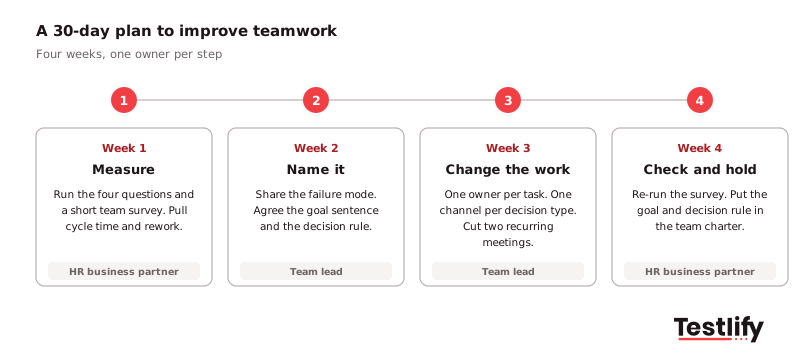
Teamwork work fails when it stays a value rather than a sequence. Four weeks is enough to find the failure mode, change the work and check whether it moved.
Week | What happens | Owner |
|---|---|---|
1 | Run the four diagnostic questions and a three-item survey. Pull cycle time and rework for the last quarter | HR business partner |
2 | Share the failure mode with the team. Agree the goal sentence and the decision rule in writing | Team lead |
3 | Change the work: one owner per task, one channel per decision type, two recurring meetings cut | Team lead |
4 | Re-run the survey and the metrics. Put the goal sentence and decision rule into the team charter | HR business partner |
Nothing on that list is a workshop. If the team needs a trust intervention, it will be obvious from week one, and it will work far better once the goal and the ownership are fixed.
Where to start
Pick one struggling team, run the four questions this week, and fix the first no. Then make the goal sentence and the decision rule part of how every new team is set up, so the next one starts with the conditions already in place.
If collaboration keeps breaking at the hiring stage, browse the Testlify test library for the teamwork, collaboration and conflict management tests and put the same situations in front of every candidate.
Frequently asked questions (FAQs)

Content Writer
Yashika Khandelwal is a Content Writer with 3+ years of experience creating research-backed content on hiring, talent assessment, and HR technology. She is a registered Organizational Psychologist and subject matter expert who combines behavioral science with practical recruitment insights to produce accurate, evidence-based content.
LinkedInRelated resources
View all
Workplace culture
What is an upskilling strategy? A practical guide for HR teams

Workplace culture
Employee engagement metrics: 12 to track and how to measure them

Workplace culture
How to identify flight risk employees: signs, steps and a risk matrix

Workplace culture
How to create an employee recognition program in 9 steps

Workplace culture
How to communicate with Gen Z workers: 9 tips for managers

Workplace culture
Participative Leadership: Meaning, Types, Pros and Cons
Get started.
Hire on proof, not resumes.
Run your first skills-based assessment free — no credit card required.