
How to hire a machinery mechanic: a 7-step guide for 2026
A 7-step plan to hire plant mechanics: define the role, source widely, test skills before interviews, score fairly and onboard safely.

Knowing how to hire a machinery mechanic comes down to one idea: prove the skills before you spend shop time on interviews. Define the machines and shifts the role covers, source from trade schools, referrals, and job boards, run a short online skills test, confirm with a hands-on fault-finding task, then use a scored, structured interview and a planned onboarding.
This machinery mechanic hiring guide is written for TA teams, plant HR, and maintenance managers who need to fill these roles quickly without risking downtime or a safety incident. It covers each step, the skills to check, interview questions with what good answers sound like, 2025 pay data, and a scorecard you can copy.
 ChatGPT
 Gemini
 Claude
 Grok
 Perplexity
TL;DR
- Define the machinery, equipment, shifts, and technical skills required before opening a position.
- Use a skills-first hiring process: start with a 15–30-minute online skills assessment, follow it with a 30–60-minute hands-on task, and finish with a structured interview.
- Assess mechanical repair, hydraulics, pneumatics, electrical systems, troubleshooting, preventive maintenance, and safety awareness.
- Source candidates through trade schools, apprenticeships, employee referrals, union halls, and job boards rather than relying on one channel.
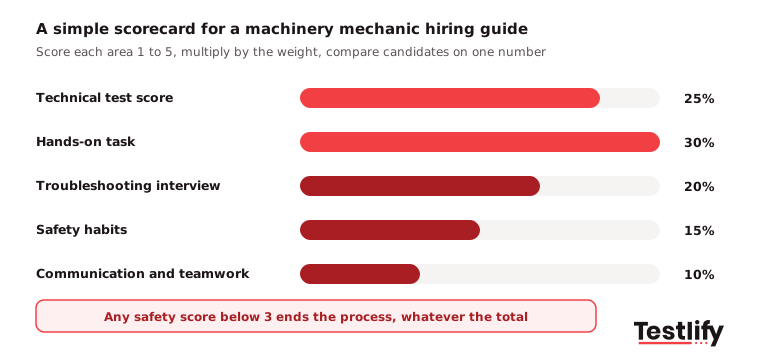
- Use a consistent, weighted scorecard to compare candidates, with safety as a non-negotiable requirement.
- Consider apprenticeships alongside experienced hires to address long-term talent shortages.
- Speed up onboarding with safety training, an experienced buddy, and a structured 30-60-90 day plan.

What does it take to hire a machinery mechanic today?
Hiring a machinery mechanic today takes a faster, skills-first process, because qualified candidates are scarce and every open week costs uptime. Most strong mechanics are already employed, so a long, resume-led process loses them to the plant down the road.
The numbers show why. Deloitte and The Manufacturing Institute estimate that US manufacturing may need 3.8 million new workers between 2024 and 2033 and that 1.9 million of those jobs could go unfilled if the skills gap is not closed. The same Deloitte manufacturing workforce study reports that more than 65% of manufacturers in NAM's Q1 2024 outlook survey named attracting and retaining talent their main business challenge.
Across the teams we work with, the plants that fill mechanic roles fastest do three things: they publish pay and shift details up front, they screen with a short skills test instead of a resume filter, and they make an offer within a week of the hands-on task.
What does the role involve day to day?
A machinery mechanic keeps production machinery running: inspecting it, finding faults, repairing or replacing parts, and planning preventive maintenance so breakdowns happen less often. The work spans mechanical, hydraulic, pneumatic, and electrical systems, from conveyors and packaging lines to presses and CNC equipment.
According to O*NET's profile of industrial machinery mechanics, common job titles include industrial mechanic, machine mechanic, and maintenance technician, and the tools of the trade now include PLC software, ladder logic, SCADA, and maintenance management software alongside meters and hand tools.
Typical duties:
- Inspect and maintain: Run routine checks, lubricate, adjust, and clean machines on a set schedule.
- Diagnose faults: Find the root cause of a stoppage using gauges, meters, schematics, and machine logs.
- Repair and rebuild: Replace bearings, seals, belts, gears, pumps, and motors; weld or fabricate simple parts.
- Prevent breakdowns: Build and follow preventive maintenance plans, often in a CMMS.
- Work safely: Apply lockout/tagout and other safety procedures on every job.
Job titles overlap, so be clear about which role you are hiring before you write the ad:
Role | Main focus | Typical extra skills | Best fit when |
|---|---|---|---|
Machinery mechanic | Repair and maintain production machines | Hydraulics, pneumatics, basic electrical | You run a mix of production equipment |
Maintenance technician | Broader facility and equipment upkeep | HVAC, building systems, general repairs | One person covers the whole site |
Millwright | Install, move, align and rebuild heavy machinery | Precision alignment, rigging, setting machines | You install or relocate equipment often |
Industrial electrician | Power, motors and control circuits | PLC troubleshooting, wiring, drives | Your downtime is mostly electrical |
How to hire a machinery mechanic in 7 steps
The seven steps below move from defining the role to onboarding. Steps 4 and 5 do most of the filtering, so candidates who reach an interview have already shown they can do the work.
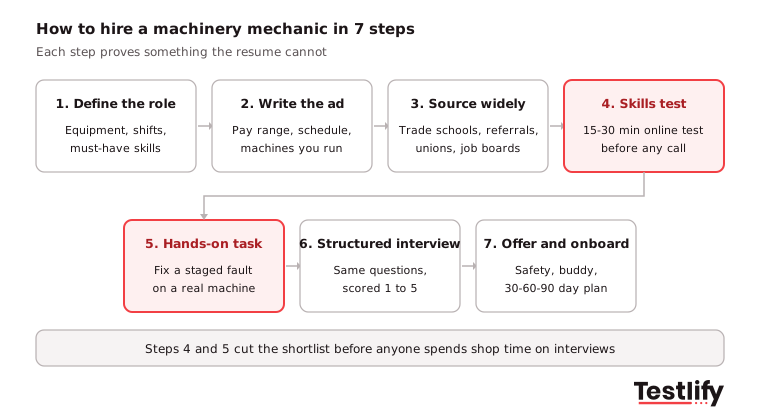
- Define the role: List the machines, brands, and control systems the person will maintain; the shift and on-call pattern; and the three to five skills a new hire must have on day one. Everything else is a nice-to-have.
- Write the ad: Lead with pay range, shift, location, and the equipment they will work on. Mechanics compare jobs on those four facts first.
- Source widely: Post on job boards, but also work with trade schools, apprenticeship programs, referrals, and union halls (more on this below).
- Run a short skills test: Send every applicant a 15 to 30-minute online test before any phone call. It removes the resume guesswork and keeps strong candidates moving.
- Set a hands-on task: Invite the top scorers on site to find and fix a staged fault on a real machine. Watch the process, not just the result.
- Hold a structured interview: Ask every candidate the same questions and score each answer from 1 to 5 against agreed criteria. A structured interview is fairer and much easier to compare.
- Offer and onboard: Make the offer fast, then start with safety training, a buddy mechanic, and a 30-60-90 day plan.
Pro tip: Book the hands-on task slot when you send the skills test. Candidates who pass can then come in within days, which protects your time to hire against faster competitors.
Which skills should you test before making an offer?
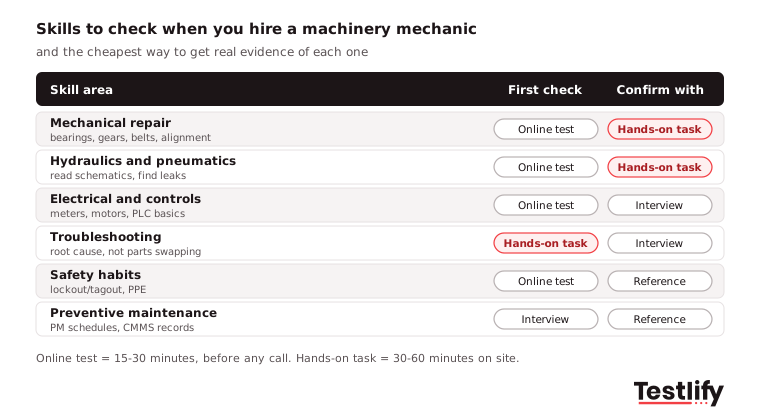
The skills to test before an offer are mechanical repair, hydraulics and pneumatics, electrical and controls basics, troubleshooting, safety habits and preventive maintenance. Each one needs real evidence, and some are cheaper to check online while others only show up on a machine.
Hard skills:
- Mechanical systems: Bearings, gears, couplings, belts, chains, and shaft alignment.
- Fluid power: Reading hydraulic and pneumatic schematics, finding leaks and pressure faults.
- Electrical and controls: Using a multimeter, testing motors and sensors, and reading basic ladder logic. A PLC programming test helps if your lines are heavily automated.
- Welding and fabrication: Simple repairs and brackets, if your plant expects it.
- Safety procedures: Lockout/tagout, PPE, and machine guarding. OSHA's control of hazardous energy standard is the baseline every candidate should know.
Soft skills:
- Structured troubleshooting: Works from symptoms to root cause instead of swapping parts until something works.
- Clear communication: Explains a fault and its fix to operators and supervisors in plain words.
- Calm under pressure: Stays methodical when a line is down and a supervisor is waiting.
- Record keeping: Logs work orders and parts so the next shift knows what happened.
A short, role-specific online test is the fastest first check. The Testlify machinery mechanic test takes 15 minutes and covers technical proficiency, problem-solving, safety awareness, and attention to detail. Pair it with the industrial machinery mechanics test or a mechanical reasoning test for entry-level roles where aptitude matters more than experience.
Where can you find qualified candidates?
Qualified candidates come mostly from five places: trade and technical schools, apprenticeship programs, employee referrals, union halls, and job boards. Relying on one channel, usually job boards, is the most common reason plant roles stay open for months.
- Trade schools and community colleges: Build a relationship with industrial maintenance programs, offer site visits, and take students on placement.
- Apprenticeships: Grow your own. An apprenticeship pairs paid work with structured training and builds loyalty early.
- Employee referrals: Your mechanics know other mechanics. A clear employee referral program with a real bonus is often the best channel for experienced hires.
- Union halls: In unionized regions, local halls can supply qualified mechanics quickly.
- Job boards and social media: Use clear titles (machinery mechanic, industrial mechanic, maintenance mechanic) so you show up in all three searches.
- Military transition programs: Veterans from vehicle and equipment maintenance roles bring strong troubleshooting and safety habits.
Key takeaway: Post in several channels at once and send every applicant the same skills test link. You compare everyone on evidence, whatever channel they came from.
What should the job description include?
A good job description includes the pay range, shift pattern, the machines and controls the person will maintain, five or six real duties, and only the must-have requirements. Skip vague lines like "dynamic team"; mechanics want facts.
Job title: Machinery mechanic (industrial maintenance)
About the role: You will keep our [packaging / stamping / assembly] lines running across [shift pattern] at our [city] plant, working on [equipment brands and control systems].
What you will do:
- Inspect, maintain and repair production machinery, including hydraulic, pneumatic, and electrical systems.
- Diagnose breakdowns and restore production quickly and safely.
- Follow and improve preventive maintenance schedules in our CMMS.
- Weld and fabricate simple parts when needed.
- Apply lockout/tagout and site safety rules on every job.
- Record work orders and parts used.
What you need:
- Hands-on experience maintaining industrial machinery, or a completed industrial maintenance program.
- Ability to read mechanical, hydraulic, and electrical schematics.
- Comfort with a multimeter and basic electrical troubleshooting.
- Willingness to work [shift / on-call] as needed.
Nice to have: PLC troubleshooting, welding certification, and a recognized industrial maintenance credential such as NIMS or SMRP's CMRT.
Pay and benefits: $[range] per hour, plus shift premium, overtime, [benefits], paid training, and tool allowance.
Which interview questions reveal real experience?
The interview questions that reveal real experience ask for a specific past repair, a step-by-step diagnosis or a safety decision, and then probe for details only someone who did the work would know. Score each answer from 1 to 5 against what a good answer sounds like.
Troubleshooting:
- "Walk me through the last machine breakdown you fixed. What were the first three things you checked?" A good answer starts with safety and symptoms, then narrows down logically.
- "A conveyor motor keeps tripping its overload. How do you find the cause?" Look for checks on load, alignment, bearings and electrical supply before replacing the motor.
Hydraulics and electrical:
- "How would you find a pressure drop in a hydraulic press?" Strong candidates mention gauges, the schematic, pumps, valves and leaks in a sensible order.
- "What does a multimeter tell you that your eyes cannot?" Expect voltage, continuity and resistance with a real example.
Preventive maintenance:
- "How do you decide how often a machine needs a PM task?" Good answers use manufacturer guidance, run hours and breakdown history.
Safety:
- "Tell me about a time you stopped a job for safety reasons." The best answers show they would stop production when needed and explain why.
Teamwork and communication:
- "How do you hand over an unfinished repair to the next shift?" Look for written notes, tags and a direct conversation.
For more question ideas, see our guide to assessing blue-collar skills and experience.
How much should you budget for pay and hiring?
Budget for a median of about $64,520 a year, or roughly $31 an hour, for an experienced industrial machinery mechanic in the US, based on May 2025 data. Entry-level and apprentice mechanics start lower, while specialists in controls or automation and night-shift roles earn more.
The BLS Occupational Outlook Handbook reports 446,900 industrial machinery mechanic jobs in 2025 and projects 18% growth to 2035, with about 51,900 openings a year across mechanics, maintenance workers and millwrights. It also notes that overtime, on-call duty and night or weekend shifts are common, so build those premiums into the offer.
Cost item | What to plan for |
|---|---|
Base pay | Around the $64,520 national median, adjusted for your region and shift |
Shift and on-call premiums | Common for 24/7 plants; state them in the ad |
Tools and training | Tool allowance, safety training, manufacturer courses |
Hiring cost | Job ads, referral bonuses, assessments and interview time |
Cost of a vacancy | Lost output and overtime for the rest of the team every week the role is open |
How should you onboard a new mechanic?
Onboard a new mechanic with safety first, then machine-by-machine training alongside an experienced buddy, and a 30-60-90 day plan with clear sign-offs. A good first 90 days protects both uptime and retention.
- Week 1: Site safety, lockout/tagout on your machines, CMMS access and a walk of every line.
- First 30 days: Shadow a senior mechanic on breakdowns and PMs; sign off on the most critical machines first.
- Days 31 to 60: Handle routine PMs and simple breakdowns alone, with a buddy on call.
- Days 61 to 90: Take a full shift rotation and lead at least one repair from diagnosis to sign-off.
Our guide to onboarding and training blue-collar workers has a fuller checklist.
How does Testlify help you hire mechanics faster?
Testlify helps you hire mechanics faster by testing skills before anyone books an interview. You pick a ready-made test from a library of 3,500+ tests, or build one from your job description with the AI test builder, and every candidate gets the same questions and automatic scoring.
- Role-specific tests: Machinery, industrial maintenance, millwright, electrical, PLC and safety awareness tests you can combine in one assessment.
- Practical question types: 25+ question types, including video answers, file upload and practical tasks, so candidates can explain a repair in their own words.
- Fair, trusted results: 20+ proctoring checks and the same scoring for every candidate.
- Fits your stack: 100+ ATS and HRIS integrations, and tests in 15+ languages for multilingual plant teams.
Ready to hire your next plant mechanic?
Send your next applicants a 15-minute skills test before you book a single interview, and spend shop time only on the people who have already shown they can do the work. Browse the Testlify test library or book a demo. You can start a 7-day free trial with no credit card.
Frequently asked questions (FAQs)
Related resources
View all
HR & recruitment
Does the DISC personality test belong in the workplace?

HR & recruitment
Pros and cons of the DISC personality test in hiring process

HR & recruitment
DISC hiring: how to use DISC profiles without screening people out

HR & recruitment
Top 10 advantages of using the DISC Personality test in the Hiring Process

HR & recruitment
What is a DISC personality test for jobs? How employers use it

HR & recruitment
Case studies of companies with successful talent pools
Get started.
Hire on proof, not resumes.
Run your first skills-based assessment free — no credit card required.