
How to overcome geographical and cultural barriers in remote hiring
Explore proven ways to overcome geographical and cultural barriers in remote hiring. Discover tactics to connect, evaluate, and collaborate across borders.

Remote hiring gives you the ability to reach candidates across the globe. But that reach can quickly turn into complexity if key aspects aren’t addressed properly.
In remote hiring, you need to deal with different time zones, languages, customs, work expectations, and regulations. That’s where the real barriers begin, and they show up in the numbers too.
A survey by Instahyre found that more than 51.7% of recruiters struggle to source and evaluate remote candidates effectively. In most cases, the root cause lies in geographical and cultural barriers.
What that tells us is simple: without the right process, remote hiring breaks down. In this guide, we’ll break down the key barriers in remote hiring and share practical ways to overcome them.
 ChatGPT
 Gemini
 Claude
 Grok
Grok Perplexity
TL;DR – Key takeaways
- Remote hiring can be tricky, but most barriers are manageable with the right process.
- Time zone gaps, legal hurdles, and tech issues slow things down if not handled early.
- Cultural mismatches often lead to misjudged soft skills or unclear communication.
- Async tools and skill-based assessments help streamline and standardize the process.
- A structured global hiring framework builds consistency and trust across regions.

What causes barriers in remote hiring?
Hiring remotely sounds easy at first. But things change quickly when you begin to delve into it. Commonly, challenges arise in four areas: time zones, communication gaps, unclear soft skills, and regional compliance rules.
The first roadblock is time. If your team is based in New York and your candidates are in Manila, even a basic scheduling step can drag across days. Then comes communication. Even when someone speaks English fluently, regional tone or expressions can trip things up.
The other common issue is assessing soft skills. In person, you get a sense of how someone listens, responds, or works with others. That’s harder through a screen. And legal red tape doesn’t make it easier.
Want to see a full list of common issues? Read our detailed guide on the “Top benefits & challenges in remote hiring“.
Geographical barriers in remote hiring
Most remote hiring breakdowns start with geography. From mismatched schedules to legal red tape, these barriers affect every stage of the recruitment process. Let’s walk through the most common ones.
1. Time zones stretch your process
Hiring across time zones affects how quickly decisions are made and how well aligned your team stays throughout the process.
A recruiter in San Francisco, a hiring manager in Austin, and a candidate in Nairobi may share just two overlapping hours. That limited window makes coordination harder at every stage.
If one person misses a step or takes longer to respond, you might lose a full business day. Multiply that across three or four interview rounds, and the delay compounds.
2. Scheduling across regions leads to silent delays
Even with a clear hiring plan, time zone differences cause significant delays.
Let’s say a hiring manager wants a second opinion on a candidate’s response. They message a teammate, who’s offline. That delay creates a 24-hour pause. And if it gets repeated, those pauses become costly.
You might not notice it right away. But your candidate does. A communication gap signals disinterest or disorganization. That’s where candidate drop-offs happen, especially for in-demand roles.
3. Infrastructure is uneven
Not every candidate has access to reliable bandwidth, power, or even the same quality of devices.
In one region, video interviews run smoothly. In another, frequent power cuts or unstable internet are part of daily life. Around 16% of recruiters reported infrastructure as a core blocker during early-stage interviews.
If a candidate drops off during an interview, it’s not always a red flag. But many recruiters mark it that way. There, you lose good talent over technical noise.
4. Legal systems don’t translate well across borders
If you are hiring full-time employees internationally, you need to navigate varying labor laws, mandatory benefits, rules for equipment delivery, and tax frameworks. What works in New York won’t work in São Paulo or Jakarta.
This is where many companies stall because of compliance anxiety. Some organisations end up misclassifying workers. Others rely on quick fixes, such as contractor roles, that don’t support long-term growth.
5. A bigger talent pool doesn’t mean better candidates
Yes, a bigger talent pool doesn’t mean you get better candidates unless you know how to filter them. Job listings for remote roles often attract hundreds of applications, but you may find most of them irrelevant. The problem is the lack of structure.
How to fix geographical barriers in remote hiring
Geographical differences can create practical challenges in remote hiring, from time zone conflicts to compliance requirements and technical barriers. A structured approach helps hiring teams create a consistent candidate experience while keeping the process efficient across locations.
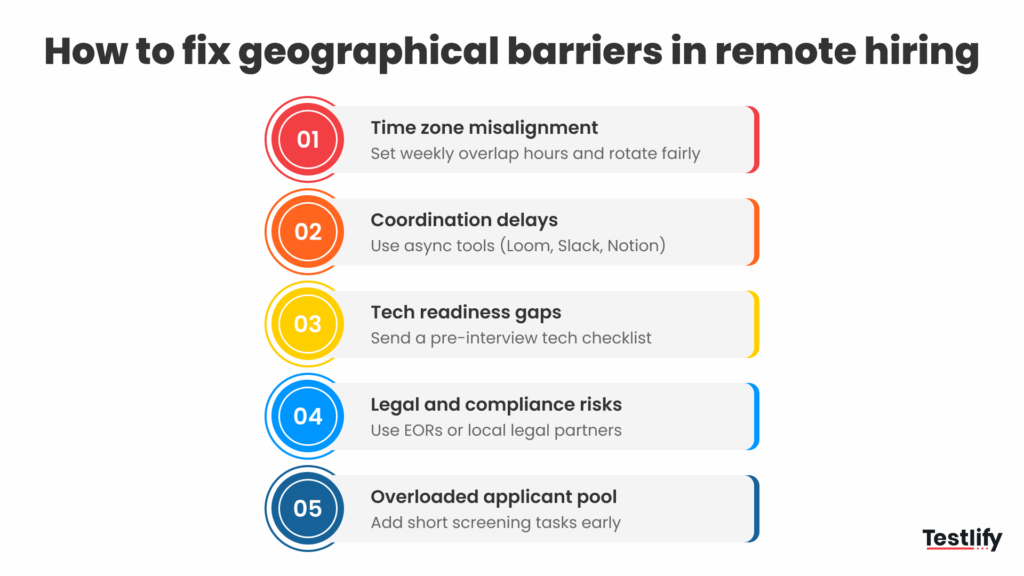
Address time zone misalignment
Time zone differences can make collaboration difficult when teams have limited overlapping working hours. Set a few shared hours for important meetings and rotate meeting times when teams operate across multiple regions.
Reduce coordination delays
Remote teams can lose momentum when every decision depends on someone being online. Use asynchronous tools such as Slack, Loom, and Notion to share updates, document decisions, and keep work moving across time zones.
Close tech readiness gaps
Technical issues can disrupt interviews and assessments before candidates get a fair opportunity to demonstrate their skills. Send a pre-interview technology checklist covering the required device, internet connection, browser, camera, microphone, and assessment setup.
Manage legal and compliance risks
Hiring across countries introduces different employment, tax, labor, and data protection requirements. Work with an Employer of Record (EOR) or trusted local legal partner to understand and manage the requirements in each location.
Prevent an overloaded applicant pool
Remote job postings can attract large volumes of applicants from different locations, making manual screening difficult. Use online assessments early in the process to identify qualified candidates before recruiters invest time in interviews.
Platforms like Testlify can help you test communication ability, task understanding, and job-specific strengths. This allows your team to focus only on the qualified candidates.
Practical fixes you can use right away
Barrier | What You Can Do | Why It Works |
|---|---|---|
Time zone clashes | Set weekly overlap hours. Rotate them fairly. | Keeps communication flowing without overloading one region. |
Delayed coordination | Use async tools: Loom, Slack, Notion. | Lets people respond on their own time without blocking progress. |
Unstable tech setups | Send a pre-interview tech checklist. Include internet speed, backup device, and platform access. | Prevents dropped calls or missed interviews due to preventable issues. |
Legal uncertainty | Use EOR (Employer of Record) or local legal partners. | Handles contracts, tax rules, and compliance without guesswork. |
Too many unqualified applicants | Add short async screening tasks in early stages. | Helps shortlist only relevant candidates without bias or manual overload. |
Cultural barriers in remote hiring
Cultural differences influence how people communicate and work. What seems like a straightforward comment in one culture might be perceived differently (even negatively) in another.
These differences can show up in communication styles, language, and norms. For example, a casual tone or a friendly gesture might be misinterpreted by someone from a different cultural background.
Language barriers can also lead to miscommunication; even when everyone speaks a common language, local phrases or accents can confuse. Tone and style also vary. In some cultures, directness is valued. In others, it’s seen as rude.
A hiring manager who expects blunt honesty might think a polite “yes” means full agreement, but it may actually mean “maybe, but I don’t want to offend.” That’s how good candidates get misjudged.
Then there’s body language. In some regions, avoiding eye contact shows respect. In others, it signals a lack of confidence. If you’re not aware of these differences, you might see disinterest where there’s actually trust or humility.
Examples of cultural barriers in remote hiring
Cultural Barrier | Example | Impact on Hiring |
|---|---|---|
Language Barriers | Misunderstood idioms or accents | Leads to confusion, missed expectations, or poor evaluation |
Communication Style Differences | A polite “yes” meant as a soft “no” | Causes misalignment, overestimation of agreement |
Body Language & Cues | Avoiding eye contact read as disinterest | Wrongly judged as lacking confidence or engagement |
Cultural Fit Assumptions | Candidate appears too formal or casual | Misread as not aligning with team norms |
Norms Around Authority & Feedback | Hesitant to speak up or push back | Seen as passive or lacking initiative |
Strategies to overcome cultural barriers
Hiring globally means you’re interpreting candidates through a cultural lens. That’s where things often go wrong.
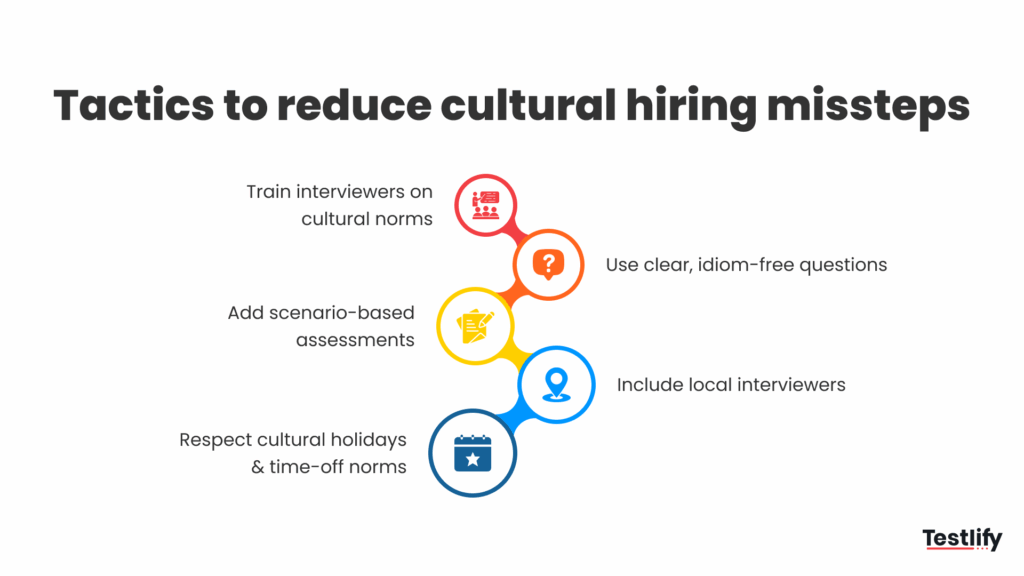
Cultural sensitivity training for hiring teams
Ensure your recruiters and hiring managers are equipped to work with candidates from diverse cultures.
Host cultural sensitivity workshops to educate your team on communication styles, business etiquette, and social norms across various cultures. This training builds awareness and empathy.
For example, understanding that candidates from some cultures may be less forthcoming about their achievements (out of modesty) helps an interviewer not misjudge their confidence.
Use simple, clear interview questions. Avoid idioms.
It’s easy to forget that everyday phrases aren’t always global. If your question includes things like “hit the ground running” or “wear many hats,” you’re creating confusion.
Replace them with simple, literal alternatives that are easy to understand regardless of someone’s background. Keep your questions direct and grounded in real tasks, not abstract phrasing.
Add scenario-based questions to assess soft skills
Live interviews can introduce bias. Online assessments help level the playing field. You give the same prompt to all candidates and review their responses on your own time.
Scenario-based questions are especially useful here. Ask things like, “How would you handle a deadline shift with a remote client?” It lets candidates show how they communicate, adapt, and collaborate.
Platforms like Testlify offer structured soft skill assessments that reduce subjectivity.
Include local team members in interviews for perspective
If you’re hiring in a new region, include someone from that culture in the hiring process. They’ll pick up on tone, formality, or nuances that may not be obvious to the core team.
It will help you determine whether a candidate’s communication style reflects cultural norms or actual concerns about fit. That insight leads to better hiring calls and fewer false negatives.
Adapt to local customs and holidays
Show cultural respect by acknowledging a candidate’s local customs, holidays, and working norms. For example, if you’re hiring someone in the Middle East, be aware of Ramadan timings; if your candidate is in Japan, understand the importance of Golden Week holidays.
Adjust interview schedules or start dates when they conflict with important cultural events. This will help you demonstrate empathy.
Also, be conscious of differing work practices (some cultures value a bit of small talk before business, others get straight to the point). Adapting your approach to honor these customs will make candidates feel valued and comfortable.
Build a diverse & inclusive hiring process
Make diversity and inclusion a cornerstone of your remote hiring. Some companies also appoint “cultural ambassadors” or mentors (existing employees from a similar background to the new hire) to help new remote hires acclimate and have someone to relate to.
Recommended reading: How to design a fair and inclusive hiring process?
How to build a global hiring process
Remote hiring only works when you have a proper structure for it.
- Start by creating your own global hiring playbook: This includes how to write inclusive job descriptions, what to screen for beyond skills (like work environment fit), and how to spot red flags without bias.
- Try to standardize onboarding: Create a checklist that works across roles and locations. This can include a tech setup guide, first-week schedules, company values, and shadowing sessions with peers.
- Make assessments part of the process early: scenario-based assessments help you compare candidates fairly across time zones without rushing live interviews.
- Create space for async collaboration: Use written tasks, shared docs, or recorded responses to keep momentum without forcing everyone into the same schedule.
- Build a culture that’s flexible but aligned: That means clear communication norms, shared values, and room for local customs.
- Lastly, check in often: Weekly one-on-ones and monthly team calls can go a long way. Not to micromanage, but to surface blockers and share wins.
Conclusion
Remote hiring becomes much easier when the process is designed around the realities of a distributed workforce. Clear communication, flexible scheduling, reliable infrastructure, compliant hiring practices, and structured screening can remove much of the friction that comes with hiring across locations.
The goal is not to eliminate every geographical challenge. It is to build a hiring process that keeps those challenges from affecting candidate quality or slowing down your recruiters.
Ready to simplify remote hiring and assess candidates based on the skills that matter? Book a demo with Testlify to see how you can streamline candidate screening and make more confident hiring decisions.
Frequently asked questions (FAQs)

People and Talent Partner
Arushi Shah runs day-to-day talent acquisition and candidate experience at Testlify. She writes on interviewing, structured hiring, and giving candidates a fair, fast process.
LinkedInRelated resources
View all
Remote hiring
5 practical ways to evaluate job candidates remotely

Remote hiring
The role of communication in remote job interviews

Remote hiring
Best practices for remote employee management

Remote hiring
How to improve employee experience in a remote workplace?

Remote hiring
How to manage a remote team?

Remote hiring
Remote work and talent acquisition: Adapting to the new normal
Get started.
Hire on proof, not resumes.
Run your first skills-based assessment free — no credit card required.