
How to lead cross cultural change across a global workforce
A practical guide to leading cross cultural change: the common traps, the skills that close them, and how to track progress.

A change initiative that works in one country can face resistance in another, even when the business goals are the same. Different cultural values, communication styles, workplace expectations, and attitudes toward leadership can shape how employees respond to change.
Leading cross-cultural change across a global workforce requires more than rolling out a uniform strategy. It means understanding local perspectives, adapting communication, and building trust across cultural boundaries.
When leaders balance global business objectives with local cultural realities, they can turn resistance into engagement and create lasting change across the organisation.
TL;DR:
- HBR's 2025 research on leading global teams found that 70% of the world's workforce works in collectivist, hierarchical cultures, which clashes with the autonomy-and-egalitarianism style most Western leadership training teaches.
- Cross cultural change fails most often at the communication layer: unclear feedback, assumed context, and one-size-fits-all messaging, not the plan itself.
- Lead with structure, not style: agree on explicit norms (how feedback is given, how decisions get made) instead of assuming everyone shares the same unwritten rules.
- Train specific skills: active listening, adapting pace and directness, and reading non-verbal cues, rather than a one-off "diversity" session.
- Global engagement is already fragile: Gallup's 2025 State of the Global Workplace put worldwide engagement at only 21%, so cultural friction on top of that is what actually derails change.
- Measure change by behavior (participation in new processes, retention across regions, time-to-adopt by team) not just a survey sent once at the end.
 ChatGPT
 Gemini
 Claude
 Grok
 Perplexity
What is cross cultural change?
Cross cultural change is the process of introducing a new way of working, a process, a merger, a leadership model, or a hybrid-work policy across a workforce made up of people from different cultural backgrounds. Managing this effectively requires organizations to adopt global recruitment strategies that account for regional differences, communication styles, and workforce expectations.
Communication is the mechanism that makes or breaks it. A change plan can be well designed and still stall if feedback is delivered in a style one region reads as rude and another reads as vague, or if "flexible deadlines" is heard as "optional" on one team and "firm, just not announced" on another.

Why does cross cultural change fail without deliberate communication?
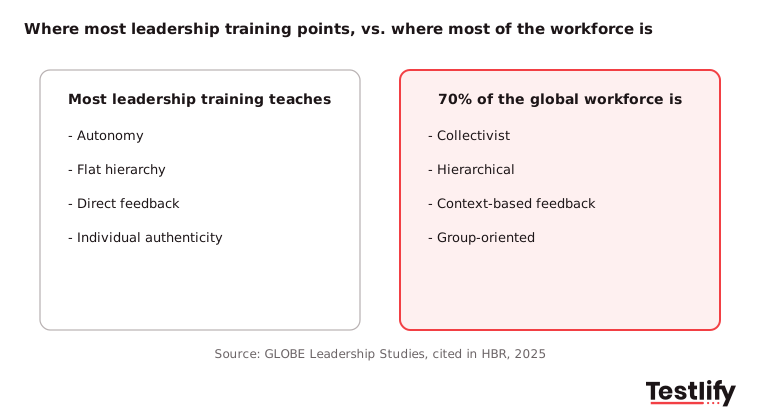
Most leadership training still assumes a western baseline: autonomy, flat hierarchy, direct feedback, and individual authenticity. However, leaders managing culturally diverse teams need adaptive leadership skills to adjust their approach, recognize different workplace expectations, and guide employees through organizational change.
HBR's research on leading global teams effectively reports that the GLOBE Leadership Studies found 70% of the world's workforce operates in collectivist, hierarchical cultures, where that style can read as uncomfortably blunt or as abandoning a team member instead of empowering them.
That mismatch shows up fastest during change, because change is exactly when people fall back on the unwritten rules they trust most. A manager who gives autonomy-first instructions to a team that expects structure and clear direction from leadership will often get silence, not resistance, which is easy to mistake for buy-in until adoption quietly fails weeks later.
Across the teams we have seen roll out a global change this way, the silence is almost always the first warning sign, not the absence of one.
The timing makes it worse. Engagement worldwide is already low: Gallup's State of the Global Workplace report found worldwide engagement at only 21%. A change effort layered on top of already-thin engagement has very little goodwill to draw on if the communication around it feels foreign or one-sided to half the teams it touches.
How do you lead cross cultural change, step by step?
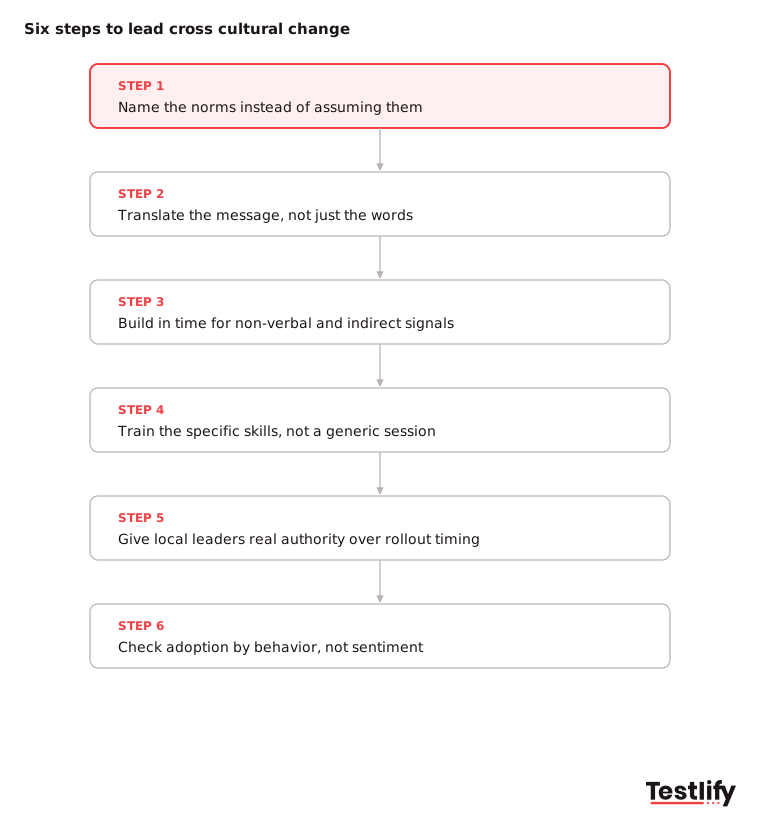
Name the norms instead of assuming them
Before rolling out the change, agree explicitly on how feedback will be given, how decisions get made (by a leader, by consensus, or by vote), and how disagreement gets raised. Do this with input from people in the regions affected, not just head office.
Translate the message, not just the words
Keep the core reason for the change constant, but let local leaders adapt the framing. A more hierarchical team may need clear direction from leadership, while a flatter team may need room to ask questions and shape the rollout.
The same principle applies to hiring, where language fairness in assessments helps ensure candidates are evaluated on their abilities rather than their language proficiency.
Build in time for non-verbal and indirect signals
Silence, a lack of questions, or polite agreement can mean genuine buy-in in one culture and quiet disagreement in another. Follow up one-on-one with team members who stay quiet in group settings before assuming the message landed.
Train the specific skills
Active listening, adjusting speaking pace and directness, and recognizing non-verbal cues are learnable skills. Organizations should also prioritize interpersonal skills when assessing candidates, as these abilities help employees collaborate, communicate effectively, and navigate differences in diverse workplaces.
Give local leaders real authority over rollout timing
A global deadline with no flexibility for regional context (holidays, local approval chains, language translation time) reads as disregard for the team, which undermines the change before it starts.
Check adoption by behavior, not sentiment
Track who is actually using the new process, not just who said yes in a meeting. The gap between the two is usually where the real resistance is hiding.
Pro tip: Run the first version of any global change with one team from each major cultural cluster in the pilot, not just the team that is easiest to reach. The gaps show up in the pilot, not the full rollout, if you choose it this way. In my work with global rollouts, the pilot almost always surfaces the one region where the framing needs to change before anyone else sees the plan.
What communication pitfalls slow down cross cultural change?
Pitfall | What it looks like | Fix |
|---|---|---|
Assuming silence means agreement | No questions in a group meeting after announcing the change | Follow up privately; ask specific, closed questions rather than "any concerns?" |
One global message, no local framing | Same slide deck and tone sent to every region unedited | Keep the reason constant, let local leaders adapt the framing and pace |
Treating feedback style as universal | Direct, public feedback used everywhere regardless of norms | Agree on feedback norms per team before the change starts, not during it |
Rigid timelines with no local flexibility | One global deadline, no room for approval chains or holidays | Build regional buffer time into the rollout plan from the start |
One-off training instead of practiced skill | A single cultural-awareness session before launch | Short, repeated practice on specific skills: listening, pacing, reading cues |
How do you build the skills that make cross cultural change stick?
Skills, not awareness, are what change behavior day to day:
- Active listening: Confirming understanding before responding, especially across a language gap, prevents a change from being quietly reinterpreted as it moves down the chain.
- Adjusting pace and directness: Slowing down, using plainer language, and checking in more often costs little and prevents the most common misreadings during a rollout.
- Reading non-verbal and indirect cues: Recognizing that a nod, a pause, or a "yes, understood" can carry different weight across cultures keeps a leader from mistaking politeness for agreement.
- Psychological safety across hierarchy levels: People in more hierarchical cultures may need an explicit invitation and a safe, private channel to raise concerns about the change, rather than an open floor in a group call. Creating this environment also requires organizations to address unconscious bias in recruitment.
Build these as hiring criteria too, not only as training for the team already in place. Testlify's situational judgment tests can screen for how a candidate handles ambiguous, cross-cultural scenarios before they join a global team, and assessments running in 15+ languages let every candidate, in every region, be evaluated in the language they think in.
Organizations can also use a cross-cultural communication test to evaluate how candidates communicate and navigate interactions across different cultural settings.
How do you know if cross cultural change is working?
Sentiment surveys taken right after a launch tend to be too generous; they capture politeness, not adoption. Track instead:
- Adoption rate by region or team: The share of people actually using the new process, not just the share who said they understood it.
- Time-to-adopt by team: How long each region takes to reach steady use. A wide gap between the fastest and slowest team usually points to a communication or framing problem specific to that team, not a lack of effort.
- Participation in the two-way channels you opened: If a private feedback channel or office hours go unused in one region, that is a signal the invitation did not land in a way that felt safe, not that there is nothing to say.
- Retention across regions after the change: A change that quietly drives attrition in one region while leaving others unaffected is a strong sign the communication, not the change itself, was the problem.
Ready to build cross-culturally fluent teams from the hiring stage?
Screen for the communication and adaptability skills that make cross cultural change land, in the language every candidate thinks in. Start a 7-day free trial of Testlify, no credit card required, and build an assessment around situational judgment and real-world cultural scenarios.
Frequently asked questions (FAQs)

People and Talent Partner
Arushi Shah runs day-to-day talent acquisition and candidate experience at Testlify. She writes on interviewing, structured hiring, and giving candidates a fair, fast process.
LinkedInRelated resources
View all
Workplace culture
How to create a learning and development plan (with template)

Workplace culture
Learning and development activities: 16 types with examples

Workplace culture
How to build a strong employer brand without a marketing agency?

Workplace culture
How to use workplace culture to improve employee engagement?

Workplace culture
The future of workplace culture: Everything you need to know
Workplace culture
Companies With Strong Workplace Cultures: 4 Case Studies
Get started.
Hire on proof, not resumes.
Run your first skills-based assessment free — no credit card required.