
Compensation and benefits: types, examples and strategy
What compensation and benefits cover, the main types with examples, current cost data, the laws to know and seven steps to build a program.

The offer is where a hiring process is won or lost. A candidate who has passed every interview can still walk away over one weak line in the package.
Compensation and benefits is everything an employer gives for work, from salary and bonuses to health cover and paid leave. In US private industry, wages make up 70% of hourly employer cost and benefits 30%, according to the Bureau of Labor Statistics.
Pay that feels unfair is also one of the main reasons good people leave. Read on for types, examples, cost data, key US laws and a seven-step plan for a package that wins offers and keeps people.
TL;DR:
- Compensation and benefits is the total package an employer gives for work: cash pay (compensation) plus non-cash rewards such as health cover, retirement and leave (benefits).
- Benefits are a large cost, not a perk: they were 30% of US private employers' compensation cost per hour in June 2026, or $14.07 of $46.89.
- Health benefits still matter most. In SHRM's 2026 survey, 88% of employers rated them very or extremely important, and paid parental leave rose to 46% of employers.
- Pay fairness drives retention: 31% of organizations told Payscale that unfair pay is the main reason they lose talent.
- Build the program in 7 steps: pay philosophy, job architecture, market data, pay ranges, benefits, compliance and communication, then review it every year.
- Track compa ratio, range penetration, offer acceptance rate and regretted turnover to see if the package works.
- Pay the skill, not the CV: assessed skills give a fairer basis for where a new hire sits in the pay range.
 ChatGPT
 Gemini
 Claude
 Grok
 Perplexity
What is compensation and benefits?
Compensation and benefits is the HR function that designs, prices and runs what employees receive for their work. Compensation is the cash part: base pay, overtime, bonuses, commissions and equity.
Benefits are the non-cash part: health insurance, retirement plans, paid time off and other perks. Together they make up total compensation.
In most companies, the compensation and benefits team (often called total rewards) owns four jobs:
- Pay structure: job levels, pay ranges and the rules for raises and promotions.
- Market data: checking pay and benefits against similar employers every year.
- Benefits administration: choosing plans and vendors, running enrollment and answering questions.
- Compliance and budget: keeping pay legal and fair, and keeping the program inside its budget.
A well-run program does three things at once. It helps you attract the people you want, keeps the people you have, and spends the payroll budget where it has the most effect.

What is the difference between compensation and benefits?
Compensation and benefits differ in form: compensation is money paid for work, while benefits are rewards in kind such as insurance, retirement contributions and leave. Compensation is also called direct pay and benefits indirect compensation.
Total compensation adds the two together, and total rewards adds non-cash extras like flexibility and learning.
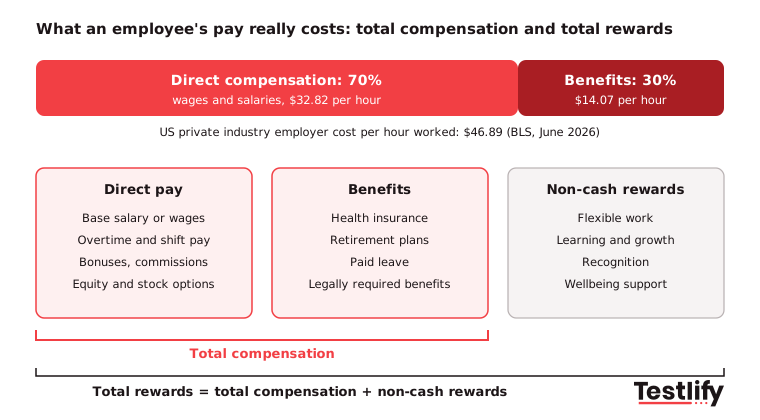
The cost split matters when you build an offer. The BLS Employer Costs for Employee Compensation release for June 2026 put private industry costs at $46.89 per hour worked: $32.82 in wages and salaries and $14.07 in benefits. A candidate who only compares base salaries sees about two thirds of what you actually spend on them, so show the full value in the offer.
The broader idea is total rewards: total compensation plus non-cash rewards such as flexible work, career growth and recognition.
What are the types of compensation?
Compensation comes in six main types: base pay, overtime and premium pay, variable pay, sales pay, equity and deferred pay. Base pay is fixed.
The other five reward extra hours, results or long-term commitment, and the mix you choose signals what the company values.
Type | What it is | What it rewards |
|---|---|---|
Base pay | Annual salary or hourly wage | The job and the level it sits at |
Overtime and premium pay | Extra pay for hours past 40 a week, night shifts, weekends | Time and inconvenience |
Variable pay | Bonuses, profit sharing, spot awards | Company, team or individual results |
Sales pay | Commission, quota bonuses | Revenue closed |
Equity | Stock options, restricted stock units | Long-term company growth |
Deferred pay | Pay held back to a later date, retention bonuses | Staying with the company |
Overtime is the one type the law sets for you in the US. Under the Fair Labor Standards Act, covered nonexempt employees earn at least 1.5 times their regular rate for every hour over 40 in a workweek, and the federal minimum wage is $7.25 an hour (where state and federal minimums differ, the higher one applies).
The right mix depends on the business: a start-up short on cash often leans on equity to attract people willing to take a risk. A mature enterprise tends to offer higher base pay, a bonus plan and fuller benefits.
Sales roles carry the most variable pay, with a large share of earnings tied to commission. For a deeper breakdown, see the different types of compensation and benefits.
What are the types of employee benefits?
Employee benefits fall into two groups: legally required benefits that every employer must provide, and voluntary benefits that employers choose to offer to compete for people. In the US, required benefits include Social Security and Medicare contributions, unemployment insurance and workers' compensation.
Everything else is a choice.
The voluntary benefits most employers offer:
- Health and wellbeing: medical, dental and vision cover, mental health support and wellness programs.
- Retirement: a 401(k) or pension plan, often with an employer match.
- Paid time off and leave: vacation, sick days, holidays, parental and family leave.
- Flexibility: remote or hybrid work, flexible hours, compressed weeks.
- Growth: training budgets, tuition support, coaching and mentoring.
- Financial and life support: life and disability insurance, commuter help, childcare support, student loan help.
The SHRM 2026 Employee Benefits Survey (5,472 HR responses) shows where employers are putting money now:
- 88% rate health benefits very or extremely important, and 82% say the same of retirement and of leave.
- Paid parental leave rose 7 points to 46% of employers, and paid family leave rose 5 points to 36%.
- Employer-paid subscriptions to AI tools jumped 17 points to 33%.
- Leadership and managerial coaching rose 8 points to 55%.
- Flextime during core hours fell 6 points and hybrid work fell 3 points, while 27% offer limited-time work-from-anywhere.
SHRM's 2025 survey also found 93% of employers offer a traditional 401(k), while wellness programs with resources fell to 39%, from 53% in 2021. For more on how to choose plans, see how to create a compensation and benefits package.
What are some compensation and benefits examples?
Compensation and benefits examples show how the same building blocks add up differently by role. A recruiter, a software engineer, a contact center agent and a sales executive can all work at one company and still get very different mixes of base pay, variable pay and benefits.
The figures below are illustrative, not market data.
Role | Compensation | Benefits |
|---|---|---|
Talent acquisition partner (salaried, enterprise) | Base salary in the role's pay range, annual bonus tied to hiring goals | Health cover, 401(k) with match, 20 days paid leave, hybrid work, learning budget |
Software engineer (SaaS scale-up) | Base salary, stock options or RSUs vesting over 4 years | Health cover, remote work, home office stipend, conference budget |
Contact center agent (BPO, hourly) | Hourly wage, overtime at 1.5x past 40 hours, shift premium for nights | Health cover after a waiting period, paid sick leave, attendance bonus, clear promotion path |
Account executive (sales) | Base plus commission on closed revenue, quota bonus | Health cover, car or travel allowance, phone and laptop, sales incentive trip |
Pro tip: Write the offer letter as total compensation, not just base salary. Show the value of the health plan, the retirement match and the leave in money terms, so candidates compare your full package with a competitor's salary figure.
Why are compensation and benefits important?
Compensation and benefits are important because they decide whether people join, how hard they work and whether they stay. A competitive package helps you win candidates, fair pay keeps them, and well-chosen benefits protect their health and finances so they can focus on the job.
Pay is also usually a company's largest operating cost.
- Attracting talent: Candidates compare offers line by line. Pay below market loses people at the offer stage after weeks of hiring work.
- Retention: In Payscale's 2025 Compensation Best Practices Report, 31% of organizations said unfair pay was the main reason they lost talent. Replacing a regretted leaver means paying to recruit, onboard and train all over again.
- Motivation and performance: Merit raises and bonuses tie effort to reward. When people see that link, they are more willing to push for results.
- Wellbeing and engagement: Health cover, leave and flexibility reduce money and health worries, which supports job satisfaction and morale.
- Fairness and trust: A clear, consistent pay structure reduces pay gaps and the sense that pay depends on who negotiated hardest.
- Cost control: A planned structure stops ad hoc counteroffers and keeps raises inside the budget.
Compensation remains the hardest part of HR to get right. Payscale's 2025 report found compensation was the most challenging HR activity for 44% of organizations, ahead of recruiting and retention.
Budgets are tight too: Payscale's 2026-2027 Salary Budget Survey found average base pay increases of 3.4% in 2026, with 3.5% projected for 2027.
How do you build a compensation and benefits strategy?
A compensation and benefits strategy is built in seven steps: set a pay philosophy, build a job architecture, benchmark the market, set pay ranges, design benefits, check compliance and communicate the plan. Then review it every year.
The steps work the same for a first program or a rebuild after growth or a merger.
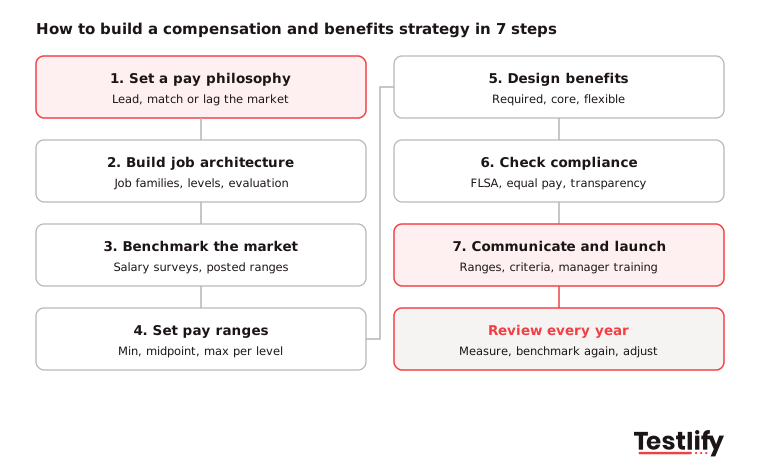
Work through the seven steps in order, because each one feeds the next. Here is what to decide at each stage:
- Set a pay philosophy: Decide whether you will lead, match or lag the market, and for which roles. Many companies pay above market only for hard-to-fill or business-critical roles.
- Build a job architecture: Group roles into job families and levels, and use job evaluation to rank them on skills, responsibility and impact.
- Benchmark the market: Compare each role with similar employers by industry, size and location. Payscale found organizations rely most on free online data and traditional salary surveys (52% each). Use more than one source.
- Set pay ranges: Give every level a minimum, midpoint and maximum. Align the midpoint with your chosen market position and leave room to grow inside the range.
- Design benefits: Cover legal requirements first, then choose core benefits for everyone and flexible options people can pick. Ask employees what they value before you spend.
- Check compliance: Test the structure against wage and hour rules, equal pay law and pay transparency rules in every location you hire.
- Communicate and launch: Explain the philosophy, the ranges and how raises are decided, and train managers to answer pay questions.
Only 61% of organizations have a formal compensation strategy, according to Payscale. Writing one down puts you ahead of many competitors for talent.
To keep costs under control as you grow, see how to manage compensation and benefits costs.
How do you tailor compensation and benefits to different employees?
Tailoring compensation and benefits means keeping one fair pay structure while letting different groups choose the rewards that matter to them. A new graduate, a parent of young children and a senior leader near retirement value very different things, and a single fixed package wastes money on benefits people do not use.
- By career stage: Early-career staff often value training, student loan help and clear promotion paths. Mid-career staff tend to value family health cover, childcare and flexibility. Senior leaders often focus on retirement plans, equity and executive benefits.
- By work arrangement: Remote staff may value a home office stipend over a commuter benefit. Part-time and hourly staff need clear eligibility rules for benefits. See compensation and benefits for remote teams.
- By location: Pay ranges usually vary by city or country. Use location bands rather than one-off deals.
- By choice: A flexible benefits plan gives each employee a budget or credits to spend on the options they want.
Ask before you design. Short surveys and regular feedback sessions show which benefits people use and which they would trade away.
Keep the menu simple: too many options confuse people and raise admin costs.
What laws apply to compensation and benefits?
Compensation and benefits in the US are shaped mainly by wage and hour law, equal pay law, benefits law and a growing set of state pay transparency laws. Other countries have their own minimum wage, leave and equal pay rules, so check each location where you employ people.
Law or rule | What it requires |
|---|---|
Fair Labor Standards Act (FLSA) | Federal minimum wage of $7.25 an hour, overtime at 1.5x past 40 hours for nonexempt staff, pay records |
Equal Pay Act | Equal pay for men and women doing substantially equal work in the same workplace |
Title VII, ADEA and ADA | No pay discrimination by race, color, religion, sex, national origin, age or disability |
ERISA and the Affordable Care Act | Rules for retirement and health plans; large employers must offer affordable health cover or pay a penalty |
State and city pay transparency laws | Pay ranges in job ads or on request in a growing number of states and cities |
The EEOC's equal pay guidance makes clear that equal pay covers all forms of pay, not just salary: overtime, bonuses, stock options, profit sharing, life insurance, vacation and holiday pay, allowances and benefits. Job content, not job title, decides whether two jobs are equal.
Run a pay equity audit at least once a year to catch gaps before they become claims. Our guides on staying compliant with compensation and benefits laws and the gender pay gap go deeper.
How should you communicate pay and benefits?
Communicating pay and benefits well means explaining how pay is set, sharing ranges, and keeping the conversation two-way. Employees who understand why they earn what they earn are more likely to trust the result, even when it is not the number they hoped for.
- Share the philosophy: Explain your market position and what drives raises and bonuses.
- Share ranges: Payscale found 56% of organizations post pay ranges in job ads, and pay transparency laws are pushing that number up. Read more on pay transparency.
- Explain changes: When pay structures or benefits change, say what changes, when and why, before it hits payslips.
- Train managers: Managers get most pay questions. Give them the ranges, the criteria and a short script.
- Show total value: Send a yearly total compensation statement that puts a money value on benefits.
- Listen: Use surveys, one-to-ones and performance reviews to collect concerns about pay and benefits, and act on what you hear.
For a step-by-step plan, see how to communicate compensation and benefits to your employees.
How do you measure compensation and benefits?
Compensation and benefits are measured with a small set of pay metrics and people metrics. Pay metrics show whether people are paid fairly within their ranges.
People metrics show whether the package helps you hire and keep the people you want. Review both at least once a year, and after any major market change.
Metric | How to calculate it | What it tells you |
|---|---|---|
Employee salary / range midpoint | Below 0.9 or above 1.1 is worth a closer look | |
Range penetration | (Salary - range min) / (range max - range min) | How far through the range each person sits |
Offer acceptance rate | Offers accepted / offers made | Whether the package wins candidates |
Regretted turnover | Regretted leavers / average headcount | Whether pay and benefits keep your best people |
Benefits participation | Employees enrolled / employees eligible | Which benefits people value |
Benefits cost per employee | Total benefits spend / headcount | Whether costs stay inside budget |
Pay equity gap | Pay difference between groups doing equal work | Legal and fairness risk |
Testlify's free compa ratio calculator and job offer acceptance rate calculator help you run two of these quickly. Benefits programs can be checked the same way: track healthcare use, absence and engagement survey scores before and after a change.
What technology supports compensation management?
Compensation management software, an HRIS and benefits administration platforms support the work. They keep pay data in one place, calculate bonuses and raises, run benefits enrollment and show pay gaps.
About 30% of organizations use purpose-built compensation technology, up 5 points in a year, according to Payscale.
- Fewer errors: Automated bonus and raise calculations replace spreadsheets that break.
- Better data: Market data, salary ranges and performance data sit side by side, so decisions rest on facts.
- Self-service: Employees can see their pay, benefits and total compensation statements without asking HR.
- Security: Pay data is sensitive. Look for access controls, encryption and an audit trail.
Payscale also found 48% of organizations see AI as useful for monitoring pay equity. Whatever tool you use, keep a person accountable for every pay decision.
How do compensation and benefits connect to hiring?
Compensation and benefits connect to hiring at the offer: a fair, competitive package turns a chosen candidate into a hire, and a clear pay range speeds up the decision. The harder question is where a new hire should sit in the range, and that is where evidence of skill helps.
Many companies still place new hires in a range by years of experience or the salary they last earned. Both carry old pay gaps forward.
Skill-based pay sets pay by the skills a person shows, which is fairer and easier to defend.
Skills assessments give you that evidence before the offer. Testlify's library of 3,500+ tests covers technical and non-technical roles, and each candidate report breaks results down by skill, so the hiring team can compare candidates on the same scale and place an offer within the range with a reason behind it.
Read more on skills-based hiring.
Key takeaway: Pay the skill, not the CV. Base pay ranges on job level and market data, then use assessed skill to decide where in the range each new hire starts.
What does a compensation and benefits manager do?
A compensation and benefits manager plans, builds and runs an organization's pay and benefits programs. The role sets pay structures, tracks market wage rates, manages benefits vendors, keeps programs compliant with federal and state law and runs the budget for both.
Larger companies split the work between compensation analysts and benefits specialists.
According to the BLS Occupational Outlook Handbook, compensation and benefits managers earned a median of $149,230 a year in May 2025, and there were 23,700 such jobs in 2025. Employment is projected to grow 1% from 2025 to 2035.
Hiring for the role? Start with the compensation and benefits specialist job description, then screen candidates with the HR manager test or the benefits administrator test.
Ready to hire the right people for your pay ranges?
A strong compensation and benefits program works best when you know each candidate can do the job. Book a demo to see how Testlify skills tests give you skill-by-skill results before you make an offer.
Prefer to try it yourself? Start a 7-day free trial, no credit card required, or browse the Testlify test library to find a test for your next role.
Frequently asked questions (FAQs)

Human Resources Lead
Snehi Parmar leads People at Testlify, owning hiring, culture, performance, and retention for a 90-person team. She writes on practical HR strategy and building people processes that scale.
Related resources
View all
HR & recruitment
8 Workforce Planning Case Studies & Real Examples from FAANG

HR & recruitment
How will workforce planning shape the future of work?

HR & recruitment
Succession planning: a quick guide for startups

HR & recruitment
How to inform compensation and benefits to your employees?

HR & recruitment
A guide to workforce planning for remote teams

HR & recruitment
Workforce planning for startups: a 2026 guide
Get started.
Hire on proof, not resumes.
Run your first skills-based assessment free — no credit card required.