
10 ideas to promote work-life balance in the workplace
Ten employer ideas for work-life balance, from flexible hours and meeting limits to fixing workload, with a 90-day plan to roll them out.
Work-life balance is the state where the demands of a job leave people enough time and energy for health, family and life outside work. For employers, promoting it means changing how work is planned, staffed and led, so that balance does not depend on each person fighting their inbox alone.
TL;DR:
- Work-life balance improves when employers address workload, working hours and management practices, rather than relying on perks alone.
- Offer flexible schedules, set expectations for after-hours messages, reduce unnecessary meetings and encourage employees to take real time off.
- Train managers to spot overload, support caregivers and address staffing gaps before they lead to burnout.
- Roll out changes through a 90-day pilot: gather employee feedback, test a few ideas and measure the results before scaling.
- Track overtime, after-hours activity, unused leave, employee feedback and attrition to identify where balance is breaking down.
- Follow applicable working-time, leave and right-to-disconnect laws, while setting clear internal boundaries that support employees.
- Hiring teams can reduce evening work by filling vacancies faster and using asynchronous skills assessments and AI interviews to screen candidates during working hours.
 ChatGPT
 Gemini
 Claude
 Grok
 Perplexity
What is work-life balance?
Work-life balance is how well the time and energy a job takes fits with the rest of a person's life. Good balance means people can do their work well, switch off at the end of the day, rest, and handle family or health needs without constant conflict between the two.
Balance does not mean an even split of hours every day. Some weeks are heavier than others. What matters is that heavy periods are the exception, that people can predict their hours, and that time off is real time off. Many teams now talk about work-life integration instead, where flexible hours let people fit work around life rather than keep the two strictly apart.
For a short definition and related terms, see the work-life balance glossary entry.

Why does work-life balance matter for employers?
Work-life balance matters for employers because overloaded people disengage, burn out and leave, and their work suffers long before they resign. Balance is a business issue: it shapes engagement, retention, error rates and how attractive the company looks to the candidates it wants to hire.
The data shows how stretched many workplaces are:
- Engagement is low: Gallup's State of the Global Workplace 2026 puts global employee engagement at 20% in 2025, down from 23% in 2022. Manager engagement fell to 22%, from 31% in 2022.
- The workday has no edges: The Microsoft Work Trend Index 2025 found that 29% of active workers are back in their inbox by 10 pm, and meetings that start after 8 pm rose 16% in a year.
- Flexibility helps: Gallup's hybrid work indicator reports that hybrid workers have better work-life balance and less burnout than fully on-site peers, and 54% of hybrid workers are thriving compared with 49% of on-site workers in remote-capable jobs.
Low manager engagement is the number to watch. Managers set the pace of the team, so a stretched manager usually means a stretched team.
What are the best ideas to promote work-life balance?
The best ideas to promote work-life balance change how work is organized rather than adding perks: flexible hours with clear rules, limits on after-hours messages, fewer meetings, protected time off, trained managers, realistic workload and support for caregivers. Start by asking employees what is out of balance, then measure whether each change works.
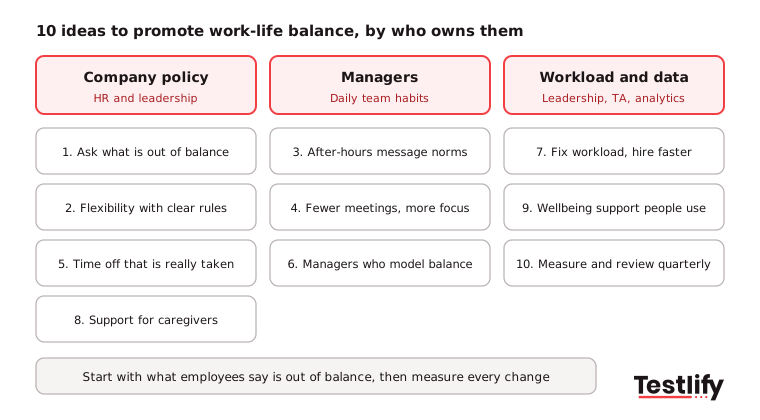
Idea | What it looks like | Who owns it | Effort |
|---|---|---|---|
1. Ask what is out of balance | Short pulse survey and team conversations | HR | Low |
2. Flexibility with clear rules | Core hours, hybrid days, flexible start and end times | HR and leadership | Medium |
3. After-hours message norms | No-reply expectation after hours, scheduled send | Leadership and managers | Low |
4. Fewer meetings, more focus time | Meeting-free blocks, shorter default meetings | Managers | Low |
5. Time off that is really taken | Minimum time off, cover plans, no check-ins | HR and managers | Medium |
6. Managers who model balance | Training, visible boundaries, workload check-ins | HR and leadership | Medium |
7. Realistic workload and staffing | Fill vacancies fast, cut low-value work | Leadership and TA | High |
8. Support for caregivers | Leave above the minimum, flexible schedules | HR | Medium |
9. Wellbeing support people use | Mental health resources, EAP, rest days | HR | Medium |
10. Measure and review | Quarterly balance score, overtime and leave data | HR and people analytics | Low |
1. Ask employees what is out of balance
Ask before you build. A short pulse survey with three or four questions shows where the pressure comes from: long hours, late messages, unpredictable schedules, caregiving, or a commute. Different teams usually have different problems. A support team on shifts needs predictable rosters, while a product team may need fewer meetings. Share the results and say which two or three issues you will act on first.
2. Offer flexibility with clear rules
Flexible work is the most requested support, and SHRM's 2025 Employee Benefits Survey found that 68% of organizations still prioritize flexible work benefits. Flexibility works best with rules everyone understands: core collaboration hours, clear hybrid days, and flexible start and finish times around them. For roles that cannot be remote, offer shift swaps, compressed weeks or predictable rosters. See the guide to flexible work arrangements for the main options.
3. Set team norms for after-hours messages
Write down what "after hours" means for each team and what still counts as urgent. Make it normal to reply the next working day, encourage scheduled send for late emails and messages, and keep a single on-call route for real emergencies. Norms only hold when senior leaders follow them, so the first late-night email from a director undoes more than any policy document.
Pro tip: Turn on scheduled send by default for leaders in your email and chat tools. Leaders can still write at 11 pm, but the message lands at 9 am, and nobody feels pressure to answer at night.
4. Cut meetings and protect focus time
Meetings and messages fragment the day, and fragmented days spill into evenings. The Microsoft Work Trend Index found that the most active workers are interrupted about every 2 minutes by a meeting, email or notification, and 57% of meetings are ad hoc calls with no calendar invite. Set meeting-free blocks, make 25 or 50 minutes the default length, and ask whether each recurring meeting still needs to exist.
5. Make taking time off normal
Annual leave only helps if people take it. Set a minimum number of days off per year, plan cover before someone leaves so work does not pile up, and agree that nobody checks in during leave. Managers should look at leave balances each quarter and nudge anyone who has not taken a break. Treat time off as part of the plan, not a reward people earn after the work is finished.
6. Train managers to model and protect balance
Managers decide how much work lands on each person and when it is due, so they matter more than any policy. Train them to spot overload early, to have workload check-ins in one-to-ones, and to model the behavior they ask for: leaving on time, taking full holidays and not messaging late. With manager engagement at 22% in Gallup's 2026 report, managers often need support with their own balance first.
7. Fix workload and staffing gaps
Most balance problems are workload problems. When a role stays open for months, the rest of the team covers it with longer hours, and the best people burn out first. In recruiting teams we have seen the same pattern: every slow hire turns into overtime for someone else. Fill critical vacancies quickly, stop low-value work before adding new projects, and check that headcount plans match what the team is asked to deliver.
8. Support caregivers and life events
Parents, carers and people going through illness or bereavement feel imbalance hardest. Offer leave above the legal minimum where you can, flexible or part-time return-to-work options, and short-notice time off for family emergencies. SHRM's 2025 survey found that 10% of employers now offer paid prenatal leave beyond what the law requires, a sign that leave is one of the benefits employers are still adding.
9. Offer wellbeing support people actually use
Wellbeing programs only help when people know about them and have time to use them. SHRM found that 39% of employers offered wellness programs with resources in 2025, down from 53% in 2021, so many employees have less support than before. Focus on what helps with balance: mental health support, an employee assistance program, and recovery time after busy periods. Link to resources on burnout so managers know the warning signs.
10. Measure balance and review it every quarter
Measure balance so you know whether the ideas work. Combine a short quarterly survey question ("I can switch off from work at the end of the day") with hard data: overtime, after-hours messages, unused leave and attrition by team. Review the numbers with each leader and agree one change per quarter. The guide on how to measure work-life balance covers survey questions and metrics in detail.
How do you roll out a work-life balance program?
A work-life balance program rolls out best as a 90-day pilot: ask employees what is out of balance, pick two or three changes, pilot them with a few teams, measure the results, then scale what works. Small pilots show what fits your business before you change company-wide policy.
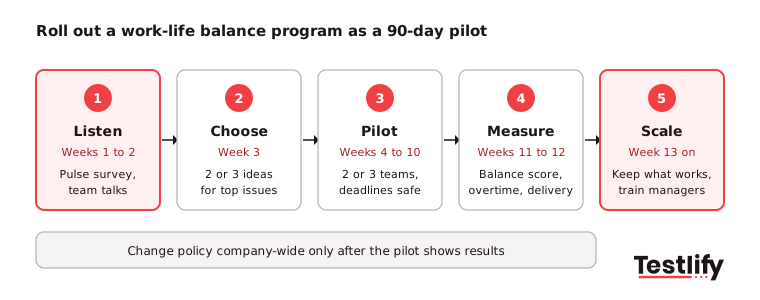
- Listen (weeks 1 to 2): Run the pulse survey and a few team conversations. Pick the two or three problems that come up most.
- Choose (week 3): Match each problem to one idea from the list above, such as after-hours norms for late messages or meeting-free blocks for fragmented days.
- Pilot (weeks 4 to 10): Try the changes with two or three teams. Agree how you will keep service levels and deadlines safe while you test.
- Measure (weeks 11 to 12): Compare the balance score, overtime, after-hours activity and delivery against the start of the pilot.
- Scale (week 13 on): Roll out what worked, drop what did not, and write the new norms into team agreements and manager training.
For the culture side of the change, read how to create a culture of work-life balance.
What laws affect work-life balance in 2026?
Work-life balance laws mainly cover working time, leave and, more and more, the right to disconnect from work messages after hours. Employers with staff in several countries should check each country's rules, because limits on working hours, overtime pay and after-hours contact differ widely.
- Right to disconnect: Several countries now give employees a right to disconnect. France introduced one in 2017, and Australia gave most employees the right to refuse unreasonable after-hours contact in 2024, with small businesses covered from 2025.
- European Union: In July 2025 the European Commission opened second-stage talks with social partners on an EU-level right to disconnect and fair telework. The Commission notes that 20.3% of Europeans worked from home at least part of the time in 2024.
- Working time and leave: Most countries set limits on weekly hours, rest breaks and minimum paid leave. These are the floor, not the goal.
Treat a right-to-disconnect law as a minimum. Team norms on after-hours messages (idea 3) usually go further and work in every country.
What mistakes undermine work-life balance programs?
Work-life balance programs usually fail for one of five reasons: perks replace workload fixes, leaders break their own rules, time off has no floor, flexibility depends on the manager, or nobody measures the result. Each mistake teaches employees that the program is for show.
- Perks instead of workload: Yoga classes and snacks do not help someone covering two jobs.
- Leaders who break the rules: A director who emails at midnight sets the real norm, whatever the policy says.
- Unlimited leave with no minimum: Without a floor, people often take less time off, not more.
- Flexibility by manager luck: If each manager decides, employees in the same role get very different deals.
- No measurement: Without data, a program cannot show it works and is the first thing cut in a budget review.
Key takeaway: Work-life balance improves when employers change workload, norms and staffing, not when they add perks. Pick a few changes, make leaders follow them, and measure the result every quarter.
How can employees protect their own work-life balance?
Employees can protect their own work-life balance by setting clear working hours, planning their top priorities each day, turning off non-essential notifications, taking real breaks and fully unplugging on holiday. Personal habits help most when the employer's norms support them.
- Set clear boundaries: Agree your working hours with your manager and team, and keep work apps off your phone after hours where you can.
- Prioritize tasks: List the two or three tasks that matter most each morning so less important work does not spill into the evening.
- Use technology on purpose: Check email at set times instead of all day, and silence notifications that are not urgent.
- Take short breaks: A walk or a few minutes away from the screen helps you focus for the rest of the day.
- Delegate and share the load: Hand off work that others can do, at work and at home.
- Unplug on holiday: Tell colleagues in advance, set an out-of-office reply, and do not check in.
For more personal tips, see the guide on how to improve work-life balance.
How can hiring teams protect work-life balance?
Hiring teams protect work-life balance in two ways: they fill open roles quickly so teams are not stretched, and they keep their own recruiters from working evenings to fit interviews around candidates. Slow hiring is a balance problem for the hiring manager's team and for the recruiter.
Recruiters often schedule interviews across time zones and late into the evening. Asynchronous steps help. With Testlify, candidates complete skills tests and Video AI, Voice AI or Chat AI interviews when it suits them, and every answer is scored automatically, so recruiters review results during working hours instead of sitting on late calls. Testlify's library has 3,500+ tests for tech and non-tech roles, including a time management test.
Read more about recruiter burnout and how AI interviews work.
Frequently asked questions (FAQs)

Related resources
View all
Workplace culture
How to use workplace culture to improve employee productivity

Workplace culture
19 ideas for creating a healthier workplace
Workplace culture
Effective teamwork: what it looks like and how HR builds it

Workplace culture
What is an upskilling strategy? A practical guide for HR teams

Workplace culture
Employee engagement metrics: 12 to track and how to measure them
Workplace culture
How to identify flight risk employees: signs, steps and a risk matrix
Get started.
Hire on proof, not resumes.
Run your first skills-based assessment free — no credit card required.