
How to hire top talent using sales tests: a step-by-step guide
A practical way to hire sales reps on proof: pick the right sales test per role, add a role play, score on a rubric and decide on evidence.

A sales candidate who interviews brilliantly can still miss quota in the first quarter. You often find out only after the salary and ramp time are spent.
Interviews reward polish, and every salesperson has practiced polish. A sales test checks the skills the job needs, such as prospecting, discovery and objection handling, before you spend interview time.
To hire top talent using sales tests, define what a great rep does, then test every applicant on those skills before the first interview. Use the scores to decide who moves forward, and let a role play and interview confirm the result.
TL;DR:
- Hire top sales talent by testing the skills the role needs (prospecting, discovery, objection handling, pipeline judgment) before you interview, not after.
- Match the test to the role: SDRs need prospecting and resilience, AEs need discovery and closing, managers need coaching and forecasting.
- Use 3 signals for every finalist: a role-based sales test, a short role play and a structured interview, each scored on a written rubric.
- Weight the signals before anyone applies, for example 40% test, 30% role play and 30% interview for an account executive.
- Set the cut-off from your current top performers, not from a guess, and review it after every hiring cohort.
- Keep it fair: same test for everyone in the role, job-related questions, proctoring and accommodations on request.
- Never hire on a test score alone. The score decides who you spend interview time on.
 ChatGPT
 Gemini
 Claude
 Grok
 Perplexity
What does it mean to hire top talent using sales tests?
Hiring top talent using sales tests means screening sales candidates on what they can do instead of what their resume or interview says they can do. A sales test is a timed, scored assessment of selling skills such as prospecting, discovery questions, handling objections, prioritizing a pipeline and working with numbers.
The test usually sits right after the application and before the first interview. Every candidate takes the same test, so the hiring manager compares like with like.
The best candidates reach the interview stage with a score and a list of strengths and gaps. The interview can then go deeper instead of starting from zero.
A sales test is not one product. Depending on the role, it can mix a situational judgment section, sales knowledge questions, a written task such as a cold email, numerical reasoning and a short personality section.

Why do interviews alone miss top sales talent?
Interviews alone miss top sales talent because salespeople are good at interviews. A confident candidate can talk about quota, pipeline and big wins without showing that they can run a discovery call or recover a deal after an objection.
The interview rewards polish, and polish is the one skill every sales candidate has practiced.
Three problems show up again and again:
- Volume: Sales roles attract large applicant pools. The US Bureau of Labor Statistics counts about 1,571,400 wholesale and manufacturing sales representative jobs and projects about 123,400 openings a year to 2035, with a median pay of $76,460 in 2025. Hiring teams cannot interview everyone who applies for roles like these.
- Inconsistency: Each interviewer asks different questions and remembers different answers, so two strong candidates are judged on different evidence.
- Late discovery: The gap between talk and skill often shows up only in the first quarter, after onboarding and ramp time are already spent.
The skills bar keeps rising too. Gartner's 2024 sales survey, as reported by ITPro, found that sellers who partner well with AI tools are 3.7 times more likely to hit quota.
That is a skill an interview rarely checks, and a short practical task can.
A sales test fixes the order. Skill evidence comes first, conversation comes second.
Which skills should a sales test measure?
A sales test should measure the skills that separate your top performers from the rest, not a generic list of traits. For most quota-carrying roles, that means 6 skill areas, each tested in the format that shows it best.
Skill area | What good looks like | Best way to test it |
|---|---|---|
Prospecting and outreach | Researches the buyer, writes a short, relevant first message | Written task: cold email or LinkedIn message to a sample prospect |
Discovery | Asks open questions, finds the business problem before pitching | Role play or AI voice interview with a scripted buyer |
Objection handling | Stays calm, clarifies the objection, answers with value | Situational judgment questions plus one live objection in the role play |
Pipeline judgment | Prioritizes the deals most likely to close this quarter | Scenario questions with a sample pipeline |
Numerical reasoning | Reads a quota report, works out discounts and commissions | Short numerical section with sales data |
Resilience and drive | Recovers from rejection, keeps activity up in slow weeks | Personality section plus behavioral interview questions |
Tool skills matter too. If your reps live in a CRM all day, add a CRM section.
For a HubSpot shop, the HubSpot for SDRs and inside sales test covers lead management, sales automation and sales metrics in about 20 minutes.
Pro tip: Before you choose a test, ask your 3 best reps how they spent last week. The tasks they name are the tasks the test should cover.
Which sales test fits each sales role?
The right sales test depends on the role, because an SDR, an account executive and a sales manager do different jobs. Testing a manager on cold email, or an SDR on forecasting, wastes the candidate's time and tells you little.
Role | What to test | Format | Testlify tests to start from |
|---|---|---|---|
SDR / BDR | Prospecting, written outreach, resilience, CRM basics | Test of 20 to 30 minutes plus a short cold call role play | |
Account executive | Discovery, objection handling, negotiation, closing | Test plus a 20 minute discovery role play | |
Account manager | Relationship building, upsell judgment, renewal risk | Test plus an account review case | sales aptitude test combined with a customer service section |
Sales manager | Coaching, forecasting, pipeline reviews, hiring judgment | Test plus a coaching exercise on a recorded call |
For entry-level SDR hiring, where few candidates have a track record, the test carries more weight. For senior AEs and managers, the test screens the pool and the role play and references carry the final call.
For a full SDR process, see the guide to hiring a sales development representative.
How to hire top talent using sales tests in 7 steps
Hiring top talent using sales tests works best as a fixed sequence: define the profile, write the job description, pick the test, invite every applicant, shortlist on scores, confirm with a role play and structured interview, then decide on the combined evidence. The sequence below fits SDR, AE and manager roles with small changes.
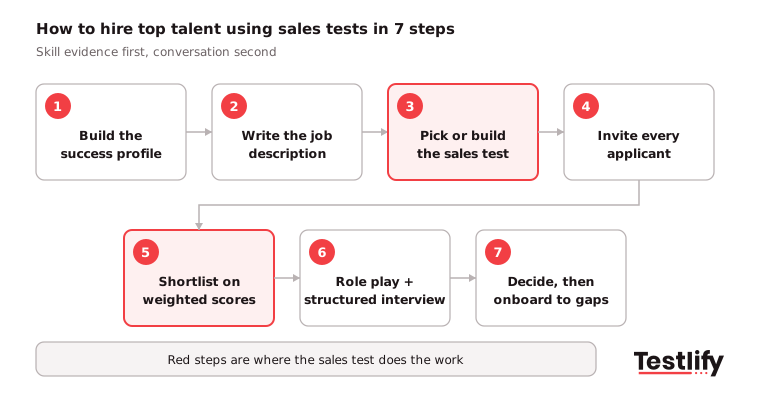
- Build the success profile: List the 4 to 6 skills your top performers share, the sales motion (inbound, outbound, transactional or consultative) and the deal size. This profile drives every later step.
- Write the job description from the profile: Describe the real work, the targets and how the role is measured. A template such as the sales consultant job description saves time; edit it to match your profile.
- Pick or build the test: Start from a role-based sales test, then add sections for your CRM, product area or language needs. Keep it between 20 and 40 minutes so strong candidates finish it.
- Invite every applicant who meets the basics: Send the test link with the application acknowledgment, ideally through your ATS, so nobody is screened out on resume keywords alone.
- Shortlist on scores: Rank candidates on the weighted score and invite the top group to the next stage. Read the per-skill breakdown, not only the total.
- Confirm with a role play and a structured interview: Run one realistic role play (a discovery call or an objection) and a structured interview that probes the gaps the test showed.
- Decide on combined evidence, then onboard to the gaps: Combine the 3 scores, check references for the finalist, and use the test results to plan the first 90 days. Coaching that starts from known gaps helps cut sales rep ramp time.
How should you score and weight sales test results?
Sales test results should be scored on a weighted total that you set before the first candidate applies. Deciding the weights in advance stops the team from moving the goalposts for a candidate they already like.
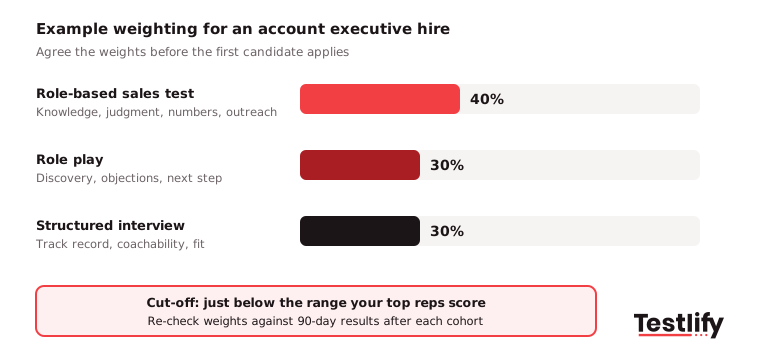
A simple starting point for an account executive:
Signal | Weight | What it scores |
|---|---|---|
Role-based sales test | 40% | Sales knowledge, situational judgment, numerical reasoning, written outreach |
Role play | 30% | Discovery questions, objection handling, next step agreed |
Structured interview | 30% | Track record, motivation, coachability, team fit against the profile |
Three rules keep the scores useful:
- Calibrate on your own team: Ask 5 to 10 current reps to take the test. Your top performers' scores show where the cut-off should sit; set it slightly below their range so you do not lose good candidates.
- Score role plays on a rubric: Use a 1 to 5 scale for each behavior (for example "asked about budget and timeline") and have 2 people score independently.
- Review after each cohort: Compare test scores with 90-day results such as pipeline created or ramp milestones, and adjust the weights if a section does not track performance.
Measuring the outcome matters. In the Future of Recruiting 2025 report from LinkedIn Talent Solutions, 93% of talent acquisition professionals said accurately assessing skills is crucial to improving quality of hire, yet only 25% were highly confident they could measure quality of hire.
Key takeaway: The weighted score tells you who deserves interview time. The role play and interview tell you who gets the offer.
How do you keep sales testing fair and hard to game?
Sales testing stays fair when every candidate for the same role takes the same job-related test under the same conditions, and it stays hard to game when the test is proctored and the questions are not easy to look up. Fair and secure go together: a test that candidates can cheat on is unfair to the candidates who did not.
- Job-related questions only: The EEOC guidance on employment tests says a test that screens out a protected group must be job-related and consistent with business necessity. Tie every section to the success profile.
- Same test, same rules: Do not change the test, time limit or cut-off for individual candidates in the same role.
- Accommodations on request: Offer extra time or other adjustments to candidates who need them, so the score reflects sales skill, not a disability.
- Proctoring: Use checks such as webcam snapshots, tab-switch monitoring, copy-paste blocking and AI assistance detection, so the score belongs to the candidate. See anti-cheating and proctoring.
- Candidate experience: Tell candidates how long the test takes and what it covers, and keep it under 40 minutes. Strong salespeople have options and drop out of long, unexplained processes.
What mistakes should you avoid when testing sales candidates?
The most common mistake when testing sales candidates is using one generic test for every sales role. A test built for retail associates will not tell you who can run a six-month enterprise deal.
Other mistakes to avoid:
- Testing after the interviews: By then the team has a favorite, and the test becomes a box to tick.
- Personality only: A personality profile shows style, not skill. Pair it with knowledge, judgment and a work sample.
- No cut-off: Without a minimum score, every candidate moves forward and the test saves no time.
- Long take-home projects: Unpaid multi-day tasks put off strong candidates. A 20 minute role play shows more.
- Never checking results: If you never compare scores with on-the-job results, you cannot tell whether the test works.
How does Testlify help you hire sales talent?
Testlify helps hiring teams hire sales talent by turning the job description into a role-based assessment, running AI interviews and ranking candidates on the results. Hiring teams can start from a ready-made test or build their own.
- Role-based sales tests: 3,500+ tests, including sales aptitude, SDR, inside sales, account executive, B2B SaaS sales and sales manager tests, plus CRM tests such as HubSpot and Salesforce.
- Role plays at scale: Video AI, Voice AI and Chat AI interviews let candidates handle a discovery call or objection through AI video interviews, without a scheduled call.
- Custom questions: 25+ question types, including audio, video, typing and written responses, for cold email or voicemail tasks.
- Trustworthy scores: 20+ proctoring checks, weighted scoring and AI candidate insights with a per-skill breakdown.
- Fits your stack: 100+ ATS and HRIS integrations, including Greenhouse, Lever, Workday and SmartRecruiters, with two-way sync.
More than 1,500 companies use Testlify, and G2 users rate it 4.7. Read how it works for sales teams on the sales hiring page.
Ready to test your next sales hire?
Pick the sales test that matches the role, invite your current applicants and see the ranked shortlist before you book a single interview. Start a 7-day free trial with no credit card, or book a demo to see a sales assessment built from your own job description.
Frequently asked questions (FAQs)

Head of Sales
Pradeep is the sales and business growth engine behind Testlify’s enterprise expansion, bringing over 20 years of experience scaling revenues in complex, high-growth environments. He played a pivotal role in taking Testlify to $1M ARR, building a high-performing sales organization from the ground up and forging the strategic partnerships that accelerated market penetration.
LinkedInRelated resources
View all
HR & recruitment
How to hire top talent using analytical ability test

HR & recruitment
Candidate screening tools: 7 types and how to choose them
HR & recruitment
How to improve employer brand: 10 steps that hold up in 2026

HR & recruitment
How to handle employee conflicts with a proactive approach

HR & recruitment
How to simplify candidate screening with talent assessment tools
HR & recruitment
Marketing test: what to assess and 10 questions to ask
Get started.
Hire on proof, not resumes.
Run your first skills-based assessment free — no credit card required.