
Bad candidate experience: what it costs and how to fix it
What a bad candidate experience costs in declined offers, lost referrals and revenue, what causes it, and how TA teams can fix it.

A bad candidate experience is any hiring process that leaves applicants feeling ignored, confused or disrespected: long forms, weeks of silence, unprepared interviewers, surprise steps or no answer at all. The cost does not stay with the candidate. It shows up as declined offers, fewer referrals, a weaker employer brand, higher cost per hire and, for consumer brands, lost customers.
TL;DR / Key Takeaways
- A bad candidate experience costs a business real money: roles reopen, offers get declined, referrals dry up and some rejected applicants stop buying from you.
- CareerPlug's 2025 Candidate Experience Report found a poor experience led 26% of job seekers to decline an offer in 2024, and 36% turned down offers after a negative interview.
- Talent Board's 2024 benchmark recorded the highest candidate resentment in its history, at 25% in tech and finance in North America against a 14% average.
- The most common causes are slow or missing communication, long applications, unstructured interviews and slow offers. Speed and silence matter more than perks.
- Track five numbers to spot the problem early: application completion, days to first reply, assessment completion, days between rounds and offer acceptance.
- Fix the basics first: reply within a week, keep each step short and relevant, train interviewers, and close the loop with every candidate.
 ChatGPT
 Gemini
 Claude
 Grok
 Perplexity
What is a bad candidate experience?
A bad candidate experience is a hiring process that makes applicants feel their time and effort were not respected. Candidates rarely judge you on the outcome alone. They judge how long things took, how clearly you explained each step, whether interviewers were prepared and whether anyone told them where they stood.
A negative candidate experience usually has three signs:
- Silence: The candidate applies, interviews or completes a task and hears nothing for weeks.
- Friction: The application or assessment is long, repetitive or irrelevant to the job.
- Disrespect: Interviewers arrive late, read the resume for the first time on the call, or ask questions that have nothing to do with the role.
Candidates are noticing more than ever. Talent Board's 2024 Candidate Experience Benchmark, based on more than 230,000 candidate responses, found that resentment reached its highest level ever in 2024 and rose in every region. For a full definition of the wider topic, see the candidate experience glossary entry.

What causes a bad candidate experience?
A bad candidate experience is usually caused by slow communication, long or irrelevant application steps, unprepared interviewers and slow decisions. Few teams set out to treat candidates badly. Most bad experiences come from busy recruiters, unclear ownership between recruiters and hiring managers, and processes that grew one step at a time.
Hiring stage | What goes wrong | What the candidate concludes |
|---|---|---|
Job post | Vague role, no salary range | "They are hiding something" |
Application | Long forms, retyping the resume | "They do not value my time" |
Screening | No reply for weeks, then a template | "I am a number to them" |
Assessment | Long, generic or unrelated tests | "This has nothing to do with the job" |
Interview | Late, unprepared or off-script interviewers | "This is how they treat employees" |
Decision | Ghosting after the final round | "I will never apply here again" |
The data backs this up. Indeed's State of the Job Seeker 2026 report found that 46% of job seekers abandoned an application midstream because it was tedious or time-consuming, rising to 63% for active job seekers. Greenhouse's 2024 State of Job Hunting report found that 61% of job seekers had been ghosted after an interview, up 19 points since April 2024. And CareerPlug reports that negative interactions during interviews caused 36% of candidates to decline offers.
Silence is the cause teams underestimate most. Our guide to candidate ghosting shows how it runs in both directions.
How does a bad candidate experience affect a business?
A bad candidate experience affects a business through seven costs: lost applicants, declined offers, fewer referrals, a weaker employer brand, longer time to fill, higher cost per hire and, for consumer-facing companies, lost customers. Each one is small in a single hiring process. Across hundreds of hires a year, they add up.
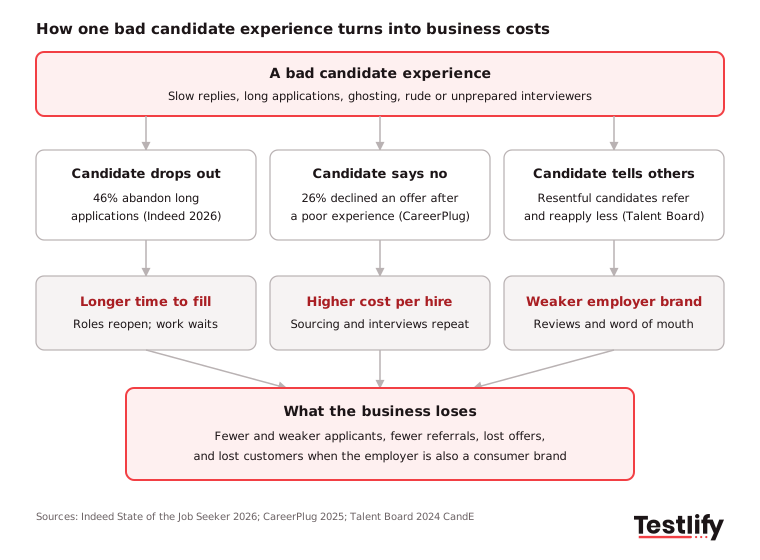
- Smaller talent pool: Candidates who drop out or are treated badly rarely reapply. Talent Board found resentful candidates are less likely to apply again, refer others or feel any affinity for the brand.
- Declined offers: CareerPlug found poor experiences led 26% of job seekers to decline offers in 2024 alone. Your best candidates usually have other options, so they are the first to walk.
- Fewer referrals: Employers hire 20% to 40% of their workforce from referrals, according to Talent Board. Employees stop referring friends into a process they find embarrassing. See how an employee referral program depends on trust.
- Weaker employer brand: Candidates share stories on review sites, social media and in private. Your employer brand is what candidates say about you, not what your careers page says.
- Longer time to fill: Every declined offer or late dropout reopens the role. Teams already struggle here: SHRM's 2025 Talent Trends report found 69% of organizations have trouble filling full-time roles and 41% see candidates ghosting during interviews.
- Higher cost per hire: Reopened roles mean more ads, more screening hours and sometimes agency fees.
- Lost customers and morale: Talent Board found resentful candidates are less likely to buy from consumer-facing companies. Inside the business, hiring managers who keep losing finalists lose patience, and current employees question how the company treats people.
Key takeaway: The impact of poor candidate experience is not limited to the employer brand. In most companies, the largest costs are reopened roles and lost offers, which land directly on the hiring budget.
How much revenue can a bad candidate experience cost?
A bad candidate experience can cost a mid-sized employer hundreds of thousands of dollars a year once you add repeat hiring costs, empty seats and lost customers. The exact figure depends on your volumes, so the best approach is to calculate it with your own numbers rather than rely on a headline statistic.
Start with a known benchmark. SHRM's 2025 benchmarking data puts the average cost per hire at $5,475 for nonexecutive roles and $35,879 for executive roles. Then apply it to the hires your process loses.
Cost line | Example inputs (illustrative) | Example cost | Your numbers |
|---|---|---|---|
Repeat hiring for lost offers | 30 offers a year declined because of the process x $5,475 | $164,250 | Declined offers x your cost per hire |
Empty seat while the role reopens | 30 roles x 20 extra days x $1,000 gross profit per day | $600,000 | Roles x extra days x value per day |
Lost customers (consumer brands) | 20,000 rejected applicants x 5% who stop buying x $300 a year | $300,000 | Rejected applicants x churn x annual spend |
Total | $1,064,250 |
The inputs above are assumptions for a company making about 400 hires a year, not survey results. Replace them with your own offer decline count, your cost per hire and your revenue per employee. Even if only the first line applies to you, candidate experience lost revenue is usually larger than the cost of fixing the process.
Pro tip: Ask finance for revenue per employee and divide by working days. That gives you a defensible value per empty-seat day, which makes the business case easier to approve.
How do you measure candidate experience problems?
Candidate experience problems are measured with funnel data and candidate feedback together. Funnel numbers show where candidates leave. Feedback tells you why. Most teams already have the funnel data in their applicant tracking system but never look at it by stage.
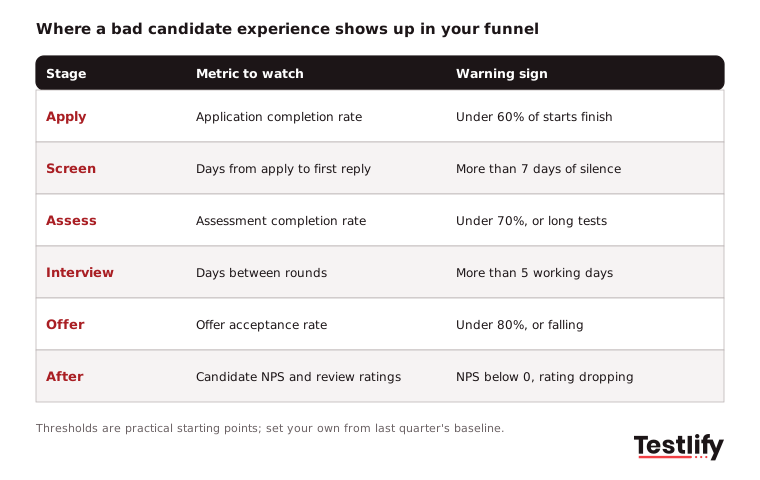
Track these numbers every month:
- Application completion rate: The share of candidates who start and finish the application. A sudden drop points to a new form field or step.
- Days to first reply: Talent Board found 29% of North American candidates had not heard back one to two months or more after applying.
- Assessment completion rate: Low completion usually means the test is too long or does not look relevant to the job.
- Days between rounds: Long gaps are where finalists accept other offers.
- Offer acceptance rate: Ask every candidate who declines for the main reason, and tag process-related answers.
- Candidate NPS and review ratings: Survey candidates after each stage, including rejected ones. Talent Board found only 27% of candidates are asked for feedback at all.
If candidates leave at one stage far more than at others, start there. Our post on candidate drop-off goes deeper on finding the leak.
How can you fix a bad candidate experience?
A bad candidate experience is fixed by making the process faster, shorter, clearer and more human at the points where candidates leave. You do not need a new tool for most of it. You need owners, deadlines and a habit of closing the loop.
- Set a reply deadline: Commit to a status update within five working days at every stage, and automate the first acknowledgement.
- Cut the application: Remove fields you already get from the resume. Let candidates apply from mobile.
- Show salary and steps up front: CareerPlug found 47% of job seekers expect to learn about salary before applying. List the stages and how long each takes.
- Keep assessments short and job-relevant: Test the few skills the role needs, explain why each step exists and tell candidates how long it will take.
- Use structured interviews: Give interviewers the same questions and scorecard. A structured interview is fairer and easier to prepare for.
- Brief every interviewer: Share the resume, the role scorecard and what earlier rounds covered, so candidates are not asked the same questions twice.
- Close the loop with everyone: Send a clear, kind rejection. These rejection email templates help recruiters do it at volume.
- Give finalists feedback: Talent Board found candidates who were asked for feedback were 126% more likely to refer others. Specific feedback to finalists also raised willingness to refer.
Can assessments and AI make candidate experience worse?
Assessments and AI can make candidate experience worse when they add length, feel generic or replace every human touchpoint. They make it better when they replace slower, less relevant steps and give candidates a faster answer. The difference is in how you use them.
CareerPlug found 33% of job seekers have abandoned applications that required one-way video interviews, and 40% are uncomfortable with AI in hiring. That is a warning against stacking tools, not against using them. A short, role-relevant skills test that replaces a resume screen and a phone screen usually feels fairer to candidates than waiting weeks for a recruiter to read their CV.
AI should also give recruiters time back for people. LinkedIn's Future of Recruiting 2025 found TA professionals using generative AI save about 20% of their work week. Spend that time on candidate calls, feedback and faster decisions.
Simple rules keep tools on the right side:
- One assessment stage: Combine skills into one test rather than sending several.
- Tell candidates what to expect: Length, format, what is measured and when they will hear back.
- Keep a human decision: A person reviews scores before anyone is rejected.
- Offer their language: Candidates perform better and feel more respected in the language they work in.
Give candidates a hiring process worth talking about
Testlify helps hiring teams replace long, unstructured screening with short, role-relevant assessments candidates can take on their own schedule. Pick from 3,500+ tests in the Testlify test library, or let the AI test builder create one from your job description.
Tests run in 15+ languages, results sync to 100+ ATS and HRIS tools through Testlify integrations, and reporting and analytics include candidate feedback and a drop-off report so you can see where candidates leave. Testlify reports 94% candidate satisfaction.
Start a 7-day free trial, no credit card needed, or book a demo to see it on one of your open roles.
Frequently asked questions (FAQs)
Related resources
View all
HR & recruitment
How to enhance team productivity via cognitive reasoning

HR & recruitment
Building your HR tech stack for new-age recruiting

HR & recruitment
Difference between orientation and onboarding

HR & recruitment
The pros and cons of internal recruitment

HR & recruitment
Employee retention: What is the cost of losing talent?

HR & recruitment
Pros and cons of pre-recorded video interviews for hiring teams
Get started.
Hire on proof, not resumes.
Run your first skills-based assessment free — no credit card required.