
Hiring technical talent: a step-by-step guide for 2026
A practical guide to hiring technical talent: define the role, find passive candidates, test real skills, interview well and close fast.

Hiring technical talent means finding, testing and hiring people with specialist technology skills, such as software engineers, data and AI specialists, cloud and DevOps engineers and security analysts. It works best as a fixed process: define the role from the work it must deliver, source beyond job boards, test real skills before engineers spend time on interviews, and decide from scored evidence instead of gut feel.
TL;DR / Key Takeaways
- Hire technical talent in seven steps: define the role, write a specific job description, source passive candidates, run role-based skills tests, hold a structured interview, close fast and track the results.
- Tech roles are slow to fill: iCIMS data shows tech time to fill rose from 48 to 51 days between February 2024 and February 2025, and SHRM finds 69% of organizations still struggle to fill full-time roles.
- Test three layers, not one: hard skills on real tasks, AI fluency, and communication. Most teams only test the first.
- Put the skills test before the first engineer interview. Engineers then spend their time on a short, scored shortlist.
- Use the same questions and rubric for every candidate, and have interviewers score before the debrief.
- Plan for fraud: Gartner expects 1 in 4 candidate profiles worldwide could be fake by 2028, so verify identity and proctor remote tests.
- Track time to shortlist, time to hire, offer acceptance and quality of hire together.
 ChatGPT
 Gemini
 Claude
 Grok
 Perplexity
What is technical talent?
Technical talent is the group of people whose main value at work is a specialist technology skill they can show and measure, such as writing production code, running cloud systems, building data pipelines or securing a network. Technical skills are a subset of hard skills: all of them can be tested directly, which is why skills tests suit these roles so well.
The term covers more than developers. The table shows the main role families and what a hiring team should test for each.
Role family | Example roles | What to test |
|---|---|---|
Software engineering | Backend, frontend, full-stack, mobile developers | Coding in the team's stack, code review, debugging |
Data and AI | Data engineers, data scientists, ML engineers | SQL, Python, data modelling, judgement on model output |
Cloud and DevOps | DevOps, site reliability, cloud engineers | AWS or Azure, CI/CD, incident handling scenarios |
Security | Security analysts, security engineers | Threat scenarios, secure coding, tooling knowledge |
QA and testing | QA automation, test engineers | Test design, automation scripting, bug reports |
Technical leadership | Tech leads, engineering managers | System design, decision-making, communication |

Why is hiring technical talent so hard in 2026?
Hiring technical talent is hard because demand for specific, deep skills keeps growing faster than the supply of people who have them, and the strongest candidates are rarely looking. The problem is less about how many people apply and more about how few of them match what the role needs.
The numbers back this up:
- Roles stay open longer: The iCIMS March 2025 Workforce Report found tech time to fill rose from 48 days in February 2024 to 51 days in February 2025. Tech openings grew 11% over the year while tech hires fell 3%.
- Most employers still struggle: SHRM's 2025 Talent Trends research shows 69% of organizations are still struggling to fill full-time roles, and 28% now require new skills for those roles.
- Demand keeps rising: The US Bureau of Labor Statistics projects faster than average growth for computer and IT jobs from 2025 to 2035, with about 280,000 openings a year.
- Skills move fast: LinkedIn's 2025 Work Change Report expects 70% of the skills used in most jobs to change by 2030, with AI as the main driver.
Three things make this worse for hiring teams. Specialist roles in AI, cloud, security and data stay scarce even when general developer supply is healthy. Requirements written too broadly attract the wrong applicants, while requirements written too narrowly screen out good ones before the first call. And every approved headcount now carries more weight, so a wrong hire costs more than it used to.
What are the steps for hiring technical talent?
The steps for hiring technical talent are: define the role, write a specific job description, source candidates beyond job boards, test skills with role-based assessments, run a structured interview, close the offer quickly, and measure the results. Each step removes guesswork from the next one.
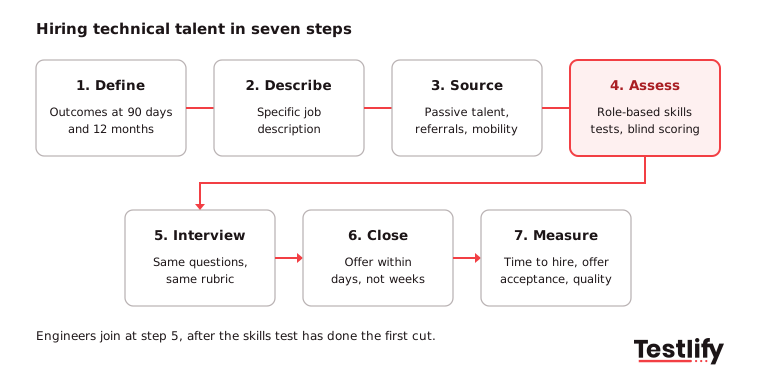
- Define the role: Agree what success looks like at 90 days and 12 months, and which skills are needed on day one.
- Write the job description: State the stack, the depth needed and the problems the person will solve.
- Source: Reach passive candidates, referrals and internal movers, not only applicants.
- Assess: Give every candidate the same role-based skills test and set a pass score in advance.
- Interview: Use the same scenario questions and rubric for every shortlisted candidate.
- Close: Make the offer within days of the final round, with pay set from market data.
- Measure: Track speed, offer acceptance and quality of hire, then fix the slowest step.
The sections below take each step in turn.
How do you define a technical role before you post it?
A technical role is defined by the work it must deliver, not by the last person who held it. Most technical hiring failures start here, because the team skips this step and writes requirements from habit or from a hiring manager's wish list.
A good role profile answers three questions before anyone writes a job post:
- What does success in this role look like at 90 days and at 12 months?
- Which skills are needed on day one, and which can the person learn during onboarding?
- What gap on the current team does this hire fill?
Be specific about the mix of skills. A software developer role may need a named language and framework, while a data analyst role may need SQL and a visualization tool. Pinning this down early saves time at every later step and points you to the right test. This is where skills-based hiring starts.
Pro tip: Before you write the job description, map the skills the team already has against what the next 12 months of work needs. The gap between the two should drive the role, not a template from a previous hiring round. Revisit the map every hiring cycle, because tools and languages change fast.
Skill category | Must have on day one | Can be developed |
|---|---|---|
Core technical skills (role stack) | Yes | No |
Adjacent technical skills | Depends on ramp-up time | Yes, in 6 to 12 months |
AI fluency and tooling | Yes, at a baseline level | Partly |
Domain knowledge | Depends on the role | Yes |
Communication and teamwork | Tested, not screened out | Yes |
Leadership | Depends on seniority | Yes |
What should a technical job description include?
A technical job description should include the business problem the role solves, the exact skills and depth required, and what the person gains by joining. A job post that attracts the wrong people is a specification problem, not a sourcing problem.
Write it on three levels:
- Role context: What problem does this role solve? What does success look like at 90 days and 12 months? Which teams will the person work with? This framing attracts candidates who are checking real fit, and they are the ones most likely to accept and stay.
- Skills, with depth: Separate required skills from nice-to-haves. "Experience with Python" and "production Python at scale" attract very different people. Name the AI tools or workflows that are part of the job.
- Growth and environment: Strong engineers look at the technical challenge, the team, career paths and pay ranges as closely as salary. Leave these out and you lose good candidates before they apply.
Drop degree requirements that do not connect to the work. For most technical roles, a portfolio, work history or skills test result tells you more than a degree, and removing the filter widens your pool.
Where do you find technical talent that is not applying?
Technical talent that is not applying is found through public work, referrals, internal mobility and the communities engineers already use. The strongest candidates are often passive candidates who are not reading job boards, so a plan that relies only on inbound applicants misses them.
Channel | Best for | Watch out for |
|---|---|---|
GitHub, open-source projects, Stack Overflow | Seeing real code and how people explain it | Many strong engineers have little public work |
LinkedIn and social media | Reaching passive candidates at scale | Outreach fatigue: make every message specific |
Employee referrals | Pre-vetted candidates from trusted networks | Can narrow diversity if it is your only channel |
Internal mobility | Staff with proven learning speed and company knowledge | Needs a clear training plan for the gap |
Meetups, conferences, tech communities | Specialists in a niche stack | Slow to build, needs ongoing presence |
Specialist agencies | Rare or senior searches on a deadline | Cost, and less control over the process |
A few rules make these channels work:
- Look at public signals: GitHub activity, conference talks, technical blog posts and community answers show both skill and how a person communicates. Targeted outreach to these people tends to beat job board traffic.
- Run referrals as a program: Engineers refer people they have worked with, which adds a layer of pre-screening. A structured employee referral program with a narrow ask, fast feedback and a clear reward gets far more than an open "know anyone?" message.
- Check inside first: For roles where the core aptitude exists in-house and the rest can be learned in 6 to 12 months, internal candidates often settle in faster and stay longer than external hires.
How do you assess technical skills without wasting engineering time?
Technical skills are assessed most efficiently with a role-based skills test that every candidate takes before any engineer interview. Ad hoc interviews, where each engineer tests something different with no shared rubric, give scores you cannot compare and pull senior engineers into early screening that a test could have done.
A simple three-stage setup scales across many open roles:
### 1. Set the criteria first Before any candidate starts, the team agrees the competencies for the role, weights each one by business priority and sets the pass score for the next stage. This stops two common mistakes: testing skills the role does not need, and giving one generic test to very different roles. ### 2. Test asynchronously Candidates take a role-based assessment on their own schedule, which removes scheduling delays. Scoring answers without names, schools or past employers in view (blind scoring) cuts the bias that creeps into resume screening. Hiring managers see scored profiles, not raw answers. ### 3. Decide from scores Only shortlisted candidates reach the structured interview, which uses rubrics built from the stage 1 criteria. The final decision traces back to scored evidence that stakeholders can review.
Assessment method | Scheduling needed | Bias risk | Signal quality | Works across many roles |
|---|---|---|---|---|
Live coding interview | High | High | Varies by interviewer | No |
Take-home project | Low | Medium | High, but slow | Partly |
Async role-based skills test | None | Low with blind scoring | High | Yes |
Resume screen only | None | Very high | Low | Yes |
Key takeaway: Structured assessment does not make hiring slower. It moves the evaluation earlier, cuts the cost of late-stage mistakes and gives decisions that hold up when stakeholders ask why.
Which technical skills should you test in 2026?
Technical skills worth testing in 2026 fall into three layers: hard skills for the role, AI fluency, and the soft skills that decide how well the person works with others. Most hiring teams test only the first layer.
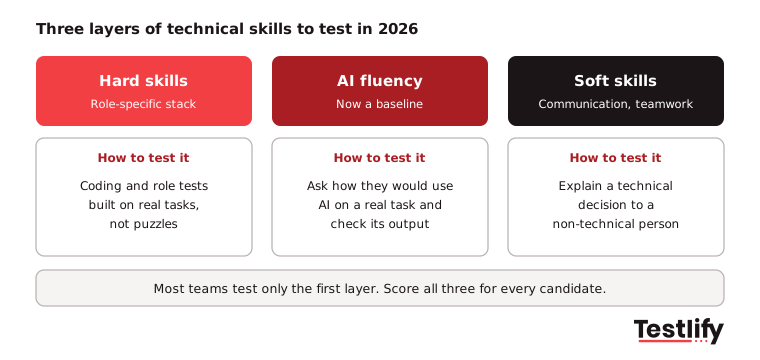
- Hard skills: Role-specific skills are the most tested and the easiest to game. Candidates who have seen enough standard questions can pass generic coding tests without the depth to work in production. Tests built on realistic tasks from the job give a far more reliable signal than algorithm puzzles. Use coding tests in the team's actual languages.
- AI fluency: AI use is now normal for developers. The Stack Overflow 2025 Developer Survey found 84% of respondents use or plan to use AI tools, yet 46% distrust the accuracy of what those tools produce. Test whether candidates know when to use AI, how to check its output and when not to rely on it.
- Problem-solving: Give real scenarios from your industry and watch how the candidate reasons through them, not only whether they reach the textbook answer. A problem-solving test adds a scored view of this before the interview.
- Soft skills and culture add: Communication, teamwork and adaptability carry real weight in technical roles that work with product, design and business teams every day. Ask about past team projects, conflicts and how they explained trade-offs. A communication test helps compare candidates on the same scale.
The three layers apply at every level. A junior engineer who cannot explain a technical limit to a product manager creates bottlenecks. A senior engineer who communicates well but avoids AI tools is already behind on productivity.
How should you structure a technical interview?
A technical interview should use the same scenario questions, the same competencies and the same scoring rubric for every candidate. The unstructured interview, where an engineer asks whatever comes to mind and scores on gut feel, rewards confident talkers over capable ones and gives scores no panel can combine.
A structured interview for technical roles covers four parts:
- Scenario questions: Present a real problem from the team's work, not trivia. Judge the reasoning as well as the answer. How someone approaches an unclear problem says more about future performance than a textbook solution under pressure.
- AI fluency probe: Ask how the candidate would use AI tools on a specific task in the role, and how they would check the result. This tests practical judgement, not awareness.
- Cross-functional communication: Ask the candidate to explain a complex technical decision as if to a non-technical stakeholder. Translating between technical limits and business results is part of the job above junior level.
- Rubric scoring: Every interviewer scores the same criteria with clear anchors for "below", "meets" and "exceeds" expectations. Interviewers submit scores before the debrief starts, so the loudest voice does not set everyone else's score. Big gaps between interviewers are useful: they show where the evidence is unclear.
How do you stop cheating and fake candidates in technical hiring?
Cheating and fake candidates in technical hiring are stopped with identity checks, proctored remote tests and interview questions that probe the candidate's own work. Remote technical screens are an easy target, and AI makes it easier to fake both answers and identities.
Gartner's July 2025 candidate survey, reported by HR Dive, predicts that by 2028 1 in 4 candidate profiles worldwide could be fake. In the same survey of 3,000 candidates, 6% admitted to interview fraud, such as having someone else interview for them, and about 4 in 10 said they use AI during the application process.
Practical controls for technical roles:
- Verify identity early: Use photo ID checks and face matching before or during the skills test, not after the offer.
- Proctor remote tests: Webcam snapshots, tab and screen monitoring, copy and paste tracking and AI assistance detection flag answers that need a second look.
- Set clear AI rules: Tell candidates which tests allow AI tools and which do not. A fair rule followed by everyone beats a secret ban.
- Follow up in the interview: Ask candidates to walk through their own test answers and change one requirement live. People who wrote the code can explain and adapt it.
How do you close technical candidates before a competitor does?
Technical candidates are closed by moving fast after the final round, paying in line with the market and showing a clear path to grow. Strong engineers often hold more than one offer, so a slow or vague close loses people you already spent weeks finding.
- Move within days: Decide and make the offer within a few days of the last interview. Agree the approval chain before the final round so nothing waits on a signature.
- Benchmark pay first: Check pay before you open the role, not at offer stage. The BLS Occupational Outlook Handbook puts the median annual wage for computer and IT jobs at $109,470 in May 2025, more than twice the all-occupation median, and specialist roles sit well above it.
- Sell growth, not only salary: Show training budgets, conference time, mentoring and the technical problems the person will work on. Engineers want to know how their skills will grow with you.
- Offer flexibility where you can: SHRM found organizations with flexible work arrangements report less trouble recruiting than those without (22% versus 29%).
- Plan onboarding before day one: A 30, 60 and 90 day plan with a first real task keeps the new hire engaged and protects retention in the first months.
How does employer brand shape technical hiring?
Employer brand shapes technical hiring because engineers research employers as closely as employers research them. Before a strong engineer agrees to an interview, they have usually read the engineering blog, checked review sites for team and management feedback, looked at the company's public code and formed a view of its technical standards.
For technical candidates, employer brand is not mainly a marketing job. It comes from how the engineering team works, what it ships and how it grows people. The signals engineers weigh most are the scope of the technical work, the quality and tenure of the team, the approach to career growth and how open the company is about pay and levels.
The hiring process itself is part of the brand. A slow, unclear or inconsistent technical interview tells candidates how the company treats people when it needs something from them. Tech communities are small, so a poor process spreads by word of mouth. Treat candidate experience as something you measure: clear timelines, fast feedback and a fair, relevant test leave a good impression even with candidates you do not hire.
Which metrics show your technical hiring is working?
Technical hiring is working when time to shortlist and time to hire fall while offer acceptance and quality of hire hold or rise. Read the metrics together: speed with weak quality of hire just means you are making bad decisions faster.
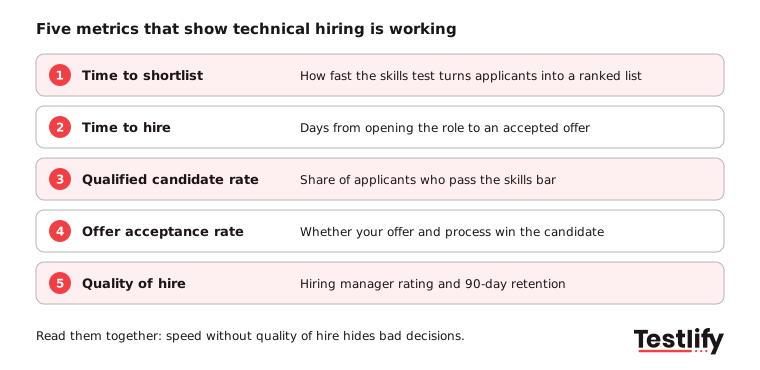
Metric | What it tells you | Step to fix if it slips |
|---|---|---|
Time to shortlist | How fast applicants become a ranked list | Assess (async skills test, pass score) |
Time to hire | Days from opening the role to an accepted offer | Interview and close (fewer rounds, faster approvals) |
Qualified candidate rate | Share of applicants who pass the skills bar | Define and describe (clearer role and job post) |
Offer acceptance rate | Whether your offer and process win the candidate | Close (pay benchmarks, speed, growth story) |
Quality of hire | Hiring manager rating and 90-day retention | Assess and interview (better tests and rubrics) |
Interviewer hours per hire | How much engineering time each hire costs | Assess (move screening before interviews) |
Free calculators help you set a baseline: the time to hire calculator, the offer acceptance rate calculator and the quality of hire calculator.
Assessment data also improves your next round of hiring. Scores from past hires set a benchmark for each role, show which skills new hires lack and point to training needs for the team you already have.
How does Testlify help with hiring technical talent?
Testlify helps with hiring technical talent by testing real skills before the first interview, so engineers spend their time on a short, ranked list. Hiring teams at 1,500+ companies use it to screen technical and non-technical roles in one place.
- Role-based tests: A library of 3,500+ tests covers programming languages, frameworks, cloud, data and security, plus cognitive, problem-solving and communication tests. The AI test builder turns a job description into a custom assessment.
- Coding in the team's stack: Coding questions and a live coding environment support 45+ programming languages, with automatic scoring.
- AI interviews: Structured AI interviews by video, voice or chat ask every candidate the same questions and score each answer.
- Anti-cheating: 20+ proctoring checks include webcam snapshots, tab monitoring, copy and paste tracking and AI assistance detection, with photo ID verification and face matching available.
- Fits your stack: 100+ ATS and HRIS integrations send results straight into the tools your team already uses.
Customers report 55% faster time to hire and 94% candidate satisfaction.
Ready to hire technical talent on proof?
Hiring technical talent gets faster and fairer when every candidate takes the same relevant test before the first interview. Browse the Testlify test library to find coding and role tests for your open positions, then start a 7-day free trial with no credit card.
Frequently asked questions

Founder and CEO, Testlify
Abhishek Shah is the Founder and CEO of Testlify, a pre-employment assessment platform used by 1,500+ companies globally to hire fairly and at scale. He focuses on skills-based, bias-free hiring technology. Testlify is part of the SHRM Labs 2026 WorkplaceTech Accelerator.
LinkedInRelated resources
View all
Candidate assessment
What tools support voice responses for language proficiency testing?

Candidate assessment
Comment les évaluations intégrées à l'ATS fluidifient-elles les processus de recrutement ?

Candidate assessment
How to assess financial modeling and accounting skills pre-hire?

Candidate assessment
How do assessment libraries cover niche skills?

Candidate assessment
What’s the best way to combine psychometric tests with skills tests?

Candidate assessment
How to use AI to tailor assessments to job descriptions
Get started.
Hire on proof, not resumes.
Run your first skills-based assessment free — no credit card required.