
How lateral hiring can enhance your teams’ inclusivity
Lateral hiring boosts team inclusivity by bringing in diverse backgrounds and skills, creating a more adaptable, innovative workforce where everyone feels valued and empowered.

When organizations talk about diversity and inclusion, the conversation often starts with early career hiring. Graduate programs, internships, and entry-level roles are commonly positioned as the primary levers for building a diverse workforce.
While these initiatives are important, they rarely address the deeper issue that diversity at the entry level does not automatically translate into inclusion at senior or decision-making levels. This is precisely where lateral hiring plays an important role in bridging that gap.
In this blog, we will explore how lateral hiring supports inclusive hiring outcomes, why it matters, and how companies can design lateral hiring practices that can enhance their team’s inclusivity.
 ChatGPT
 Gemini
 Claude
 Grok
Grok Perplexity
Why do traditional hiring pipelines limit inclusion
Traditional hiring pipelines often rely on a narrow definition of qualified talent. Candidates are screened based on familiar job titles, specific employers, or elite educational institutions. Over time, this approach reinforces homogeneity and unintentionally excludes capable professionals who followed non-linear career paths.
Recent research shows that overreliance on legacy pipelines remains a major barrier to inclusive hiring. Many underrepresented professionals build strong careers outside of brand-name companies or take alternative routes due to systemic barriers, caregiving responsibilities, or geographic limitations.
When hiring criteria remain rigid, these candidates are filtered out before their skills are even evaluated.

How lateral hiring expands access to opportunity
Lateral hiring enables organizations to widen their talent lens. Instead of asking where a candidate studied or who they previously worked for, lateral hiring focuses on what the candidate can do today and how their experience aligns with current business needs.
By opening roles to experienced professionals across industries, regions, and career backgrounds, lateral hiring creates access to opportunities that are often closed to underrepresented groups. This shift is especially impactful for mid-career and senior professionals who may have been overlooked despite years of proven performance.
In fact, research consistently shows that diverse teams make better decisions up to 87 percent of the time, and organizations that implement effective diversity-focused recruitment practices are up to 36 percent more likely to outperform their competitors.
Key benefits of lateral hiring for inclusive teams
Lateral hiring is a strategic mechanism for strengthening inclusion across the workforce, not merely a way to fill roles quickly. When executed intentionally, it directly addresses structural limitations in traditional hiring models and enables organizations to build diverse, high-performing teams at scale.
The following benefits demonstrate how lateral hiring expands access to opportunity, reduces systemic bias, and embeds inclusivity into teams.
Breaking reliance on elite universities and employers
Traditional hiring models often treat prestigious institutions and brand-name employers as shortcuts for assessing talent, despite limited evidence that these markers reliably predict performance. Lateral hiring challenges this assumption by shifting candidate evaluation toward skills, outcomes, and on-the-job experience.
This shift meaningfully advances inclusion as it expands access to experienced professionals who may not have had the opportunity to attend elite institutions but have built deep expertise through hands-on work, adaptability, and sustained performance.
Expanding hiring beyond traditional professional networks
Conventional recruitment methods often rely heavily on referrals and existing networks, which tend to reflect and reinforce existing power structures. Over time, this approach reproduces the same demographic patterns across teams, limiting both diversity and perspective.
Lateral hiring requires a deliberate expansion of sourcing strategies. Recruiters move beyond familiar circles by sourcing talent through niche job boards and professional community platforms like GitHub and Behance.
They also engage candidates through cross-industry hiring programs and skills-focused talent communities built around assessments and certifications rather than referrals or employer pedigree.
In organizations committed to inclusion, lateral hiring functions as a corrective mechanism. It helps counteract historical imbalances created by network-driven recruitment and ensures that access to opportunity is not determined by proximity to existing power structures but by capability and potential.
Bringing in candidates from diverse geographies and industries
Lateral hiring also supports geographic and industry diversity. Candidates who have worked in different markets or sectors bring varied perspectives on problem-solving, customer needs, and team dynamics.
In 2026, as remote and hybrid work models mature, geographic boundaries are less restrictive. Lateral hiring allows organizations to tap into talent pools across regions, including professionals from emerging markets and non-traditional industry backgrounds.
This diversity of experience contributes to more inclusive decision-making and stronger organizational adaptability.
Creating access to senior roles for underrepresented professionals
A major inclusion challenge persists at the leadership level. Many organizations report diverse entry-level hiring but struggle with representation in management and executive roles.
Lateral hiring helps address this gap by directly bringing underrepresented professionals into senior positions. Instead of waiting for internal pipelines to mature, organizations can intentionally hire experienced leaders who bring both expertise and diverse perspectives.
In 2026, leadership diversity is increasingly recognized as a business imperative, not just a social goal. Lateral hiring plays a central role in accelerating progress where internal mobility alone falls short.
The role of skills assessment tools in lateral hiring
Skills-based assessment platforms are becoming central to how organizations approach lateral hiring. Instead of relying on resumes or past job titles, these platforms evaluate candidates on the skills and competencies required to perform in the role from day one.
This shift is especially important for lateral hiring, where candidates often come from different industries, career paths, or organizational contexts and cannot be compared fairly using traditional credentials alone.
Platforms like Testlify support inclusive lateral hiring by empowering recruiters with 3500+ role-specific tests and conversational AI interviews to assess role-fit. Through skills-based assessments, hiring teams can identify transferable capabilities that may not be obvious from a resume but are critical for success in mid-level and senior roles.
This reduces bias in early screening stages and ensures that candidates are assessed on what they can actually do, not where they have worked before.
Different types of skill tests for lateral hiring
To evaluate experienced professionals fairly, organizations rely on a range of structured assessment tests that measure decision-making ability and on-the-job readiness. The following are the most effective types of assessment tests used in lateral hiring today.
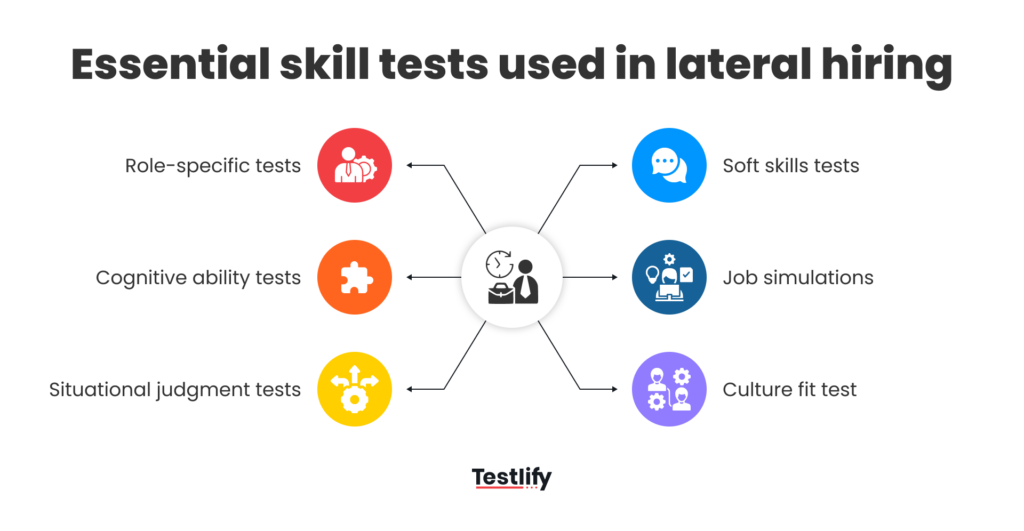
- Role-specific tests: Evaluate hands-on expertise required for the role, such as programming, data analysis, finance, operations, or domain-specific knowledge. These tests help verify whether a lateral hire can perform core job tasks from day one.
- Cognitive ability tests: Measure critical thinking, logical reasoning, and the ability to solve unfamiliar problems. These are especially useful for assessing transferable skills across industries and functions. Situational judgment tests: Present real workplace scenarios to assess how candidates make decisions, handle ambiguity, and respond to complex professional situations common in mid-level and senior roles.
- Soft skills tests: Assess communication, collaboration, leadership, adaptability, and emotional intelligence. These skills are crucial for lateral hires who need to integrate quickly into teams and influence stakeholders.
- Job simulations: Replicate real tasks the candidate would perform in the role, such as writing a strategy memo, reviewing data, or managing a simulated project.
- Culture fit test: Measure how a candidate’s working style and values align with organizational expectations without relying on subjective culture fit judgments that can introduce bias.
Why intentionality matters in inclusive lateral hiring
Lateral hiring does not automatically lead to inclusion. Without structure and accountability, organizations risk repeating the same biases present in traditional hiring. Inclusive lateral hiring requires deliberate design. This means redefining roles, standardizing evaluations, and measuring outcomes at every stage of the hiring process.
Defining roles based on skills and outcomes
Inclusive lateral hiring begins with how roles are defined. Job descriptions should focus on core skills, responsibilities, and expected outcomes rather than years of experience in specific companies or industries.
In 2026, many organizations are rewriting job descriptions to remove unnecessary credential requirements that disproportionately exclude qualified candidates. Clear outcome-based role definitions attract a more diverse applicant pool and reduce self-selection bias.
Using structured and bias-free assessments
Structured assessments are essential for fair lateral hiring. Skills assessments, work samples, and standardized interviews ensure that every candidate is evaluated against the same criteria. Research shows that structured hiring processes reduce bias and improve hiring accuracy.
When decisions are based on evidence rather than intuition, organizations make more inclusive and defensible hiring choices. Bias-aware assessments also help hiring teams focus on potential rather than familiarity.
Auditing sourcing channels regularly
Inclusive lateral hiring requires ongoing evaluation of sourcing channels. Organizations should routinely assess where candidates are coming from and whether those channels reflect diverse communities.
If sourcing efforts rely heavily on the same platforms or networks, diversity outcomes will remain limited. Expanding outreach to new platforms, professional groups, and cross-industry communities is essential for inclusive growth.
Tracking candidate progress through each hiring stage
Tracking candidate demographics and progression through each hiring stage helps organizations identify where drop-offs occur and why.
In 2026, many HR teams use hiring analytics to understand bias points and improve process equity. Transparency and data-driven insights turn inclusive hiring from intention into action.
Case studies: Success stories of inclusive lateral hiring
Salesforce: Salesforce has been a pioneer in prioritizing diversity and inclusion. The company actively seeks talent from underrepresented groups, and their commitment to inclusivity is reflected in their diverse workforce. By embracing lateral hiring practices, Salesforce has created a culture that values innovation through diverse perspectives.
Unilever: Unilever is another example of a company that understands the importance of diversity. Through targeted lateral hiring initiatives, Unilever has increased the representation of women in leadership roles. This not only brings gender diversity to the forefront but also serves as a catalyst for positive cultural change within the organization.
Microsoft: Microsoft has implemented programs to encourage neurodiversity in the workplace. By actively seeking and hiring individuals with autism and other neurodivergent conditions, Microsoft has not only created a more inclusive environment but has also tapped into a pool of unique talents that contribute to the company’s success.
Final thoughts
Inclusion is not just shaped by who enters an organization, but by who gets access to meaningful roles, influence, and growth over time.
As careers become less linear, strong talent often comes from unexpected backgrounds. Lateral hiring allows companies to focus on real skills and experience instead of job titles, past employers, or education. This helps ensure that opportunity is based on ability, not familiarity.
When done with the right structure and fairness, lateral hiring strengthens teams, improves decision-making, and builds a workforce that better reflects the world organizations operate in.
Build a skills-first lateral hiring process with Testlify
Testlify supports skills-first lateral hiring with 3500+ role-specific tests, job simulations, and conversational AI interviews that help uncover proven ability and role readiness of candidates
Start building a more inclusive lateral hiring process with Testlify. Book a demo today
Frequently asked questions (FAQs)

Content Writer
Yashika Khandelwal is a Content Writer with 3+ years of experience creating research-backed content on hiring, talent assessment, and HR technology. She is a registered Organizational Psychologist and subject matter expert who combines behavioral science with practical recruitment insights to produce accurate, evidence-based content.
LinkedInRelated resources
View all
HR & recruitment
Talent planning essentials for modern businesses

HR & recruitment
Navigating talent planning in the digital era

HR & recruitment
Balancing theory and practice: Effective essay strategies for aspiring HR professionals

HR & recruitment
Key functions of HR you learn in college

HR & recruitment
The ROI of Cognitive Ability Tests: What the Data Shows

HR & recruitment
25 exit interview questions HR must ask in 2026 (+ the heard framework)
Get started.
Hire on proof, not resumes.
Run your first skills-based assessment free — no credit card required.