
Legal considerations in recruitment compliance tips for 2026
A stage-by-stage guide to the hiring rules in force in 2026, from job postings and AI screening laws to background checks and records.

A single job posting or automated screen can create a discrimination claim before anyone has been interviewed. Recruitment compliance means keeping every hiring step inside the employment, data protection and anti-discrimination rules that apply.
The legal considerations in recruitment compliance tips below follow your hiring process stage by stage for 2026. You will get the key US and AI hiring rules, record retention periods and a nine-point audit to run each quarter.
TL;DR:
- Recruitment compliance means keeping every hiring step inside the law and keeping enough evidence to show how each decision was made.
- Liability starts the moment someone applies. A job posting, automated screen or sourcing filter can create a claim on its own.
- The EEOC received 88,201 new discrimination charges in fiscal year 2025 and recovered almost $660 million for 17,680 people.
- The EEOC withdrew its AI guidance in January 2025, but Title VII, the ADA and the four-fifths rule still apply to automated screens.
- The employer, not the vendor, is liable when an AI tool screens candidates out. Ask every vendor for an independent bias audit from the last 12 months.
- Build NYC Local Law 144 steps into your default process: a yearly bias audit, a published summary and candidate notice before use.
- Keep applications at least one year under EEOC rules, four years in California, and until final disposition if a charge is filed.
 ChatGPT
 Gemini
 Claude
 Grok
 Perplexity
What does recruitment compliance mean?
Recruitment compliance is the practice of keeping every hiring decision inside the law that applies to it, and keeping enough evidence to show how the decision was made. Compliance covers three things at once: the questions you ask, the criteria you screen on, and the records that survive after the role is filled.
Most hiring teams treat compliance as a legal review of the offer letter. The exposure sits much earlier.
Protection attaches the moment somebody applies, long before an interview, so a job posting, an automated screen or a sourcing filter can create a claim on its own.
The volume is not theoretical. The EEOC received 88,201 new discrimination charges in fiscal year 2025, resolved 90,743, and recovered almost $660 million for 17,680 people, with roughly $528 million of that secured before any lawsuit was filed.

Which laws govern recruitment in the United States?
Recruitment in the United States is governed by a handful of federal statutes, two enforcement agencies, and a thick layer of state and city rules that usually go further than the federal floor. The federal statutes set the minimum.
The state and local rules decide what your job postings and screening questions can actually say.
Rule | What it covers in hiring | Who enforces it |
|---|---|---|
Title VII of the Civil Rights Act | Race, color, religion, sex and national origin in every hiring step | EEOC |
Americans with Disabilities Act | Accommodations, medical questions, accessible assessments | EEOC |
Age Discrimination in Employment Act | Applicants aged 40 and over, including posting wording | EEOC |
Equal Pay Act and state pay equity laws | Pay set for the same work, and salary history questions | EEOC and state agencies |
Fair Credit Reporting Act | Disclosure, consent and adverse action when a third party runs a check | FTC |
Immigration and Nationality Act | Right to work verification, done the same way for everyone | USCIS and DOJ |
Uniform Guidelines on Employee Selection Procedures | Whether a screen, test or interview has an adverse impact | EEOC and OFCCP |
State and local rules | Pay range in the posting, fair chance timing, drug testing limits | State and city agencies |
Two layers trip teams up most often. Pay transparency now reaches more than a dozen states plus the District of Columbia, which require a pay range inside the posting itself; Connecticut's posting duty started on October 1, 2026 and Delaware's arrives in September 2027.
Fair chance rules decide when you may ask about criminal history at all: according to the National Employment Law Project's fair chance tally, 37 states and the District of Columbia plus more than 150 cities and counties now restrict the question.
The EEOC's own enforcement results show where those charges land and how they are resolved.
Which AI hiring laws are in force in 2026?
Four AI hiring rules bind US employers right now: Illinois's AI Video Interview Act, in force since 2020, New York City's Local Law 144, Illinois House Bill 3773, and California's automated decision regulations. Two more arrive on fixed dates, in Colorado on January 1, 2027 and across the EU high-risk regime on December 2, 2027.
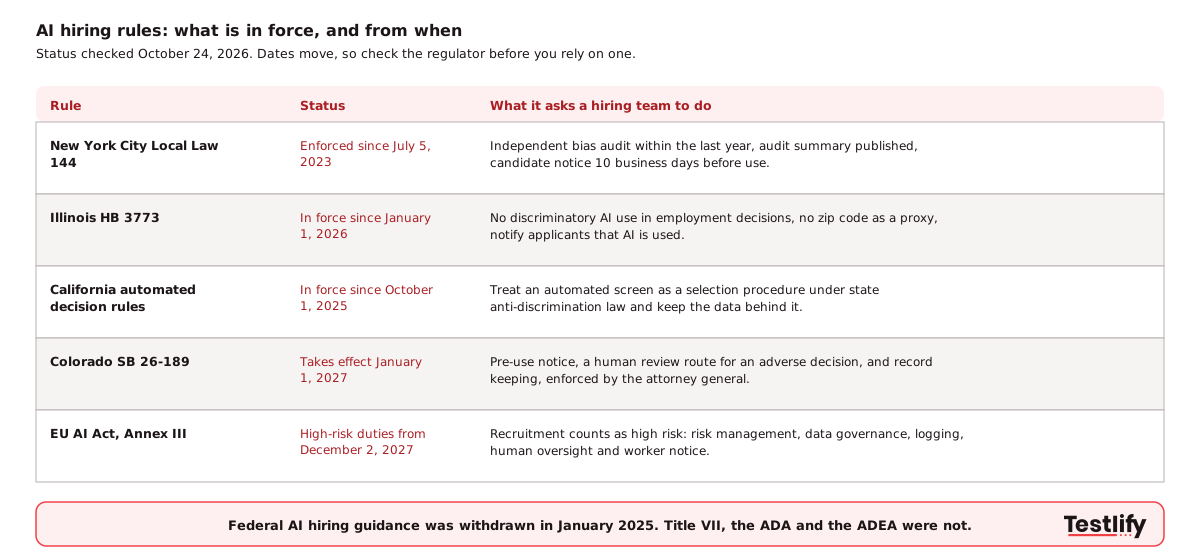
New York City has the sharpest requirements. The city's rules on automated employment decision tools have been enforced since July 5, 2023 and ask for an independent bias audit completed within the previous year, a published summary of that audit, and notice to candidates at least ten business days before the tool is used.
Illinois HB 3773 amended the state's Human Rights Act from January 1, 2026. Discriminatory use of AI in an employment decision is now a civil rights violation, zip codes may not be used as a proxy for a protected class, and employers must tell applicants when AI is part of the decision.
According to the Illinois Department of Human Rights, implementing rules were proposed in May 2026 and withdrawn the following month, so the notice mechanics are still open.
California's Civil Rights Council added automated decision system rules to the state's employment regulations with effect from October 1, 2025, and filed a further set in January 2026 that took effect on April 1, 2026. The practical reading is simple: an automated screen counts as a selection procedure, and the usual anti-discrimination duties apply to it.
Colorado is the one to diary. The original Colorado AI Act was repealed and replaced in May 2026 by Senate Bill 26-189, a narrower framework that starts on January 1, 2027 with pre-use notice, a human review route for adverse decisions, record keeping, and enforcement by the attorney general only.
Pro tip: Build the NYC requirements into your default process even if you do not hire in New York. A published audit, a candidate notice and a human review step satisfy almost every other rule on this list, and they are far cheaper to set up once than to retrofit per jurisdiction.
What changed when the federal AI guidance was withdrawn?
The withdrawal removed guidance, not law. On January 27, 2025 the EEOC took down its 2022 technical assistance on the ADA and software-based assessment and its 2023 Title VII document on automated selection, following the executive order on federal AI policy signed that month.
The OFCCP dropped its own AI guidance in the same period.
Three things did not change. Title VII, the ADA and the ADEA still apply to an automated screen exactly as they apply to a human one.
The Uniform Guidelines still define adverse impact, and the four-fifths rule still flags a problem when one group's selection rate falls below 80 percent of the highest group's rate. Private claimants can still sue, and state agencies in Illinois and California are now the active enforcers.
Across the teams we work with, this is the most common misreading of 2026: a recruiter hears that the federal guidance is gone and assumes automated screening is now unregulated. The safer reading is that the published how-to disappeared while the liability stayed, and the rules moved to the states.
Key takeaway: Withdrawn guidance is not a repealed statute. Keep testing your screens for adverse impact and keep the evidence, because the standard a court applies has not moved.
What are the legal considerations in recruitment compliance tips at each hiring stage?
The legal considerations in recruitment compliance tips that matter are stage-specific. Each of the eight stages has one dominant obligation, and most complaints come from the handover between two stages, where nobody owns the record.
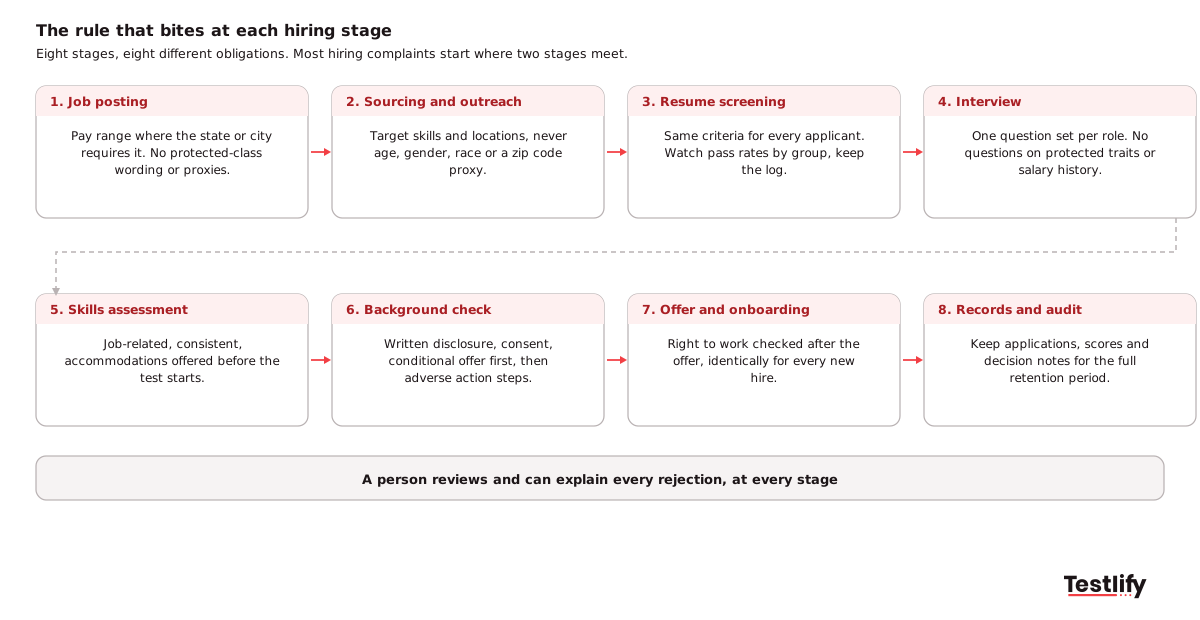
1. Job posting
Job postings must include a pay range where the state or city requires one. Drop anything that signals a protected trait, and avoid proxies such as "digital native" or "recent graduate". Keep one approved template per role family.
2. Sourcing and outreach
Sourcing should filter on skills and work location only. Audience filters that use age, gender or a zip code stand-in are the fastest route to a claim, and Illinois now names the zip code case directly.
3. Resume screening
Resume screening needs written criteria. Write down every criterion you screen out on, apply it to every applicant, and track pass rates by group. Common types of hiring bias shows where those criteria usually drift.
4. Interviews
Interviews work best with one question set per role, asked in the same order. Avoid questions on age, family plans, health, religion, immigration status beyond right to work, or salary history where that is banned. Structured interviews are the cheapest defense available.
5. Skills assessment
Skills assessments should be job-related. Give every candidate the same version and the same time, and publish the route to request an accommodation before the test opens. Legal compliance for hiring tests covers the detail.
6. Background checks
Background checks follow a fixed sequence under the Fair Credit Reporting Act. Start with a standalone written disclosure and the candidate's consent, then run the check. Send a pre-adverse action notice with a copy of the report and a reasonable window to dispute before the final adverse action letter. Fair chance rules decide how early you may ask at all.
7. Offer and onboarding
Offer and onboarding checks should verify right to work after the offer, with the same documents requested from every hire. Asking only some candidates for extra proof is itself a violation.
8. Records and audit trail
Records need one retrievable home. Store applications, scores, interview notes and the reason for each rejection somewhere searchable by role, not in individual inboxes.
How long do you have to keep candidate records?
Retention periods are shorter than most teams assume and longer than most systems are configured for. The federal floor is one year, several states and contractor rules go further, and any filed charge freezes everything relevant until the matter ends.
Record | Minimum retention | Source of the rule |
|---|---|---|
Applications, resumes and hiring records | 1 year from the decision | EEOC regulations under Title VII and the ADA |
Records of an involuntarily terminated employee | 1 year from the termination date | EEOC regulations |
Payroll records | 3 years | ADEA and the Fair Labor Standards Act |
Records relevant to a filed charge | Until final disposition, including appeals | EEOC charge rules |
Applicant and personnel records in California | 4 years | California Fair Employment and Housing Act |
Automated decision data where state AI rules apply | Set by the state rule, commonly longer than a year | Illinois, California and Colorado rules |
Retention is only half the duty. Candidates in the EU, the UK, and California can ask what you hold and ask for deletion, so you also need a working route to find and remove one person's data. Our article on Candidate data security covers how to set that up without losing the audit trail.
Who is liable when an AI tool or assessment screens candidates out?
The employer carries the liability, not the vendor. Buying a screening tool transfers the work, not the legal duty, and both the New York City rules and the California regulations place the obligation on the employer who deploys the tool.
A vendor's assurance is evidence, not a defense.
Four questions are worth asking any screening vendor before you sign, and worth re-asking every year:
- Can you show a bias audit of this tool, completed within the last twelve months, by someone independent?
- What exactly does the model use as input, and can you confirm it does not use zip code, name or photograph?
- Can a recruiter see why a specific candidate was ranked where they were, in language a candidate would understand?
- Who indemnifies whom if a screen produces an adverse impact, and is that in the contract?
This is where scored skills assessment is easier to defend than resume filtering. A role-based test records what each candidate did, scores every answer against the same criteria, and leaves a reason behind each ranking.
Testlify publishes the results of a third-party bias audit of its matching model on its New York City bias audit page. The same logic applies to any tool you buy: if the vendor cannot show you the audit, you are the one holding the risk.
What do recruitment compliance rules look like outside the United States?
Outside the United States, the center of gravity moves from anti-discrimination enforcement to data protection. The duties are often stricter, and they apply as soon as you process a candidate's data in that region, wherever your company is based.
In the European Union, the GDPR requires a lawful basis for processing candidate data, a stated retention period, and a right to human intervention where a decision is made solely by automated means. Recruitment also sits in Annex III of the EU AI Act, which classes it as high risk.
Regulation (EU) 2026/1744 moved those high-risk obligations from August 2026 to December 2, 2027, so there is a real window to prepare rather than a reason to stop.
The United Kingdom runs UK GDPR plus the Equality Act 2010, with nine protected characteristics, and the Information Commissioner's Office has been explicit that recruitment tools must be fair, explainable and proportionate. Right to work checks are mandatory for every hire.
Acas guidance is the practical reference recruiters use for fair process.
Canada splits the duty between federal and provincial human rights codes and privacy law, and Ontario now requires employers to disclose the use of AI in publicly advertised job postings.
India relies on the Equal Remuneration provisions of the Code on Wages, the Rights of Persons with Disabilities Act, and the Digital Personal Data Protection Act of 2023, which brings consent and deletion duties close to the GDPR model. GDPR compliance explains how assessment data is handled under that regime.
Which legal considerations in recruitment compliance tips belong in your audit?
The legal considerations in recruitment compliance tips worth auditing are the nine that produce a document rather than an opinion. Run the list once a quarter, and treat any line you cannot evidence as a failure rather than a maybe.
Our article on Legal compliance checklist for hiring is the longer version to hand to whoever owns the process.
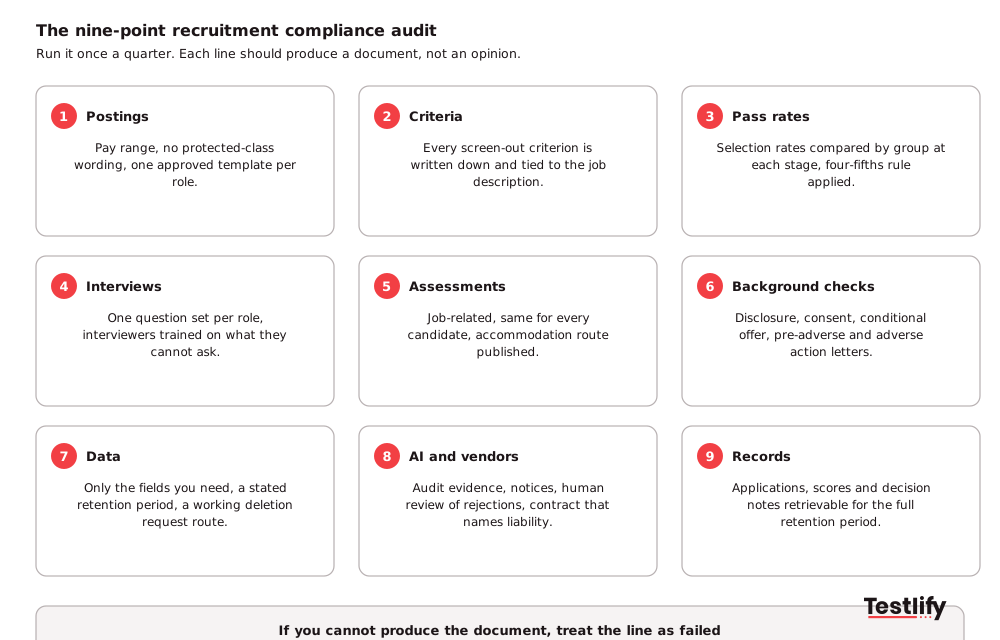
Run the nine-point audit as a working document each quarter. Give every line one named owner, record the date it was checked, and attach the evidence. That might be the approved posting template, a pass-rate comparison by group, or a vendor's bias audit. Any line without evidence counts as a failure until it is fixed.
Ready to make your skills assessments easier to defend?
Testlify gives every candidate the same job-related test, scored against the same criteria, with a record of each result. Choose from 3,500+ validated tests in 25+ question types, backed by 20+ proctoring checks and 100+ ATS integrations, so your assessment records sit alongside the rest of your hiring evidence.
Start your 7-day free trial with no credit card required, browse the test library, or book a demo to get started today.
Frequently asked questions (FAQs)

People and Talent Partner
Arushi Shah runs day-to-day talent acquisition and candidate experience at Testlify. She writes on interviewing, structured hiring, and giving candidates a fair, fast process.
LinkedInRelated resources
View all
HR & recruitment
Creating a positive candidate experience

HR & recruitment
Pre-employment assessments: what you need to know

HR & recruitment
7 Candidate Sourcing Strategies That Work in 2026

HR & recruitment
Building a strong employer brand: tips

HR & recruitment
10 skills every recruiter should look for

HR & recruitment
How to craft effective job descriptions
Get started.
Hire on proof, not resumes.
Run your first skills-based assessment free — no credit card required.