
Remote hiring challenges and how to overcome them
Remote hiring opens access to global talent and lower costs, but it also brings new challenges. Here’s how to manage both with structure and trust.

 ChatGPT
 Gemini
 Claude
 Grok
Grok Perplexity
TL;DR: Key takeaways
- The five remote hiring challenges that actually cost you hires are judging skills without an in-person read, communication and time-zone gaps, protecting culture, onboarding people you never meet, and cross-border compliance.
- The hardest one is assessing candidates accurately. A confident video call is easy to mistake for real ability, so score the skill before the first conversation.
- Hiring for skills is five times more predictive of job performance than hiring for education (McKinsey), which is exactly the signal a remote screen should lead with.
- Structure beats surveillance. Async rules, scorecards, and a paced onboarding plan fix more than any monitoring tool.
- Get remote hiring right and you buy access to talent in every time zone, a faster shortlist, and a fairer process. Get it wrong and you scale mis-hires across borders.
Remote hiring did not get easier, it became the new normal. About 9% of US workers are now fully remote and another 28% are hybrid, per Owl Labs’ 2025 State of Hybrid Work report. So the question stopped being whether to hire remotely and became how to do it without shipping bad hires to five countries at once.
In this article, we’ll break down the biggest remote hiring challenges, from assessing candidates without face-to-face interaction to maintaining consistency, communication, and culture across distributed teams. We will also provide you with the practical fixes for each challenge faced by your hiring team.

Remote hiring challenges at a glance
Challenge | Why it bites harder remotely | The fix that works |
|---|---|---|
Evaluating skills | No in-person read; charisma reads as competence on video | Skills test before the first call |
Communication and time zones | Live loops stretch into weeks; candidates drop out | Async-first rules, dual-time-zone scheduling |
Culture and inclusion | Proximity bias favors the people managers physically see | Shared rubric, deliberate visibility |
Remote onboarding | New hires guess; slow ramp-up, early attrition | Structured 30-day plan, named buddy |
Cross-border compliance | Different laws, taxes, and data rules per country | Classification review, Employer of Record, role-based access |
Applicant volume | Hundreds of hard-to-verify applicants per role | Objective assessment, identity verification |
What are the biggest challenges in remote hiring?
The biggest challenges in remote hiring are evaluating candidates accurately, closing communication and time-zone gaps, keeping culture and inclusion intact, onboarding people you never meet in person, and staying compliant across borders. Each one traces back to the same problem: remote hiring strips out the casual cues, the desk-side chat, the read-the-room moment, that used to fill the gaps in a hiring decision.
1. Evaluating candidates accurately (the hard one)
This is the challenge that quietly costs the most, and it is the one most guides wave past. On a video call, charisma reads as competence. A candidate who interviews well can look like a strong hire and turn out to be a weak one, and you only find out three months in, after onboarding a stranger across a border. The old proxies (a firm handshake, watching someone whiteboard) are gone.
The fix is to measure the skill before you meet the person, not after. Hiring for skills is five times more predictive of job performance than hiring for education and more than twice as predictive as hiring for experience, according to McKinsey. A short, role-specific skills test or work sample at the top of the funnel tells you more than a polished resume ever will.
2. Communication gaps and time-zone differences
When a candidate is eight hours ahead, a hiring loop that ran in three days over desk chats can stretch into three weeks of missed replies. Interview scheduling turns into a negotiation. Feedback that used to happen in a hallway now sits in someone’s inbox overnight. Candidates drop out of slow processes, and the best ones drop out first.
Treat communication as async-first by default. Write the job scope and the process steps down so nothing depends on catching someone live. Batch interviews, use scheduling tools that show both time zones, and set a clear service level for feedback (say, one business day). For a deeper playbook on spanning distance and culture, our guide on recruiting across cultures and time zones goes further than we can here.
3. Protecting culture and inclusion
Culture does not travel through a screen on its own. New hires can feel like contractors instead of teammates, and remote workers risk being quietly passed over. Harvard Business Review calls this proximity bias, the pull to favor the people managers physically see. Left alone, it means the in-office crowd gets the stretch projects and the promotions while remote talent stalls.
Design against it. Score every candidate against the same rubric so who-you-clicked-with stops deciding offers. After the hire, make visibility deliberate: rotate who leads meetings, document decisions in writing, and judge output rather than hours online. Inclusion in a remote team is a process choice, not a vibe.
4. Onboarding people you never meet in a room
A remote new hire can spend their first week guessing. No desk neighbor to ask, no ambient sense of how things work here. A shaky start is expensive: it slows time-to-productivity, and it is where a lot of early attrition begins.
Give the first 30 days a real structure. Schedule introductions, book system-access and training sessions in advance, set week-one and month-one goals, and assign a named buddy so there is always one person to ask.
5. Compliance and data security across borders
Hire across borders and every country brings its own labor law, tax rules, and worker rights. Misclassify a contractor as an employee, or get the tax jurisdiction wrong, and you are looking at penalties and backdated taxes. On top of that, candidate data now moves through video tools, inboxes, and test platforms, which widens your security exposure.
Two moves handle most of it. Use an Employer of Record to hold local compliance, contracts, and payroll in each country, so you are not standing up a legal entity per hire. And lock down candidate data with role-based access and a VPN, so only the people who need a candidate’s information can see it.
6. Screening a flood of applicants
Drop the location filter and a single role can pull hundreds of applicants from a dozen countries with credential systems you cannot eyeball. Manual screening does not scale to that, and a tired reviewer skimming resume number 214 makes worse calls than the assessment they skipped.
Put an objective filter at the top of the funnel. A skills assessment scores every applicant on the same task, so the shortlist rises on evidence instead of keyword-matched resumes.
It also protects you from your own bias when the pile is huge. A few tips for overcoming remote job application hurdles on the candidate side: keep the assessment short, tell people where they stand, and score fast so strong applicants do not go cold.
If you are formalizing this, our walkthrough on building objective hiring assessments covers how to design one that predicts performance rather than test-taking.
Remote hiring challenges at a glance
Challenge | Why it bites harder remotely | The fix that works |
|---|---|---|
Evaluating candidates accurately | No in-person read; charisma reads as competence on video | Skills test before the first call; combine multiple signals |
Communication and time zones | Live loops stretch to weeks; candidates drop out | Async-first rules, dual-time-zone scheduling, 1-day feedback SLA |
Culture and inclusion | Proximity bias favors the people managers see | Same rubric for all; judge output, not hours online |
Remote onboarding | New hires guess; slow ramp, early attrition | Structured 30-day plan, named buddy, reuse assessment data |
Cross-border compliance | Different laws, taxes, misclassification risk | Employer of Record; role-based data access and VPN |
Applicant volume | Hundreds of hard-to-verify resumes per role | Objective assessment scores the top of the funnel |
What does remote hiring compliance cover?
Remote hiring compliance covers four areas: worker classification, payroll and taxation, data protection, and device security. Each area carries its own penalty for getting it wrong, and together they explain why hiring globally is never as simple as posting a job and picking a winner.
Know everything about the art of remote recruitment covers the wider recruitment picture if you want the full process view before this deeper compliance breakdown.
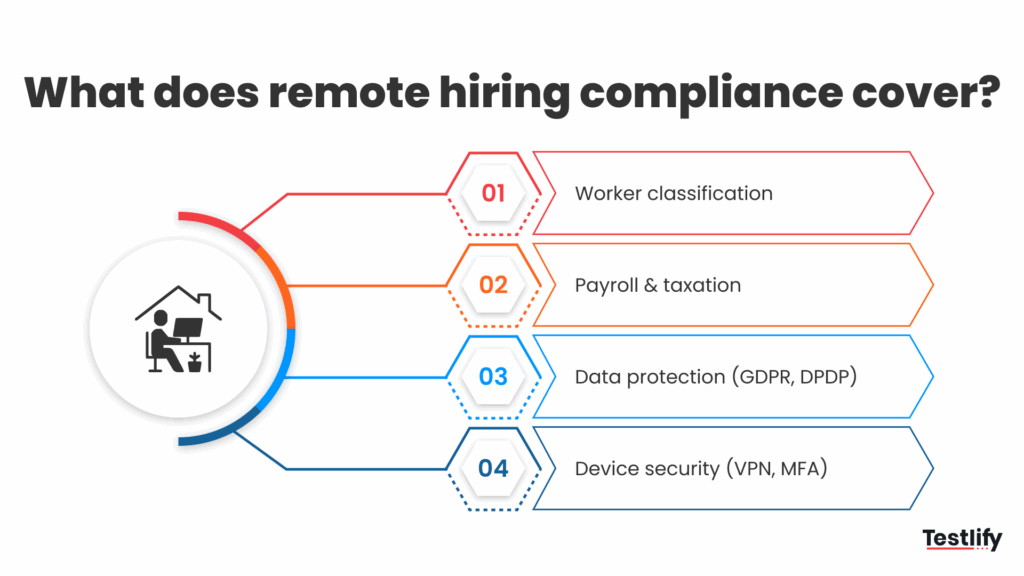
Worker classification
Worker classification determines whether the person you hire counts as an employee or an independent contractor under local law. The distinction controls tax withholding, benefits eligibility, and termination rights, and different countries draw the line differently.
Control is usually the deciding factor. The more you dictate how, when, and where someone works, the more likely regulators are to classify that person as an employee, even if your contract calls them a contractor.
Misclassification is expensive to unwind. It can trigger back taxes, unpaid benefits, and penalties in more than one jurisdiction at once, especially since labor agencies keep revising their tests for who counts as a contractor.
Payroll and taxation
Payroll and taxation cover how you pay a remote worker correctly, in their own country, in their own currency, with the right statutory contributions withheld. Get the jurisdiction wrong and you risk double taxation for the employee, incorrect social security contributions, or a permanent establishment problem for the company.
A permanent establishment problem means your company accidentally creates a taxable presence in a country simply by having an employee work there. That single mistake can trigger corporate tax obligations you never planned for.
Most companies solve this with an Employer of Record, a third-party organization that legally employs the worker on your behalf and handles local payroll, tax, and statutory benefits.
Data protection under GDPR and DPDP
Data protection covers how you collect, store, and process candidate and employee information during recruitment. Two laws matter most for a global hiring team right now.
The General Data Protection Regulation, or GDPR, is the European Union's data privacy law. It applies to any candidate data from someone in the EU no matter where your company operates, and it requires a lawful basis for processing, clear retention limits, and breach notification within seventy two hours.
The Digital Personal Data Protection Act, or DPDP Act, became India's data privacy law in 2023. The law treats an employer as a data fiduciary and every candidate or employee as a data principal, and it applies to digital personal data that a company processes within India as well as data it processes outside India when that processing relates to offering services to people who live there.
Both laws demand the same underlying discipline. Collect only the candidate data a role actually needs, define how long you keep it, and document a plan for notifying the right authority if a breach happens.
Device security with VPN and MFA
Device security covers how you protect candidate and employee data once it moves through video tools, inboxes, and assessment platforms outside a controlled office network. A remote hiring process multiplies the number of unmanaged devices and networks that touch sensitive information.
Two controls handle most of the exposure. A virtual private network, or VPN, encrypts the connection between a remote device and your systems, and multi-factor authentication, or MFA, requires a second proof of identity beyond a password before anyone can reach candidate data. Forbes' Human Resources Council names both as baseline controls for any distributed team.
The cost of skipping this step is measurable. IBM's Cost of a Data Breach research has repeatedly found that breaches cost over one million dollars more on average when remote work is a contributing factor, largely because detection and containment take longer across distributed devices. Are background checks enough to stop employment fraud covers the identity side of this same problem, since a secure connection means little if the person on the other end was never who they claimed to be.
How do you overcome the challenges of remote hiring?
Remote hiring works when you replace office-based structure with a clear, consistent process. Focus on these six steps to assess candidates fairly, maintain trust, and reduce the biggest challenges of remote recruitment.
1. Define the role in evidence
Before you post the job, identify the three or four things the person must actually be able to do and decide how you will measure each one. “Strong communicator” is a preference. “Can write a clear async project update that gives a stakeholder enough information to act” is something you can test.
2. Assess skills at the top of the funnel
Use a short, role-specific assessment early in the process rather than relying on resumes and interviews to do all the filtering. This turns a large applicant pool into a scored shortlist and puts job-relevant evidence ahead of credentials, polish, or proximity.
3. Combine signals before you decide
Do not let one interview, assessment, or work sample determine the outcome. Review multiple independent signals together, such as assessment scores, work samples, structured interviews, and reviewer notes. When those signals point in the same direction, you have stronger evidence for the decision.
4. Keep remote assessments honest
Remote testing creates a different challenge: you need confidence that the result represents the candidate's own ability. Identity verification and AI-assistance detection can help protect the integrity of an assessment without turning the hiring process into constant surveillance. The goal is not to watch candidates. It is to trust the evidence you collect.
5. Standardize the human steps
Give every candidate the same core interview questions, scorecard, and evaluation criteria. This makes candidates easier to compare and reduces the influence of proximity bias, interviewer preference, and gut feeling. In remote hiring, structure has to replace the consistency that an office environment used to provide naturally.
6. Outsource the legal load
Cross-border hiring adds another layer of complexity, from employment contracts and payroll to taxes and local compliance. An Employer of Record can handle much of that infrastructure for you, so the hiring team does not have to build a separate legal and payroll process for every country.
The bigger lesson: remote hiring works best when you replace the structure an office provided for free with deliberate structure in the hiring process. Assess skills early, collect multiple signals, standardize decisions, protect assessment integrity, and use the right infrastructure for international hiring. You get a process that is more consistent without resorting to surveillance.
What do small teams and staffing agencies get wrong?
Small firms and recruitment agencies feel two of these challenges harder than anyone: volume and compliance. The top challenges of remote work for search agencies and the small firms’ remote talent challenges are really the same two problems at different scale. A lean team of three cannot read 300 applications a week, and one misclassified contractor can wipe out a quarter’s margin in back taxes. Agencies feel it double, because they carry the risk across many clients and roles at once.
The trap is trying to solve it with more hours. The way out is to automate the top of the funnel with an assessment that scores applicants for you, and to lease compliance through an Employer of Record rather than owning it. Both moves turn a headcount problem into a tooling one, which is the only version a small team can win. The skills that matter are shifting fast too: the World Economic Forum’s Future of Jobs Report finds employers expect 39% of workers’ core skills to change by 2030, so a screen built on last year’s job description ages quickly. Test for the skill the role needs now, and revisit it often.
What do you gain when remote hiring works?
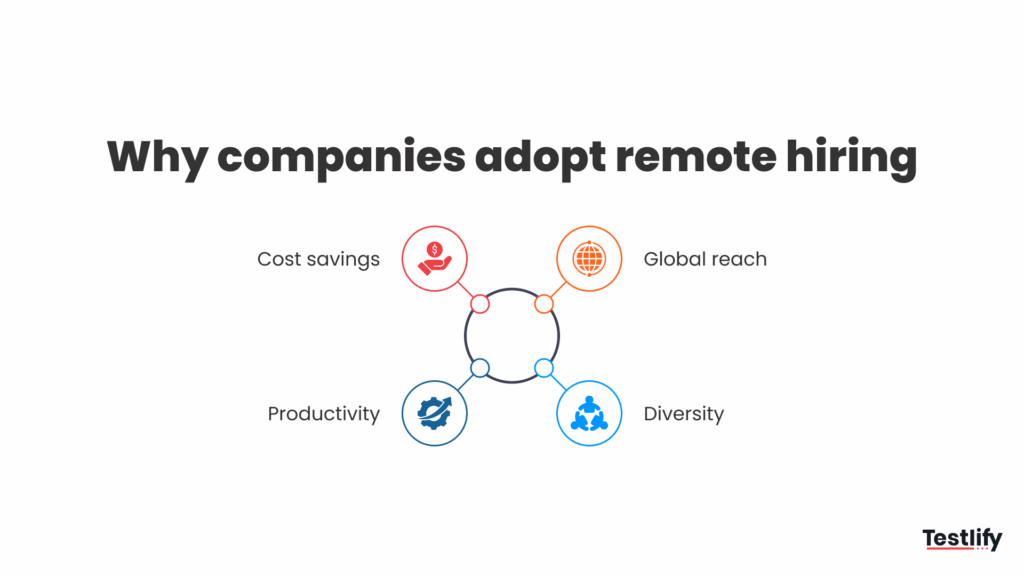
Solve these challenges and remote hiring stops being a risk and starts being an edge. You can hire the best person for the role whether they are in Austin or Lisbon, instead of the best person within a 40-minute commute.
Costs drop because you are not paying for desks or one city’s salary band. And a skills-first, structured process tends to produce a fairer shortlist, since it judges what people can do rather than where they went to school or who they reminded you of.
The challenges are real, but every one of them has a known fix, and the fixes compound. A company that runs remote hiring well is not just coping with distributed work. It is out-hiring the competitors still fishing in one zip code. For the full end-to-end process, our complete guide to remote hiring maps every stage.
Score skills before the first call
The hardest remote hiring challenge, judging ability without an in-person read, is the one Testlify was built for. Send a role-specific skills assessment to every applicant, combine it with structured interviews and reviewer scores, and keep the test honest with identity and AI-assistance checks. You walk into the first call already knowing who can do the work.
Book a demo to see skills-first remote screening in action, or start a free trial and browse the remote hiring assessment library.
Key takeaways
- Assessment is the challenge that pays back most. A video call rewards confidence, not competence, so scoring the skill first is where remote hiring is won or lost. Fix this one and the others get easier.
- Lead with skills, not credentials. Skills-based hiring is five times more predictive of performance than education (McKinsey). A short assessment at the top of the funnel turns a resume pile into ranked evidence.
- Structure beats surveillance. Async communication rules, a shared scorecard, and a paced onboarding plan solve more than any monitoring tool, and they protect against proximity bias while they do it.
- Compliance is a tooling choice, not a heroics one. An Employer of Record plus role-based data access removes most cross-border risk, which is what lets a small team hire globally at all.
- Skills expire faster now. With 39% of core skills expected to change by 2030 (WEF), test for what the role needs today and refresh the assessment as the job moves.
Frequently asked questions

Content Writer
Yashika Khandelwal is a Content Writer with 3+ years of experience creating research-backed content on hiring, talent assessment, and HR technology. She is a registered Organizational Psychologist and subject matter expert who combines behavioral science with practical recruitment insights to produce accurate, evidence-based content.
LinkedInRelated resources
View all
HR & recruitment
Best practices for using personality tests for inclusive hiring

HR & recruitment
How to keep lateral hires engaged and thriving in a company

HR & recruitment
How to use AI and ATS for efficient lateral hiring in 2026

HR & recruitment
How lateral hiring can enhance your teams’ inclusivity

HR & recruitment
Talent planning essentials for modern businesses

HR & recruitment
Navigating talent planning in the digital era
Get started.
Hire on proof, not resumes.
Run your first skills-based assessment free — no credit card required.