
40 sales operations analyst interview questions to ask in 2026
Ask these sales operations analyst interview questions to test CRM, Excel, SQL and forecasting skills, then score answers the same way.

One bad CRM field can turn a pipeline report into a guess. Yet many interviews for this role reward fluent talkers and miss the people who can clean the data.
These 40 sales operations analyst interview questions cover CRM and data hygiene, Excel and SQL, forecasting, process fixes and sales partnership. Each set shows what a strong answer looks like, which red flags to watch for and how to confirm skills with a work sample.
TL;DR:
- The best sales operations analyst interview questions test five skills: CRM data, Excel and SQL, forecasting, process improvement and partnership with sales.
- Ask candidates to explain a stage-weighted forecast and how they checked its accuracy. Strong analysts compare forecast to actuals and adjust.
- A short work sample on a messy pipeline export tells you more than any answer about "attention to detail".
- Red flags: tools listed with no business result, results with no method, and blaming reps for bad data instead of fixing the process.
- Run a skills test on Excel, SQL and CRM before the interview so the panel spends its time on judgment, not basics.
- Score every candidate on the same scorecard, alone first, then debrief. Only 25% of TA pros feel highly confident measuring quality of hire, according to LinkedIn.
 ChatGPT
 Gemini
 Claude
 Grok
 Perplexity
What does a sales operations analyst do?
A sales operations analyst keeps the sales engine measurable. The analyst owns CRM data quality, builds reports and dashboards, supports the forecast, models territories and quotas, and finds where deals stall so sales leaders can fix the process.
The role sits between sales, finance and RevOps systems.
Day to day, that means pulling pipeline data from Salesforce or HubSpot, cleaning it in Excel or SQL, and explaining what changed and why. Senior analysts also design commission plans, run win and loss analysis and own the forecast call.
The analyst role is more analytical than a coordinator role, which handles scheduling, order entry and admin for the sales team. If you are hiring the admin side, use our sales operations interview questions for coordinators instead.
Before you interview, align the panel on a clear sales operations analyst job description.

Which skills should sales operations analyst interview questions test?
Sales operations analyst interview questions should test five skills: CRM and data hygiene, Excel and SQL, forecasting and sales metrics, process improvement, and the ability to explain numbers to sales leaders and win their buy-in. Each question set below maps to one or two of these skills.
Skill | What good looks like | Best way to test it |
|---|---|---|
CRM and data hygiene | Builds validation rules, runs duplicate and stale-deal reports, knows the object model | Technical questions + CRM skills test |
Excel and SQL | Pivots, lookups, joins, cleans data before analysing it | Skills test + work sample |
Forecasting and metrics | Stage-weighted pipeline, coverage ratio, forecast accuracy, cycle length | Forecasting questions + worked example |
Process improvement | Finds the real bottleneck, measures before and after | Behavioral questions |
Sales partnership | Explains data in plain words, handles pushback from reps | Situational questions + work sample presentation |
Skills-based screening pays off for analytical roles. LinkedIn's Future of Recruiting 2025 report found that companies running the most skills-based searches are 12% more likely to make a quality hire.
What general questions should you ask a sales operations analyst?
General sales operations analyst interview questions check motivation, scope of past roles and the tools the candidate used every day. Use them in the screening call to confirm the candidate has done analyst work, not only sales admin.
- Walk me through the sales operations work you owned in your last role. Which reports or processes would break if you left?
- How big was the sales team you supported, and how was it structured by segment or region?
- Which CRM did you use, and what did you change in it yourself?
- Which reports or dashboards did sales leaders open every week, and which did you build?
- What does a good week look like for a sales operations analyst?
- Which sales metric do you think most teams track badly, and why?
- What do you want to learn in this role that you could not learn in your last one?
- What would you focus on in your first 90 days here?
Pro tip: Ask question 1 first and listen for ownership. Strong candidates name reports and processes they built. Weak candidates describe what "the team" did.
What technical questions test CRM, Excel and SQL skills?
Technical sales operations analyst interview questions test whether the candidate can get clean data out of the CRM and analyse it without help. Ask for steps, not definitions, and follow up on any tool the candidate names.
- How do you find and fix duplicate accounts and contacts in the CRM? Listen for: a matching rule, a report or query to find duplicates, a merge plan and a rule to stop new ones.
- Which validation rules or required fields have you added, and what did they fix? Listen for: a specific field, the data problem behind it and the drop in bad records.
- How would you build a report of deals that have sat in one stage for over 30 days? Listen for: stage history or a date field, a filter, and who gets the report.
- When do you use a pivot table, XLOOKUP or SUMIFS on sales data? Listen for: real use cases, such as pipeline by rep and stage, or matching bookings to quota.
- How would you write a SQL query that returns closed-won revenue by rep for last quarter? Listen for: a join between opportunities and users, a date filter, a status filter and GROUP BY.
- How do you reconcile CRM bookings with finance's revenue numbers when they differ? Listen for: matching on deal ID, timing differences, and a shared definition of "booked".
- Which dashboard tools have you used, and how do you decide what goes on a sales dashboard? Listen for: Tableau, Power BI or native CRM dashboards, and a short list of decision-driving metrics.
- How do you clean a raw export before you analyse it? Listen for: checks for blanks, outliers, wrong currencies and duplicate rows, before any chart.
- How have you automated a manual sales report? Listen for: scheduled reports, flows or scripts, and the hours saved each month.
Which forecasting and metrics questions reveal analytical depth?
Forecasting and metrics questions show whether a sales operations analyst understands what drives revenue, or only reports it. Strong candidates explain the math, admit forecasts are wrong at first and describe how they improved accuracy over time.
- How do you build a monthly forecast from the pipeline?
- A rep has $400,000 in pipeline: $200,000 in discovery at a 20% close rate and $200,000 in proposal at a 50% close rate. What is the weighted forecast?
- Which metric best predicts whether a team will hit quota this quarter?
- How do you measure forecast accuracy, and what would you do if the team over-forecasts by 10% every month?
- How would you calculate pipeline coverage, and what ratio would worry you?
- How do you measure sales cycle length, and why might it differ by product or segment?
- How would you set quotas for a new territory with no sales history?
- Which leading indicators do you track, and which lagging ones?
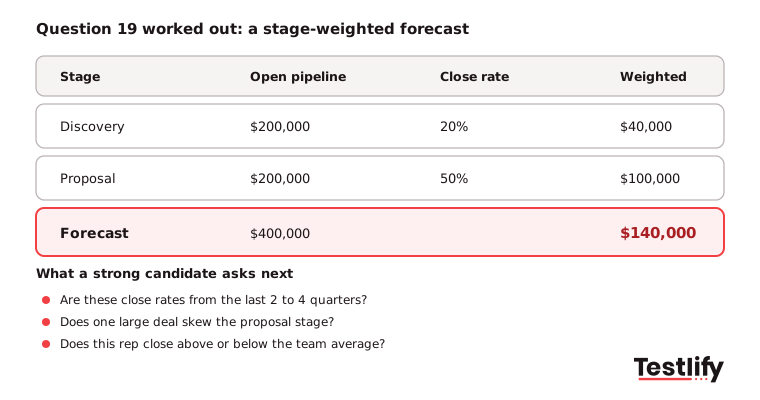
For question 19, the answer is $140,000 ($40,000 from discovery plus $100,000 from proposal). The best candidates go further: they ask whether the close rates are recent, whether large deals skew the stage, and whether the rep's own history differs from the team average.
Key takeaway: A strong analyst treats the forecast as a model to test, not a number to defend. Ask how they compared forecast to actuals and what they changed.
Which behavioral questions should you ask?
Behavioral sales operations analyst interview questions ask for real past situations, so the candidate has to show what they did, not what they would do. Ask for the situation, the action and a measured result, and probe any number they give.
- Tell me about a time you found an error in a report that leaders had already used. What did you do?
- Describe a sales process you fixed. What was broken, how did you prove it, and what changed after?
- Tell me about a time sales reps pushed back on a new CRM rule or process. How did you get them to adopt it?
- Describe a time you had to deliver bad news from the data to a sales leader.
- Tell me about an analysis that changed a decision on pricing, territories or headcount.
- Describe a time you had to deliver several urgent reports at once at quarter end. How did you decide the order?
- Tell me about a time you worked with finance or marketing to agree on one definition of a metric.
- Describe a tool or system rollout you supported. What would you do differently?
Which situational questions show how a candidate thinks?
Situational questions give the candidate a realistic problem with no single right answer. They show how a sales operations analyst structures an unknown problem, which data they reach for first and how they bring sales leaders along.
- Revenue in one region has dropped for two quarters. Where do you start?
- The CRM pipeline shows $2 million for an account, but the account manager says it is closer to $500,000. Which number goes in the forecast?
- Reps are not using a new sales tool the company paid for. How do you find out why?
- The VP of Sales wants a new dashboard by Friday, and finance needs a commission report the same day. What do you do?
- Marketing says lead quality is fine, sales says it is poor. How would you settle it with data?
- You find that one top rep's deals often slip from one quarter to the next. How do you raise it?
- Leadership asks you to cut the sales cycle by 20%. What would you analyse first?
Question 35 comes up in real sales analyst interviews, according to candidate reports on Glassdoor. Good answers reconcile the gap before choosing: check the deal stages, close dates and products, talk to the account manager, then document which source wins and why.
What do strong answers to sales operations analyst interview questions look like?
Strong answers to sales operations analyst interview questions name a specific situation, a method, a result with a number and what the candidate learned. Here are five worked examples you can use as a benchmark for your scorecard.
Question 9: How do you find and fix duplicate accounts in the CRM?
Look for: a repeatable method and prevention, not a one-time cleanup.
Example answer: "I ran a report grouping accounts by cleaned domain name and found about 900 likely duplicates. I agreed merge rules with the sales manager, such as keeping the record with the most recent activity, merged them in batches and added a duplicate rule on new accounts."
"Duplicate creation dropped to a handful a month."
Question 18: How do you build a monthly forecast from the pipeline?
Look for: stage-weighted math, a human review of large deals and a feedback loop.
Example answer: "I apply our historical close rate for each stage to the open pipeline, then review every deal over $50,000 with the rep. Each month I compare the forecast to actual bookings."
"When we over-forecast three months in a row, I lowered the proposal-stage rate and accuracy improved the next quarter."
Question 27: Describe a sales process you fixed.
Look for: the problem in numbers, a change the candidate drove and a before and after.
Example answer: "Leads waited four days on average before first contact because routing was manual. I mapped the steps, set up automatic round-robin routing in the CRM and an alert after four hours."
"Average time to first contact fell to under one day, and the sales manager kept the alert as a weekly report."
Question 28: Tell me about reps pushing back on a new CRM rule.
Look for: listening first, a smaller ask and proof the change helped the reps themselves.
Example answer: "Reps hated a rule with eight required fields at proposal stage. I asked which fields they actually used, cut it to three that finance and marketing needed, and showed reps how those fields fed their commission report."
"Completion went from about half of deals to nearly all of them."
Question 34: Revenue in one region has dropped. Where do you start?
Look for: a structured breakdown before any conclusion.
Example answer: "First I check whether the drop is seasonal by comparing the same quarters last year. Then I split it by rep, product, deal size and stage conversion to see whether pipeline shrank or win rate fell."
"Only then do I talk to the regional manager about churned accounts, new competitors or ramping reps."
What red flags should interviewers watch for?
Red flags in sales operations analyst interviews are answers that sound fluent but show no method, no ownership or no respect for data quality. Score them down consistently, and probe once before you decide, because nerves can hide real skill.
Topic | Strong answer | Red flag |
|---|---|---|
Tools | Names the tool, the task and the result | Lists tools with no business outcome |
Results | Explains how the result was measured | Big percentages with no method or baseline |
Data quality | Prevents bad data with rules and audits | "I just double-check everything" |
Forecasting | Compares forecast to actuals and adjusts | Defends the forecast, never checks error |
Working with sales | Understands why reps resist, finds a smaller ask | Blames reps for bad data |
Ownership | "I built", "I changed", "I found" | Only "we" and "the team" with no personal role |
Ambiguity | Asks clarifying questions, states assumptions | Jumps straight to an answer |
How do you run a sales operations analyst interview process?
A good sales operations analyst interview process has five stages: a skills test, a screening call, a technical interview, a short work sample and a scored debrief. Each stage tests something the others cannot, and the same scorecard keeps the panel consistent.
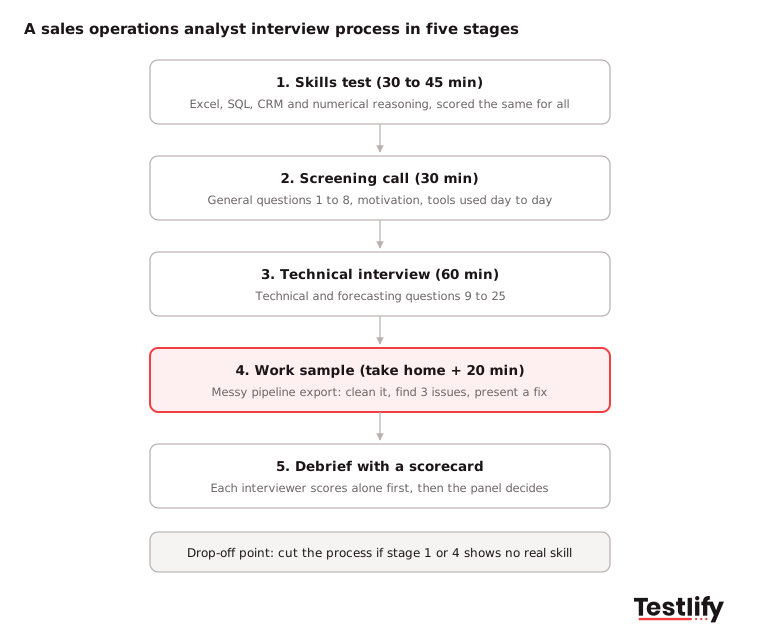
- Skills test: Test Excel, SQL, CRM knowledge and numerical reasoning before anyone spends time on interviews. Every candidate gets the same questions and an objective score.
- Screening call: Use general questions 1 to 8 to confirm scope, tools and motivation in 30 minutes.
- Technical interview: Use technical and forecasting questions 9 to 25. A hiring manager from sales ops or RevOps should run it.
- Work sample: Send a messy pipeline export of 200 to 500 rows 24 to 48 hours ahead. Ask the candidate to clean it, find three issues and present one fix in 20 minutes.
- Scored debrief: Each interviewer scores alone on a 1 to 4 scale per skill, then the panel compares evidence. Behavioral and situational questions 26 to 40 belong in stages 3 and 5.
A written scorecard also gives you data to judge the hire later. According to LinkedIn's Future of Recruiting 2025 report, only 25% of TA pros feel highly confident in measuring quality of hire.
Use a structured interview format so every candidate gets the same questions in the same order. Skills-first hiring is now common: SHRM's 2025 skills-first research found that 34% of organizations often or almost always use skills-first methods, and those organizations were more likely to exceed financial objectives (35% versus 27%).
Across the teams we work with, the work sample is the stage that separates candidates most clearly, and we have seen it catch gaps that a polished interview hid. Two candidates with similar interviews often look very different once they handle a real export with blanks, duplicates and mixed currencies.
Which skills tests should you use before the interview?
Skills tests for a sales operations analyst should cover CRM, Excel, SQL, data analysis and numerical reasoning. Testlify's test library has 3,500+ validated tests, so you can combine several into one assessment and send it before the first call.
Skill | Testlify test |
|---|---|
CRM | |
Excel | |
SQL | |
Data analysis | |
Numbers | |
Judgment |
A single Testlify assessment can cover CRM, Excel, SQL and numerical reasoning in one sitting. Candidates finish it before the first call, so your panel meets only people who show the basics. Here is what that setup gives you:
- One assessment, several skills: Combine three to five tests and add your own questions from 25+ question types, such as a file upload for a short Excel task.
- Fair, comparable scores: Every candidate is scored automatically on the same questions, with a per-skill breakdown for the panel.
- Integrity checks included: 20+ proctoring checks, such as tab monitoring, copy and paste blocking and webcam snapshots, help you trust remote results.
- Fits your ATS: Testlify connects with 100+ ATS and HRIS tools, so scores sit next to the candidate profile.
Hiring for a pure reporting role? Our sales analyst interview questions go deeper on analysis and visualization.
Ready to hire your next sales operations analyst?
Pick tests for the role, then use the questions above in the interview. Browse the Testlify test library to find the skills you need.
Book a demo to see how Testlify fits your hiring process, or start a 7-day free trial, no credit card required.
Frequently asked questions (FAQs)

Head of Sales
Pradeep is the sales and business growth engine behind Testlify’s enterprise expansion, bringing over 20 years of experience scaling revenues in complex, high-growth environments. He played a pivotal role in taking Testlify to $1M ARR, building a high-performing sales organization from the ground up and forging the strategic partnerships that accelerated market penetration.
LinkedInRelated resources
View all
HR & recruitment
60 Community Manager interview questions to ask job applicants

HR & recruitment
60 Public Affairs Specialist interview questions to ask job applicants

HR & recruitment
60 Learning and Development Coordinator interview questions to ask job applicants

HR & recruitment
60 Diversity and Inclusion Coordinator interview questions to ask job applicants

HR & recruitment
60 Events Coordinator interview questions to ask job applicants

HR & recruitment
60 Reverse Logistics Coordinator Interview Questions to Ask
Get started.
Hire on proof, not resumes.
Run your first skills-based assessment free — no credit card required.