
11 high-volume hiring strategies for enterprises in 2026
Discover 11 high-volume hiring strategies for enterprises and key recruitment metrics you need to track for seamless candidate experience

High-volume hiring isn’t just a challenge, it’s a high-stakes operation for enterprises. The pressure to hire at scale, without compromising on speed, quality, or consistency, creates a complex equation that most systems struggle to solve.
And the numbers prove it: while 73% of large enterprises actively engage in high-volume hiring, a striking 32% admit their current strategies fall short. This results in a talent gap that directly impacts frontline operations, customer experience, and bottom-line performance.
In this blog, we’ll explore high-volume hiring strategies built specifically for enterprise-scale frontline and operations roles.
 ChatGPT
 Gemini
 Claude
 Grok
Grok Perplexity
What is high-volume hiring?
High-volume hiring or high-volume recruiting is the process of recruiting multiple employees within a short time. This recruitment strategy is focused on filling a large number of roles within a short timeframe.
Companies in the rapid growth phase, seasonal demands, or those that have opened a new office, etc, might lean toward such practices. HR professionals might try different recruitment methods (direct, indirect) to find talent quickly.
That’s where platforms like Testlify come in, helping HR teams move from reactive to scalable hiring engines with data-driven screening, workflow automation, and global consistency.
Related: 5 high-volume recruitment strategies to adopt in 2025

11 high-volume hiring strategies every enterprise needs
Companies in the operating, technical, and retail fields have a persistent problem: a massive number of applicants (which they need). But here’s where it becomes a challenge,
How to select top talent in a huge pool of applicants?
What are the necessary steps for onboarding employees without sacrificing quality?
Are there any tools which is 100% accurate?
Good news: there is. Consider these 11 high-volume hiring strategies to recruit top talent across any industry.
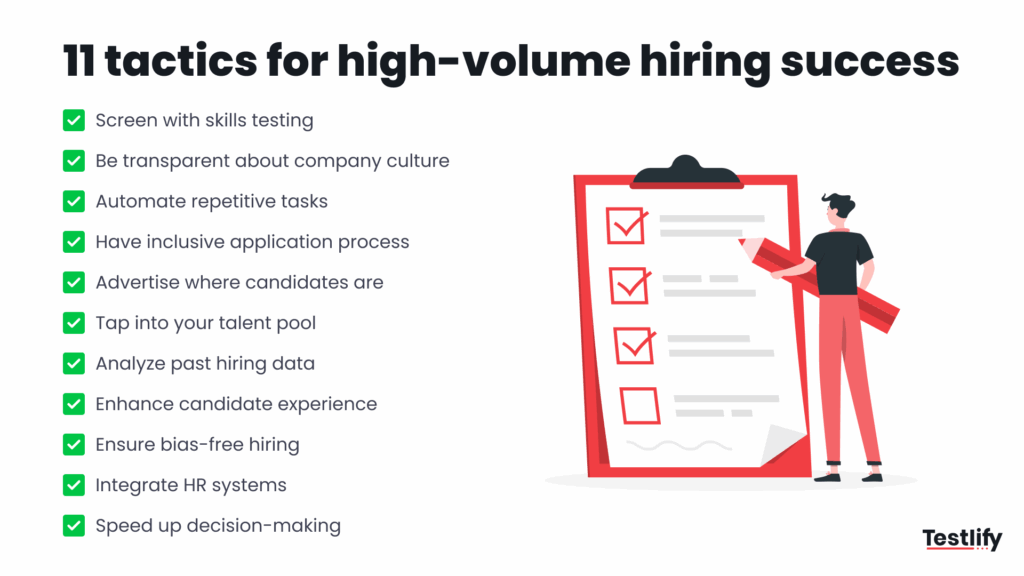
Use a skills testing platform for screening
When employers use AI to speed up hiring, it’s only natural that candidates are using AI tools too. This means blindly applying to hundreds of job postings, which indirectly means double the job for your HR team.
Screening out low-performing candidates using pre-employment assessment tools is a great method. Another smart way to cut through the noise is by using a reliable skills testing platform for screening. But don’t settle for basic.
Look for features like:
- Multilingual support for global hiring
- Advanced anti-cheating tools (like webcam proctoring, browser lockdown, and plagiarism detection)
- Global benchmarking to compare candidate performance
- Tests for both hard and soft skills, including cognitive abilities and behavioral traits
Testlify offers all of this and more. With a library of 3,500+ tests covering 4,500+ in 50+ countriess, and support for 12+ languages, it helps you screen faster, hire smarter, and maintain quality at scale. Using a skills assessment platform as one of the high-volume hiring strategies gives you a winning edge.
Be transparent with company culture
First impressions matter a lot. Before applying, candidates review the company’s culture by browsing through the official website, reading online reviews, and social media platforms, etc.
Top candidates prefer companies that align with their values. Capitalize this opportunity.
Clearly communicate your company culture everywhere, starting from the job description to the onboarding process. Include employee testimonials, walk around the office, a little insider videos, etc, to demonstrate your company’s positive work culture.
Automate boring repetitive tasks
High-volume recruitment cycle often involves repetitive processes and iterations. Try to automate as many repetitive, unimportant tasks as possible. But here’s the catch: don’t ruin positive candidate experience.
What can you automate?
Tasks like resume screening, skills testing, interview scheduling, etc. Pre-employment tests act as an effective way of screening candidates. Use assessment tools like Testlify anywhere in your HR hiring lifecycle (beginning or as a confirmatory step).
Automate feedback process to inform the candidates about their test scores. All of this frees up human resource professionals’ time, which they can use on building meaningful relationships with candidates.
Make the application process simple and inclusive (mobile-friendly)
Hiring at scale means sorting through a large number of applications to find the right people. The more applicants you get, the better your chances of finding qualified candidates.
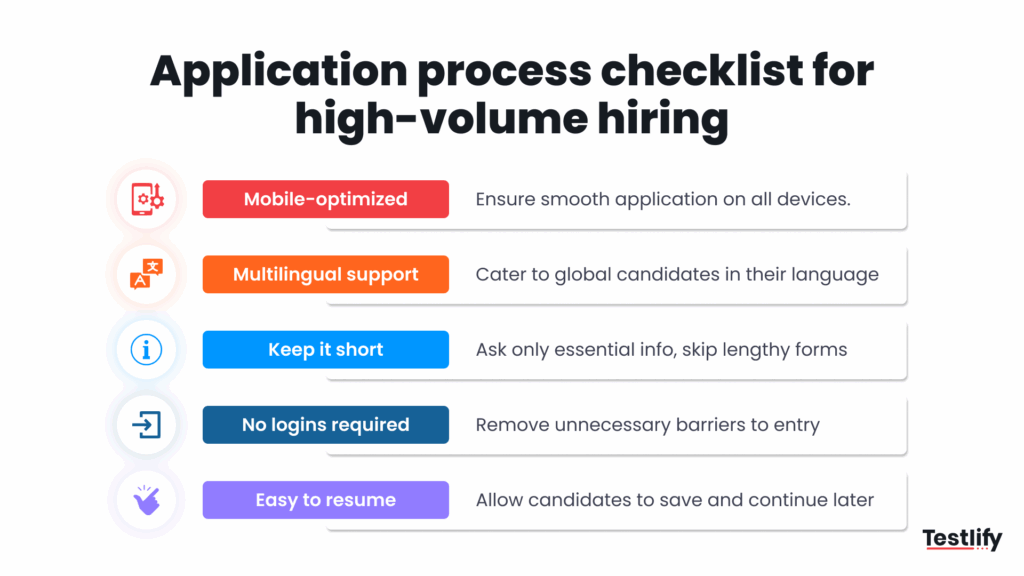
To attract more people, your application process should be easy for everyone to access and complete. Make sure it works well on mobile phones, offer it in different languages, and only ask for essential information. This is immensely important for enterprises hiring remotely.
Avoid long, complicated forms; a short and clear application increases the chances that candidates will actually finish and submit it.
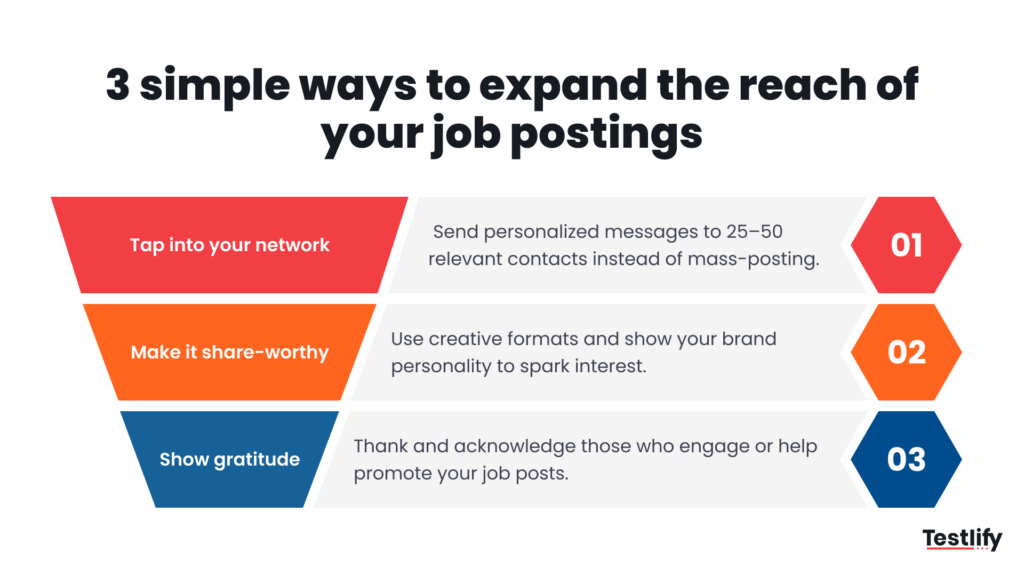
Market jobs where your candidates are
To get more people to apply, share your job openings where the right candidates are likely to see them. Think about where your ideal applicants spend their time, it could be job boards, industry-specific websites, social media, or even alumni or professional groups.
Use platforms like LinkedIn to reach people actively searching for jobs, or post on your company’s social pages to tap into your existing audience. Also, make sure each job post is clear and tailored to the role.
A well-written description helps attract the right candidates. Unfortunately, HR professionals take atleast 2 hours to write one job description. That’s massive time wasted. Check out 500+ job description templates curated by veterans.
Don’t want to go through pile of JDs, try our free AI job description generator and create bias-free, inclusive descriptions within seconds.
Make use of the existing talent pool
During busy hiring periods, companies get a lot of applications, even if they don’t hire everyone right away. Instead of starting from scratch each time, they can save these applications in a talent database.
When new roles open up, recruiters can quickly search through past candidates who were already interested in the company and might be a good fit. This saves time and is often more effective than posting a new job and waiting for responses.
Examine previous hiring data
Use data from previous hiring rounds to your advantage. Check what worked and what did not. Check important metrics like:
- Application completion rate: Which job descriptions or platforms get the most people to finish applying?
- Quality of hire: Which sourcing channels consistently bring in top performers? Double down on those.
- Candidate Net Promoter Score (cNPS): Which stages of the process leave candidates satisfied or frustrated?
- Interview-to-hire ratio: Are your interviews helping you make better decisions faster, or creating drop-offs?
- Time-to-hire by role and region: Which departments or locations take the longest to fill? Why?
- Offer acceptance rate: What factors impact whether top candidates say “yes”? Salary? Speed? Experience?
- Drop-off analysis: At which stage do most candidates lose interest or drop off, and how can you fix it?
With every new hire, your dataset grows, allowing you to fine-tune your high-volume hiring strategies.
Make candidate experience your mantra
Creating a great candidate experience becomes more challenging when you’re dealing with hundreds or thousands of applicants.
But in high-volume enterprise hiring, it’s not just a “nice to have”, it’s a “must have”. A poor experience can damage your employer brand, reduce offer acceptance rates, and shrink your future talent pool.
Try our Job Offer Acceptance Rate calculator for free without signing up.
On the flip side, a smooth, respectful process builds long-term goodwill even among those you don’t hire.
Here’s how enterprises can create a standout candidate experience at scale:
- Automate without losing the human touch: Use automation for status updates and reminders, but personalize wherever possible like using the candidate’s name or referencing their experience.
- Set clear expectations: From the job description to interview timelines, let candidates know what to expect, and stick to it.
- Communicate proactively: Don’t leave candidates guessing. Send timely updates, even if it’s a simple “we’re still reviewing applications.”
- Respect their time: Streamline assessments and interviews. Don’t make candidates jump through unnecessary hoops, especially for frontline or hourly roles.
- Close the loop: Always notify candidates when they’re no longer in the running. A thoughtful rejection message is better than silence.
- Gather feedback: Send short surveys to understand where friction exists and fix it.
- Make the process inclusive: Ensure accessibility across languages, devices, and for people with disabilities.
Bonus tip: Treat every candidate like your customer.
Create a bias-free hiring process
Hiring bias is a persistent problem that causes recruiters to overlook qualified candidates or select candidates who aren’t good matches unconsciously.
Yale research shows that applicants with male names have a 41% higher chance of getting called for interviews than their female counterparts.
Though some companies use ATS or automated platforms to combat hiring bias, sometimes algorithms can replicate human prejudice as well. Include the following measures in your recruitment cycle:
- Follow anonymous hiring
- Train hiring managers and interview panels
- Follow a standard interviewing protocol
- Use skill assessments to mitigate hiring bias
- Create a transparent hiring process and evaluation
Integrate your HR systems for high-volume hiring
In enterprise-level volume hiring, disconnected systems create delays and missed opportunities. The key is integration. When your ATS, video interview tools, and HRIS are connected, candidate data flows smoothly across platforms, saving time and reducing manual errors.
This unified system gives recruiters instant access to everything they need to make faster, data-driven decisions.
Even better, you can tap into powerful insights by combining pre- and post-hire data. This helps you build accurate “success profiles,” improve future hiring quality, and support performance management and succession planning.
A good ATS also unlocks talent rediscovery, screening past applicants, and matching them to current roles based on skills and experience, reducing sourcing costs.
Try our free sourcing channel efficiency calculator to find the best channel for attracting top talent faster and at lower cost.
Shorten the candidates’ decision-making time
It’s important to give candidates enough time to think about a job offer; rushing them can lead to hiring people who aren’t fully engaged, don’t clearly understand the role, or aren’t genuinely interested in joining your team.
However, when you’re hiring at scale, you also need to move quickly. Setting a clear time limit, like 48 hours, gives candidates a fair chance to consider the offer without slowing down your process.
This helps you stay efficient and reduces the risk of losing your next-best candidates, who might accept other offers while you’re waiting.
Best practices for high-volume hiring and common mistakes to avoid
Use a skills testing platform
Screening hundreds of resumes manually is inefficient and prone to bias. A skills testing platform helps you identify top talent quickly based on real capabilities, not just qualifications on paper. It ensures objective, fair, and scalable hiring without clogging your pipeline.
Choose the right ATS platform
Your ATS is the backbone of high-volume hiring. Choose one that integrates seamlessly with your assessment tools, supports automation, and offers clear analytics. A clunky or outdated ATS can slow down your hiring cycle and hurt candidate engagement.
Heavily invest in a candidate-centric process
In high-volume scenarios, candidate experience often gets neglected. Prioritize clear communication, faster feedback loops, and user-friendly application processes. A candidate-centric approach not only improves conversion but also boosts your employer brand in the long run. No matter how many candidates you have in your pipeline, always respond to them and keep them informed.
Don’t sacrifice candidate quality for the sake of speed
Sacrificing quality for speed is one of the biggest challenges in high-volume hiring. Speed matters in volume hiring, but not at the cost of fit. Avoid rushing decisions just to hit hiring targets. Use structured assessments and data-backed decisions to ensure you’re bringing in the right people, not just fast hires.
What solutions help reduce manual screening for high-volume roles?
Manual screening drains 23 hours per requisition and still misses top candidates. Five technology solutions eliminate that bottleneck for high-volume hiring teams.
The five solutions are AI-powered resume parsing, conversational chatbots, automated pre-employment assessments, asynchronous and AI-led interviews, and automated scheduling tools.
Each one targets a specific stage of the funnel and cuts manual work by 60% or more. Together, these tools collapse a 23-hour screening process into under 2 hours per role.
Recruiters reclaim their week, candidates get faster responses, and quality of hire climbs.
Where each solution earns its keep
Solution | Funnel stage | The hidden cost | What the solution fixes |
|---|---|---|---|
AI-powered resume screening | Resume review | Recruiters skim and miss strong candidates | AI ranks the entire pool against the same criteria |
Conversational chatbots | Pre-qualification | Knockout questions sit in inboxes for days | Chatbot collects candidate details and answers queries in seconds |
Pre-employment assessments | Skills validation | Recruiters guess at job fit from resumes | Assessments produce evidence on the actual work |
Asynchronous and AI interviews | First-round interview | Calendars collapse under volume | Async and AI interviews scale to any pipeline size |
Automated scheduling | Final round interview scheduling | Email tagging burns hours per hire | The final round interviews are auto-scheduled with top candidates |
AI-powered resume screening
AI-powered resume parsing uses machine learning to read and rank thousands of resumes in seconds. Machine learning describes algorithms that learn patterns from data without explicit programming.
The software extracts structured data such as skills, experience, and certifications from unstructured resume text. It then scores each candidate against the exact job criteria recruiters define.
Testlify’s AI resume screener replaces manual keyword matching and surfaces best-fit candidates automatically. The system filters out unqualified applicants before a human reviewer opens a single file.
Conversational chatbots and virtual recruiting assistants
Recruiting chatbots act as an always-on frontline recruiter that handles top-of-funnel candidate screening at scale.
The AI engages candidates through text or messaging apps and asks critical screening questions on work authorization, shift availability, and basic qualifications.
The bot instantly advances qualified candidates or disqualifies those who fail core requirements. Candidates receive answers in seconds instead of waiting days for a recruiter callback.
Automated pre-employment assessments
Pre-employment assessment refers to standardized tests that predict on-the-job performance before hire. Recruiters must carefully pick the assessment test that mirrors the job, not the one that sounds rigorous.
For example, a customer service role needs a situational judgment test on de-escalation, while a finance role needs an Excel simulation.
Deploy Testlify’s role-specific tests immediately after the candidate passes the resume screening stage to assess if they have the skills needed to perform the job.
Asynchronous video interviews and conversational AI interviews
Asynchronous video interviews let candidates record answers to predefined questions on their own schedule. Conversational AI interviewers go further by asking dynamic follow-up questions through text, voice, or video.
The system presents prompts, captures responses, and applies natural language processing to score communication skills. Natural language processing refers to AI that interprets human language with near-human accuracy.
Recruiters can even configure the AI interviewer’s tone, depth, and follow-up logic for each role.
Testlify’s conversational AI interviews let hiring managers evaluate hundreds of candidates in the time it would take one live panel.
Automated interview scheduling
Automated scheduling tools eliminate the back-and-forth emails that bury recruiters in high-volume hiring. The platform sends candidates a booking link the moment they pass AI screening or complete an assessment.
The system pulls real-time availability from every interviewer’s calendar and books slots without human input. Candidates self-select times that work for them, and recruiters never touch a calendar invite.
How to stack the five solutions
Deploy in the order candidates encounter them
- AI resume screener ranks the pool, chatbot qualifies the top of the ranked list
- Conversational chatbots capture basic candidate details, and assessments validate role-specific skills
- Asynchronous or AI conversational interviews test communication and critical thinking skills
- Finally, automated scheduling sends qualified candidates straight to the hiring manager, who will then schedule live interviews
Each stage carries a defensible reason to advance or reject. Test the stack on one role before rolling out.
A pilot exposes the parts of your process that do not survive the move from manual to automated, and those parts are usually the most valuable to fix.
What to watch for
Audit the rejection patterns every month. AI systems drift, and a screener that worked last quarter may filter out a skill set or demographic you actually want.
Keep a human in the loop on borderline cases. Automation acts as a force multiplier on recruiter judgment, not a replacement for it.
Watch your candidate feedback closely. The same candidates who praise the speed will tell you exactly where the experience felt cold, and that signal is gold for tuning the system.
Tie all of this back to recruitment KPIs that matter, such as quality of hire and time-to-hire, to ensure your recruitment strategy is delivering top talent.
Best tool for screening high-volume hiring
High-volume hiring can often feel like a gamble because you have to balance speed, quality, accuracy, and time. Though the entire process might seem complex, it is not entirely impossible.
Implement high-volume hiring strategies discussed in this article and combine them with tools like Testlify to help you find the best candidates in a shorter timeframe.
Cut down your hiring cost by 70%, provide better candidate experience, and reduce time-to-hire. Try Testlify for free or schedule a demo today.
Frequently asked questions (FAQs)

Related resources
View all
High volume hiring
How to build a scalable mass recruitment process

High volume hiring
Volume hiring: An ultimate guide to plan and implement

High volume hiring
Pre-hire assessments for high-volume hiring: What to test and why it matters

High volume hiring
High volume hiring checklist for faster hiring

High volume hiring
High-volume hiring trends: What the latest data tells us this year

High volume hiring
Scale hiring in the IT industry with automated tech screening tools
Get started.
Hire on proof, not resumes.
Run your first skills-based assessment free — no credit card required.