
High volume hiring checklist for faster hiring
Learn how to turn messy mass recruitment into a clear, repeatable high volume hiring process with simple steps, smart tools and better decisions.

High volume hiring has slowly turned into one of the toughest responsibilities inside any company. Teams are expected to hire fast, keep up with demand and still maintain the quality of hire that hiring managers ask for.
The numbers explain the struggle well. 60% of employers say they get a lot of applicants but not enough strong ones. On top of that, people start dropping off the moment the application feels long or confusing.
These small gaps slow everything down and make the process heavier for hiring teams. Here, a high volume hiring checklist helps bring some order back. It keeps the recruitment process easier to manage when the pressure is high.
Most teams realise this only after seeing how often these gaps repeat. The natural response is to pause for a moment and understand the actual hiring load in front of them. Once that part becomes clear, the rest of the checklist starts to work the way it should.
 ChatGPT
 Gemini
 Claude
 Grok
Grok Perplexity
TL;DR – Key takeaways
- Start by getting clear on hiring demand: how many people, for which roles, by when. Without this, every later step slows down.
- Create a simple volume hiring SOP so recruiters, hiring managers and coordinators know exactly who owns which part of the process.
- Standardize job descriptions and postings so must-haves are clear, titles match what candidates search and every new job opening is faster to launch.
- Use multiple sourcing channels and keep your employer brand clean and honest so better potential candidates choose to apply.
- Cut friction in the application and early screening stages with short forms, knockout questions, skills tests and an ATS that automates routine tasks.
- Speed up interviews with video interviews, self-scheduling and structured questions so you move quickly on strong candidates without lowering quality.

Define your hiring requirements
Most hiring teams run into trouble because they start recruiting before they understand the actual demand.
When hiring managers say they want “people hired quickly,” it sounds simple. The reality is different. Volume, timelines, role priorities and capacity all affect how smoothly the rest of the recruitment checklist works.
To make this step easier, hiring teams usually start with three basic questions. They look simple, but they shape everything that happens next.
What to clarify | Why it matters | Example |
|---|---|---|
How many hires are needed? | Helps decide capacity, tools and timelines. | Hiring 50 reps is very different from hiring 5. |
By when? | Sets the pace of the hiring process and the urgency level. | “30 days” forces a tighter plan than “this quarter”. |
Which roles and locations? | Avoids scattered efforts and misaligned priorities. | Warehouse roles in two cities need separate planning. |
In practice, most delays happen because these specifics are not written down or agreed upon early. Teams start sourcing, hiring managers start interviewing, and only then does everyone realise their expectations were different.
Align early with your hiring manager
This part is usually where clarity improves the most. A short conversation about priorities does contribute more in the hiring process than a long email thread.
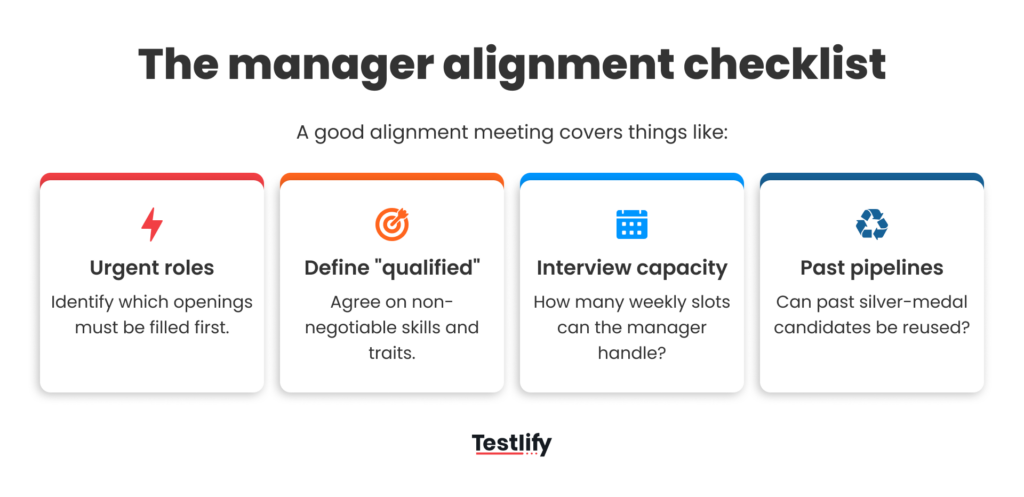
It also prevents hiring managers from changing requirements midway, which happens more often in high-volume hiring than people admit. And once expectations are aligned, teams can use the recruitment checklist properly instead of improvising.
Decide the metrics that will guide your decisions
High-volume hiring only moves smoothly when the team knows what success looks like. Two metrics always shape the early plan:
- Time to hire: How quickly the team must move to avoid losing potential candidates.
- Quality of hire: How well the new hires perform and how long they stay.
Both of these become meaningful when paired with real data. For example, if your past reports show that 40% of candidates drop off before finishing the application, you already know where to focus first.
Set up a volume hiring SOP
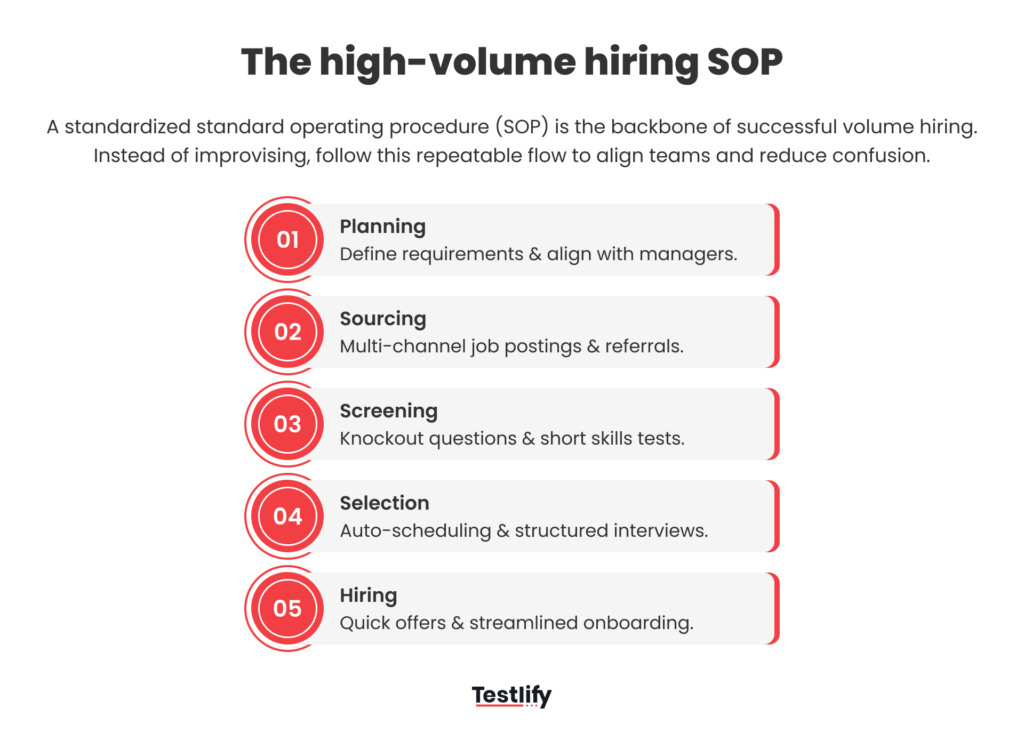
Once you know your hiring requirement, the next step is to stop relying on memory and create a simple playbook or SOP. Most of the chaos in mass recruitment comes from poor preparation at the beginning. A proper volume hiring SOP is that preparation.
1. Give every person a clear lane
When hiring ramps up, even small overlaps in ownership slow things down. A quick role map helps:
Role | What they mainly handle |
|---|---|
Recruiters | Sourcing, screening, moving candidates through stages |
Hiring teams / managers | Final interviews and selection decisions |
Coordinators / HR ops | Scheduling, offers, paperwork, systems updates |
Writing this down sounds basic, but it removes a lot of silent assumptions. Additionally, new team members can plug into the process without weeks of confusion.
2. Turn the journey into a repeatable flow
Next, sketch the candidate journey from first contact to start date. In practice this might look like:
Apply > Auto-screen > Interview > Offer > Onboarding
Your actual flow can be longer, but the important part is that every step has a name and an owner. Research shows that companies with a standardized process see big gains in both quality of hire and time to hire.
You don’t need fancy software for this. A one-page diagram or table that lives in your shared drive is enough, as long as people actually use it.
3. Add simple response time agreements
A strong SOP also protects candidates from waiting in limbo. In high-volume hiring, a good candidate doesn’t stay for too long if the process seems confusing.
Setting basic service levels, such as “CVs reviewed within 24 hours” or “interview feedback within two working days,” keeps the whole system moving.
These small rules do two things. They stop candidates getting stuck in your ATS, and they make it clear where a delay is happening so you can fix it quickly.
Once this structure is in place, every future campaign becomes easier. New roles plug into the same blueprint. New teammates can join mid-stream without slowing everyone down.
Most importantly, your hiring teams spend less time figuring out what to do next and more time making good decisions about people.
Standardize job requirements and postings
Once the hiring plan and SOP are in place, the next weak spot is usually the job posting itself. In high-volume hiring, one confusing description can generate hundreds of the wrong applicants.
On average, a single corporate job opening attracts around 250 applications, so a small mistake in the way you describe the role quickly multiplies across the funnel.
Separate “must-haves” from “nice-to-haves”
Mass hiring is more about filtering out clearly unqualified candidates. The fastest way to do that is to sit with the hiring manager and split requirements into two lists:
Must-haves | Nice-to-haves |
|---|---|
Day-one skills or conditions that are non-negotiable | Things you can teach in the first weeks |
Guides from recruiting platforms stress being explicit about this split, because vague wishlists shrink the talent pool and push time to hire up.
Turn that clarity into reusable job descriptions
Once you know what really matters, turn it into a simple template that talent acquisition can reuse across similar job openings. A solid template usually includes:
- A plain-English overview of the work
- 4-6 key responsibilities
- A short must-have list
- A short nice-to-have list
- Basic terms: shift pattern, location, pay range, benefits
Standardized descriptions make approvals faster, keep the recruitment process consistent across locations, and reduce last-minute edits from different stakeholders.
Use job titles and content candidates actually search for
The job posting behaves like a small advert on job boards. If your title is too clever, people won’t find it easily.
Both job boards and hiring guides recommend using clear, industry-standard titles like “Customer Service Representative” or “Warehouse Associate,” instead of internal labels such as “Customer Hero” or “Logistics Ninja.”
Right under the title, state the basics candidates care about most: pay, hours, contract type and one or two meaningful benefits.
Surveys show that salary, growth and work-life balance sit at the top of most people’s decision criteria, so hiding them deep in the posting only wastes everyone’s time.
Expand your sourcing channels
Once the role and JD are clear, you have to answer a practical question: where will the people come from. In high volume hiring, relying on a single source is the fastest way to fill your funnel with noise.
Recent benchmarks show that job boards and social sites generate almost half of all applications, yet they account for less than a quarter of actual hires. So volume is not the problem. Fit is.
Source | What it is good for | What to watch |
|---|---|---|
Large job boards | Reach and speed when many roles open at once | High volume, lower conversion, more screening effort |
Niche boards / local sites | Targeted skills or locations | Smaller pools but often stronger intent |
Social media | Reaching people by location or interest, especially hourly roles | Clicks without completion if the landing page is weak |
Referrals and past applicants | Warmer fit, people who already know you | Often the highest hire rate per application |
In practice, this means you still use job boards, but they are not the only tap you open. Social media helps you appear where potential candidates already spend time.
Simple geo-targeted ads around your store or warehouse can reach people who might never visit a careers site on their own.
At the same time, your warm network quietly does a lot of heavy lifting. Studies show that referred candidates are several times more likely to be hired and often stay longer than those from other sources.
All of this is amplified by your employer brand. Around seven in ten job seekers research a company before applying, and many check reviews and social channels as part of that check.
If your online presence looks honest and clear, more people from every channel will apply because they feel they can trust your company.
Over a few hiring cycles, track simple numbers for each source: how many apply, how many reach interviews, how many you actually hire. Patterns appear quickly. Some channels will be good for awareness, others for final hires.
Simplify the application process
In high volume hiring, many good candidates are lost before anyone even sees their profile. The main reason is friction. Studies on high volume application processes show that nearly half of candidates who drop out do so because the form is too long or confusing.
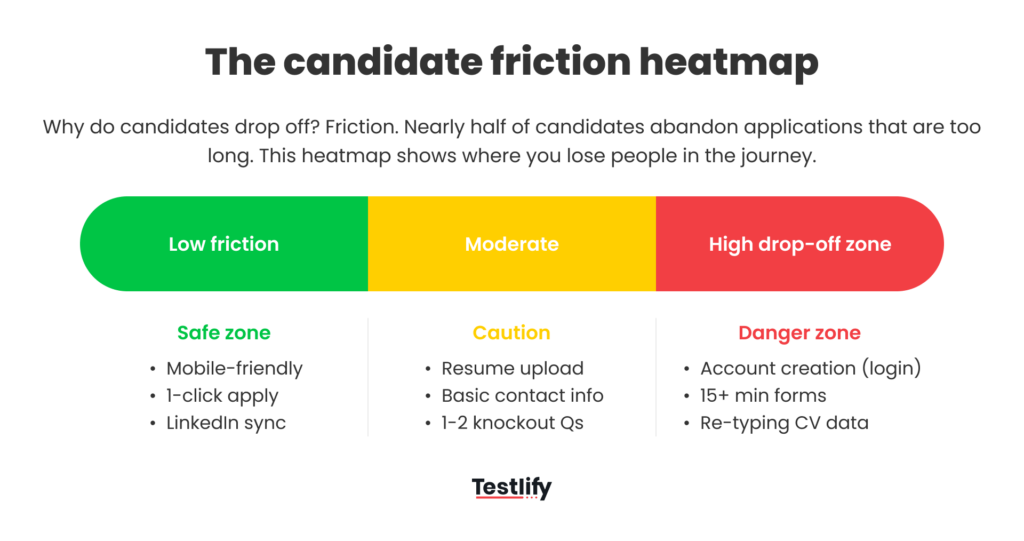
A simple rule helps here: make it easy to start and quick to finish. Keep forms short and mobile-friendly, and only ask for essentials at the first step, such as name, contact details and a resume or LinkedIn link.
Extra questions, account creation and repeated data entry can wait until later in the hiring journey, once the person is already engaged.
It also helps to remove small technical barriers. Clear buttons, a visible “Apply now” call to action and options like one-click apply or “Apply with LinkedIn” reduce drop-off sharply.
A smooth application process improves candidate experience and increases the number of completed applications.
Use the right tools (ATS & Automation)
Once applications start coming in, spreadsheets and shared inboxes collapse very quickly.
In high volume hiring, recruitment teams may handle hundreds or even thousands of candidates at once, and many are already managing far more requisitions than a few years ago.
Set up an ATS built for volume
An Applicant Tracking System is your control room. At a basic level it should:
- Collect all applications in one place instead of across email and forms.
- Allow bulk actions so recruiters can move 50 candidates from “Applied” to “Screening” with a single click.
- Use simple knock-out questions at the application stage, which can cut manual screening work by as much as half.
- Connect with HR or onboarding tools so new hire data does not have to be retyped later.
Automate the slowest tasks
The goal of automation is not to remove humans. It is to remove routine work that slows them down. Practical wins include:
- Automatic screening rules that flag candidates who meet key requirements first.
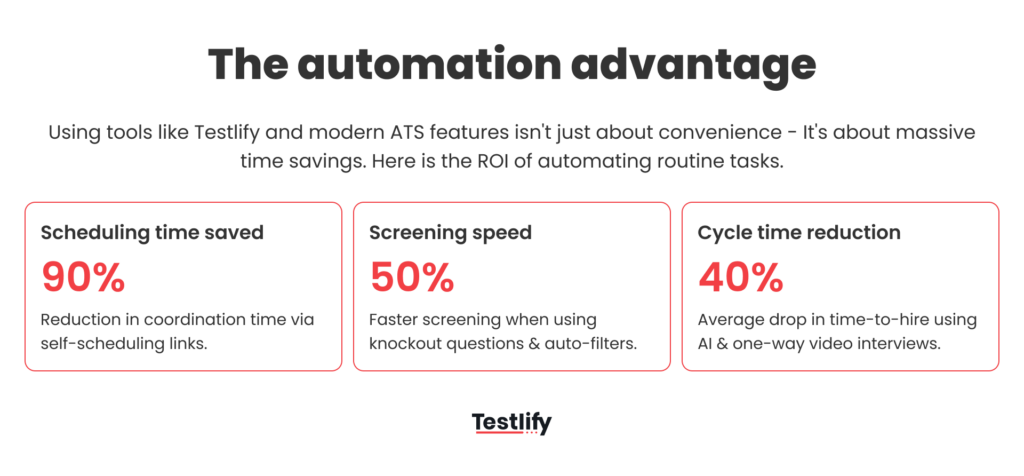
- Self-scheduling links so candidates can book interview slots on their own. Some teams report that automated scheduling cuts coordination time by close to 90%.
- Bulk emails for acknowledgements, rejections and simple follow-ups, so nobody waits in silence.
Each of these steps shortens the time between stages and keeps your funnel moving without constant manual chasing.
Keep candidates informed in real time
Many high volume candidates apply outside office hours. Chatbots on your careers site can answer basic questions, check simple criteria and even book interviews while the team is offline.
SMS is another quiet workhorse. Text messages have very high open rates, far above email, which makes them ideal for reminders and quick status updates.
A short text that confirms an interview or nudges someone to complete a form can be the difference between a show and a no-show.
Pre-screen and filter smartly
Once applications start flowing, the real work begins. A single corporate job can easily attract 250 applications, and high volume roles often see far more.
If every CV gets the same manual attention, recruitment teams drown in low fit profiles and the high volume hiring process slows to a crawl. Smart pre-screening keeps the funnel manageable and protects quality of hire.
Use knockout questions for the basics
Start with a few simple questions that check non-negotiable conditions, such as shift availability or license requirements.
Platforms like Indeed report that jobs using screener questions are around 50% more likely to result in a hire, because recruiters can focus on people who meet the baseline from day one.
You can keep this very practical:
Role | Knockout question example |
|---|---|
Delivery driver | Do you have a valid license for this vehicle type? |
Call center agent | Can you work evening or weekend shifts? |
Warehouse associate | Are you comfortable lifting 20-25 kg regularly? |
These questions sit early in the application, often inside your ATS, and quietly remove people who clearly cannot do the job. That one step alone can cut a big chunk of low-quality candidates from your hiring process.
Add short skills tests
Next, bring in a quick skills or aptitude check. Most employers now use some form of pre-employment assessment, and surveys from Criteria show that 92% of HR leaders see better quality of hire when they use them.
The key is to keep tests short, fair and job related. A 10-15 minute typing test, chat simulation or basic problem solving task is often enough.
Research comparing selection methods finds that work samples and cognitive tests predict performance much better than resumes or unstructured impressions.
Build your shortlist on real data
When knockout answers and scores sit together in one view, your shortlist almost builds itself. Recruiters and hiring managers can sort candidates by how well they meet the essentials, rather than by who happened to apply first.
Over time, linking assessment scores with on-the-job results gives you a feedback loop to keep improving quality of hire.
By the time you invite someone to interview, you already know they clear the basics and have shown real ability, so the conversation can focus on fit and growth.
Speed up interviews
In most hiring drives, the interview stage slows everything down. Calendars are full, candidates wait, and the best people move on. One-way video interviews and AI-led first-round interviews are changing that.
Some studies show that one-way video interviews can cut time-to-hire by nearly half, and AI interview platforms report cycle time drops of 30% – 50% when they handle early screening and Q&A for recruiters.
Use video and AI interviews where they make sense
For the first round, short video interviews work better than long phone chains. Candidates answer the same set of questions on their own time, and your team can review answers in batches instead of juggling dozens of calls.
AI interviews can sit on top of this and help with simple tasks like checking basic criteria, summarizing answers and flagging clear fits for the hiring manager. Humans still make the final call, but they start from a cleaner shortlist and get to real conversations faster.
Let candidates choose their own slot
Scheduling is another hidden delay. Research on interview scheduling tools shows they can cut coordination time by 80% – 90% by letting candidates self-schedule and sending automatic reminders.
In practice, you block out interview windows and share a link. Candidates pick a time that works, change it if needed, and both sides get instant calendar updates. Fewer emails, fewer no-shows, and a smoother experience for everyone.
Give hiring managers a simple structure
Fast interviews still need to be fair and useful. That is where structure helps. Meta-analyses show that structured interviews are roughly twice as effective at predicting job performance as unstructured chats.
Training each hiring manager to ask the same core questions and score answers on a basic rubric keeps interviews shorter, easier to compare and more defensible later.
Conclusion
High volume hiring is hard, but it gets easier when you break it into simple steps: know what you need, write honest job posts, remove friction from the application, screen smart and move quickly on interviews.
Follow that checklist and you protect both speed and quality without burning out your team. If you want a platform that supports this way of working, Testlify can help with skills tests, AI interviews and bulk workflows that plug into your ATS.
Book a short demo and see how it handles your next hiring wave.
Frequently asked questions (FAQs)

B2B SaaS Content Writer
Rishav Kumar is a B2B SaaS content writer with 4 years of experience. He loves crafting engaging content. Always exploring fresh ideas, he's passionate about helping businesses grow through impactful writing.
LinkedInRelated resources
View all
High volume hiring
High-volume hiring trends: What the latest data tells us this year

High volume hiring
Scale hiring in the IT industry with automated tech screening tools

High volume hiring
How can the BPO industry hire at scale without compromising quality?

High volume hiring
Automated candidate scoring: how it works and speeds up hiring

High volume hiring
How high-volume hiring works with AI interviews

High volume hiring
How to find the best candidate for every role?
Get started.
Hire on proof, not resumes.
Run your first skills-based assessment free — no credit card required.