
How to utilize artificial intelligence for large volume hiring?
Learn how AI for large volume hiring boosts efficiency, reduce bias, and improves candidate experience in enterprise-level recruitment.

Ask any recruiter handling high-volume hiring, and you will hear a similar story. The struggle is not finding talent. It is keeping pace with the flow of applicants.
In volume hiring, a single job post can attract hundreds of applicants, and the traditional process slows down the moment recruiters try to screen, shortlist, and coordinate everything manually. As a result, the time to fill stretches and good candidates drop off.
We see this play out across industries. Hilton once took more than 43 days to hire for frontline roles, and Domino’s saw applicants abandon long forms until they redesigned the experience.
These examples show a simple truth. The current model cannot keep pace with the volume and expectations of large-volume hiring today. This is where artificial intelligence for volume hiring starts to matter.
Let’s look at how AI supports each stage of large-volume hiring and what it means for your team.
 ChatGPT
 Gemini
 Claude
 Grok
Grok Perplexity
TL;DR – Key takeaways
- AI helps recruiters handle large applicant volumes by automating the most time-consuming tasks, such as screening, assessments, and scheduling.
- It improves hiring speed, reduces drop-offs, and creates a more predictable process for both teams and candidates.
- Companies like Hilton, Unilever, and Electrolux have seen major gains in time-to-hire, quality of hire, and application completion after using AI tools.
- AI reduces bias by scoring candidates based on skills and behavior rather than subjective factors.
- Testlify brings all of this into one workflow, including skills tests, AI video interviews, proctoring, automation, and structured insights, built for high-volume hiring.

What artificial intelligence actually does in hiring?
In simple terms, artificial intelligence for volume hiring focuses on one thing: helping hiring teams handle scale without losing speed or quality. Instead of replacing recruiters, AI performs the repetitive tasks that slow down the volume hiring process.
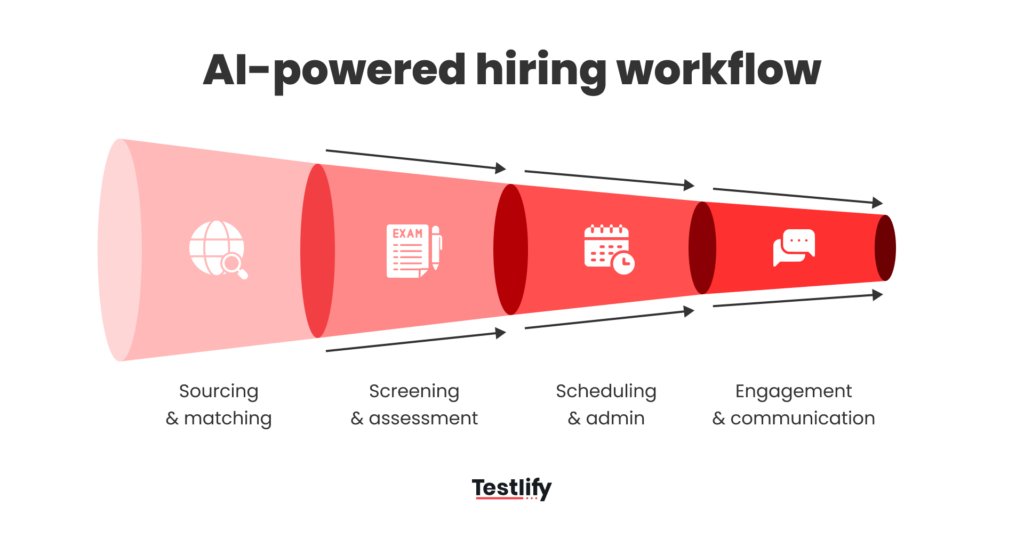
AI scans, sorts, and matches applicants faster
In large volume hiring, the number of applicants often grows rapidly. AI technologies help by scanning resumes, job postings, and talent pools to match candidates based on skills and experience, not just keywords.
This reduces the hours recruiters spend screening manually and increases fairness by applying consistent rules to every applicant.
Example:Electroluxadded 126,000 candidates to their talent community in six months and saw an 84% increase in application conversion after adopting AI screening tools.
AI handles the early assessments
AI-powered video, voice, and text assessments evaluate communication, problem-solving, behavioral patterns, and role readiness at scale. These tools use NLP, deep learning, and structured scoring to measure real skills.
AI-led recruitment can cut time-to-hire by up to 60% and reduce attrition by nearly 30% through better job-to-skill matching.
Explore Our: Average Time to Hire Calculator
AI automates admin and communication
A major issue in volume hiring is silence. Up to 62% of candidates receive no communication during the hiring process. AI fixes this through automated updates, chatbots, and 24/7 scheduling tools.
AI supports final decision-making with data
Once candidates reach hiring managers, AI provides structured insights: scorecards, behavioral data, predicted retention scores, and comparisons across the full applicant pool. It does not make the final call, but it gives teams a clearer picture. This shift from intuition-based hiring to data-backed decision-making is where a thoughtful AI strategy becomes essential.
How Testlify fits naturally into this workflow
Testlify supports large-volume hiring by automating screening, delivering validated skills tests, and running AI-powered video interviews that assess communication, behavioral traits, and job readiness. Recruiters get a structured, comparable view of every candidate.
Real-world impact of artificial intelligence for volume hiring
Company | What Changed After Using AI | Measurable Impact |
|---|---|---|
Hilton | Used AI-driven interviews to speed up screening and reduce manual steps. | Time-to-hire dropped from 43 days to 5 days. |
Unilever | Automated screening, video assessments, and candidate workflows at scale. | Reduced hiring time by 75% and saved 50,000+ candidate hours. |
Domino’s | Simplified and automated the application process to reduce friction. | Saw a 40% increase in applicants. |
How AI improves each stage of the high-volume hiring process
Volume hiring breaks down when too many tasks pile up at once. AI steps in by doing the work that normally eats up hours. Here is how it strengthens each stage of the hiring process:
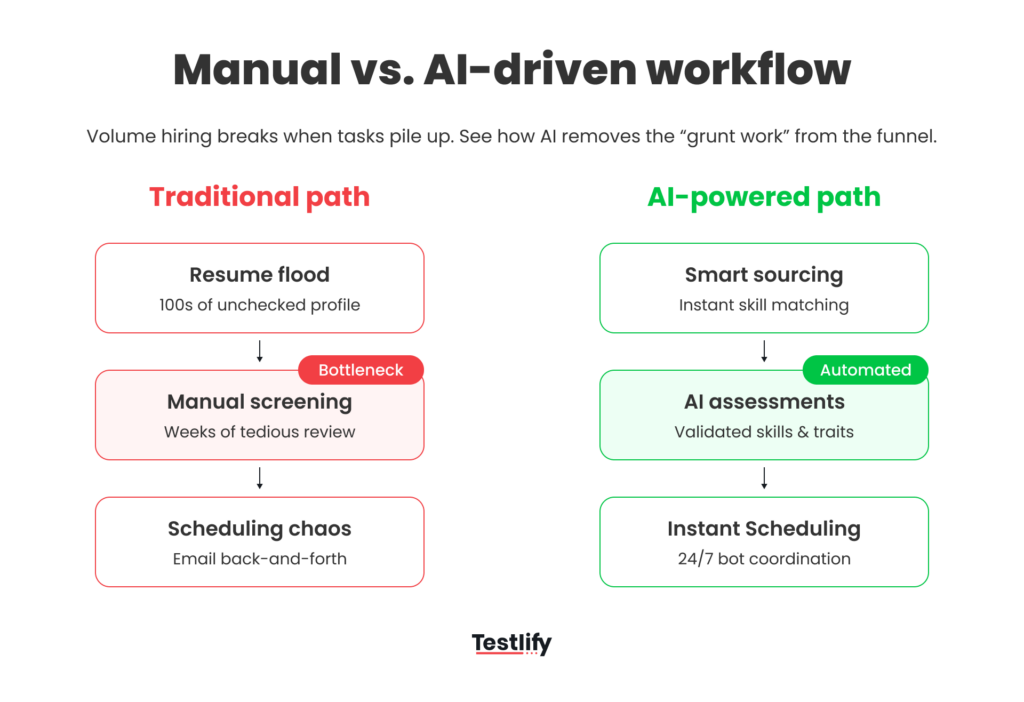
Application & sourcing
When hundreds of people apply, recruiters cannot review each profile with the same level of care. AI scans resumes and talent pools and pulls forward people who match the role based on skills.
What this improves:
- Recruiters save hours of manual sorting
- Every applicant gets checked
- Good candidates are found earlier
A simple example is Electrolux. After adding AI to sourcing, they saw more candidates complete the application and more qualified people enter the funnel.
Screening & assessment
Screening is usually the slowest step in high-volume hiring. AI assessments make it faster and more consistent by evaluating skills, communication, and problem-solving in the same way for every applicant.
What this improves:
- Less time spent on phone screens
- A more accurate understanding of each candidate
- Less bias due to tired or rushed decisions
Testlify supports this stage with skills tests and AI video interviews that measure how a candidate communicates and handles basic work situations.
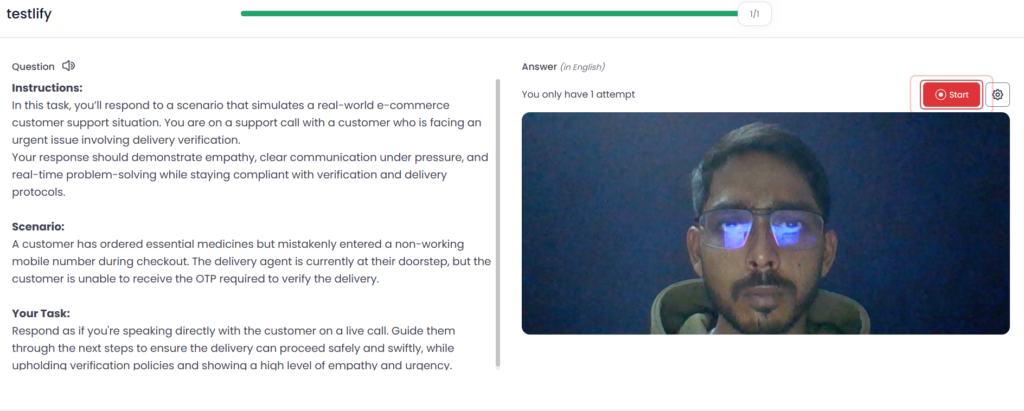
AI-powered interviews help teams evaluate candidate communication, behavior, and job readiness at scale. Instead of scheduling live interviews for every applicant, recruiters receive structured video responses that are scored objectively.
Communication & scheduling
A big reason people drop out is silence. Studies show that more than half of candidates receive no updates. AI tools send reminders, answer common questions, and schedule interviews without back-and-forth.
What this improves:
- Fewer drop-offs
- Faster interview scheduling
- Clearer updates for candidates
Some teams save several hours each week by letting AI handle scheduling.
Selection & prediction
At the final stage, recruiters must choose the right person from a very large group. AI provides simple, structured insights, such as skill scores and fit indicators.
What this improves:
- Better decisions at scale
- Stronger quality of hire
- Lower early attrition
Teams use these insights to understand who is ready for the job, rather than relying solely on interviews.
Testlify gives scorecards, ranking views, and benchmark data so hiring managers can compare candidates quickly and confidently.
Benefits of using AI for large volume hiring
(Why companies are turning to AI and what results they’re getting)
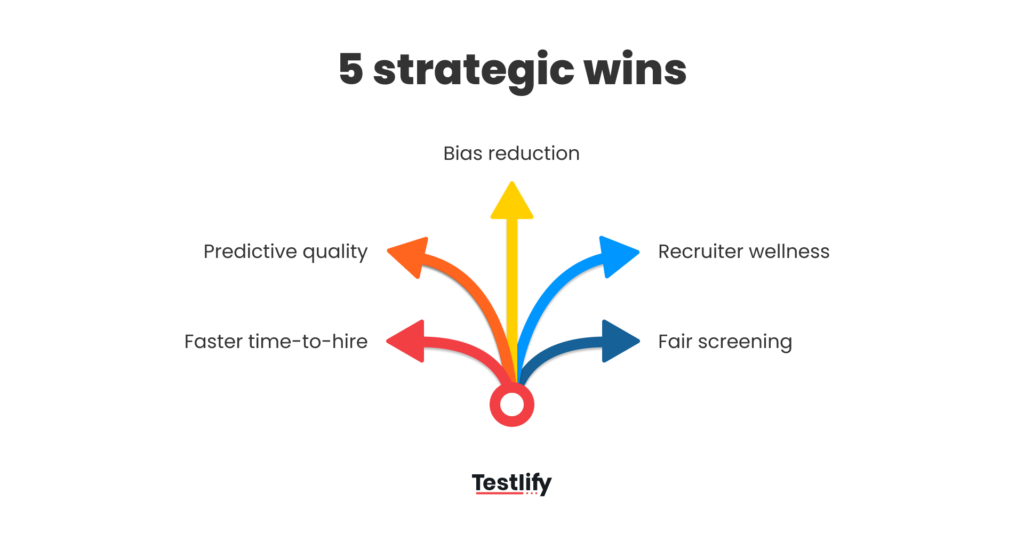
In high-volume hiring, even small improvements in speed and accuracy make a big difference for both recruiters and candidates.
Faster time-to-hire
AI takes over tasks that slow down a high-volume hiring process, such as resume screening and interview scheduling. These steps consume hours if done manually. With AI, the hiring process becomes steady and predictable.
Hilton reduced its hiring cycle from 43 days to 5 days after adopting automated screening and AI assessments.
To speed time-to-hire, Testlify offers two options at the very first stage of creating an assessment. You can either create assessments with AI or build them manually based on your requirements.
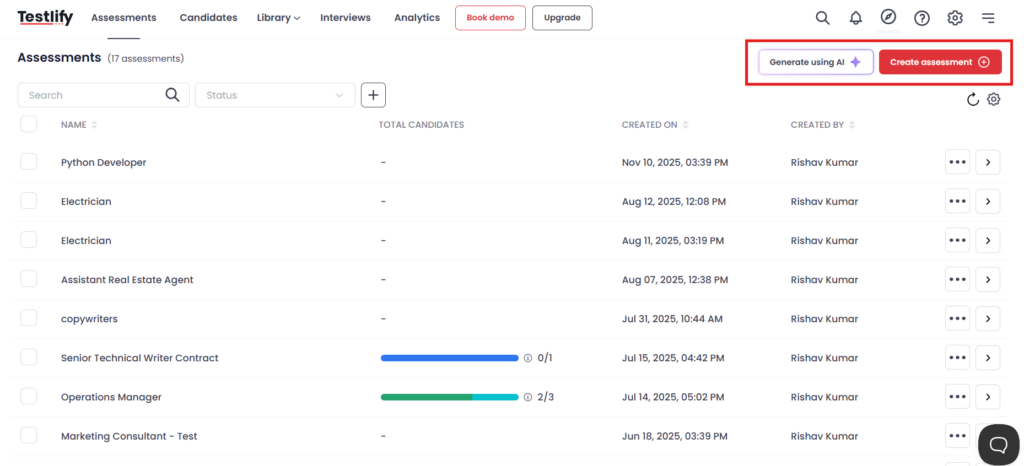
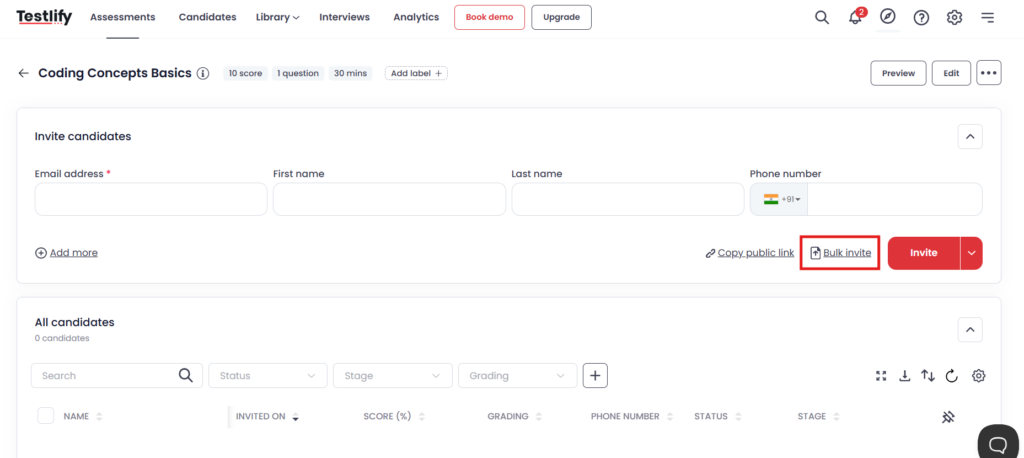
This flexible flow itself helps recruiters shorten time-to-hire. It also supports bulk invites, which are very useful for high-volume hiring.
Better quality-of-hire
AI can evaluate a candidate’s actual skills more accurately than quick resume scans, which often miss the full picture.
Unilever reported millions of pounds in savings and a 75% faster hiring process after using an AI-led recruitment process for early-career roles.
To improve the quality of hire, Testlify offers a 3,500+ test library, along with structured reporting and analytics that help teams sort candidates more accurately.
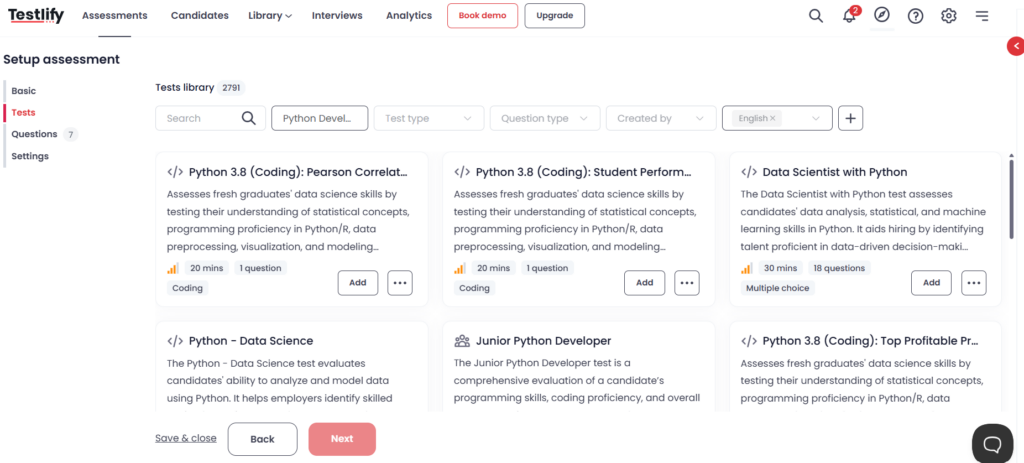
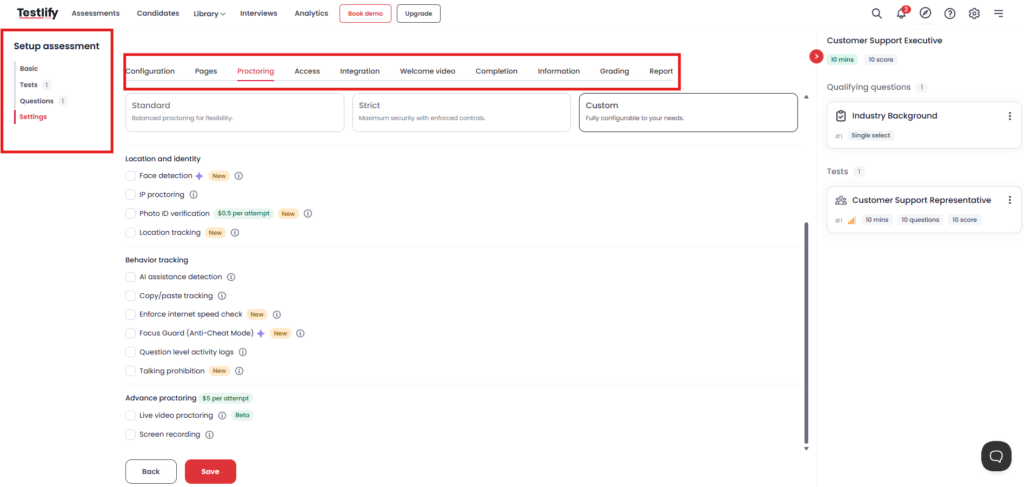
Another key factor in quality of hire is ensuring that remote assessments maintain integrity. Without this, irrelevant or unfit applicants can enter the hiring cycle.
To prevent this, Testlify includes AI-powered proctoring within the same assessment workflow.
More consistent and fair screening
AI reduces biases by scoring candidates on skills and behavior rather than names, formatting, or educational background.
Testlify improves fairness through validated pre-hire assessments, question randomization, and clear scoring rubrics that integrate seamlessly with almost any applicant tracking system.
Less recruiter burnout
High-volume hiring puts real pressure on recruitment teams. They lose time on long shortlisting sessions and constant follow-ups with candidates. AI relieves this load by automating admin work in the background.
According to industry reports, 74% of TA leaders see the greatest opportunity in GenAI to automate repetitive tasks.
Improved candidate experience
When thousands of candidates apply, most of them never receive a response. A 2025 report on the “Ghosting Index” found that three out of four applications disappear without any feedback from the employer.
Ghosting is a major reason for candidate drop-off. AI fixes the communication gap by providing instant updates and predictable timelines to the candidates. Research shows that 78% of candidates value timely updates.
As highlighted earlier, Domino’s increased applicant flow by 40% after simplifying and improving the candidate experience.
Testlify supports this with short, mobile-friendly assessments and automated notifications that keep applicants informed throughout the hiring process. AI brings speed, structure, and fairness to high-volume hiring.
Read more on: How to choose the correct pre-hire assessment for high-volume hiring.
Getting started with AI for volume hiring
Getting started with AI is not complicated at all.
You can begin by fixing the slowest parts of your hiring process and letting automation handle the repetitive work.
Companies like Unilever, Electrolux, and Hilton adopted AI and saw strong results across speed, consistency, and candidate experience. If you want to bring the same clarity and pace to your own high-volume hiring, Testlify can help.
Testlify is built to reduce manual work and give your team the control and confidence needed to hire well at scale. Book a demo today and see how much simpler high-volume recruiting can be.
Know more about how Testlify works and makes mass recruitment easier:
Frequently asked questions (FAQs)

Content Writer
Yashika Khandelwal is a Content Writer with 3+ years of experience creating research-backed content on hiring, talent assessment, and HR technology. She is a registered Organizational Psychologist and subject matter expert who combines behavioral science with practical recruitment insights to produce accurate, evidence-based content.
LinkedInRelated resources
View all
High volume hiring
11 high-volume hiring strategies for enterprises in 2026

High volume hiring
How to build a scalable mass recruitment process

High volume hiring
Volume hiring: An ultimate guide to plan and implement

High volume hiring
Pre-hire assessments for high-volume hiring: What to test and why it matters

High volume hiring
High volume hiring checklist for faster hiring

High volume hiring
High-volume hiring trends: What the latest data tells us this year
Get started.
Hire on proof, not resumes.
Run your first skills-based assessment free — no credit card required.