
Pre-hire assessments for high-volume hiring: What to test and why it matters
Streamline high-volume hiring with smart assessments. Learn how to attract top talent, reduce bias, and hire faster using scalable strategies and tools.

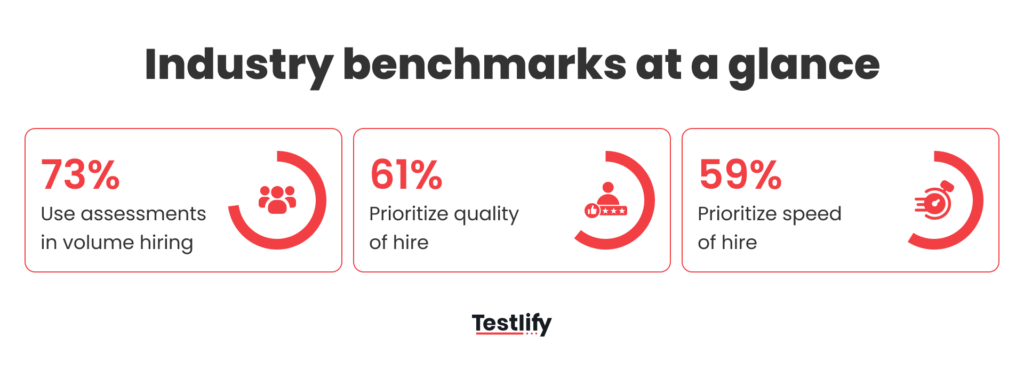
For high-volume hiring, pre-hire assessments should test the four things that actually predict who will do the job well: job-specific skills, cognitive ability, behavioral and situational fit, and, for sensitive roles, integrity. Test those in short, mobile-friendly formats and you can rank hundreds of applicants on evidence instead of gut feel.
Why it matters comes down to cost and churn. SHRM puts the average cost per hire at about $4,129, and the frontline sectors that hire at volume also lose people fastest: U.S. workers quit at an average rate of 2.1% a month in 2024 (BLS JOLTS). Multiply one weak screening rule across 300 hires and the waste compounds fast.
The World Economic Forum expects 39% of workers’ core skills to change by 2030, so what you screen for now matters more than the resume in front of you. Here is what to test, and why each signal earns its place.
 ChatGPT
 Gemini
 Claude
 Grok
Grok Perplexity
TL;DR
- Test four signals that predict success: job-specific skills, cognitive ability, behavioral fit, and situational judgment.
- Keep each test short (about 5 to 15 minutes) and mobile-first, so applicants actually finish it.
- Automate delivery and scoring inside your ATS so recruiters review only ranked, qualified candidates.
- Map every test to a role competency first (the Testlify Competency-to-Evidence Matrix), then pick the format.
- Watch completion rates, pass rates, and 90-day retention, and adjust the assessment mix by what the data shows.

Why does high-volume hiring need a different approach?
High-volume hiring breaks manual screening because a single job post pulls several times the applicants of a standard role, and no two recruiters sort resumes the same way. Structured assessments fix both problems at once: they filter on evidence, and they hold every candidate to one consistent standard, however large the pool gets.
The first problem is sheer volume. A single job post for a high-volume role draws far more applicants than a standard opening. Most of those resumes do not match, and sorting them by hand pushes up time to hire and slows every downstream step.
The second problem is consistency. When many recruiters and hiring managers screen at the same time, everyone judges differently. Some scan for keywords, some skim, some go on instinct. That variation is how strong candidates slip through and how bias creeps in.
The third problem is the candidate experience. When the process feels slow or unclear, drop-off climbs. Small delays and quiet gaps push good applicants toward the next offer before they ever reach an interview.
This is why many teams move structured assessments to the front of the funnel. With Testlify, recruiters can run skills tests, cognitive tests, or chat simulations in minutes and see every candidate’s results in one place.
What should you test in a high-volume assessment?
Test the competencies that separate strong performers from average ones: job-specific skills, cognitive ability, behavioral fit, and situational judgment, plus integrity for safety- or cash-sensitive roles. The rule is simple. Start with the role, map each competency to a piece of measurable evidence, then pick the shortest test that captures it.
That mapping is the Testlify Competency-to-Evidence Matrix. It starts with the role, not the test: define what good performance looks like, list the competencies that matter, then connect each one to concrete evidence, whether that is a skills test, a cognitive test, a situational scenario, or a structured reviewer score. At volume, that discipline keeps every one of your hundreds of assessments tied to something the job genuinely requires.
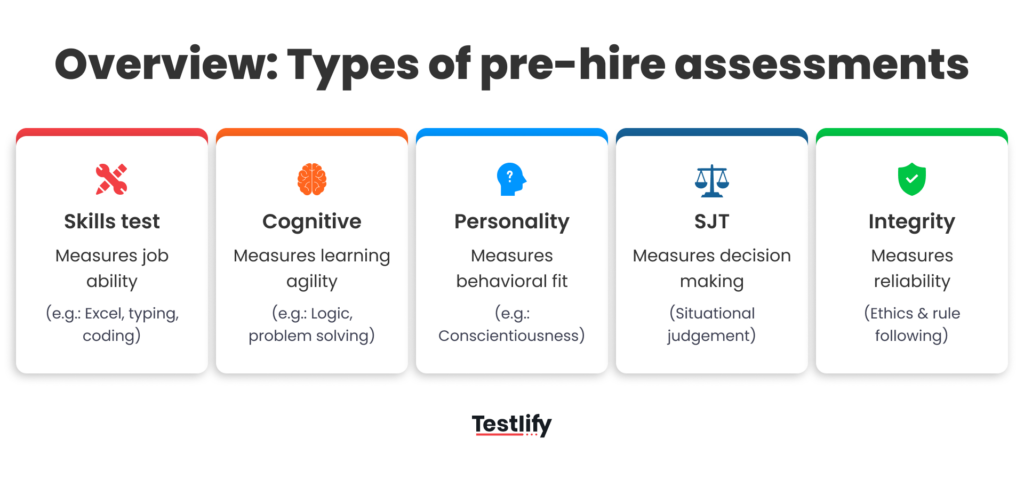
Assessment type | What it measures | Best-fit high-volume roles | Typical length |
|---|---|---|---|
Skills / job knowledge | Can they do the core task today | Data entry, customer support, technical | 10 to 15 min |
Cognitive ability | Reasoning, learning speed, potential | Trainees, early-career, operations | 8 to 12 min |
Personality / behavioral | Work style, reliability, service orientation | Retail, sales, frontline | 5 to 10 min |
Situational judgment / RJP | Decisions and fit in real scenarios | Call center, hospitality, retail | 8 to 15 min |
Integrity / reliability | Rule-following, risk, dependability | Cash handling, delivery, safety-sensitive | 5 to 10 min |
1. Job-specific skills and knowledge
These tests show whether a candidate can actually do the work: Excel for an operations analyst, coding for a developer, language fluency for support, typing speed for data entry, or role-specific knowledge. In large applicant pools, most resumes do not reflect real ability, so a skills test gives you objective proof of competence and keeps unqualified applicants from advancing.
A BPO team, for example, can use typing, navigation, and customer-scenario tests to shortlist quickly; only applicants who clear the minimum move on. Testlify supports this with job-based assessments and proctoring features that protect result integrity, which lifts quality of hire, the metric most teams optimize for at volume.
Pro Tip: Set a clear minimum score for each test before you launch, not after results come in. At volume, a defined cutoff is what lets you auto-advance the top tier and keep the funnel moving without a recruiter reviewing every result by hand. Pair it with the Quality of Hire calculator to sanity-check where you set the bar.
2. Cognitive ability and aptitude
Cognitive tests measure the general mental abilities that carry across roles:
- Problem-solving
- Logical reasoning
- Numerical and verbal aptitude
- Learning agility
- Attention to detail
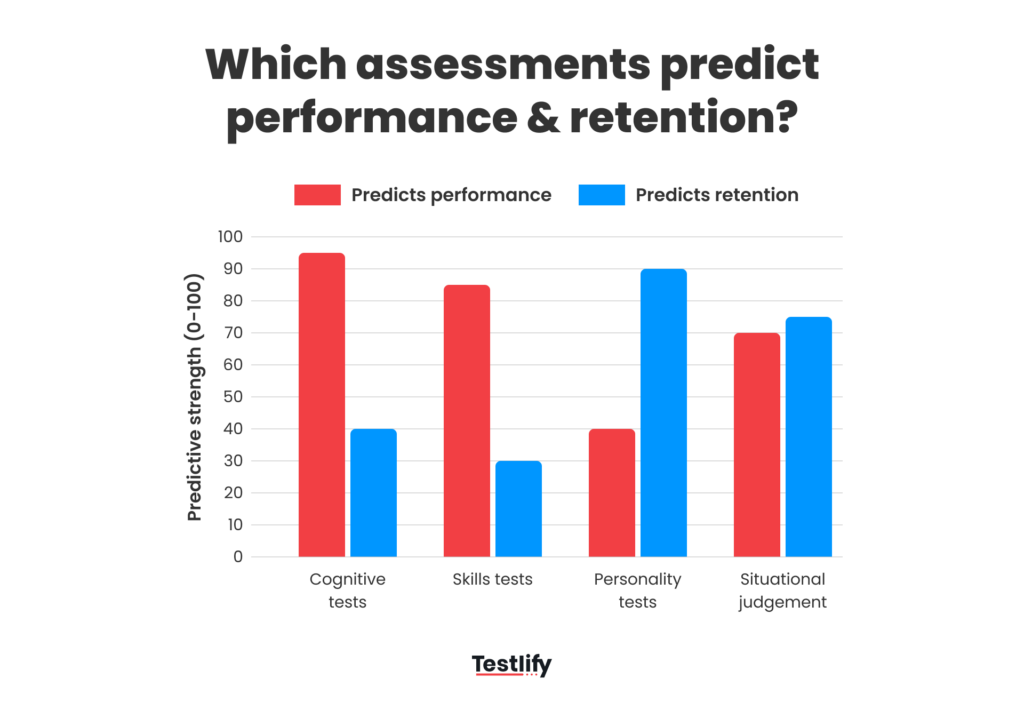
Cognitive ability is one of the most studied predictors of job performance. In high-volume pools full of similar-looking resumes, it surfaces the high-ceiling candidates who learn fast and handle complexity, even when they lack direct experience.
When you are hiring 100 management trainees, a short cognitive test shows which applicants have the analytical horsepower to thrive in training, and it ranks them automatically so recruiters skip a manual first pass.
3. Personality, behavioral fit, and culture add
These assessments look at how someone prefers to work: conscientiousness, extraversion, adaptability, teamwork, customer-service orientation, and alignment with your values. Behavioral fit often drives early retention more than raw skill, so measuring it upfront is one of the cleaner ways to cut first-year turnover.
Structured personality measures flag the reliability and service orientation that keep frontline hires past their first few months, the exact window where volume hiring usually bleeds people.
4. Situational judgment tests and realistic job previews
Situational Judgment Tests (SJTs) present realistic work scenarios and ask how a candidate would respond. Realistic Job Previews (RJPs) work the same way, immersing candidates in the job through short videos or interactive tasks to show how they handle common challenges.
Both do two jobs at once in high-volume frontline hiring for call centers, retail, and hospitality. First, they reveal how a person behaves in job-like situations, which predicts real performance better than a resume claim. Second, they give candidates an honest picture of the role.
Applicants who realize the job is not for them opt out early, which leaves the people who continue more prepared and genuinely interested. That means lower attrition and higher engagement from day one.
5. Integrity, work ethic, and reliability (optional)
For roles that involve cash handling, delivery, or safety, add assessments that measure integrity, reliability, and work ethic. These flag tendencies toward rule-breaking, risk-taking, or inconsistency before they become a problem on the floor.
These checks reduce risk at scale. When you hire hundreds of people, even a handful of unreliable hires can cause real damage, and a structured integrity test helps you catch that risk early, fairly, and consistently. Properly validated, integrity measures can predict counterproductive work behaviors. The key is to keep every test job-relevant and compliant with guidelines such as EEOC requirements, especially for security- or cash-sensitive work.
What are the benefits of pre-hire assessments at volume?
Pre-hire assessments let you handle large applicant volumes without losing accuracy or fairness. They speed up screening, raise quality of hire, standardize decisions, improve the candidate experience, and scale to thousands of applicants at once. Here is how each benefit plays out in practice.
- Faster screening. Assessments filter out unqualified applicants automatically, so recruiters spend time only on candidates who clear the baseline. That cuts early-stage delay and shortens time to hire.
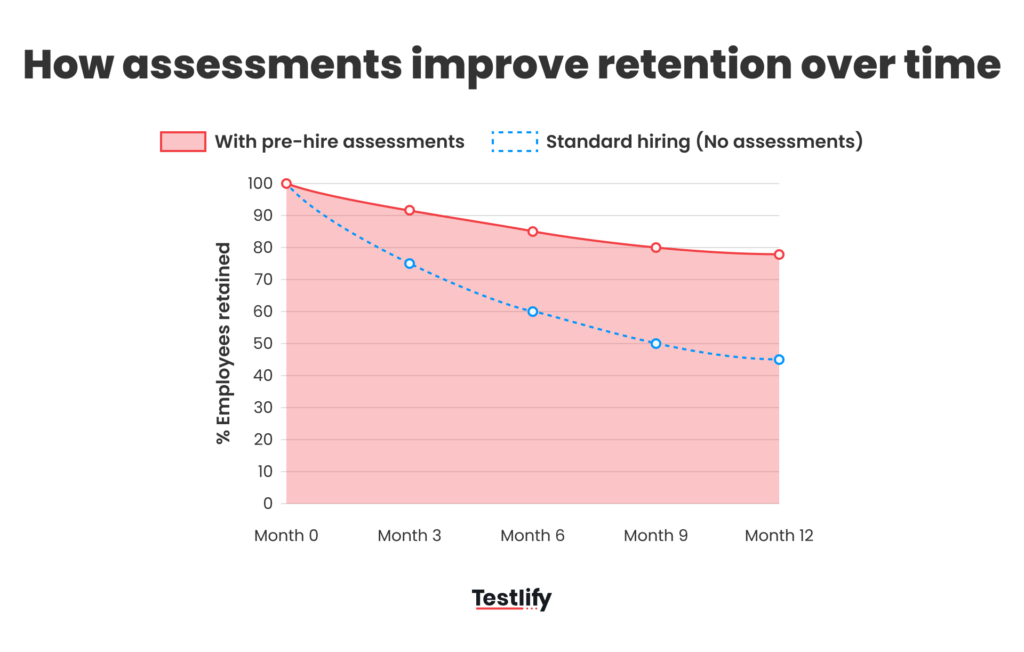
- Better quality of hire. Tests measure real skills and reasoning instead of resume claims, which lifts on-the-job performance and lowers early turnover.
- More consistent, fairer decisions. Every applicant is judged on the same criteria, which reduces subjective calls and makes volume hiring reliable even with many recruiters involved.
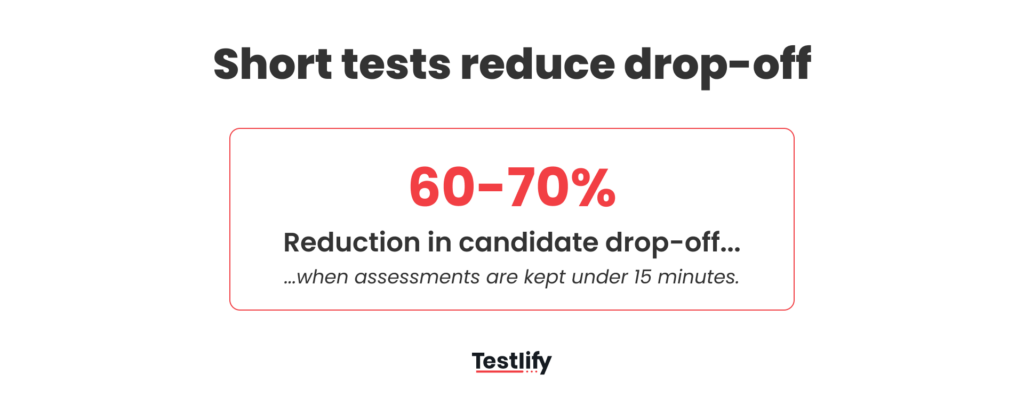
- Better candidate experience. Short, relevant tests give applicants a clear path and a chance to show ability early, which reduces candidate drop-off.
- Real scalability. Assessments handle thousands of applicants at once, so you can raise hiring volume without adding headcount or losing accuracy.
How do you run pre-hire assessments at scale?
Run them by matching each test to the role, keeping tests short and mobile-first, automating delivery and scoring in your ATS, communicating clearly with candidates, reviewing the data every cycle, and holding one fair standard for everyone. When you hire in large numbers, small inefficiencies multiply, so these six practices carry most of the weight.
1. Match the assessment to the role
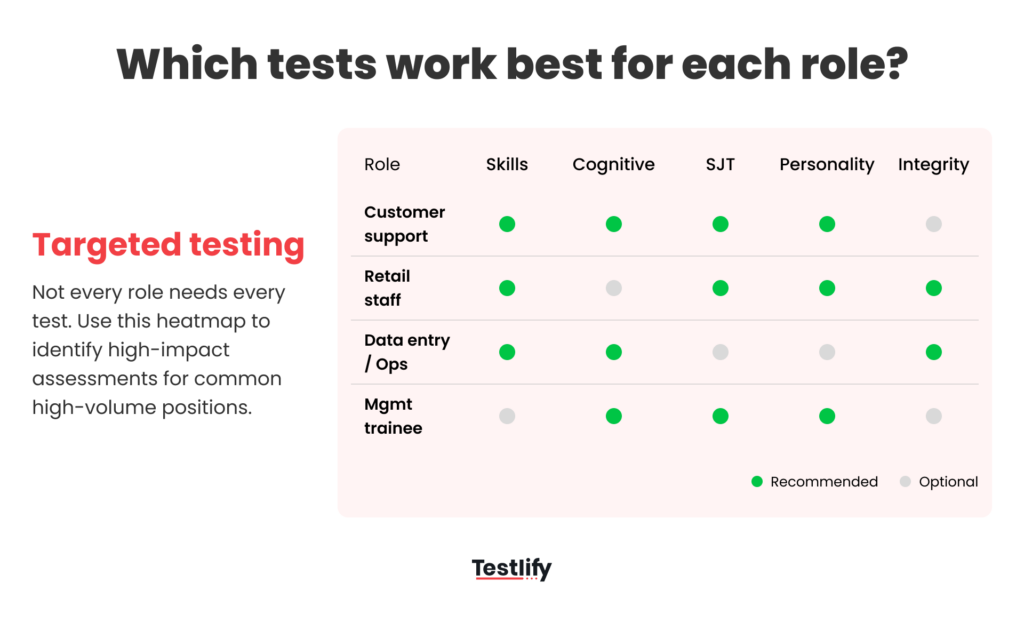
Good assessments start with clarity about the job. Teams struggle when they pick tests that look useful but do not predict success. Instead, name the skills and behaviors that separate strong performers from average ones, then test for those. Customer support benefits from writing clarity, typing accuracy, and language proficiency; operations and field roles lean on rule awareness, reliability, and situational judgment.
2. Keep tests short and mobile-friendly
Length is one of the biggest reasons candidates abandon early screening, and in high-volume hiring that drop-off costs you qualified people before you ever see them. Keep early-stage tests around 5 to 15 minutes and put the highest-signal test first, since many hourly applicants apply from a phone.
3. Automate assessment steps inside your ATS
In high-volume environments, manual work is where funnels stall. If a recruiter sends invitations one by one or advances candidates by hand, bottlenecks form within days. Connect assessments to your applicant tracking system so the test goes out when a candidate applies and the score lands automatically when they finish.
Recruiters then spend their time reviewing top performers, not doing clerical work. Testlify integrates with most applicant tracking systems, so results, rankings, and scorecards are ready the moment a candidate completes a test, which keeps momentum through a busy hiring week.
4. Communicate clearly with candidates
Candidates want to know what to expect, and at scale, unclear communication is a direct cause of drop-off. A short line in the job post explaining why you use assessments makes the process feel fair. Simple touches like an estimated completion time or a progress bar cut anxiety and lift completion rates.
5. Review the data and adjust
Assessments are not set-and-forget. Look at completion rates, average scores, and pass rates. If many candidates drop at one question or section, shorten the test or simplify the instructions; if almost everyone passes, raise the benchmark. The more people you hire, the more your data reveals, and patterns show up fast at volume.
Over time, you might find that high scorers on a specific cognitive test consistently outperform after joining, or that communication scores track closely with 90-day retention. Those patterns are how you sharpen the process cycle after cycle.
6. Keep it fair and compliant
Large-scale screening has to be consistent. Measure every candidate with the same structure and criteria, which cuts unconscious bias and protects you from compliance risk. Job-relevant, validated tests make hiring decisions more defensible because they tie directly to clear, measurable requirements, so you can evaluate thousands of candidates confidently and stand behind every call.
What mistakes sink high-volume assessment programs?
Most high-volume assessment programs fail for the same handful of reasons: the test does not map to the job, the funnel ignores fraud risk, or nobody reviews the data until something breaks. Fix these before you scale, not after.
- Testing skills the role does not need. A generic aptitude battery applied to every requisition wastes candidate time and produces scores nobody trusts. Build the test list from the Competency-to-Evidence Matrix for each role family, not a one-size-fits-all template.
- Ignoring candidate fraud at scale. A 2Q25 Gartner survey of 3,000 job candidates found 6% admitted to interview fraud, either posing as someone else or having someone else pose as them, and Gartner projects one in four candidate profiles worldwide will be fake by 2028. Proctoring and identity checks matter more as volume grows, not less.
- Setting the pass bar after results come in. Deciding cutoffs retroactively to hit a headcount number turns the assessment into theater. Lock the minimum score before launch, the same rule that keeps the funnel defensible in an audit.
- Never revisiting the assessment mix. Teams that pick a test stack once and never touch it again miss the signal that a specific test stopped predicting anything. Review completion, pass rate, and 90-day retention every cycle, and retire or swap tests that do not correlate with performance.
- Treating every role the same. A single assessment stack across customer support, warehouse, and management-trainee roles ignores that each hires for different competencies. Match the stack to the role family, not the requisition volume.
Screen your next high-volume pipeline on evidence
Run short, role-matched skills, cognitive, and situational tests, auto-score them inside your ATS, and compare every candidate on one scorecard. Start free, or book a walkthrough with the team.
Key takeaways
- Start with the role, not the test. Map each competency to one piece of measurable evidence with the Competency-to-Evidence Matrix, so every assessment you send at volume ties back to something the job needs. That keeps your funnel defensible and your data clean.
- Use a mix, not a single test. Skills prove they can do the task, cognitive ability shows learning potential, and behavioral or situational tests predict fit and retention. One signal is fragile at scale; a short stack of two or three is far more reliable.
- Keep it short and mobile-first. Long screens lose good applicants who apply from a phone, so cap early-stage tests near 5 to 15 minutes and lead with the highest-signal test.
- Automate delivery and scoring in your ATS. Manual invites and manual scoring are where volume funnels stall; automation frees recruiters to focus only on ranked, qualified candidates.
- Treat fairness as a system. One consistent, job-related standard for every candidate cuts unconscious bias and keeps decisions defensible under EEOC scrutiny.
- Review the data every cycle. Completion rates, pass rates, and 90-day retention tell you what to shorten, tighten, or re-benchmark, so the process gets sharper with every hundred hires.
Frequently asked questions (FAQs)

Content Writer
Yashika Khandelwal is a Content Writer with 3+ years of experience creating research-backed content on hiring, talent assessment, and HR technology. She is a registered Organizational Psychologist and subject matter expert who combines behavioral science with practical recruitment insights to produce accurate, evidence-based content.
LinkedInRelated resources
View all
High volume hiring
High volume hiring checklist for faster hiring

High volume hiring
High-volume hiring trends: What the latest data tells us this year

High volume hiring
Scale hiring in the IT industry with automated tech screening tools

High volume hiring
How can the BPO industry hire at scale without compromising quality?

High volume hiring
Automated candidate scoring: how it works and speeds up hiring

High volume hiring
How high-volume hiring works with AI interviews
Get started.
Hire on proof, not resumes.
Run your first skills-based assessment free — no credit card required.