
What is a talent gap and how to address one?
Understand what a talent gap is and learn strategies to address it. Discover how to identify skill shortages and build a stronger, more capable workforce.
As a recruiter, you always have to play that balance between supply and demand of skilled talent, but most times, there appears to be a gulf between the two. As a recruiter, you always need to balance the supply and demand of skilled talent, but often, there is a significant gap between the two. According to a survey by Statista, 81% of employers stated they had talent shortages. This blog post will discuss the talent gap, why it occurs, and, most importantly, how recruiters can close it.
 ChatGPT
 Gemini
 Claude
 Grok
Grok Perplexity
What is a talent gap?
A talent gap is a condition that prompts a mismatch between the workforce’s skills and the business’s requirements. A difference between an employee’s skills and the skills desired to properly and efficiently serve a role can lead to lost opportunities and reduced productivity.
In a McKinsey & Company survey, 87% of the companies said they either are experiencing gaps now or expect them within a few years.
Common signs of a talent gap
- Decreased productivity: When employees cannot deliver performance-related outcomes because of a lack of skills, productivity will be low.
- Difficulty filling roles: When most positions open up for a long time, it might be a sign that there is not much talent qualified.
- High attrition: Employees feel ‘drowned’ by the jobs they are unequipped to do and leave the company.
- Skills mismatch: Employees already working in an organization do not have the training or skills to do the jobs properly.

Why does a talent gap occur?
According to Salesforce. 56% of hiring managers anticipate technological interventions like AI and other forms of workplace automation will cause a major shift in the skills they need employees to possess.
Talent gaps are not overnight occurrences. Different circumstances lead to it. A lot of technological change, new business needs, and changing trends in the market can lead to a talent gap. Let’s break these down for you.
1. Technological advancements
Companies never have enough time to catch up on all the modern technology the world is inventing. New jobs, like data scientists and AI specialists, are claimed to be some of the nicest jobs today. What is missing in this scenario is a trained and educated workforce to take on the new demands.
2. Changes in business needs
Businesses constantly change from the market perspectives, new competitors, or internal restructuring. The skills required in any workplace change with the changing needs of the workplace. For example, an organization that has changed from selling through brick-and-mortar to e-commerce possesses different competencies required by its workforce.
3. Inadequate learning and training
Traditional learning institutions, at times, are not in tandem with the marketplace’s needs today. The students mostly leave college with degrees but lack the skills required by this new business world, and a void exists between the qualifications of those candidates and what the employers seek.
4. Globalization
Today, companies compete internationally for talent based on the globalization opportunities that are available around the globe. However, globalization also shows disadvantages as it opens a broader market for highly skilled workers, thus raising the competition gap between talents.
Impact of the talent gap
A talent gap can be a very problematic situation for any organization. According to Salesforce, 14 G20 countries could miss out on $11.5 trillion cumulative GDP growth due to the digital skills gap. The following are a couple of ways by which the business performance is affected in the case of a talent gap:
1. Lower productivity
Employees will surely not be efficient enough in their work if they do not possess the right set of skills. It may lead to a general decrease in productivity, thereby impacting the organization’s overall performance.
2. Higher costs
The cost of recruiting, training, and the time it takes for new hires to be fully productive can quickly add up for the gap in talent through the recruitment and training of employees.
3. Reduced innovation
Innovation thrives upon new ideas and perspectives. If your team lacks skills in innovation or the implementation of new technologies, then your company risks being outperformed by the competition.
4. Increased turnover
Talent gaps can result in job dissatisfaction among employees. High employee turnover seems unavoidable as more employees become aware they lack the skills to achieve their organizational goals. This will heighten your need to hire employees, widening the talent gap.
How do you identify talent gaps in your organization?
So, how do you know if your organization has a talent gap? Here are some key steps you can take to assess whether your company is facing a skills shortage.
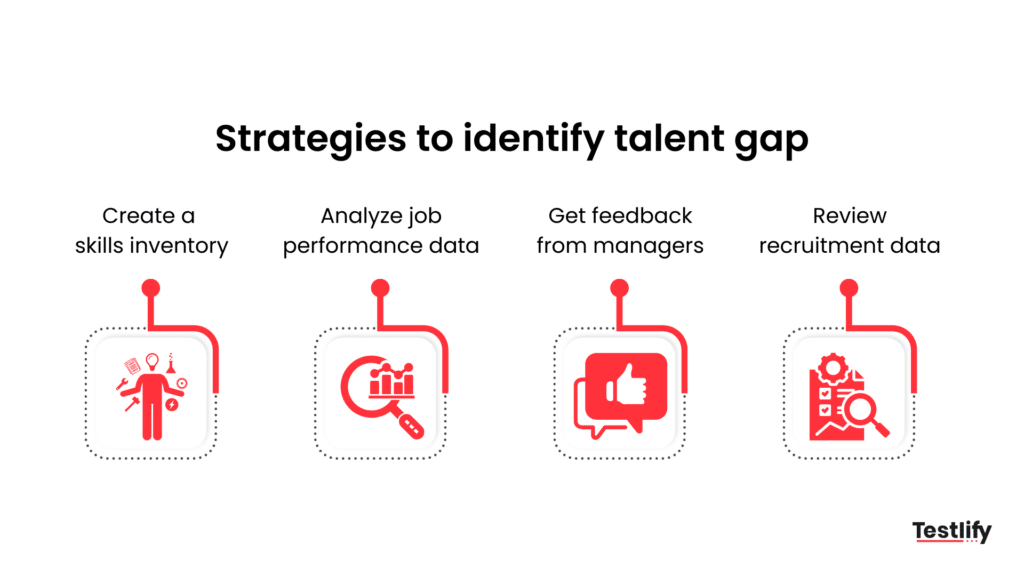
1. Create a skills inventory
A skills inventory involves analyzing the skills and qualifications of your current workforce. By analyzing your team’s skills, you can compare them against the skills your company needs now and in the future.
2. Analyze job performance data
Check on job performance metrics. Are employees performing to target in their KPIs? Is productivity up to what was expected? A sharp decline in such metrics might mean that the skills gap exists.
3. Get feedback from managers
Managers are the best positioned to monitor the occurrences around employee performance at the grassroots level. Get their opinion on whether a big issue is related to skills or competencies impairing teams.
4. Review recruitment data
Suppose you can’t fill certain roles or continue to experience high turnover within certain roles. In that case, the talent pool is not satisfying your needs, eventually leading to a talent gap.
How to close a talent gap?
The obvious next step after identifying a talent gap is to figure out a means of filling that gap. You can use several strategies to close this gap and ensure that your organization is best equipped with the skills to guide you toward success.
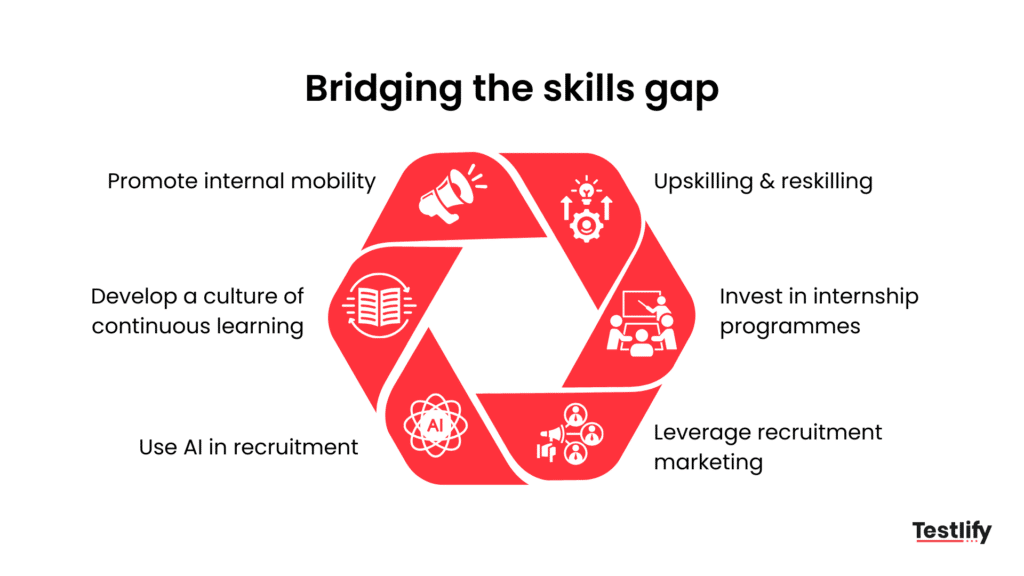
1. Upskilling and reskilling
Upskilling and reskilling are the best solutions to bridge the talent gap.
According to Forbes, 55% of employees and 62% of HR directors said workers must reskill or upskill at least once a year to maintain a competitive advantage. With this, you can develop your existing workforce rather than always relying on external hires.
How do we implement upskilling and reskilling programs?
- Identify the key skills needed: Use your skills inventory to determine which skills are lacking in your organization.
- Develop tailored training programs: Create training initiatives specific to the skills your employees need to develop.
- Provide ongoing support: Offer mentorship programs, on-the-job training, and access to online learning platforms to ensure employees continue growing.
2. Invest in internship programmes
Through internship programs, students or entry-level professionals acquire practical experience. The experience nurtures future talent and allows employers to test their potential hires and fill their skills gaps before these become critical.
3. Leverage recruitment marketing
Another strategy to bridge the talent gap is investing in recruitment marketing that attracts quality talent to the company. You must also show off the culture, training programs, and opportunities for career development that have been in the company to attract the best talent. The job descriptions must be clear and more detailed about the specific skills and qualifications necessary for the role.
5. Use AI in recruitment
Technology in the form of AI will make it possible to do a skills gap analysis. Technologies powered by AI can help pick up potential candidates based on the specified skills by using AI-powered skills assessments. These tools suggest available training opportunities to bridge the current employees’ skill gaps.
6. Promote internal mobility
Internal mobility refers to moving employees from one role or department to another within a company. This can bridge talent gaps as well. In-house employees are already well-versed in the company’s culture and operations; thus, training them for different roles may be quicker and more efficient than hiring new people outside the organization.
7. Develop a culture of continuous learning
Any individual always keeps learning as a part of evolution; therefore, only an organization that allows continuous learning will adapt to change very quickly. Encourage employees to take courses, attend workshops, and stay updated with industry trends. Offering opportunities for learning makes the employees feel important and ensures that your company is equipped to tackle the challenges posed in the future.
How do you measure the success of your talent gap initiatives?
Monitor the progress after you have undertaken measures to bridge the talent gap. Some ways in which you can measure the success of your efforts are as follows:
1. Employee performance metrics
Assess your job performance data to analyze if you have observed improvement in key areas. Are employees meeting their goals more consistently? Have you seen productivity increases?
2. Retention rates
If you invested in upskilling and reskilling, then you should monitor the retention of employees because a high retention rate will denote that your employees feel competent and satisfied at their job.
3. Recruitment time
By identifying talent gaps and knowing the right skills required you can reduce the time to hire candidates. A rapid hiring process HR recruitment tools like skills assessments can effectively bridge the talent gap.
4. Feedback from managers and employees
Surveys and feedback are as effective as determining whether the employees are confident with their tasks after training or whether the new hires are prepared for their jobs.
Conclusion
The talent gap is a huge challenge to businesses, but it is not impossible to close. Given this, you can identify the causes of the gap, recognize whether it exists in the organization, and weigh up against strategies such as upskilling, recruitment marketing, and internal mobility toward closing the talent gap.
The bottom line is that talent gaps require active answers. To stay ahead of the game, you should be well-informed, invest in your existing employees, and continue to identify factors attractive to top talent. With such actions, you close the talent gap and nurture a more skilled, dynamic, and future-ready workforce.
Facing a talent gap in your organization? Create a workforce with all the necessary skills required for a role. Try your hands on Testlify. Our skills assessment platform ensures you assess the right skills and hire the best candidates for a role. Try for free, or book a demo now.
FAQs

Content Writer
Yashika Khandelwal is a Content Writer with 3+ years of experience creating research-backed content on hiring, talent assessment, and HR technology. She is a registered Organizational Psychologist and subject matter expert who combines behavioral science with practical recruitment insights to produce accurate, evidence-based content.
LinkedInRelated resources
View all
HR & recruitment
What Is Resume Parsing? How It Works, Types, and Tips (2026)
HR & recruitment
What is 360 recruitment? What recruiters should know
HR & recruitment
What is a competency framework and how to develop one?
HR & recruitment
HR Digital Transformation: A 2026 Guide for HR Leaders
HR & recruitment
Talent Lifecycle: 5 Stages and HR’s Role (2026 Guide)
HR & recruitment
The five main responsibilities of a human resources director
Get started.
Hire on proof, not resumes.
Run your first skills-based assessment free — no credit card required.