
How high-volume hiring works with AI interviews
A clear look at how AI interviews improve high-volume hiring by reducing screening time, boosting accuracy, and strengthening the overall recruitment process.

High-volume hiring often looks straightforward from the outside. You post jobs, collect applicants, and move them through the interview process. In reality, that’s not the case.
A recent Forbes article reports that recruiting teams are dealing with 412% more applications per recruiter while operating with half the staff. The article specifically discusses AI interviews as a potential solution to this growing recruiting workload.
To address this, most organizations have begun including AI interviews in their hiring process. It helps teams manage volume hiring by handling the early candidate screenings, which usually consume the most time.
In practice, AI in recruitment allows organisations to handle high-volume recruiting without losing control. Let’s find out more about this.
 ChatGPT
 Gemini
 Claude
 Grok
Grok Perplexity
TL;DR – Key takeaways
- High-volume hiring breaks down because manual screening cannot keep up with the speed and scale of applicant spikes.
- AI interviews lighten the load by handling the first wave, improving accuracy, and shrinking time to hire.
- Early automation helps teams avoid drop-offs, especially when applications surge 5 to 10 times their usual levels.
- AI makes large cycles fairer with consistent scoring, simple proctoring checks, and clearer shortlists for recruiters.
- HR teams get the best results when they pair AI with strong inputs, bias checks, and transparent communication.

What high-volume hiring means
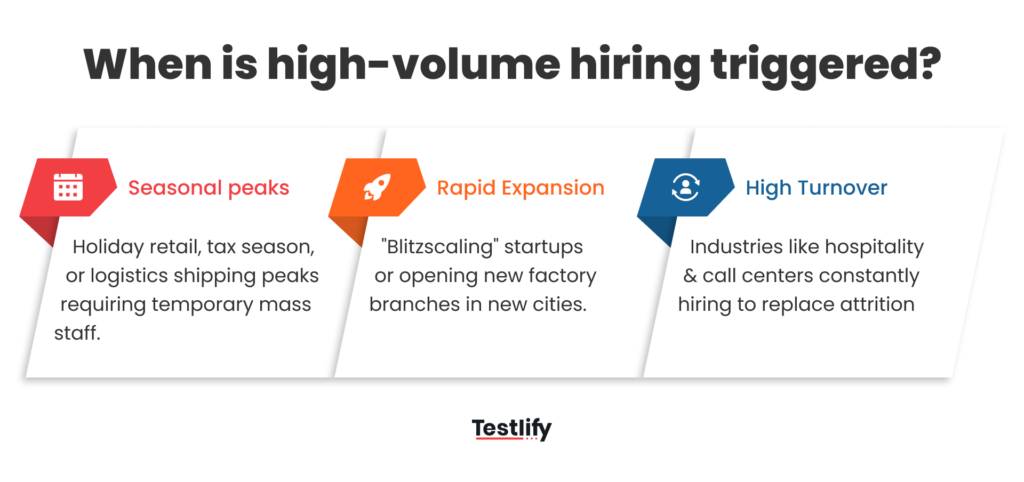
High-volume hiring, sometimes called mass recruitment or high-volume recruiting, is the process of hiring a large number of candidates for similar roles within a short period.
This type of hiring is common in sectors that scale quickly or experience steady turnover, including retail, logistics, contact centers, and seasonal operations.
Why traditional volume hiring becomes hard to manage
High-volume hiring often becomes difficult because the applicant count grows faster than the team can respond to them. LinkedIn and SHRM both report that high-volume roles receive 5 to 10 times as many applications as standard roles.
Traditional hiring processes were designed for steady talent pools, not for a large number of applicants arriving in a short time.
When old methods are used in high-volume hiring, small delays appear at every stage. These delays accumulate, increasing the overall time to hire.
You also lose track of candidates because updates sit in email threads or scattered sheets. This is common in volume hiring, where teams try to manage everything manually.
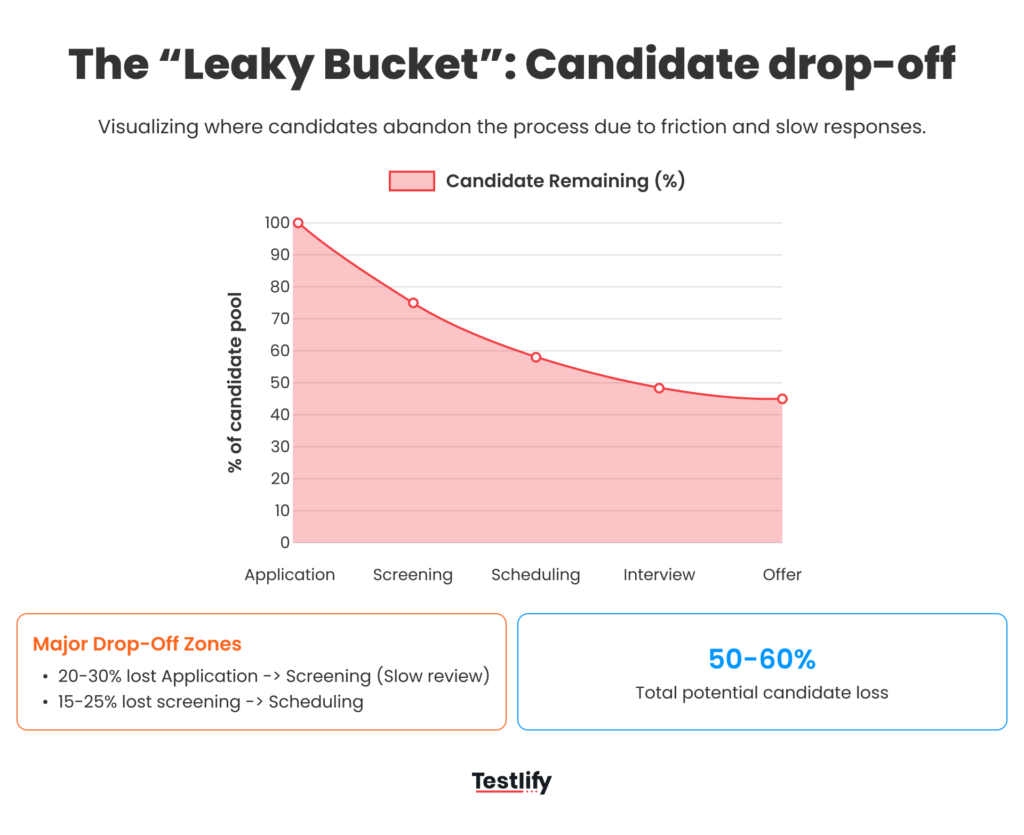
Fast Fact: CareerBuilder found that 52% of candidates lose interest in a job if they do not hear back within two weeks.
Consistency is another problem. Two recruiters may rate similar candidates differently because there is no shared workflow. As the hiring process expands, this gap becomes more visible.
These issues appear in almost every high-volume recruiting cycle. Without stronger systems or AI in recruitment to share the load, the entire process feels hard to control.
Overall, traditional volume hiring struggles because manual workflows cannot handle the speed, scale, and inconsistency that come with high-volume hiring.
Where AI fits into the volume hiring process
AI fits into volume hiring in two simple ways. It speeds up time-consuming steps and filters thousands of candidates based on the skills they actually have.
High-volume recruitment attracts far more applicants than the team can respond to. AI reduces this load by managing early screenings. It scans resumes, understands skills, and matches job descriptions without relying on strict keyword checks.
Fast Fact: According to a 2025 industry guide, automated screening in AI-powered hiring reduces the time spent on initial resume reviews by 71% while improving match accuracy.
AI interviews are another strong fit. With AI-powered interviews, you can set structured questions, analyse responses, score communication quality, and highlight patterns that matter for the role.
AI-powered interviews are especially useful in high-volume hiring scenarios where teams handle a large number of applications in a short period.
AI also strengthens the integrity layer. Proctoring tools monitor off-screen activity, unusual typing patterns, and attempts to switch tabs. This protects high-stakes assessments from cheating, which is common in bulk hiring cycles.
AI improves coordination as well. It schedules interviews, sends reminders, nudges inactive applicants, and keeps talent pools warm. These small steps reduce follow-up time and improve candidate engagement, thereby directly affecting time-to-hire.
How AI interviews work in high-volume hiring
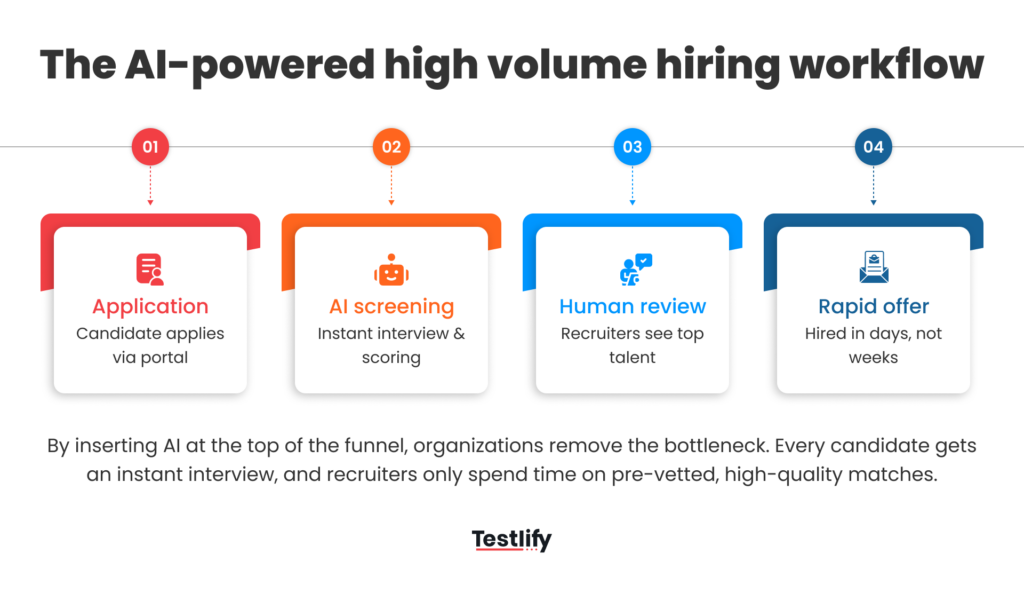
AI interviews were created to solve one core problem in high-volume hiring. When thousands of people apply at once, it becomes impossible for a team to speak with every candidate.
AI interviews reduce this load by handling the first round on the recruiter’s behalf. Here’s how the whole system works,
1. Candidates record answers on their own time
Most AI interviews work like this. The candidate opens a browser link, sees a set of questions, and records short video answers. They don’t need to wait for a recruiter or schedule a slot.
This model is helpful in volume hiring because it removes one of the biggest delays: coordinating calendars for a large number of applicants.
Once the candidate submits the video, the platform uploads it securely and begins the analysis.
2. The AI listens and reads the answer
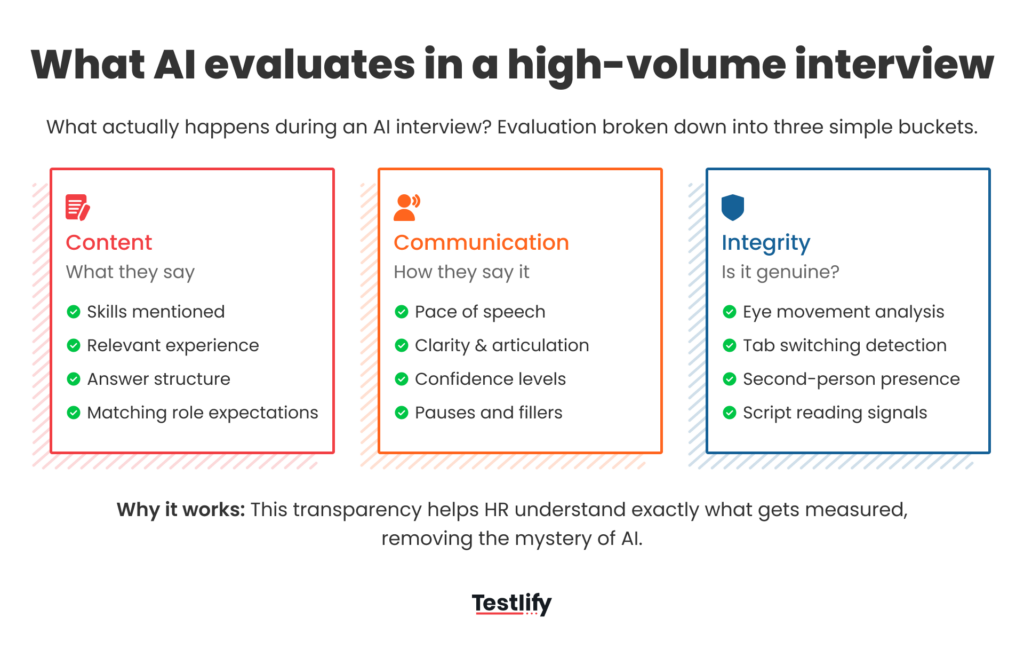
After the video is uploaded, the first step is simple. The system converts the candidate’s spoken answer into text. It then reads that text like a human would and checks:
- Did the person mention the right skills?
- Did they describe real experiences or generic lines?
- Is the answer close to what the hiring team expects for this role?
This works well in mass recruitment because the system compares thousands of answers fairly.
3. The AI checks how the candidate speaks
The next part is about communication quality. The system looks at pace, clarity, and confidence. It notes long pauses, unclear sentences, or very rushed delivery.
High-volume hiring roles like customer service, BPO, and sales often depend on clear communication, so this layer helps identify candidates who can handle real conversations.
Nothing complex here. It is just communication basics analysed at scale.
4. Basic camera checks to confirm authenticity
Some platforms also look at simple visual signals:
- Is the candidate looking at the screen?
- Are they reading from a script?
- Is the same person appearing in all responses?
This helps prevent common issues in volume recruitment, especially when the applicant count is high, and fraud risks increase.
No emotional scoring. No micro-expression judging. Just simple checks to ensure the session is genuine.
5. The proctoring layer stops cheating
High-volume hiring often attracts shortcuts. To protect the hiring process, AI interviews quietly monitor:
- If the candidate switches tabs to search for answers
- If someone else is speaking in the background
- If a second person tries to appear on screen
- If the speech pattern looks copied or generated
These checks keep the process fair when you’re dealing with a large number of applicants.
6. Recruiters get a clean shortlist
After analysing the video, the system gives a simple output:
- a score
- top skills detected
- potential concerns
- and a ranked list of candidates
The recruiting team reviews only the top group instead of watching every single video. This saves hours of work and keeps the hiring process consistent, especially during high-volume hiring seasons where the applicant flow spikes.
Why AI interviews improve high-volume recruiting outcomes
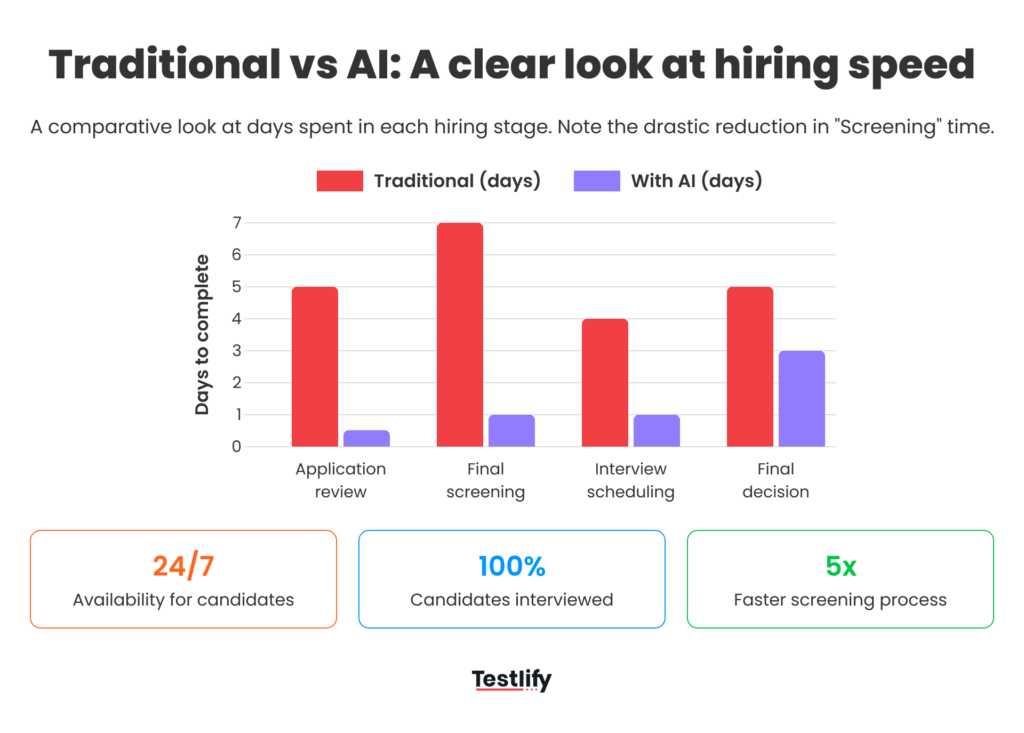
The toughest part of high-volume hiring is sorting the first wave of candidates. In a large cycle, most teams cannot review everything on time.
Research from SHRM shows that early screening often takes up the largest share of recruiter hours, slowing the overall hiring process.
AI interviews fix this. The system can listen to responses, measure how closely they match the job requirements, and surface patterns that are easy to miss when you are tired or rushing.
For mass recruitment or high-volume hiring at Amazon, this helps teams move faster without lowering the bar.
Better speed also improves the candidate experience. People get quicker updates, fewer bottlenecks, and a fairer shot. As the time to hire drops, teams end up with stronger talent pools and fewer candidate drop-offs in later rounds.
What HR teams should keep in mind when using AI interviews
AI interviews can speed up high-volume hiring, but they work best when HR teams understand what the system needs from them.
A little clarity at the start often prevents confusion later. Here’s what you should keep in mind before adding AI interviews to any volume-hiring or mass-recruitment cycle.
Area to Watch | Why It Matters in High-Volume Hiring | What to Keep in Mind |
|---|---|---|
Input Quality | AI tools rely on job descriptions and role data to judge potential candidates | Keep inputs specific so the system can score responses fairly |
Bias Checks | High volume recruiting brings a large number of applicants in a short time | Review patterns often to avoid unfair filtering |
Candidate Experience | Clear steps reduce confusion in the hiring process | Tell candidates how AI interviews work and when they’ll get updates |
Operational Fit | AI should support the recruitment process, not replace judgment | Use AI for speed, but keep final decisions human |
Conclusion
AI interviews make high-volume hiring easier to handle, but the real win comes when humans and AI share the work.
Let the system filter out early noise, and let your team focus on conversations that drive quality. When this balance is right, the whole recruiting flow feels lighter and faster.
If you want to see how structured AI interviews and skills based assessments can support your hiring process, book a demo with Testlify and see the platform in action.
Frequently asked questions (FAQs)

People and Talent Partner
Arushi Shah runs day-to-day talent acquisition and candidate experience at Testlify. She writes on interviewing, structured hiring, and giving candidates a fair, fast process.
LinkedInRelated resources
View all
High volume hiring
How to find the best candidate for every role?

High volume hiring
How to utilize artificial intelligence for large volume hiring?

High volume hiring
11 high-volume hiring strategies for enterprises in 2026

High volume hiring
How to build a scalable mass recruitment process

High volume hiring
Volume hiring: An ultimate guide to plan and implement

High volume hiring
Pre-hire assessments for high-volume hiring: What to test and why it matters
Get started.
Hire on proof, not resumes.
Run your first skills-based assessment free — no credit card required.