
HR hiring cycle: steps, tools, and best practices
Discover a step-by-step guide to the HR hiring cycle, from sourcing candidates to onboarding, with tips to streamline your recruitment process.

 ChatGPT
 Gemini
 Claude
 Grok
Grok Perplexity
TL;DR
- The average time-to-fill is 44 days in 2026, making hiring efficiency a top priority for talent teams.
- 68% of HR professionals report ongoing hiring challenges, highlighting the need for a structured and measurable hiring process.
- Skills-based hiring is used by 70% of employers, with a well-defined hiring cycle helping scale it consistently across teams.
- AI adoption in recruiting reached 43% of organizations in 2026, but only 37% of TA professionals actively integrate generative AI tools into their daily workflow.
- The Hiring cycle audit is a stage-by-stage diagnostic tool that identifies where each of the 6 stages typically stalls and what one targeted fix reduces overall time-to-fill most efficiently.
- The average cost-per-hire is $4,700, making structured hiring processes critical for improving hiring efficiency and reducing costs.
Most of the time lost in hiring does not disappear within a stage. It disappears between stages, in the handoffs from preparation to sourcing, from screening to selection, and from the offer to day one.
The HR hiring cycle is the framework that closes those handoffs. A structured 6-stage process covering preparation, sourcing, screening, selection, hiring, and onboarding, it gives every person involved in recruiting a defined role, an expected output, and a timeline to work within.
Teams that follow a structured cycle spend less per hire, make more consistent decisions at the selection stage, and onboard candidates who stay longer. This guide breaks down how each stage works, where cycles typically stall, and how to use the hiring cycle audit to identify and fix the weak point in your current process.

What is the HR hiring cycle?
The HR hiring cycle is the end-to-end process that takes a role from identified need to filled position. It spans 6 stages: preparation, sourcing, screening, selection, hiring, and onboarding. The process typically runs 42 to 63 days and is managed by internal HR teams and dedicated talent acquisition professionals.
The terms “HR hiring cycle” and “full cycle recruiting” describe the same process. Different organizations use different labels depending on whether the HR generalist team or a dedicated recruiting function owns the work.
Each stage of the cycle produces a specific output: a job profile, a candidate pool, a shortlist, an assessment score, an offer, and an onboarded employee. When any stage produces a weak output, the next stage cannot compensate for it, and time-to-fill grows as teams re-do work that should have been completed upstream.
An SHRM report identifies constrained hiring and AI integration as the two defining forces shaping talent acquisition teams this year, both of which a structured hiring cycle helps HR teams navigate more effectively.
What are the advantages and disadvantages of the HR hiring cycle?
Like any business process, the HR hiring cycle offers clear benefits but also comes with operational challenges that organizations must address to maintain hiring efficiency, let’s now discuss them in detail
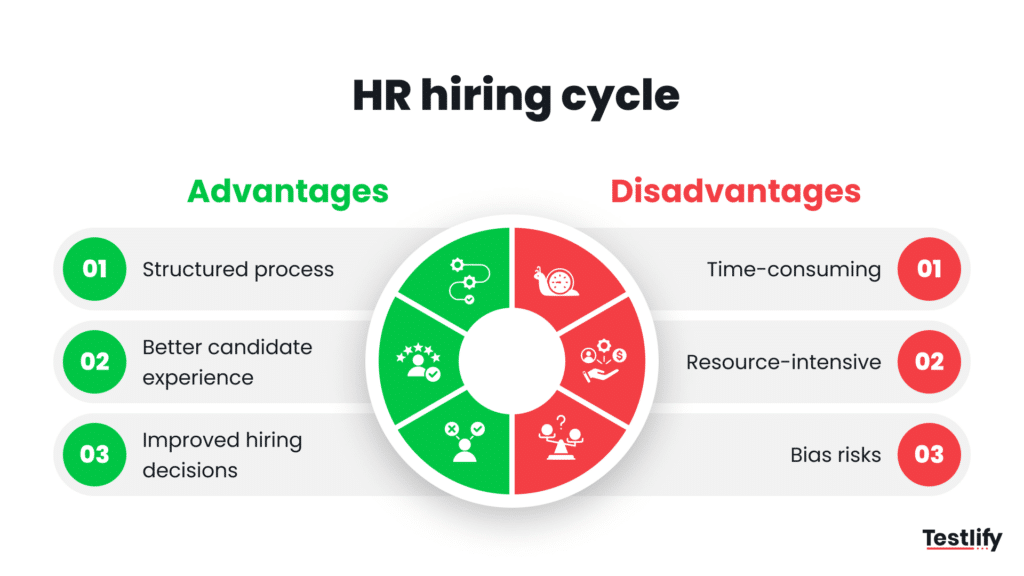
Advantages of the HR hiring cycle
A well-designed HR hiring cycle does more than help organizations fill open positions. It creates a repeatable framework for attracting, evaluating, and onboarding talent in a consistent and measurable way. When each stage is clearly defined, hiring teams can reduce inefficiencies, improve candidate engagement, and make more objective hiring decisions.
Structured process
A defined six-stage hiring cycle transforms recruitment from a series of ad hoc activities into a repeatable operating system. Instead of rebuilding the process for every vacancy, hiring teams follow a consistent framework with clear responsibilities, timelines, and evaluation criteria.
This standardization helps organizations maintain hiring quality across departments and makes outcomes easier to measure against metrics such as first-year retention, time-to-productivity, and 90-day performance.
Better candidate experience
Structured hiring sets clear expectations and communication checkpoints throughout the process. Candidates know what comes next, reducing uncertainty and improving engagement. Stronger candidate experiences also contribute to better long-term retention.
Improved hiring decisions
Consistent hiring decisions require more than good intentions. With skills-based hiring now used by 70% of employers, organizations need a reliable framework for assessing candidates against predefined competencies and job requirements.
The HR hiring cycle provides that structure by embedding assessments, interviews, and decision criteria into a repeatable process.
Disadvantages of the HR hiring cycle
While the HR hiring cycle improves consistency and hiring outcomes, it is not without challenges. Organizations must invest time, resources, and process discipline to execute each stage effectively.
Time-consuming
The average time-to-fill sits at 44 days across industries, and each stage of the cycle adds incremental processing time. Teams that compress or skip stages to move faster typically extend total time-to-fill because they re-do screening work at the selection stage that should have been completed earlier.
Resource-intensive
Cost-per-hire averages $4,700 across industries, and a full 6-stage cycle requires dedicated time from HR, hiring managers, and multiple interviewers. The resource investment pays back in retention and quality-of-hire, but the payback is difficult to measure without consistent tracking across all 6 stages.
Bias risks
Unstructured stages, particularly interviews, can introduce unconscious bias and inconsistent decision-making, leading to unfair candidate evaluations and potential legal risks.
Adding a standardized competency-based assessment during screening and selection reduces reliance on subjective interviewer judgment and provides defensible scores across all candidates.
What are the 6 steps of the full HR hiring cycle?
A successful hire rarely comes from a single interview or sourcing channel. It is the result of a structured process that moves candidates through a series of clearly defined stages, each designed to reduce uncertainty and improve decision quality.
The six-step HR hiring cycle provides that framework, ensuring every candidate is evaluated consistently and every hiring decision is supported by documented evidence rather than intuition alone.
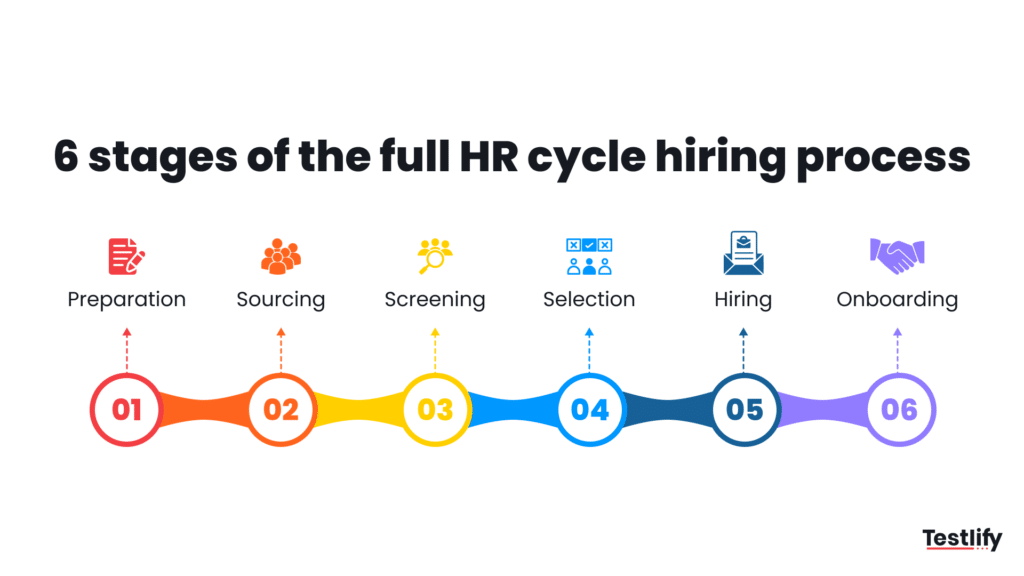
Step 1: Preparation
Preparation is the stage most HR teams underinvest in, and it is the one most responsible for downstream delays. A job profile written without hiring manager input produces a candidate pool that does not match the actual role, which forces re-screening and adds 1 to 2 weeks to the overall cycle.
A strong preparation stage should produce a documented job profile, competency framework, assessment criteria, and hiring timeline. By establishing these elements upfront, teams reduce ambiguity, improve candidate quality, and prevent delays during screening and selection.
Step 2: Sourcing
Once hiring requirements are defined, the next step is building a qualified candidate pipeline. Sourcing involves attracting talent through job boards, referrals, internal talent pools, recruitment agencies, and direct outreach to passive candidates.
The U.S. labor market holds 7.6 million open roles as of 2026 (BLS JOLTS), which means new postings compete directly with dozens of other active listings for the same candidates.
The most effective sourcing strategy depends on the role. High-volume positions typically benefit from broad job board distribution, while specialist and senior-level roles often require targeted outreach and referral programs
Step 3: Screening
Screening narrows the applicant pool into a shortlist of qualified candidates. This stage typically combines resume reviews, initial recruiter conversations, and pre-employment assessments to identify candidates who meet the role’s minimum requirements.
As application volumes continue to grow, screening is also the stage where automation and AI tools can deliver the greatest efficiency gains. Structured assessments are particularly valuable because they provide objective candidate data before interviews begin.
Instead of advancing candidates based solely on resume quality or recruiter impressions, hiring teams can prioritize individuals who have already demonstrated the required skills.
A well-executed screening stage reduces workload later in the process and creates a stronger shortlist for selection.
Step 4: Selection
Selection evaluates shortlisted candidates against the criteria defined during preparation and produces a ranked list of finalists for the offer stage. This stage carries the highest bias risk when evaluation relies on unstructured interviews.
A competency-based assessment at selection gives hiring managers a data point that is directly comparable across all finalists, rather than impression-based feedback that varies by interviewer. The outcome of this stage should be a ranked list of candidates supported by clear, evidence-based reasoning.
Step 5: Hiring
The hiring stage focuses on converting the preferred candidate into a new employee. This includes preparing the offer, obtaining approvals, negotiating terms, and securing acceptance.
Speed is critical at this point as top candidates are often engaged in multiple hiring processes simultaneously, and delays can result in losing strong talent to competing employers.
Establishing clear approval workflows and defined response timelines helps organizations move quickly without compromising decision quality. A successful hiring stage ends with an accepted offer and a smooth transition into onboarding.
Step 6: Onboarding
The onboarding stage is the final step of the hiring cycle and the first step of the employee lifecycle; what the new hire experiences in the first 30 days directly predicts 90-day performance and 12-month retention.
Organizations that invest in onboarding consistently see stronger retention, faster time-to-productivity, and better employee engagement outcomes.
Key Takeaway: The 6-stage HR hiring cycle is a system, not a checklist. Skipping or compressing a stage does not make the cycle faster; it shifts the cost of that stage forward into the next one, typically as re-screening, additional interview rounds, or early attrition.
How do you start with HR cycle hiring?
Starting with HR cycle hiring requires 3 things: a documented job profile, a defined assessment benchmark for the screening and selection stages, and a named owner for each of the 6 steps.
Most teams that struggle with the HR hiring cycle do not lack process awareness; they lack stage ownership and defined output criteria that tell everyone involved what a completed stage looks like.
The Hiring Cycle Audit
In my work with enterprise HR teams, the most effective way to improve an existing hiring cycle is a stage-by-stage diagnostic rather than a wholesale process redesign.
At Testlify, we use the Hiring Cycle Audit to uncover delays across the hiring process and identify the targeted improvements that deliver the greatest reduction in time-to-fill.
Stage | Common failure point | Most effective fix |
|---|---|---|
Preparation | Creation of incomplete job profiles as hiring manager and leadership team did not align on role requirements before the position was posted | 20-minute calibration session before posting; document agreed scoring benchmark |
Sourcing | Same channel used for all role types regardless of specialization or seniority | Role-type sourcing matrix; activate referrals for specialist and senior roles |
Screening | Manual review of large unscreened applicant pools consuming disproportionate recruiter time | Add assessment layer before first-stage calls; use AI screening tools for volume roles |
Selection | Inconsistent interview criteria across evaluators; no shared scoring standard | Structured scorecard with defined competencies; standardized assessment for all finalists |
Hiring | Slow offer turnaround due to approval chains not pre-cleared before selection completes | Pre-approve offer parameters before selection stage begins; set 24 to 48-hour SLA |
Onboarding | Without a defined 30-day onboarding plan, managers often default to reactive check-ins | Build onboarding template before hire completes; assign day-1 buddy and day-30 check-in |
Run the Hiring Cycle Audit on your last 3 filled roles. Map where each role spent the most calendar days and compare against the failure points above. The stage with the longest average cycle time is where one targeted fix will reduce overall time-to-fill most efficiently.
What tools help you manage the full hiring cycle?
The most effective hiring teams rely on a combination of specialized tools that support sourcing, screening, evaluation, hiring, and onboarding. Together, these platforms help reduce administrative workload, improve decision-making, and create better candidate experiences across every stage of the hiring cycle.
Applicant Tracking System (ATS)
An ATS manages the candidate pipeline across all 6 stages, from application receipt through offer acceptance and into onboarding handoff. Modern ATS platforms connect sourcing channels, track stage progression, and maintain a searchable talent database that carries value across multiple hiring cycles.
Interview scheduling tools
Interview scheduling tools eliminate manual calendar coordination between candidates, interviewers, and hiring managers at the screening and selection stages. Scheduling friction is one of the most common causes of candidate dropout before the offer stage, and automated scheduling removes the back-and-forth that adds days to each stage transition.
Candidate assessment platforms
Assessment platforms deliver structured, role-specific evaluations at the screening and selection stages that produce quantifiable scores rather than impression-based outcomes.
Testlify’s test library covers cognitive ability, role-specific tests, behavioral assessments, and situational judgment tests, giving HR teams a consistent evaluation layer across every role type in the hiring cycle.
Onboarding software
Onboarding software manages the administrative and cultural integration steps that determine first-90-day retention and 12-month performance. By connecting hiring data with onboarding workflows, a structured onboarding platform helps new hires become productive faster from day one.
Employee referral platforms
Referral platforms activate the existing employee network as a sourcing channel, particularly for specialist roles that underperform on general job boards.
LinkedIn research on referral hiring consistently shows that referred candidates reach full productivity faster and have lower first-year turnover than candidates sourced through other channels.
Final thoughts
The HR hiring cycle is not an HR-only concern. Every stage from preparation through onboarding involves hiring managers, team members, and senior leaders; the HR team’s role is to structure those interactions so they produce defensible outcomes.
If your current time-to-fill exceeds 45 days or your first-year turnover exceeds 15%, one structured review using the Hiring Cycle Audit will identify the specific stage where the process breaks down.
Testlify’s talent assessment library gives you a structured evaluation layer for screening and selection that integrates directly into your existing ATS workflow and produces scored, comparable data across every candidate you evaluate.
Book a demo today to see how Testlify helps you reduce hiring bias, improve candidate quality, and make faster, data-driven hiring decisions at scale.
How can HR reduce hiring time?
Use clear job descriptions, automated resume screening, structured interviews, and quick communication to speed up hiring.
What makes a great job description?
A great job description is clear, concise, and includes job title, duties, required skills, company culture, and benefits.
What is the best way to evaluate candidates?
Use structured interviews, skill assessments, personality tests, and feedback from interviewers for objective evaluation.
How can onboarding improve employee retention?
A smooth onboarding process with mentorship, training, and clear communication helps new hires feel engaged and valued.
What are the key hiring metrics to track?
Time-to-hire, cost-per-hire, candidate satisfaction, retention rate, and quality of hire are key recruitment metrics.

Related resources
View all
HR & recruitment
Understanding Key Responsibility Areas in recruitment

HR & recruitment
Employee appreciation day 2026: Why it matters (10 ideas)

HR & recruitment
Recruitment Database: Definition, Benefits, Types

HR & recruitment
A complete guide to recruitment advertising in 2026

HR & recruitment
Garden leave meaning: pay, rules, and key benefits

HR & recruitment
SEO for recruitment : The role of AI in talent search
Get started.
Hire on proof, not resumes.
Run your first skills-based assessment free — no credit card required.