
5 high volume recruitment strategies to adopt in 2026
Discover 5 powerful high-volume recruitment strategies for 2025 to streamline hiring, attract top talent, and enhance efficiency in your process!

Did you know 65% of companies have high-volume recruitment needs in 2024? Recruiting in 2025 demands agility and precision to stay ahead in the talent race. It’s time to reimagine your approach with proven strategies for high-volume hiring success.
It does not matter whether your product or service caters to retail, hospitality, customer service, or technology. If you recruit, this applies to you as well. If your business is growing, you must look at these five high-volume recruitment strategies to adopt in 2025.
This article will give you a clearer picture of what needs to be done to stay ahead in the recruiting game and do effective skill management for high-volume recruitment.
 ChatGPT
 Gemini
 Claude
 Grok
Grok Perplexity
What is high volume recruitment?
High-volume recruitment is the process of hiring employees at scale in a short period, often to fill multiple positions quickly, usually with standardized processes to manage large candidate pools. This approach is common in industries where roles must be filled quickly due to high demand, expansion, or operational growth.
“Your human talent is your most important talent.”
Carla Harris, Wall Street banker, motivational speaker, and Author of Expect to Win
Unlike traditional hiring, this focuses on managing a large inflow of applicants efficiently while maintaining quality hires.
Key characteristics are:
- Multiple applications for a single job posting.
- Tight timelines for screening, shortlisting, and onboarding.
- Use of technology to manage large-scale operations.
It differs from regular hiring in scale and urgency, requiring unique tools and strategies to handle the volume effectively.
Testlify is purpose-built for high-volume recruitment. From AI-powered resume screening and automated interview scheduling to skill-based assessments that actually predict performance, we help you cut your time-to-hire by up to 60%.

Common challenges in high volume recruitment
High-volume recruitment faces challenges like time constraints, candidate screening, quality hires, and process inefficiencies. Here are some of the most common issues faced by hiring teams in high-volume recruitment:
- Limited time: Filling positions quickly can compromise the quality of hires if processes are rushed.
- Candidate experience: A high volume of applications can lead to generic, impersonal communication, negatively impacting the candidate experience.
- High screening turnover: Sorting through thousands of resumes manually is time-consuming and prone to human error.
- Quality: Ensuring that every candidate meets job requirements is difficult when managing large pools of applicants.
- Reducing bias: High-pressure environments can increase the risk of unconscious bias in decision-making.
Related: 10 latest volume recruiting trends
Engaging technology for efficient high-volume recruitment
Technology and recruitment go hand in hand in today’s scenario. It will be an added advantage if you know how to optimize high-volume recruitment strategies.
It would be a great choice to know tools like applicant tracking systems (ATS), AI-powered screening tools, chatbots, and virtual assistants that have the potential to transform how companies handle large-scale hiring. Let us learn about these tools in detail.
1. Applicant tracking systems (ATS)
ATS platforms help mass hiring tremendously. On average, companies that use ATS save around $10,000 per hire by automating tasks and reducing time-to-hire. They enable recruiters to automate resume screening, job posting, and candidate status tracking tasks. This streamlines workflows and ensures consistency in managing applications.
Related: How to create clear and engaging job postings
2. AI-powered screening tools
AI tools analyze resumes and applications faster and more accurately than humans. A Talent Board and Phenom study found that AI-powered screening tools can cut résumé review time by up to 75%. These tools assess candidates based on skills, experience, and compatibility, helping recruiters focus on the most qualified applicants. A Harvard Business Review study found that companies using AI in their hiring process are 46% more likely to make successful hires.
3. Chatbots and virtual assistants
AI-powered chatbots assist in answering candidate queries, scheduling interviews, and providing updates. This improves communication and saves recruiters significant time. Studies show that chatbots can reduce question response time by 80%. This is tremendous as recruiters spend a lot of time scheduling interviews, with some estimates suggesting it takes up to two-thirds of their hiring time.
Related: Are recruitment chatbots necessary for talent acquisition?
4. Predictive analytics
Data-driven insights help recruiters forecast hiring needs, predict candidate success rates, and make more informed decisions. Predictive analytics allows teams to focus on candidates most likely to succeed in the role.
Integrating advanced tools into your hiring process can improve efficiency, reduce costs, and enhance the candidate experience.
Now that you know everything, starting from high volume recruitment, challenges, and technologies. Let us now discuss implementing strategies that can take you a step further.
What are the strategies to optimize high-volume recruitment?
When discussing current hiring scenarios, businesses must constantly find ways to streamline their hiring processes. By refining these processes, companies can effectively manage the influx of candidates while maintaining the quality of hires.
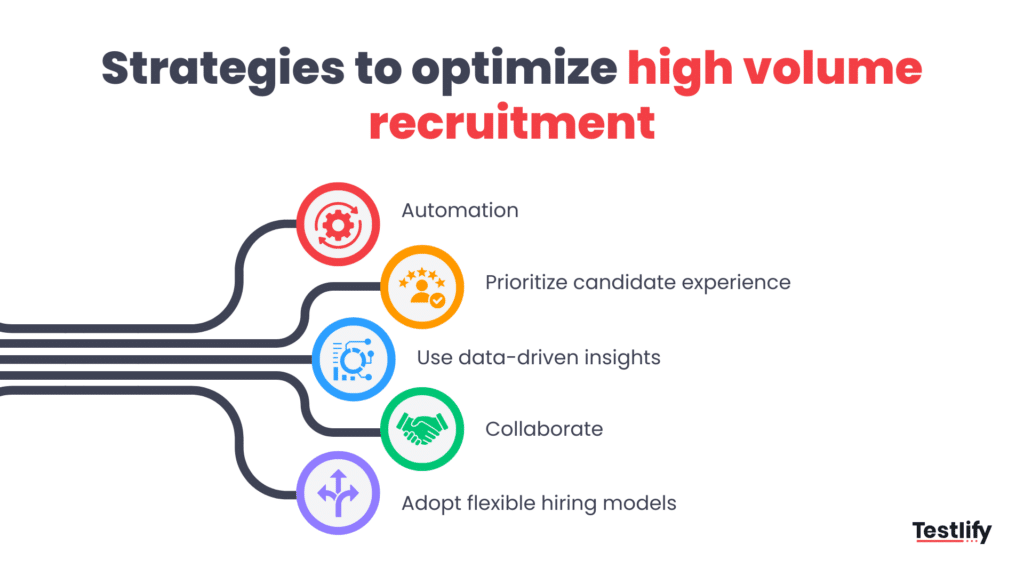
Here are five key strategies to adopt in 2025 for successful large-scale hiring:
Automation
The power of automation in screening and shortlisting candidates is beyond limit. In only a few minutes, AI systems can examine thousands of resumes, remove the unfit ones, and further compile the shortlisted candidates for additional consideration. This speeds up the process and lessens the recruiter’s workload.
Another add-on is skill-based assessments. Such skill tests are a perfect way to evaluate candidates and rank them according to their skills and knowledge. These deliver high accuracy and concrete subject knowledge and align better with the job requirements.
These assessments evaluate candidates’ abilities through practical tests, ensuring that only those with the necessary skills progress to the next stage.
Prioritize candidate experience
It’s easy to overlook the individual candidate’s experience. However, a poor experience can damage your employer’s brand and discourage talented candidates from applying. 58% of candidates have rejected a job offer due to a poor candidate experience.
Personalized communication is key. Automated email updates, chatbots, and clear timelines keep candidates informed and engaged.
Additionally, showcasing your company culture through video content and testimonials can attract talent.
Use data-driven insights
Data is a powerful tool for optimizing recruitment. Tracking key performance indicators (KPIs) such as time-to-hire, cost-per-hire (CpH), and applicant drop-off rates provides valuable insights into the effectiveness of your strategies.
Data-driven hiring also supports diversity initiatives by identifying and addressing recruitment bias. This ensures a fair and inclusive hiring approach, which is crucial for building a diverse workforce.
Collaborate
High volume recruitment often involves multiple stakeholders, from hiring managers to HR teams. Integrated recruitment platforms ensure seamless collaboration by providing a central hub for all hiring activities.
These platforms facilitate real-time updates, shared feedback, and task management, ensuring everyone is on the same page. Integration with tools like ATS and video interviewing tools like Testlify further streamlines the process.
Adopt flexible hiring models
As remote work becomes more prevalent, flexible hiring models are essential. High volume recruitment in 2025 will increasingly involve remote roles, requiring recruiters to adapt their strategies. As per Recruiterflow, 52% of recruiters have struggled to secure top candidates before their competitors.
Virtual hiring events, video interviews, and remote hiring are now standard practices. According to Novoresume, 56% of global companies allow remote work. These approaches expand your talent pool by allowing you to recruit candidates from diverse locations while saving time and resources.
Conclusion
High volume recruitment is a dynamic and challenging process, but it can also be incredibly rewarding with the right strategies.
In 2025, success lies in implementing technology, prioritizing candidate experience, and adopting data-driven, collaborative approaches. Organizations can streamline their hiring processes and secure top talent quickly and efficiently by focusing on automation, personalization, and flexibility.
As the recruitment landscape evolves, staying ahead of trends and integrating innovative solutions will ensure your high volume recruitment strategies remain competitive and effective. With these five strategies, you’re well-equipped to tackle the challenges of 2025 and beyond.
Stay ahead of the curve and ensure your recruitment efforts are efficient, effective, and scalable. Book a free demo with our hiring experts today and see how Testlify can reduce your time-to-hire and improve candidate quality.
Frequently asked questions (FAQs)

Related resources
View all
Hiring Guide
Talent matching: what it is and how it works

Hiring Guide
What is interview scheduling and how to do it?

Hiring Guide
What is affinity bias and how to avoid it in 2026?

Hiring Guide
HR checklist for 2026: Key steps you can’t miss

Hiring Guide
White Collar vs Blue Collar Jobs: Key Differences (2026)

Hiring Guide
Practical tips for HR to optimize working days
Get started.
Hire on proof, not resumes.
Run your first skills-based assessment free — no credit card required.