
High-volume hiring trends: What the latest data tells us this year
A data-driven look at this year’s high-volume hiring trends, from faster applications to stronger retention and better candidate experience.

High-volume hiring has always moved fast, but this year the pace feels different. Teams are dealing with larger applicant pools, shorter attention spans, and more pressure to fill roles without hurting quality.
Survey data shows that most employers still struggle with the basics. 60% report too many low-quality applicants, and 53% cite talent shortages. These challenges match a broader trend where 70% of organizations say they face significant recruiting difficulties despite strong applicant flow.
In practice, this creates a mix of abundance and scarcity. You may receive hundreds of applications for a single job, yet only a small share will convert because candidates drop off the moment the process feels slow or confusing.
What is changing this year is how employers respond. Instead of relying on assumptions or old playbooks, more organizations are turning to recruitment analytics to understand where they lose candidates, which channels deliver better long-term results, and how small improvements affect cost per hire and retention.
This blog breaks down the most important high-volume hiring trends emerging from the latest recruitment data insights. Let’s dive in!
 ChatGPT
 Gemini
 Claude
 Grok
Grok Perplexity
TL;DR – Key takeaways
- High-volume hiring succeeds when the process is fast, simple, and mobile-friendly.
- Data beats instinct, helping teams spot bottlenecks and improve the quality of hire.
- Clear communication strengthens employer branding and reduces candidate drop-off.
- Referrals and niche networks deliver the strongest 90-day retention rates.
- Automation and AI free recruiters to focus on conversations rather than manual filtering.

Friction is killing your talent pipeline
Speed still decides who you hire in high-volume recruiting. The moment your application process feels slow, confusing, or too long, candidates leave. Real data backs this.
Historical data shows a steep candidate drop-off after the five-minute mark, and many employers lose more than half of their qualified applicants before the first screening step even begins.
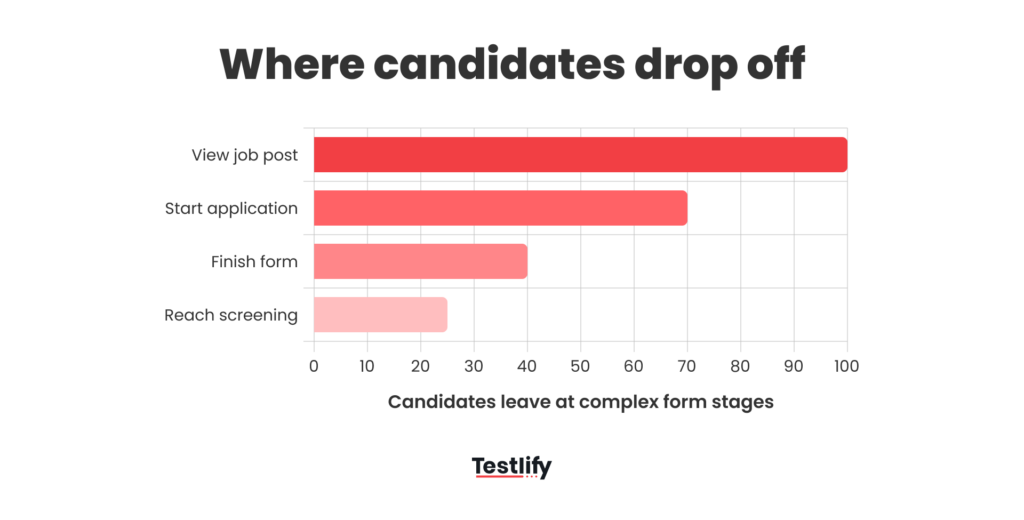
This friction becomes a direct threat to your talent pipeline. You might have strong job postings and solid employer branding, but if the application takes too long, the effort you put into attracting candidates never converts into usable talent.
It also affects the quality of your applicant pool, as the most motivated candidates are often those who expect faster, cleaner experiences.
The hiring process today needs to meet candidates where they are. Most high-volume applicants apply on their phones, often during short breaks between tasks.
Mobile-first design, simple fields, and short initial forms help you capture interest early. Many companies now collect only basic details at the start and gather the rest later, once the candidate is already engaged.
Data over gut: Recruitment analytics in action
For years, high-volume hiring relied on instinct. A recruiter would skim resumes, draw on experience, and hope the “right” candidates advanced. That approach no longer works. The volume is too high, and the cost of a wrong hire is too steep.
Recruitment analytics stepped in because the human eye cannot reliably process thousands of applications or predict long-term fit at scale.
Most organizations now use analytics to guide hiring decisions. 79% of HR leaders say analytics help them plan their workforce better than manual methods.
In practice, data highlights where candidates drop off, which sourcing channels lead to better 90-day retention, and what parts of the hiring process slow down time to fill. These insights turn hiring into a controlled and measurable system.
Analytics also help teams separate real bottlenecks from imagined ones. Many recruiters assume screening is the main delay, but data often shows the real slowdown happens during interview scheduling.
Once teams see these patterns, they redesign the hiring process around what the numbers actually reveal, not what they think is happening. This usually cuts days from the timeline without adding new tools or more people.
To make this clearer, here are a few common issues analytics uncover:
- unexpected drop-off points
- slow manager responses or approvals
- low-retention sourcing channels
- bottlenecks in interview scheduling
Let’s look at a real example. One employer used data-driven scoring to match candidates with attributes tied to long-term success, improving six-month retention from roughly 37% to 96%.
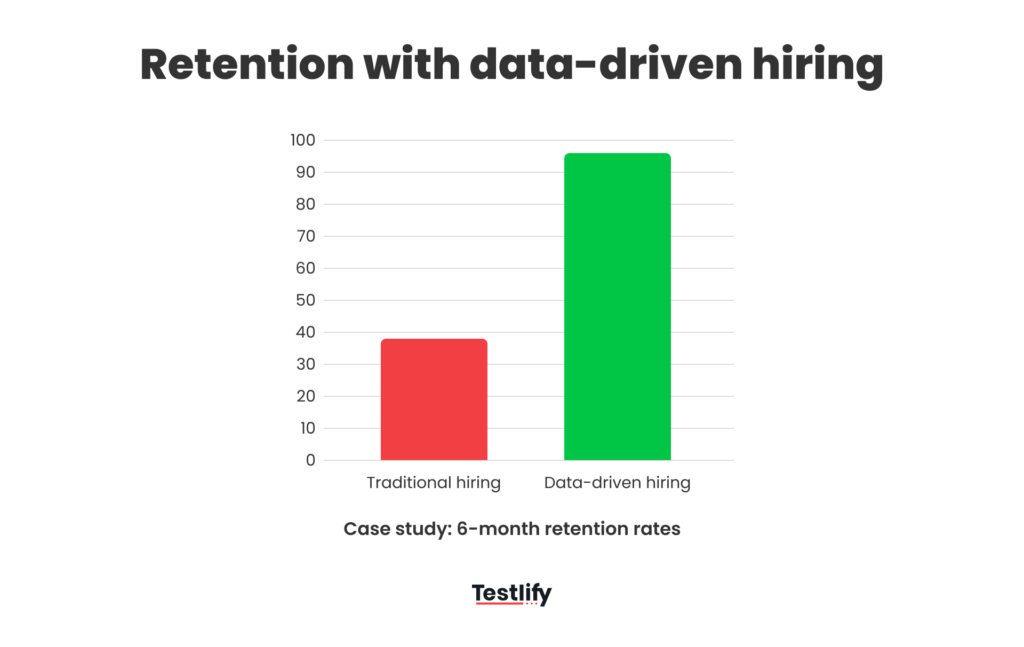
Improvements like this are not luck. They come from comparing historical data with actual employee performance and adjusting hiring criteria accordingly.
AI & automation: Doing more with less
AI has quietly become the backbone of high-volume recruiting. When thousands of candidates apply at once, manual screening and scheduling slow the entire hiring process. Automation solves this by taking over tasks that are repetitive, time-sensitive, and hard to scale.
In practice, most hiring teams now use AI for the early stages of the funnel. It screens resumes, asks knockout questions, schedules interviews, and answers candidate queries through chatbots.
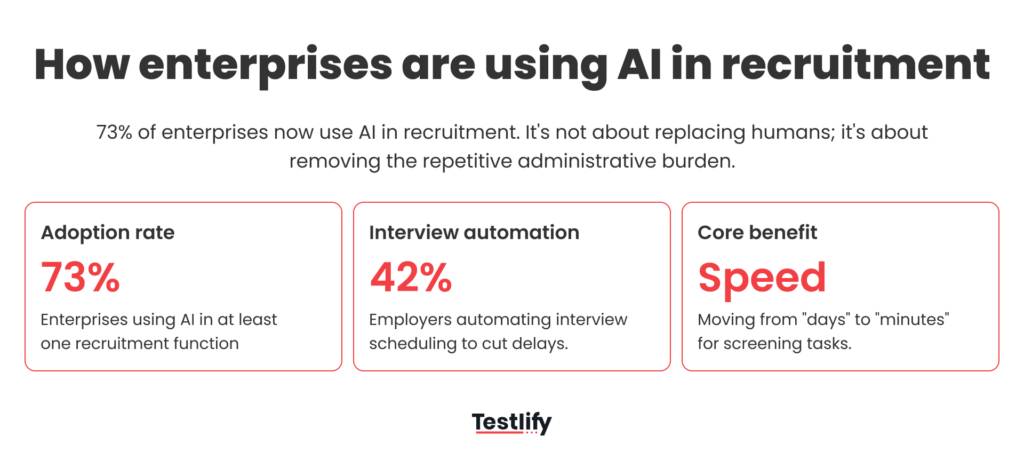
73% of enterprises use AI in at least one recruitment function, mainly because teams cannot manually keep up with the volume anymore.
Where AI helps the most:
- Screening: Filters large applicant pools within minutes
- Scheduling: Let candidates self-book time slots
- Chatbots: Handle FAQs and status updates instantly
- Assessments: Short skills checks sent automatically
These are basic but high-impact tasks. Once automated, recruiters finally get time for real conversations instead of inbox management.
Automation for time saving
Many companies cut multiple days from their hiring process with just scheduling automation.
Industry data shows that 42% of employers now automate interviews, removing the long chain of back-and-forth emails.
The same shift is happening in interviews. Asynchronous video interviews allow candidates to respond on their own time. This format avoids schedule conflicts and increases coverage for hourly roles.
Quick Comparison: Manual vs AI-Assisted:
Step | Manual Process | AI-Assisted |
|---|---|---|
Screening | Hours or days | Minutes |
Scheduling | Repeated emails | Self-booking link |
Candidate Queries | High recruiter load | Chatbot responses |
Interview Completion | Lower for shift workers | Higher with async video |
This makes the core point simple. AI does not replace recruiters. It removes friction so recruiters focus on hiring decisions and relationships, not filters and forms.
Candidate experience equals employer branding
In high-volume hiring, candidates decide how they feel about your company long before they meet a hiring manager. Most of their impression is shaped by their experience during the application process.
The data is simple but important: candidates are 4 times more likely to reapply after receiving constructive feedback, even after rejection.
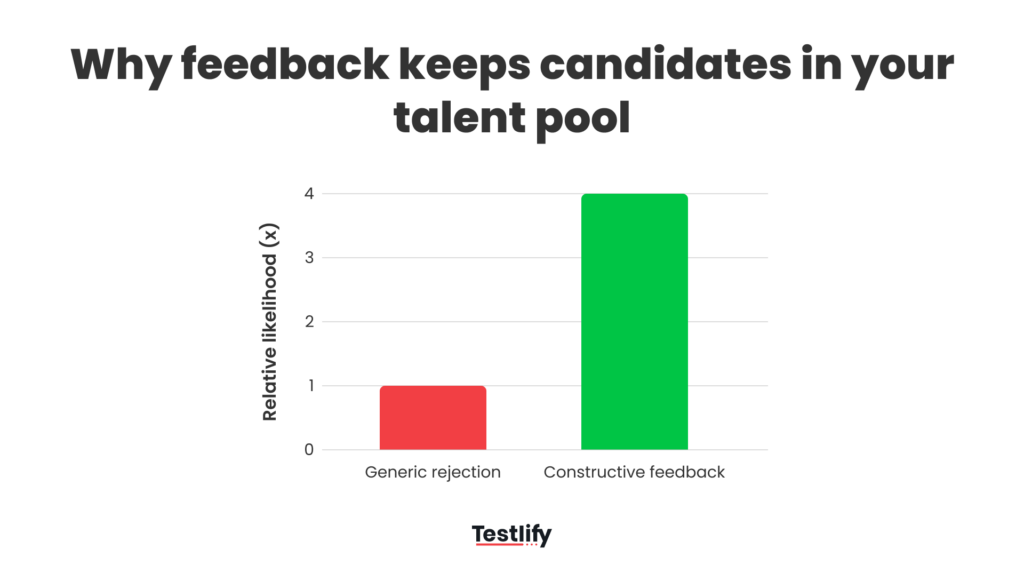
Poor communication damages employer branding more than any single factor. Candidates remember how you treated them, not how big your brand is.
In practice, even a short delay or a generic rejection message can make a strong applicant choose a competitor the next time they apply for a role.
What candidates experience vs how they feel:
Type of Communication | Candidate Reaction | Impact on Talent Pool |
|---|---|---|
No communication | Low trust | Weakens future pipeline |
Generic automated rejection | Neutral to negative | Neutral brand perception |
Personalized or constructive feedback | Strong trust | Keeps candidates open to future roles |
This pattern shows up across many recruitment trends. When candidates get no update, they talk about it. When they receive a generic template, they forget you.
But when you take a moment to send a clear and respectful message, they stay connected to your brand even after a rejection.
Where experience actually breaks
Most drop-offs during high volume hiring happen because of:
- No clear timeline after applying
- Long gaps between steps
- Confusing instructions
- No update after interviews
- Generic rejection emails
Small moments like these shape your employer branding more than paid campaigns ever will. Candidates remember the experience. They share it with friends. They write reviews. They decide whether to apply again the next time you post a role.
Why this matters for high-volume hiring
In a high-volume environment, you cannot control how many people apply, but you can control how they feel about your process.
A positive experience reduces no-shows, strengthens long-term talent pools, and builds a brand that attracts better applicants over time. It turns passive candidates into advocates and rejected candidates into future hires.
Retention is the real ROI
High-volume hiring works only when employees stay. Job boards bring volume, but referrals and niche networks deliver the strongest 90-day retention, which is the real indicator of long-term fit.
Early exits usually happen because expectations were unclear or onboarding was rushed. Clear job previews, frequent check-ins, and structured early support reduce churn and strengthen the talent pipeline.
Final thoughts: The smart shift in high-volume hiring
High-volume hiring is moving toward a model that values speed, clarity, and long-term outcomes.
Teams that rely on data, simplify the hiring process, and communicate well see stronger retention and a healthier talent pipeline. The shift is recognizing that small improvements at each step add up to a more predictable and sustainable hiring engine.
If you want to streamline your process, reduce drop-offs, and hire with confidence at scale, Testlify can help you get there. Explore how Testlify supports modern high-volume hiring and see the difference it makes. Book a demo today!
Frequently asked questions (FAQs)

B2B SaaS Content Writer
Rishav Kumar is a B2B SaaS content writer with 4 years of experience. He loves crafting engaging content. Always exploring fresh ideas, he's passionate about helping businesses grow through impactful writing.
LinkedInRelated resources
View all
High volume hiring
Scale hiring in the IT industry with automated tech screening tools

High volume hiring
How can the BPO industry hire at scale without compromising quality?

High volume hiring
How automated candidate scoring systems improve hiring speed

High volume hiring
How high-volume hiring works with AI interviews

High volume hiring
How to find the best candidate for every role?

High volume hiring
How to utilize artificial intelligence for large volume hiring?
Get started.
Hire on proof, not resumes.
Run your first skills-based assessment free — no credit card required.