
Screening In vs Screening Out: Which to Use and When
Screening in vs. screening out: Learn the differences and discover which approach is best for your hiring strategy to find the right candidates.
Most hiring teams think their candidate screening catches the best people. The data says it quietly does the opposite. In a study of 8,720 workers and 2,275 executives, Harvard Business School and Accenture found that 88% of employers admit qualified, high-skilled candidates get rejected because they do not match a job description word for word.
That is the hidden cost of how you filter applicants. Every knockout rule you set to save time also throws away people who could have done the job well, and you never see the ones you lost. The average role already takes 42 days to fill, and a thinner pool only drags that out, leaving weaker shortlists and openings that stay open while strong candidates go elsewhere.
This guide breaks down screening in vs screening out: what each one is, how they differ, when to use each, and how to run a screening-in process that does not bury your team in resumes. The short version: screening in looks for reasons to advance a candidate, screening out looks for reasons to reject one, and most teams should screen in by default and screen out only on genuine non-negotiables.
 ChatGPT
 Gemini
 Claude
 Grok
Grok Perplexity
TL;DR
- Screening in evaluates candidates for what they can do and actively looks for reasons to move them forward.
- Screening out eliminates candidates against fixed criteria and looks for reasons to reject them.
- Screening out is fast but rejects strong people and lets bias creep in. 88% of employers say their filters reject qualified candidates.
- Screen out only on true non-negotiables (a required license, a legal or safety rule, a hard location limit). Screen in on everything else.
- A skills-first screening-in process, built on assessments and structured review, widens your pool without slowing you down.
- The strongest setup is a sequence: a short screen-out on real deal-breakers, then a screen-in on multiple role-relevant signals.

What is screening in?
Screening in is the process of evaluating candidates to find the best match for a role by focusing on their skills, potential, and evidence of what they can do. It is an inclusive approach: instead of asking what a candidate lacks on paper, it asks what they can contribute, even when their background is not a perfect fit.
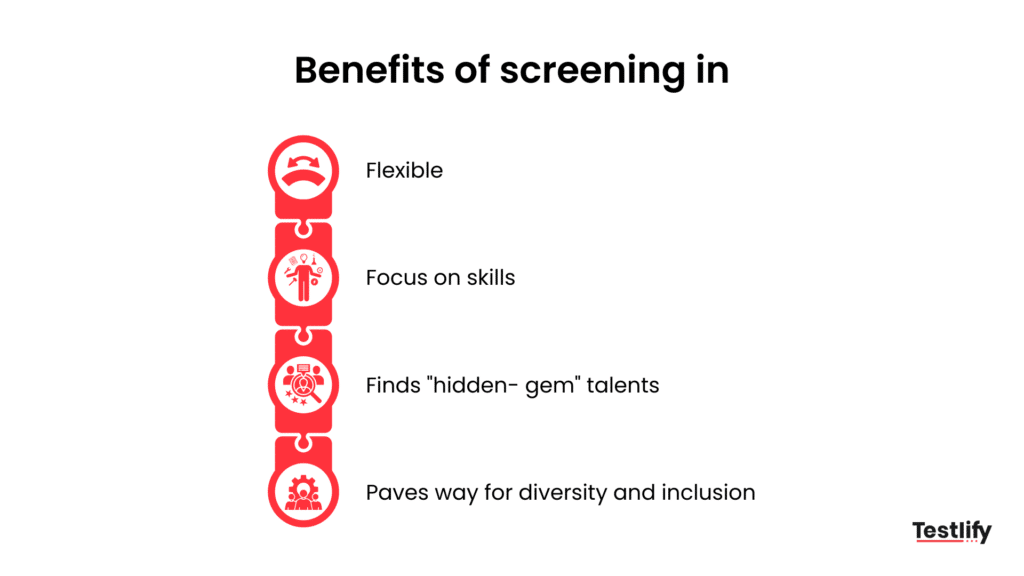
This matters because resumes are weak evidence. As Abhishek Shah, founder of Testlify, puts it: “It is easy to bend the truth on resumes, and many jobseekers do exactly that.” Screening in leans on signals that are harder to fake, like a work sample or a structured skills test, so you judge ability rather than how well someone writes about themselves.
It pays off where talent is scarce. McKinsey reports that hiring for skills is five times more predictive of job performance than hiring for education, and more than twice as predictive as hiring for experience. Widening the lens past credentials is not charity, it is a better bet on who will actually perform.
What is screening out?
Screening out is the process of removing candidates from consideration based on specific criteria they fail to meet. It narrows a large applicant pool quickly by filtering on fixed requirements, such as a certification, a years-of-experience threshold, or a location. The goal is speed: cut the list down so recruiters spend time only on people who clear the bar.
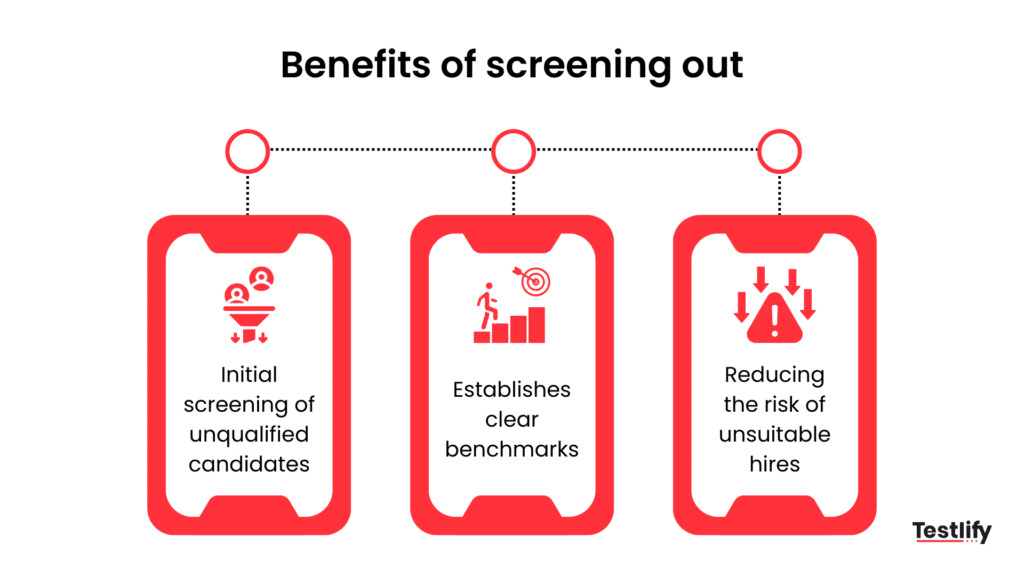
Used well, it is useful triage. When a role has a genuine non-negotiable, a pharmacy license, a CDL, a security clearance, screening out on that one rule is the right call and saves everyone time. The trouble starts when teams screen out on proxies (a degree, a six-month employment gap, an exact job title) that have little to do with whether someone can do the work.
How do screening in and screening out differ?
Both are screening methods, but they run on opposite instincts. Screening in starts from “what can this person do for us?” and treats the application as a starting point. Screening out starts from “what disqualifies this person?” and treats the application as a checklist. One widens the pool, the other narrows it. The table below maps where they split.
Dimension | Screening in | Screening out |
|---|---|---|
Core goal | Identify candidates with the skills and potential to succeed | Eliminate candidates who do not meet minimum requirements |
Mindset | Focuses on strengths, skills, and future potential | Focuses on missing qualifications or disqualifying factors |
Best for | Skills-first hiring, competitive talent markets, and hard-to-fill roles | High-volume hiring with clear, non-negotiable requirements |
Primary methods | Skills assessments, work samples, structured interviews, and job simulations | Knockout questions, minimum qualification filters, and ATS screening rules |
Main risk | May require more time and structured evaluation if screening manually | Can exclude qualified candidates based on rigid filters or resume gaps |
Effect on candidate pool | Expands the pool by considering transferable skills and potential | Reduces the pool by applying strict eligibility criteria |
Hiring outcome | Increases opportunities to identify high-potential candidates | Improves efficiency but may increase the risk of false negatives |
Why does screening out backfire?
Screening out backfires because it optimizes for rejection, and rejection rules are blunt. A filter that drops anyone without a four-year degree also drops the self-taught developer who ships better code. At scale, those false rejections add up: Harvard estimates 27 million Americans are “hidden workers,” capable people screened out before a human ever reads their application.
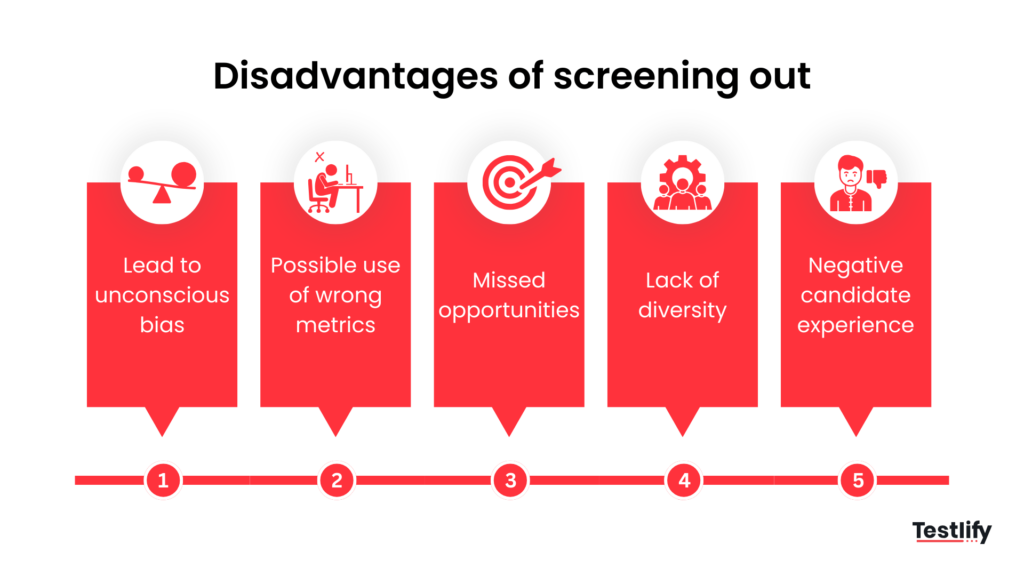
Joseph Fuller, a professor at Harvard Business School, frames the mechanism plainly: “In filtering out all but those candidates who match exacting and expanding requirements, companies reject many experienced, reliable, and creative individuals.” The filter feels efficient while it is busy removing your best non-obvious hires.
There is a fairness cost too. When the job is to eliminate fast, reviewers lean on shortcuts, and shortcuts pick up bias around names, gaps, schools, and demographics. That narrows your pool exactly when the McKinsey skills data above says ability predicts performance better than pedigree, and 92% of talent professionals already tell LinkedIn that soft skills matter as much as or more than hard ones.
When should you screen out?
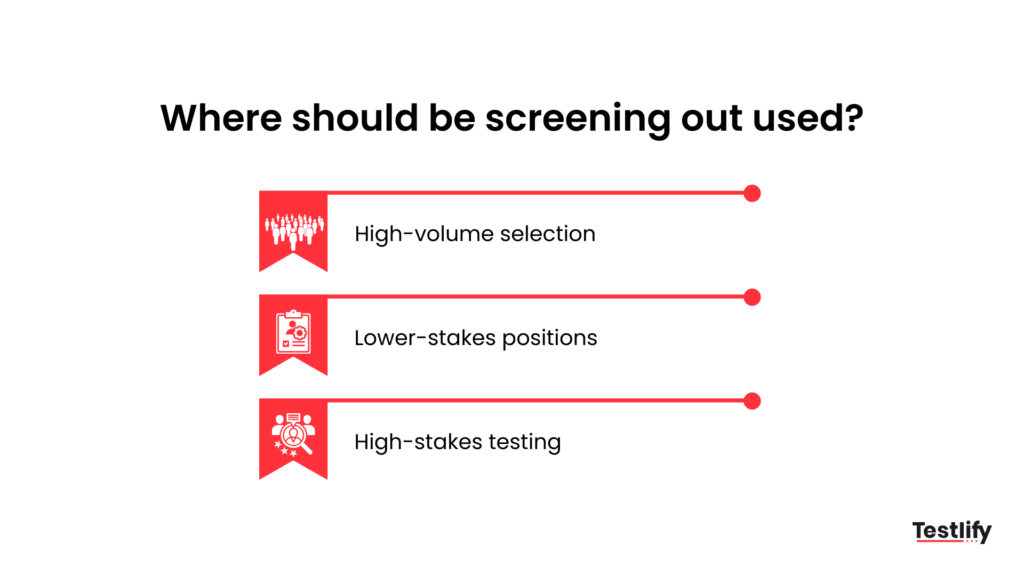
Screen out when a requirement is genuinely non-negotiable and easy to verify. These are rules where failing them makes the rest of the evaluation moot. Keep the list short and honest, because every item on it shrinks your pool.
- Legal or licensing requirements: a role that legally needs a CPA, a nursing license, or a commercial driver’s license.
- Safety-critical rules: certifications or clearances where a miss carries real risk.
- Hard logistics: a time zone, work authorization, or on-site requirement the role truly cannot flex on.
- Very high volume: when a single posting draws hundreds of applicants, one or two knockout questions make the pile reviewable before you screen in.
Notice what is not on that list: a specific degree, an exact past job title, or a tidy employment history. Those are proxies, and proxies are where good candidates get lost. If a requirement is a nice-to-have rather than a deal-breaker, move it out of your screen-out and into your screen-in scoring instead.
How do you build a screening-in process?
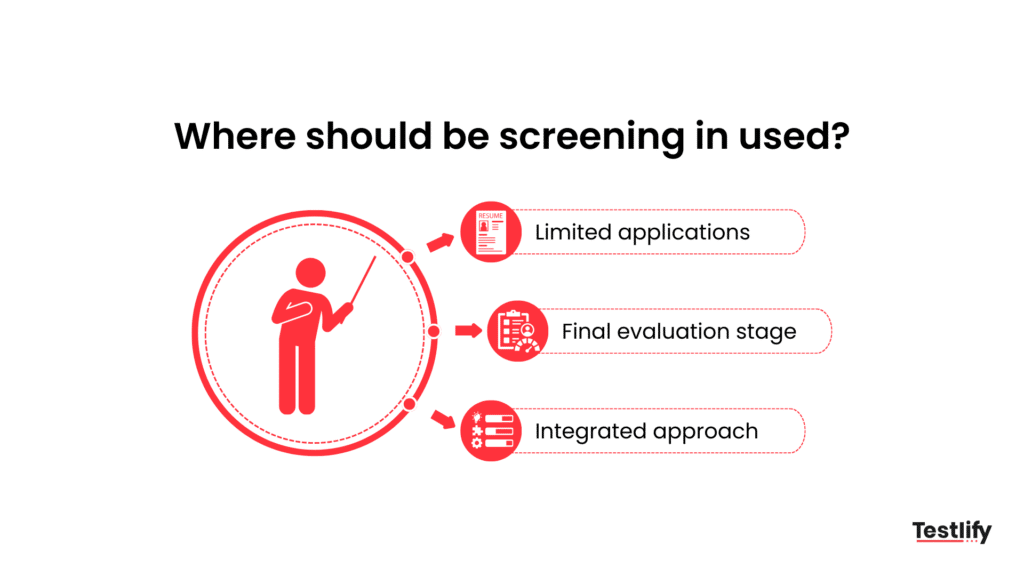
Run screening in as a structured sequence, not a gut read of resumes. The point is to gather evidence of ability early, so you spend human time on the people most likely to perform. Here is a process that scales without drowning your team.
- Define the real competencies. List the 4 to 6 skills the role actually needs, separate from credentials. Anchor each one to evidence you can measure, not a line on a resume.
- Screen out once, on deal-breakers only. Apply your short non-negotiable list first to make a high-volume pile reviewable. Everything past this point is screen-in.
- Send a skills assessment from your test library early. A focused 20 to 30 minute test on the core competency tells you more than another resume read. Send it within 24 hours so strong candidates do not cool off.
- Add a second signal. Pair the test with a structured video interview or a short work sample. Two independent signals pointing the same way beat one polished interview.
- Score against the competencies, then rank. Rate every candidate on the same rubric and review the top 10 to 15 by score. Ranking by demonstrated power skills surfaces people a resume filter would have buried.
Pro Tip: turn one of your old knockout filters into a scored signal for 30 days and compare. Teams that score a skill instead of requiring a credential routinely find their strongest finalist sitting just outside the old cutoff. The pattern is consistent enough that Harvard found firms hiring from overlooked pools were 36% less likely to report talent shortages.
A model for deciding which to use
You do not have to pick one method for the whole funnel. The strongest approach sequences them, and that is what the Testlify Multi-Signal Model is built for: combine multiple role-relevant signals (assessments, structured interviews, work samples, reviewer feedback) rather than betting a decision on a single resume or one test score.
In practice, that means a thin screen-out followed by a deep screen-in. Use a knockout filter only on the handful of non-negotiables, then evaluate everyone who clears it on several independent signals and rank by evidence. AI can sort, score, and surface the signals fast, but the hiring decision stays with your team. More signal, less noise, and a shortlist you can defend.
How to include “screening in” recruitment methods to discover top talent?
No candidate will meet every single job requirement perfectly. The screening-in approach is an excellent way to identify the ideal candidate with the most essential qualities for the role.
But how do you find them?
A skills test is the answer. Assessing candidates based on their skills and competencies gives recruiters to gain a comprehensive understanding of them. It also helps effectively weed out less suitable applicants.
With Testlify, you can streamline this process and ensure you’re identifying top talent right from the start.
Testlify’s assessments rank candidates based on their performance rather than filtering them out for not meeting random benchmarks.
Another excellent way to screen candidates is by using video interviews. You can either use customized questions or choose from the existing question pool to screen out candidates.
Our advanced algorithms do the heavy lifting, automatically grading and ranking participants to help recruiters navigate the screening process quickly and thoroughly. Check out our test library and start hiring right.
Key takeaways
- Screening out is rejection-first and blunt. It is fast, but it removes qualified people on proxies like degrees and job titles, which is why 88% of employers admit their filters reject candidates who could do the job. Keep your knockout list to true deal-breakers only.
- Screening in is evidence-first and predictive. It judges what a candidate can do, and skills evidence is five times more predictive of performance than education. Make it your default for most roles, especially in tight markets.
- Sequence the two, do not choose between them. A thin screen-out on non-negotiables followed by a deep screen-in on multiple signals gives you both speed and a wider, stronger pool, the core of the Testlify Multi-Signal Talent Evaluation Model.
- Replace proxies with scored signals. Every nice-to-have requirement you move from a hard filter into a scored assessment recovers candidates a resume screen would have lost, and cuts the bias that creeps in when reviewers eliminate fast.
- Measure the change. Convert one knockout rule into a scored skill for 30 days and compare your finalists. The strongest candidate often sits just outside the old cutoff.
Frequently asked questions (FAQs)

Related resources
View all
Candidate assessment
Live Coding Assessment: A Developer Hiring Guide

Candidate assessment
Process knowledge tests 101: A beginner’s guide

Candidate assessment
How to interview a software developer as a non-tech recruiter?
Candidate assessment
Proctored Exams: How They Work and Key Proctoring Features

Candidate assessment
How to assess candidates for cultural fit within your organization?

Candidate assessment
How to use excel assessments to test virtual collaboration
Get started.
Hire on proof, not resumes.
Run your first skills-based assessment free — no credit card required.