
Business judgment test: what it measures and how to use it
How a business judgment test works, what it measures, sample questions, the roles it suits and how to read the results to hire better.

One poor call from a new manager can cost a client, a budget or a team's trust. A business judgment test is a short, scenario-based assessment that scores how a candidate decides in realistic work situations.
Hiring teams use it to see decision quality before the interview, when it is still cheap to act on. Read on to see what it measures, what sample questions look like, which roles it suits and how to read the results.
TL;DR:
- A business judgment test puts candidates in realistic work scenarios and scores how they decide, not what they have memorized.
- The test measures trade-off reasoning, risk judgment, problem solving, client and stakeholder handling, and leadership calls under pressure.
- Use it for managers, consultants, analysts, business development, product and operations roles, where judgment drives results.
- LinkedIn found that 93% of talent acquisition pros say accurately assessing skills is crucial for quality of hire, and a scored judgment test gives you that evidence early.
- Read the pattern behind the score, then probe the weakest scenario in a structured interview. Never hire or reject on the test alone.
- Keep it fair: test only the judgment the job needs, offer accommodations, and check pass rates across groups.
 ChatGPT
 Gemini
 Claude
 Grok
 Perplexity
What is a business judgment test?
A business judgment test is a pre-employment assessment in the situational judgment format. Each question describes a realistic business situation, such as a client asking for a discount, a project running over budget or two teams fighting over the same resources, and asks the candidate to pick, rank or rate the best response.
The test looks at how a person thinks and decides at work: whether they spot the real problem, weigh short-term against long-term results, consider the people affected and act sensibly without perfect data. Knowledge of business theory or named frameworks earns no points; sound reasoning does.
The Testlify business judgment test is a 10-minute, 10-question situational judgment test at intermediate level, with scenarios where the candidate acts as a leader, manager or employee. It is available in English, French, Spanish, Dutch and German.
Note: A business judgment test is not the legal "business judgment rule", a corporate law doctrine that protects company directors from liability for good-faith decisions. The two share a name and nothing else.

Why do hiring teams use a business judgment test?
Hiring teams use a business judgment test because resumes and unstructured interviews say little about how a person decides under pressure. A candidate can describe past wins well and still make poor calls when budgets, clients and deadlines pull in different directions.
A scored scenario test shows that judgment directly, for every applicant, in the same way.
The pressure to get this right is high. SHRM's 2025 Talent Trends survey found that 69% of organizations still struggle to fill roles, so each hire for a critical seat carries more weight. LinkedIn's Future of Recruiting 2025 found that 93% of talent acquisition pros believe accurately assessing a candidate's skills is crucial for improving quality of hire.
The main reasons teams add the test:
- Better decisions on critical hires: A wrong manager or account lead can cost a client or a team. Scenario scores show who handles trade-offs well before you make an offer.
- Hidden ability shows up: Some strong decision-makers have thin resumes or no business degree. The test lets them show judgment that a CV or a short call would miss.
- Fairer, more objective screening: Every candidate sees the same scenarios and is scored against the same key, which cuts the room for gut feel and common hiring bias.
- Faster shortlists: The test runs online in minutes, so you can screen a large pool and spend interview time only on people who already showed sound judgment.
- Development and promotion: The same test helps spot internal talent ready for a first management role and shows where current staff need coaching.
What does a business judgment test measure?
A business judgment test measures how well a candidate makes practical business decisions across a handful of skill areas. The exact mix varies by provider, but most tests cover the six areas below, and the Testlify test is built around project management, client management, problem solving, leadership judgment, and operations and production judgment.
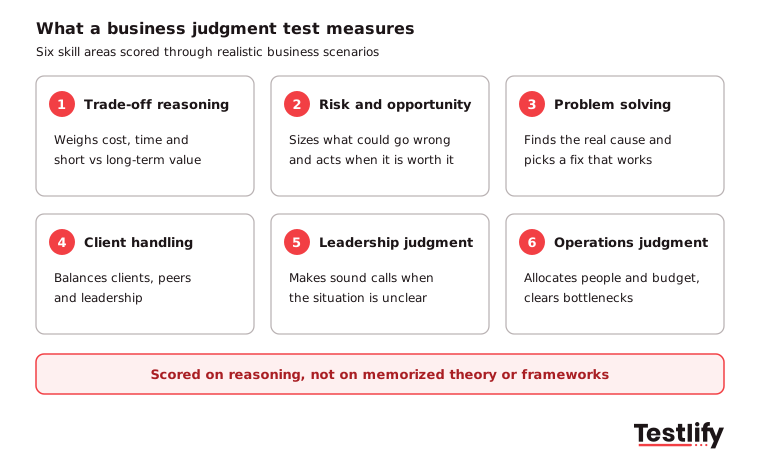
- Trade-off reasoning: Choosing between options with different costs, timelines and returns, and weighing short-term gains against long-term goals.
- Risk and opportunity judgment: Spotting what could go wrong, sizing it, and still acting when the upside is worth it. Risk appetite shows up clearly here.
- Problem solving: Finding the real cause of a workplace issue, using the evidence in the scenario, and picking a fix that works in practice.
- Client and stakeholder handling: Anticipating client risk, adapting to changing needs, and balancing the interests of customers, colleagues and leadership. Many scenarios also show how a person handles office politics and conflict.
- Leadership judgment: Making sound calls in ambiguous situations, delegating, and managing workload and people under pressure.
- Operations and resource judgment: Allocating budget and people across projects, fixing bottlenecks, and adapting processes when conditions change.
Good tests also reveal how a candidate connects facts and data points, and whether they stop to consider the ethics of a decision. Those signals rarely appear in a resume.
What do business judgment test questions look like?
Business judgment test questions describe a short situation and offer four or five possible actions. Depending on the format, candidates choose the most effective action, choose the best and worst, or rank all of them.
The three examples below are written for this guide to show the style, and they are not items from any live test.
Example 1, trade-offs: Your team can either ship a client feature on time with a known minor defect, or fix it and miss the agreed date by a week, and the client renews next month. What do you do?
- A. Ship on time and say nothing about the defect.
- B. Ship on time, tell the client about the defect and give a fix date.
- C. Delay a week without warning, then deliver a clean release.
- D. Ask the client which they prefer and agree on a plan together.
The strongest answers are D and B: both protect trust and the renewal. A hides a risk the client will find, and C breaks a commitment without notice.
Example 2, resources: Two projects need your only senior analyst this month: one brings in more revenue this quarter, and the other fixes a process that costs the business money every month. What is the best first step?
The strongest answer compares the total value and urgency of both, checks whether part of either task can move to someone else, then decides and explains why. A weak answer picks the bigger short-term number without looking at the recurring cost.
Example 3, leadership: A high performer on your team is openly dismissive of a new colleague, and the rest of the team has noticed. What do you do first?
The strongest answer is a private, direct conversation about the behavior and its effect, with clear expectations, before the issue spreads. Ignoring it because the person hits targets is the weakest option.
Pro tip: Preview the full test before you send it, by answering it yourself and asking one strong performer in the role to do the same. If your best people disagree with the scoring key, the test is not a fit for that role.
Which roles need a business judgment test?
Roles that need a business judgment test are those where a person makes decisions with money, clients or people at stake and with limited supervision. Use the table to match the role to the skill area that matters most and to the test you should pair it with.
Role | Skill area to weight most | Pair it with |
|---|---|---|
Business consultant, management analyst | Problem solving, trade-off reasoning | Critical thinking test |
Business development associate or manager | Client handling, risk and opportunity | Business acumen test |
Product or project manager | Resource and operations judgment | Role-specific skills test |
Operations manager, COO, head of growth | Operations judgment, leadership | Structured interview |
Business intelligence specialist | Problem solving, data-based decisions | Data analysis test |
First-time people manager (internal) | Leadership judgment, stakeholder handling | 360 feedback |
For entry-level roles with tightly scripted work, a business judgment test usually adds little. Use a role-specific skills test there instead.
How is a business judgment test different from other assessments?
A business judgment test differs from other assessments in what it scores: decisions in business situations, not raw reasoning speed, general workplace behavior or business knowledge. The tests overlap, so many teams combine two of them.
Test | What it measures | Best used for |
|---|---|---|
Business judgment test | Decisions in business scenarios: trade-offs, risk, clients, people | Managers, consultants, business roles |
Situational judgment test (general) | Behavior in everyday work situations such as teamwork and conflict | Most roles, including customer-facing ones |
Reasoning, numerical and verbal problem solving | Any role that needs fast learning | |
Business acumen test | Knowledge of how a business makes money: finance, markets, metrics | Finance, strategy and commercial roles |
Critical thinking test | Analyzing arguments and evidence, drawing sound conclusions | Analyst and research roles |
A business judgment test is a type of situational judgment test, not a personality test. It does not label who a person is; it shows what they would do in a given business situation.
How do you use a business judgment test in your hiring process?
You use a business judgment test best as an early, scored screening step that feeds a structured interview. Skills-based hiring is now mainstream: NACE's Job Outlook 2025 survey found that almost two-thirds of employers use skills-based hiring to identify candidates.
A judgment test brings the same idea to roles where decisions matter more than technical skill.
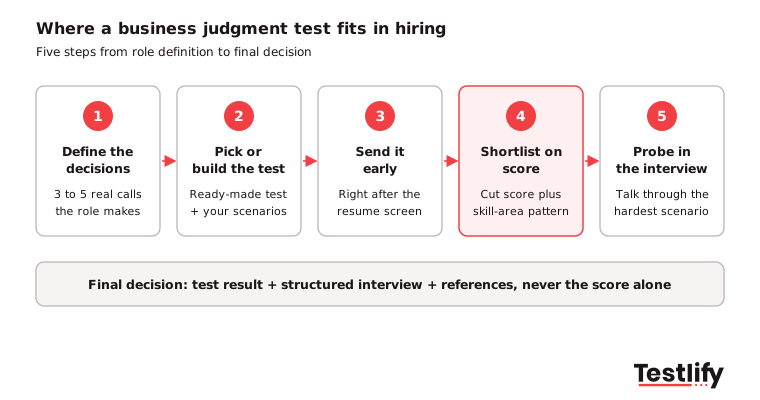
- Define the decisions the role makes: List three to five real calls the new hire will face in the first six months, such as pricing exceptions, staffing trade-offs or escalations.
- Pick or build the test: Choose a ready-made business judgment test that covers those calls, and add a few custom scenarios from your own business if needed.
- Send it early: Invite every applicant who meets the basic requirements, right after the resume screen. A 10-minute test keeps drop-off low.
- Shortlist on the score plus the pattern: Set a cut score for the role level, then look at which skill areas each finalist was strongest and weakest in.
- Probe in a structured interview: Ask each finalist to talk through the scenario they found hardest. A structured interview with the same questions for everyone keeps the comparison fair.
Key takeaway: The test narrows the pool and shows where to dig. The final decision still comes from the test, the interview and references together.
How should you read the test results?
Business judgment test results are most useful when you read the pattern behind the total score. Two candidates with the same score can have very different strengths, and the right hire depends on which strengths the role needs.
Skill evidence pays off. SHRM's skills-first research found that organizations that assess candidates' skill proficiency are more likely to meet or exceed their financial objectives, 63% compared with 51% of those that do not.
Result pattern | What it suggests | What to do next |
|---|---|---|
High overall, even across skill areas | Sound, balanced judgment | Move forward; confirm with a structured interview |
High on problem solving, low on stakeholder handling | Strong analyst who may miss the people side | Probe with a client or conflict scenario |
Strong on short-term results, weak on long-term choices | May favor quick wins over durable outcomes | Ask how they would handle a renewal or a recurring cost |
High on risk avoidance across scenarios | Careful, may stall when speed matters | Check fit with the pace of the role |
Low overall but strong resume | Experience may not carry to new contexts | Review the hardest scenarios together before deciding |
Results also show where a hire will need support. A new manager who scores low on leadership judgment can still succeed with coaching, if you know it on day one.
What are the limits of a business judgment test?
The limits of a business judgment test come from what a short test can and cannot show. Treat it as strong evidence, not as the whole decision.
- Knowing is not doing: A candidate may pick the right answer and still act differently under real pressure. The interview and references fill that gap.
- Context matters: Scenarios written for a large enterprise may not fit a small, fast-moving team. Check that the scoring key matches how your company works.
- Coaching effects: Candidates can learn the general style of these tests. Use scenarios that need real reasoning, and confirm in the interview.
- Fairness and the law: In the US, the EEOC's guidance on employment tests says a test that screens out a protected group must be job-related and consistent with business necessity. Employers stay responsible even when a vendor provides the test, and they must offer reasonable accommodations to candidates with disabilities.
Keep the test tied to decisions the job really involves, track pass rates across groups, and never use a single score as an automatic rejection for senior roles.
How does Testlify help you test business judgment?
Testlify helps you run a business judgment test as one step in a skills-based hiring process, alongside the other tests a role needs.
- Ready-made test: The business judgment test covers project, client, problem solving, leadership, and operations and production judgment, in 10 questions and 10 minutes.
- Combine and customize: Pair it with other tests from a library of 3,500+ tests, and add your own scenarios with 25+ question types.
- Scoring you can act on: Automated scoring, per-skill breakdowns and AI candidate insights show the pattern behind each result, with benchmarks across candidates.
- Fair and secure: 20+ proctoring checks protect results, and Testlify's matching model completed a third-party NYC Local Law 144 bias audit on June 16, 2023.
- Fits your stack: Results sync with 100+ ATS and HRIS tools through Testlify integrations, and candidates can take tests in 15+ languages.
Ready to test business judgment in your next hire?
Start with the decisions your next hire will make, then let candidates show how they would make them. Browse the Testlify test library to pair the business judgment test with the right role tests, or start a 7-day free trial with no credit card.
Book a demo to see the scoring and reports on your own roles.
Frequently asked questions (FAQs)

Senior SEO Specialist
Soham is a senior SEO specialist specializing in B2B HR tech. He covers search, answer, and generative engine optimization (SEO/AEO/GEO) for talent acquisition, skills-based hiring, and assessment-driven recruiting audiences.
LinkedInRelated resources
View all
Skill assessment
Why is an attention to detail visual test essential for recruiting?

Skill assessment
How can an nlp test unveil candidates’ hidden abilities?

Skill assessment
How can a performance marketing test unveil candidates’ hidden abilities?

Skill assessment
How can an attention to detail visual test unveil candidates’ hidden abilities?

Skill assessment
How can an adaptability test unveil candidates’ hidden abilities?

Skill assessment
How can a react native test online unveil candidates’ hidden abilities?
Get started.
Hire on proof, not resumes.
Run your first skills-based assessment free — no credit card required.