
How to assess personality and attitude of candidates
A practical way to judge personality and attitude in hiring: pick the traits, test and interview for them, and score every candidate alike.

A candidate can ace the skills test and still struggle with feedback, deadlines or teamwork. Resumes rarely show these behaviors, and a friendly chat is the least reliable way to find them.
To assess personality and attitude of candidates well, pick the traits the role needs, measure them with validated tests and structured interviews, and score everyone on the same scorecard.
TL;DR:
- Personality is how someone tends to behave across situations. Attitude is how they choose to act at work: effort, ownership, openness to feedback. Assess them with different tools.
- Start with the role, not a wish list. Pick 3 to 5 traits that separate your best performers from average ones.
- Use a validated personality test or a situational judgment test early, then probe attitude with behavioral questions about real past situations.
- Score each trait on a 1 to 5 scale with written examples of what a 1, 3 and 5 look like, and write notes before the debrief.
- Stop using eye contact, handshakes, "would I have a beer with them" and type tools like the Enneagram as hiring signals.
- Personality tests are legal in the US when they measure work traits, not mental health. Tests that could reveal a disorder are medical exams and are banned before a job offer.
 ChatGPT
 Gemini
 Claude
 Grok
 Perplexity
What does it mean to assess the personality and attitude of candidates?
Assessing personality and attitude means collecting evidence of how a candidate is likely to behave at work, not only what they know. Personality covers stable traits such as conscientiousness, sociability or emotional steadiness.
Attitude covers the choices people make on the job: how hard they try, how they take feedback, and whether they own their mistakes.
The two overlap, but they are measured differently:
Aspect | Personality | Attitude |
|---|---|---|
What it is | Stable tendencies across situations | How someone chooses to act at work |
Examples | Conscientiousness, extraversion, agreeableness, emotional stability | Ownership, work ethic, openness to feedback, resilience after setbacks |
How stable | Fairly stable in adults | Shaped by the job, the manager and the team |
Best ways to measure | Validated personality tests, situational judgment tests | Behavioral interviews, work samples, references |
Main risk | Faking good answers, using the wrong test | Interviewer bias, rehearsed stories |
A candidate personality assessment tells you how someone usually behaves. Attitude needs proof from things the candidate has actually done.

Why should hiring teams assess personality and attitude of candidates?
Hiring teams assess personality and attitude because employers rank work behaviors almost as high as technical skill, and those behaviors are the hardest to read from a resume. In NACE's Job Outlook 2025 survey, nearly 90% of employers said they look for problem-solving, nearly 80% for teamwork, and at least 70% for initiative and a strong work ethic.
Finding those traits is getting harder. A survey of 1,001 US hiring decision-makers by Express Employment Professionals and The Harris Poll found that 33% cite a shortage of applicants with soft skills, and 40% of those with open roles struggled to identify suitable candidates.
The cost of guessing wrong shows up later, as early attrition, low engagement and managers stuck coaching behavior instead of skills. For TA teams, assessing attitude on purpose turns a vague "good fit" into evidence a hiring manager can trust.
Which personality traits and attitudes should you look for?
The traits to look for are the ones that separate strong performers from average ones in that specific role. Run a short job analysis first: ask the hiring manager and two or three top performers what behaviors make someone succeed, and what behaviors made past hires fail.
Keep the list to 3 to 5 traits per role, because interviewers stop scoring properly when the list is longer. Common picks by role type:
Role type | Personality traits that matter | Attitudes to probe |
|---|---|---|
Customer support and BPO | Emotional stability, agreeableness | Patience under pressure, ownership of the fix |
Sales | Extraversion, drive | Resilience after rejection, coachability |
Software and data | Conscientiousness, openness to new ideas | Curiosity, openness to code review |
Healthcare and operations | Conscientiousness, calm under stress | Reliability, following procedure |
People managers | Emotional stability, agreeableness | Giving fair feedback, owning team results |
Write each trait as a behavior you can observe. "Positive attitude" is too vague to score.
"Stays calm and keeps helping when a customer is rude" can be scored. For more on why this matters, see why a positive attitude matters for a motivated workforce.
How do you assess personality and attitude step by step?
Assessing personality and attitude works best as six steps spread across the hiring process: define the traits, screen with a short questionnaire, test with a validated tool, interview with structured behavioral questions, add a work sample, and confirm with references. Each step collects a different kind of evidence, and the scorecard combines them.
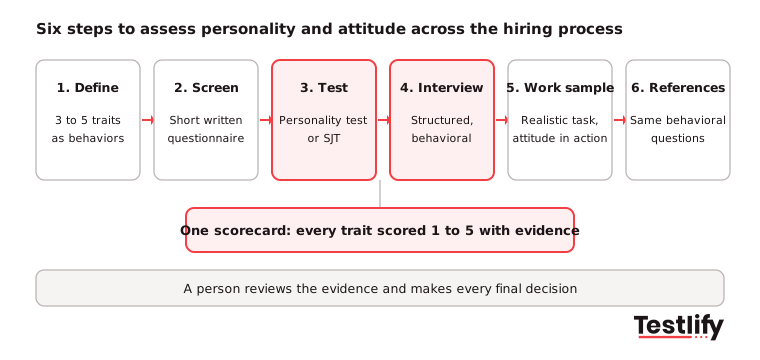
- Define the traits: Turn the 3 to 5 traits from your job analysis into behaviors and put them on one scorecard for every interviewer. Name them in the job ad too, so candidates who do not match can opt out.
- Screen with a short questionnaire: Two or three written questions about a real work situation show effort and clarity early, before anyone books an interview.
- Test with a validated tool: A personality test built for hiring, such as a Big Five test, measures stable traits in 10 to 20 minutes. A situational judgment test shows how candidates would handle realistic work dilemmas and is harder to fake than a self-report.
- Interview with structured behavioral questions: Ask every candidate the same questions about things they have actually done, with the same follow-ups. A structured interview keeps the comparison fair.
- Add a work sample: A short, realistic task, such as replying to an angry customer or reviewing a teammate's work, shows attitude in action: care, follow-through and how candidates react to an unclear brief.
- Confirm with references: Ask former managers the same behavioral questions about specific situations ("How did they react when a project went wrong?"), not "Were they a good employee?".
Pro tip: Use the personality test to choose what to probe in the interview, not to reject people. A low score on organization is a reason to ask about deadlines, not a reason to stop.
What interview questions reveal a candidate's attitude?
The interview questions that reveal attitude ask for a specific past situation and what the candidate did, then press with follow-ups. Rehearsed answers fall apart when you ask for detail.
Use one question per trait and the same follow-ups for every candidate.
Attitude | Question | Listen for |
|---|---|---|
Ownership | Tell me about a mistake you made at work. What happened next? | Owns the error, fixed it, changed something after |
Resilience | Describe a time a project or deal fell through. How did you respond? | Recovered, kept going, no blame |
Openness to feedback | Tell me about feedback that was hard to hear. What did you do with it? | Specific change in behavior |
Work ethic | Tell me about a task you did not enjoy but had to finish well. | How they kept quality up |
Teamwork | Describe a time a teammate was not pulling their weight. | Direct, fair, kept the relationship |
Adaptability | Tell me about a big change at work you did not choose. | First reaction, then what they did |
Good follow-ups: "What did you do first?", "What would you do differently?" and "How would your manager describe that moment?". Answers with names, numbers and a clear sequence are worth more than polished stories with no detail. The soft skills interview question bank has more questions by skill.
How do you score attitude without gut feel?
Attitude is scored fairly with behavioral anchors: a 1 to 5 scale for each trait, with a written example of what a 1, a 3 and a 5 look like. Interviewers score alone and write notes before the debrief, so the loudest voice in the room does not decide.
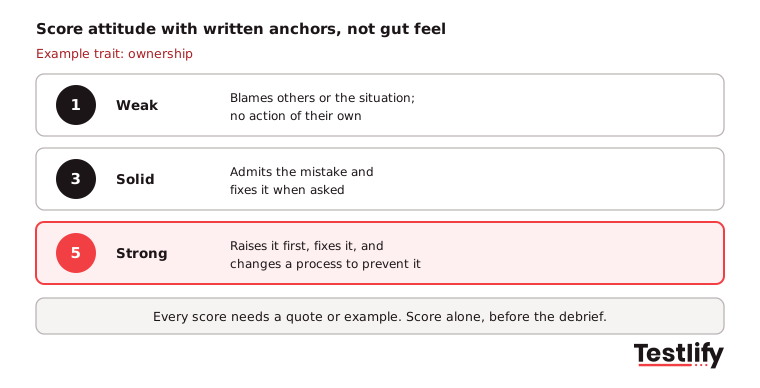
Score | Ownership: what the candidate showed |
|---|---|
1 | Blamed others or the situation, no action of their own |
3 | Admitted the mistake and fixed it when asked |
5 | Raised the mistake first, fixed it, and changed a process so it would not happen again |
Three rules keep scoring honest:
- One trait per interviewer: Each interviewer owns one or two traits and asks about them properly. A trait nobody asked about stays blank, not low.
- Evidence for every score: Every score needs a quote or an example. "Not a culture fit" with no example counts for nothing.
- Combine at the end: Add test results, interview scores, work sample and references only after each is scored on its own.
Measurement is where most teams fall short. The LinkedIn Future of Recruiting 2025 report found that 93% of TA professionals say accurately assessing skills is crucial to quality of hire, yet only 25% are highly confident they can measure quality of hire.
A scorecard is the first step.
Key takeaway: An attitude score is only as good as the anchors behind it. Write them before the first interview.
Which signals mislead hiring teams?
The signals that mislead hiring teams most are eye contact, handshakes, small talk, confidence and "would I enjoy working with them". These feel like attitude but mostly measure culture, nerves or similarity to the interviewer, and they screen out good people.
- Eye contact and body language: Norms differ across cultures, and many neurodivergent candidates avoid eye contact. Neither says anything about effort or ownership.
- Confidence: Polished, confident answers can hide a lack of detail. Score what the candidate did, not how well they told it.
- The beer test: Liking someone is a sign of shared background, not of work behavior. Judge culture fit against skill fit with defined values instead.
- Type tools: The Myers-Briggs and the Enneagram sort people into types and were not built to make hiring decisions. Use tests designed for hiring, and read whether personality tests should be used in hiring before choosing one.
- One test score alone: Candidates can present their best self on a self-report. A personality score is one piece of evidence, not the decision.
What legal and fairness rules apply?
Personality and attitude assessments are legal in most markets when they measure job-related work behavior, are given to every candidate the same way, and do not ask about health. Three rules matter most for US and global hiring teams in 2026.
- No medical questions before an offer: Under the EEOC's ADA guidance on pre-employment exams, a psychological test that can identify a mental disorder is a medical exam and cannot be required before a conditional job offer. A test that measures only things like honesty, tastes and habits is not medical.
- Audits for automated tools: In New York City, Local Law 144 requires a yearly bias audit and candidate notice when an automated tool substantially helps decide who moves forward.
- Accommodations and notice: Offer extra time or another format to candidates who ask for it, and tell everyone what the assessment measures and how results are used.
Keep a person in charge of every rejection. Treat test and interview scores as evidence for that person, never as the decision.
How does Testlify help you assess personality and attitude?
Testlify helps hiring teams assess personality and attitude in one platform, alongside the skills tests for the role, so each candidate reaches the interview with comparable evidence. Personality tests, situational judgment tests and AI interviews can sit in the same assessment workflow.
- Personality tests built for hiring: Big Five, DISC and the picture-based PicOCEAN test sit in a library of 3,500+ tests. See the Big Five personality test and the DISC personality assessment.
- Situational judgment tests: Realistic work scenarios show how candidates would act, not how they describe themselves. Read more about situational judgment tests.
- Structured AI interviews: Video AI, Voice AI and Chat AI interviews ask every candidate the same behavioral questions and score each answer against your criteria, with a reviewer able to check the evidence.
- Fair and consistent: Assessments run in 15+ languages with 20+ proctoring checks, and Testlify's matching model completed a third-party NYC bias audit on June 16, 2023.
Ready to hire for attitude, not just skills?
Build an assessment that combines a personality test, a situational judgment test and the skills test for your role, and see how candidates compare on the same scorecard. Start a 7-day free trial of Testlify with no credit card required, book a demo, or browse the test library.
Frequently asked questions (FAQs)

Human Resources Lead
Snehi Parmar leads People at Testlify, owning hiring, culture, performance, and retention for a 90-person team. She writes on practical HR strategy and building people processes that scale.
Related resources
View all
Skill assessment
Distance learning support skills: How a simulation checks who can run a virtual classroom

Skill assessment
Phone Keyboard Basics & Logging In test: How smartphone skills test can help you
Skill assessment
Accessing Telehealth Appointments Digital Literacy test: How a simulation checks if staff can help patients get online
Skill assessment
Information Literacy Digital Literacy test: How a simulation checks if new hires can spot bad sources
Skill assessment
Mac OS Digital Literacy test: How a simulation checks Mac skills before you hire
Skill assessment
Windows 11 Digital Literacy test: How a simulation checks who’s ready after an upgrade
Get started.
Hire on proof, not resumes.
Run your first skills-based assessment free — no credit card required.