
How to hire a driver: skills, tests, and costs
Hire drivers by assessing driving skills, safety awareness, and certifications to ensure reliable and secure transportation services.
Hiring a driver is a safety decision before it is a staffing one. The person you pick controls a vehicle worth tens of thousands of dollars, carries your cargo or your customers, and represents your brand on every trip.
A valid license only tells you they passed a test once. It does not tell you how they drive under pressure, whether their record is clean, or how they handle a frustrated customer at a loading dock.
In this guide, you’ll learn how to hire a driver, the skills to assess, the most effective pre-employment tests, typical hiring costs, and the interview questions that identify reliable candidates.
TL;DR
- Verify the license and record, test driving skills directly, interview for judgment, and clear the required compliance checks before the offer.
- Test, do not assume. A road test plus a structured driver assessment predicts on-road performance far better than a resume or a single interview.
- Compliance is a hard gate. Interstate commercial drivers need the correct CDL class and endorsements, a valid DOT medical card, and a pre-employment FMCSA Clearinghouse query.
- Budget for the full cost. US truck driver pay runs from about $42,770 to $57,440 a year by role, and the average non-executive hire costs about $5,475 to make.
- Map skills to evidence. The Testlify Competency-to-Evidence Matrix ties every driver competency to a measurable check, so the shortlist is scored on proof, not gut feel.
 ChatGPT
 Gemini
 Claude
 Grok
Grok Perplexity
How do you hire a driver?
Hire a driver in seven steps: write a clear job description, source candidates, screen licenses and driving records, run a skills assessment and road test, interview for judgment and reliability, complete DOT and background checks, then make a competitive offer. Each step adds evidence, so the final call rests on proof rather than a hopeful read of a resume.
- Write a job description that states the vehicle, route type, license class, and schedule up front.
- Source candidates from job boards, referrals, CDL schools, and your own careers page.
- Screen the license class, endorsements, and motor vehicle record before you invest interview time.
- Run a driver skills assessment and a supervised road test on the vehicle they will actually drive.
- Interview for judgment, reliability, and customer handling using structured questions.
- Complete DOT medical, background, and FMCSA Clearinghouse checks required for the role.
- Make a competitive offer quickly, because good drivers rarely stay on the market long.
A practical way to keep the hiring process objective is to define the evidence required for every competency the role demands, then choose the assessment that generates that evidence. No competency should influence a hiring decision based on assumptions alone. It is the same logic behind any strong skills-based hiring process.

What does a driver do day to day?
A professional driver moves goods, materials, or people safely and on schedule. The job blends hard driving skill with route planning, basic vehicle checks, cargo handling, paperwork, and customer contact. For most businesses, the driver is the last person a customer sees, so the role shapes both safety records and brand reputation on every delivery.
- Transport goods or passengers to the right place, safely and on time.
- Follow traffic law and company safety policy on every trip.
- Run pre-trip and post-trip vehicle inspections and flag maintenance issues.
- Plan routes to hold delivery windows and control fuel use.
- Load, secure, and unload cargo without damage.
- Communicate delays and updates to dispatch and customers, and represent the brand well.
What skills should you assess in a driver?
Assess two skill sets. Hard skills cover safe vehicle handling, defensive driving, route planning, cargo securing, and basic maintenance. Soft skills cover communication, customer service, time management, and calm problem-solving under stress. Weight them by the role: a long-haul trucker leans hard-skill heavy, while a passenger or last-mile driver needs more customer-facing polish.
Related resources: Hard skills vs Soft skills: Which one should you prioritize while hiring?
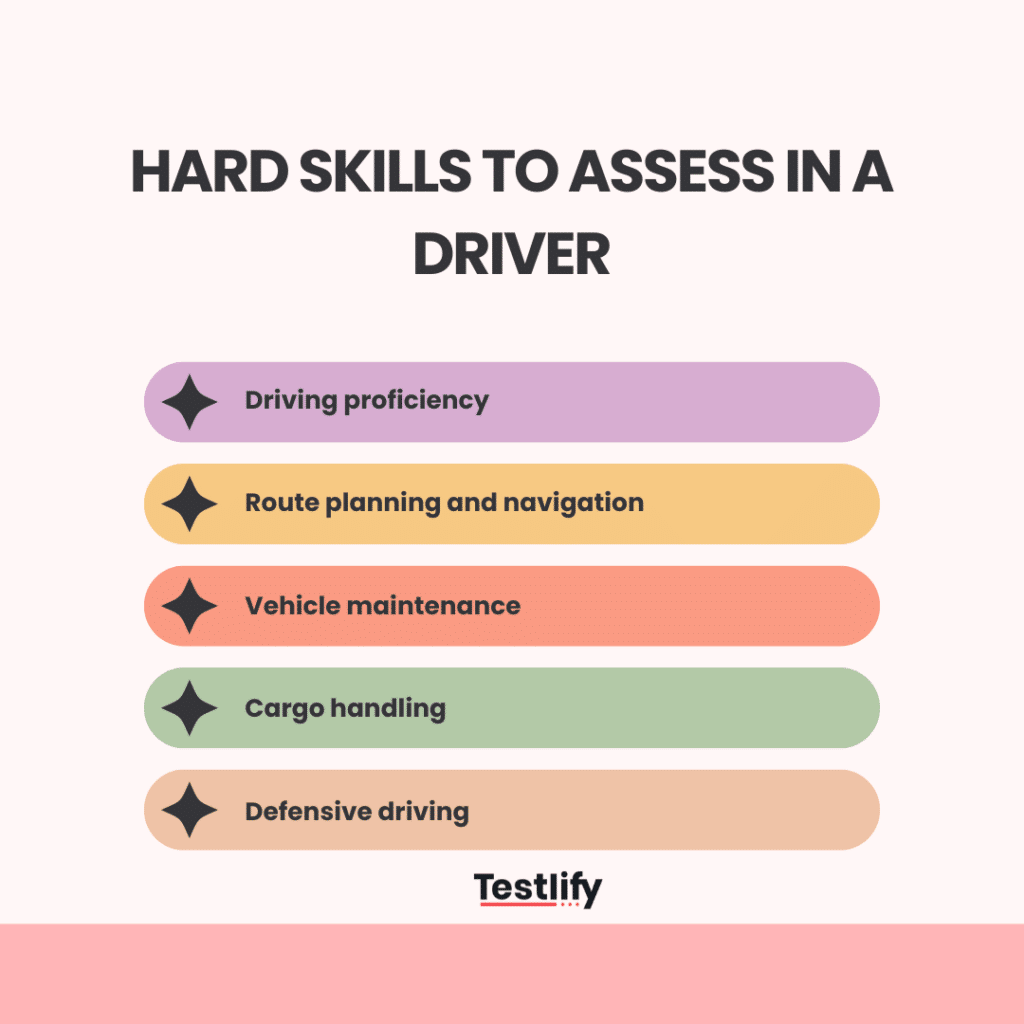
Use the table below as a checklist for hiring a driver. Define what good looks like for each competency, then collect the evidence needed to confirm every candidate meets the standard.
Competency | What good looks like | Evidence to collect |
|---|---|---|
Safe vehicle handling | Smooth control, correct signaling, safe following distance | Supervised road test on the relevant vehicle |
Hazard perception | Spots and reacts to road risks early | Hazard-perception assessment, scenario questions |
Traffic law and safety knowledge | Knows the rules for the vehicle class | Written driver knowledge assessment |
Route planning | Plans efficient, on-time routes | Timed routing scenario, GPS familiarity check |
Cargo handling | Loads and secures cargo without damage | Practical loading demonstration |
Communication and service | Clear, courteous, calm under pressure | Structured interview, situational judgment questions |
Reliability and clean record | Consistent, low-risk driving history | Motor vehicle record, references, Clearinghouse query |
How do you test a driver’s skills?
Test skills directly instead of taking them on faith. Combine a supervised road test on the vehicle they will actually drive, a written knowledge check on traffic law and safety, a hazard-perception assessment, and structured behavioral questions for customer and stress handling. A pre-employment skills assessment scores every candidate against the same bar, so you compare like with like.
- Road test: real-world control, parking, lane changes, and rule compliance on the target vehicle.
- Knowledge assessment: traffic law, safety procedures, and vehicle-class rules.
- Hazard perception: video or scenario checks of how fast a candidate spots and reacts to risk.
- Situational judgment: how they handle a late delivery, a difficult customer, or a breakdown.
Related resources: Explore Testlify’s driver assessment to identify safe, reliable, and job-ready drivers before the interview.
Pro Tip: Run the driver skills assessment before the road test, not after. Scoring knowledge and judgment first lets you road-test only the serious candidates, which cuts vehicle and examiner time on applicants who were never going to clear the bar.
What licenses and checks does a driver need?
It depends on the vehicle. Drivers of most large commercial vehicles need a Commercial Driver’s License in the correct class, plus endorsements for hazmat, passengers, tankers, or double and triple trailers. Federal FMCSA rules also require a valid DOT medical certificate and, before hiring any CDL driver, a pre-employment query of the Drug and Alcohol Clearinghouse.
Commercial driver’s license (CDL) classes
- Class A: combination vehicles over 26,001 pounds, such as tractor-trailers.
- Class B: heavy straight trucks and buses that are not towing a large trailer.
- Class C: smaller vehicles that carry hazardous materials or 16 or more passengers.
Endorsements and medical checks
- Endorsements: H for hazmat, P for passengers, N for tank vehicles, T for doubles and triples, and X for tank plus hazmat.
- DOT medical certificate: a valid physical from a certified examiner proving the driver is fit to operate a commercial vehicle.
- Motor vehicle record (MVR): pull the driving history to review violations, suspensions, and the current license status.
FMCSA Drug and Alcohol Clearinghouse
Under federal FMCSA rules, an employer must run a full pre-employment query of the Drug and Alcohol Clearinghouse before hiring any CDL driver, and a query at least once a year for every current CDL driver.
The check flags drug and alcohol program violations that would bar a driver from safety-sensitive work. Non-commercial and light delivery drivers fall outside the CDL rules, but you should still confirm a valid license, a clean MVR, and a standard background check.
Where can you find the best driver candidates?
Source where drivers look for work. Job boards pull the most volume, but referrals from current drivers tend to produce the most reliable hires. Local trade schools, CDL programs, and community groups reach candidates early, and a clear careers page lets qualified drivers apply to you directly.
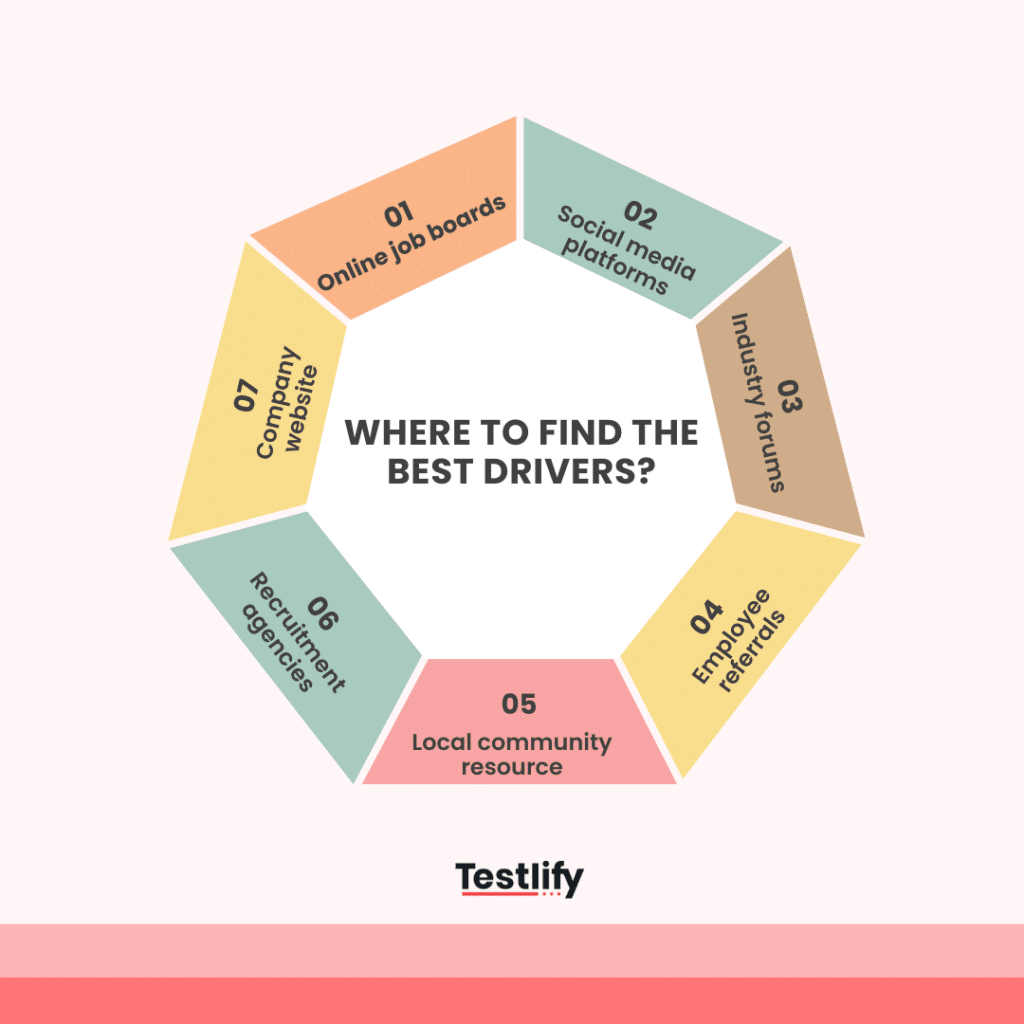
- Job boards: general boards for reach plus specialized transport and driver boards for fit.
- Employee referrals: current drivers know who is reliable and safe, and referred hires tend to stay longer.
- CDL schools and trade programs: reach new commercial drivers before they hit the open market.
- Local community resources: job fairs, community centers, and vocational schools for entry-level roles.
- Recruitment agencies: specialist transport recruiters for hard-to-fill or high-volume needs.
- Your careers page: a clear driver listing lets qualified applicants apply directly. See more sources of recruitment to widen the funnel.
How much does it cost to hire a driver?
Two costs matter: pay and the price of hiring. US delivery and light-truck drivers earn a median of $42,770 a year, and heavy and tractor-trailer drivers a median of $57,440 (BLS, 2024). On top of salary, the average non-executive hire in the US costs about $5,475 to make (SHRM, 2025).
Get the pick wrong, and it costs far more: replacing an employee can run one-half to two times their annual salary, which is why the screening rigor pays for itself.
Driver type/experience | Typical annual pay | Notes |
|---|---|---|
Entry-level (0 to 2 years) | $30,000 to $40,000 | Local and light delivery routes |
Experienced (3+ years) | $40,000 to $55,000 | Regional and specialized routes |
CDL / specialized (hazmat, tanker) | $45,000 to $70,000+ | Endorsements add roughly 10 to 20 percent |
Heavy and tractor-trailer (median) | $57,440 | BLS national median, 2024 |
Delivery and driver/sales (median) | $42,770 | BLS national median, 2024 |
Demand is steady. BLS projects delivery-driver and driver/sales roles to grow 8 percent through 2034, much faster than the average job, while heavy-truck roles grow about 4 percent. A tight market means good drivers hold options, so a slow or sloppy hiring process loses them to faster employers.
What interview questions should you ask a driver?
Ask questions that reveal judgment, not just history. Mix hard-skill questions about vehicle types and maintenance, safety questions about hazards and compliance, and behavioral questions about difficult customers or tight deadlines. The strongest signal comes from asking for a specific past situation and listening for what the candidate actually did, not what they say they would do.
Hard skills and safety
- Which vehicle types and sizes have you driven, and which are you most confident in?
- How do you run a pre-trip inspection, and what would make you refuse to drive?
- Walk me through how you handled a hazard or near-miss on the road.
- How do you stay compliant with hours-of-service and company safety rules?
Service, judgment, and reliability
- Tell me about a difficult customer or delivery dispute and how you resolved it.
- How do you plan a route to hold a tight delivery window?
- Describe a time a plan fell apart mid-route. What did you do next?
- How do you keep focused and manage distractions on a long shift?
- What would your last dispatcher say about your reliability?
Related resources: Compare structured versus unstructured interviews before you build your scorecard.
Driver job description template
A driver job description should state the vehicle and route type, the required license class and endorsements, the schedule, the pay range, and the safety and compliance expectations up front, so only qualified drivers apply. List the core responsibilities, the must-have qualifications, and the benefits, then close with a simple application step.
You can start from the ready-made driver job description template and adapt it to your company name, routes, and benefits.
When you draft the benefits section of your listing, call out what candidates actually value in this role: the independence of working on the road, steady demand from ongoing transportation needs, flexible work hours and route options, and the variety of locations and people the job brings.
Hire better drivers with evidence
Testlify turns driver hiring into an evidence-based decision. Build a role-specific driver assessment that scores safe driving, hazard perception, traffic-law knowledge, and customer handling, then send it to every applicant so your shortlist is ranked on proof before the first road test.
Key takeaways
- Hire on evidence, not resumes: A license and a good interview can both mislead. A road test plus a structured driver assessment gives you proof of on-road skill, the single strongest predictor of how someone will actually drive for you.
- Treat compliance as a hard gate: The correct CDL class, a valid DOT medical card, a clean motor vehicle record, and a pre-employment FMCSA Clearinghouse query are federal requirements for commercial drivers. Skipping them exposes your business to fines and liability.
- Weight skills to the role: A long-haul trucker and a last-mile delivery driver need different mixes of hard driving skill and customer service, so score each competency against what that specific route demands.
- Move fast on good drivers: With delivery-driver roles growing 8 percent, strong candidates hold multiple offers. A process that scores fast and road-tests only serious applicants closes them before competitors do.
- Budget for the full picture: Salary is only part of it. Factor in the roughly $5,475 average cost to make a hire, and the far larger cost of a mis-hire, when you decide how much rigor the process deserves.
Frequently asked questions

People and Talent Partner
Arushi Shah runs day-to-day talent acquisition and candidate experience at Testlify. She writes on interviewing, structured hiring, and giving candidates a fair, fast process.
LinkedIn




Get started.
Hire on proof, not resumes.
Run your first skills-based assessment free — no credit card required.