
Why a Caring Culture in the Workplace Is Important (and How to Build One)
What a caring culture at work is, why it lifts engagement and retention, and the manager habits, hiring choices and metrics that build it.

A caring culture is a workplace where people can see, in everyday decisions, that the organization cares about them as people: their workload, health, growth and life outside work. It shows up in how managers check in, how policies treat people when life gets hard, and how the company holds high standards without burning people out.
 ChatGPT
 Gemini
 Claude
 Grok
 Perplexity
TL;DR:
- A caring culture makes employees feel valued through everyday actions, not just perks.
- Employees who feel cared for are more engaged, less burned out and less likely to leave.
- Build a caring workplace by listening to employees, managing workloads, recognising contributions and creating fair policies.
- Managers shape the culture through regular check-ins, honest feedback and consistent support.
- Measure progress through wellbeing surveys, burnout rates, employee engagement and regretted attrition.
- Avoid carewashing by addressing workplace problems instead of relying on wellness programs alone.

What is a caring culture in the workplace?
A caring culture in the workplace is a set of shared habits where leaders and colleagues pay attention to how people are doing, act on what they hear, and treat wellbeing as part of how work gets done. Employees feel valued as people, not only as output, and they trust that the organization will support them when it counts.
A caring culture is also called a culture of care or a culture of caring. Three things separate it from a nice slogan:
- Care is shown in decisions. Workload, scheduling, leave and pay choices reflect people's needs, not only cost.
- Care is consistent. It does not depend on getting a kind manager by luck.
- Care comes with standards. A caring team still sets clear goals and gives honest feedback. Caring is not the same as avoiding hard conversations.
Why is a caring culture important?
A caring culture is important because employees who feel cared for are far more engaged, less burned out and less likely to leave. Yet only about one in five feel that care today, so the gap is large and the upside for employers is real.
The numbers are consistent across recent studies:
- Gallup's November 2024 wellbeing research found that only 21% of US employees strongly agreed their organization cared about their overall wellbeing in early 2024, a record low. Those who did were 4.4 times as likely to be engaged, 53% less likely to be looking for a new job and 73% less likely to feel burned out very often or always.
- WebMD Health Services' Workplace Well-Being in 2025 report, a survey of more than 4,000 US full-time employees, found 25% strongly agree their organization cares about their wellbeing. Employees with a strong sense of care reported 56% higher engagement and 37% lower burnout.
- MetLife's 2025 Employee Benefit Trends Study of 5,579 employees found that people who both trust and feel cared for by their employer are 2.4 times as likely to be engaged and 1.9 times as likely to be productive.
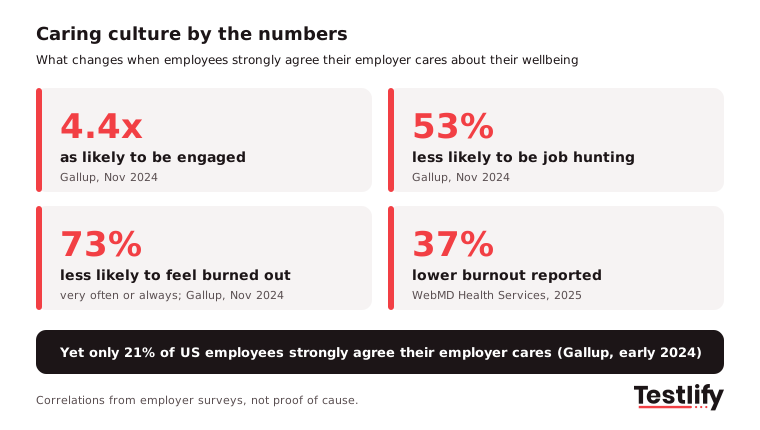
Engagement is also falling. The Gallup State of the Global Workplace report puts global engagement at 20% in 2025, down from 23% in 2022, and estimates that low engagement costs the world economy about $10 trillion in lost productivity. These studies show strong links, not proof that care alone causes the gains, but every one of them points the same way.
For hiring teams, the business case is simple: every regretted exit means another search, another onboarding and months of lost output. See what losing an employee really costs.
What does a caring culture look like in practice?
A caring culture looks like ordinary, repeated behaviour: managers who ask about workload and then change it, policies that bend for a family emergency, and feedback that is honest and kind. Perks alone do not make one. Gallup calls care without action on root causes "carewashing" and warns it can backfire.
Area | Caring culture | Carewashing | Permissive culture |
|---|---|---|---|
Wellbeing | Workload is managed so people can use the support offered | Wellness app offered while overtime stays high | No pressure, but no support either |
Managers | Regular one-to-ones that include how the person is doing | Check-ins only when there is a problem | Avoids hard conversations |
Feedback | Frequent, specific, kind and honest | Annual review only | Praise only, no real feedback |
Policies | Flexible when life happens, applied fairly | Generous on paper, hard to use in practice | Rules applied unevenly |
Performance | Clear goals plus support to reach them | Goals set, support missing | Goals vague, results drift |
Pro tip: Test any new "care" initiative with one question: does it change how work is done, or only what is offered around it? If workload, deadlines and manager behaviour stay the same, people will read the initiative as carewashing.
How do you build a caring culture?
Building a caring culture starts with listening, then changing the few things that most shape daily work: manager habits, workload, recognition and fair policies. The seven steps below work in order, and each one is small enough to start this quarter.
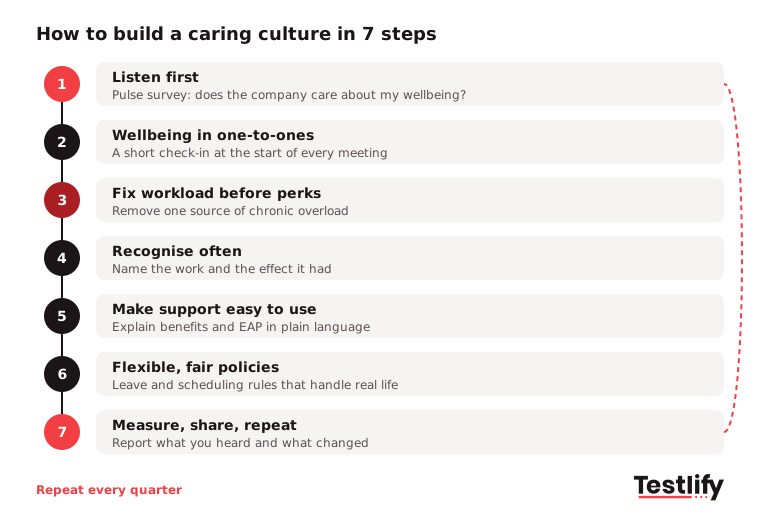
- Listen first. Run a short pulse survey and include the item "My organization cares about my overall wellbeing." Compare answers from leaders and individual contributors.
- Put wellbeing into one-to-ones. Gallup found only 36% of employees have talked with their manager about their personal wellbeing. A two-minute check-in at the start of every one-to-one changes that.
- Fix workload before adding perks. Look at overtime, after-hours messages and unfilled roles. Remove one source of chronic overload before launching a new benefit.
- Recognise people often and specifically. Name the work and the effect it had. Recognition costs little and is the habit managers most overestimate.
- Make support easy to find and use. Gallup found 31% of employees do not know whether they have an employee assistance program. Explain benefits in plain language, more than once.
- Write flexible, fair policies. Leave, scheduling and remote work rules should handle real life and apply the same way across teams.
- Measure, share results and repeat. Report what you heard, what you changed and what is next. Closing the loop is what makes people answer the next survey honestly.
For more ideas on step 3 and step 5, see how to build an employee well-being initiative.
What role do managers play in a caring culture?
Managers carry most of a caring culture because they decide workload, feedback and flexibility day to day. A company can write a caring policy, but employees experience care, or the lack of it, through their direct manager.
The gap between what managers think they do and what employees receive is wide. Gallup data cited by the Journal of Accountancy in January 2025 shows 59% of managers say they recognise good work, but only 35% of direct reports say they receive recognition. Half of managers say they give weekly feedback, while 20% of employees say they get it.
Managers also need care themselves. Gallup's global report shows manager engagement fell from 31% in 2022 to 22% in 2025. A burned-out manager cannot hold a caring team together, so give managers training, realistic team sizes and their own wellbeing check-ins. Read more on the role of leadership in employee engagement.
How does a caring culture start in hiring?
A caring culture starts in hiring because the hiring process is the first proof candidates get of how a company treats people, and because the managers you hire or promote will carry the culture. Care in hiring means respect for candidates' time and choosing leaders who can look after a team.
Three hiring habits signal care early:
- Respect candidates' time. Keep assessments short and relevant to the job, tell people what each stage involves and how long decisions take.
- Close the loop. Every candidate hears back, including the ones who are not moving forward. A fast, clear "no" is kinder than silence. See the candidate experience glossary entry.
- Hire managers for people skills, not only technical skill. Skills-based assessments such as an emotional intelligence test or a leadership and people management test add structured evidence on how a candidate handles people, alongside interviews.
Testlify's test library has 3,500+ tests, including personality and culture assessments, so hiring teams can check people skills with the same rigour as job skills. Hiring for care does not mean hiring for sameness: look for shared values and behaviours, not people who look or think alike.
How do you measure a caring culture?
A caring culture is measured by tracking whether employees feel cared for, whether behaviour matches policy, and whether outcomes like burnout and regretted attrition improve. Use a small set of metrics, review them every quarter and always split results by level and team.
Metric | How to collect it | What good looks like |
|---|---|---|
"My organization cares about my overall wellbeing" | Pulse survey, 5-point scale, % strongly agree | Rising each quarter; above the 21% to 25% benchmarks above |
Leader vs employee gap on the same item | Split survey results by level | Gap shrinking |
Wellbeing in one-to-ones | Ask: "Has your manager talked with you about your wellbeing this quarter?" | Well above Gallup's 36% |
Burnout | Survey item on feeling burned out very often or always | Falling |
Regretted attrition | HRIS: voluntary exits of people you wanted to keep | Falling, especially in year one |
Benefit and EAP awareness | Survey: "I know what support is available and how to use it" | Most employees say yes |
Employee net promoter score | "How likely are you to recommend us as a place to work?" | Rising |
The leader vs employee split matters most. WebMD Health Services found senior leaders were 28 percentage points more likely than individual contributors to agree their organization cares about wellbeing. If you only ask leaders, you will think the culture is fine. For a wider method, see how to measure workplace culture.
Key takeaway: Pick one survey item, one behaviour metric and one outcome metric, and report all three to the leadership team every quarter. A caring culture that is not measured tends to fade into a list of perks.
What gets in the way of a caring culture?
Common blockers are a perception gap between leaders and staff, chronic overload, inconsistent managers, care offered without action, and care confused with low standards. Most of them are fixable once someone owns them.
- The perception gap. Leaders see the programs they approved; employees see their week. Ask both groups the same questions.
- Workload. No benefit outweighs a team that is permanently understaffed. Fill gaps or cut work before adding programs.
- Manager lottery. If care depends on which manager you get, it is not a culture yet. Train every manager on the same basic habits and check them in surveys.
- Carewashing. Programs launched without fixing the cause of stress make people more cynical, not less.
- Care without accountability. Avoiding feedback to "be nice" hurts the people who need help to improve. Caring managers are clear about standards.
Left alone, these blockers can turn into something worse; see how a toxic company culture drives attrition.
What are examples of a caring culture?
Examples of a caring culture are usually small and specific, which is why they work. A caring workplace is one where the right thing happens without anyone needing to ask twice.
- A manager notices a team member answering messages at 11 pm for two weeks, asks why, and moves a deadline.
- A contact center adds short recovery breaks after difficult calls and protects them in the schedule.
- A new parent returns on a phased schedule agreed in advance, not negotiated under pressure.
- A team lead gives clear, private feedback on a missed target, then sets up weekly support until the person is back on track.
- A rejected candidate gets a short, polite reply within days instead of hearing nothing.
- Leaders share pulse survey results, including the bad ones, and say what will change.
For more ideas, see 7 ideas to foster a positive company culture.
Frequently asked questions
Build care into every stage, starting with hiring
A caring culture is built from repeated, visible decisions: managers who check in, workloads people can sustain, fair policies and honest feedback. Start with listening, measure the gap between leaders and employees, and fix the basics before adding perks.
Hiring is where people first see your culture, so make it fair, fast and respectful, and choose managers who can look after a team. Browse the Testlify test library to assess people skills alongside job skills, or book a demo to see how it fits your hiring process.

Related resources
View all
Workplace culture
What is an American workplace culture?

Workplace culture
9 ideas for making your workplace more inclusive

Workplace culture
7 ideas to fostering a positive company culture

Workplace culture
10 ideas to promote work-life balance in the workplace

Workplace culture
How to use workplace culture to improve employee productivity

Workplace culture
19 ideas for creating a healthier workplace
Get started.
Hire on proof, not resumes.
Run your first skills-based assessment free — no credit card required.