
What is a DISC personality test for jobs? How employers use it
How a DISC test for jobs works, what the four styles mean at work, what employers do with the report and how to use it fairly in hiring.
So, what is a DISC personality test for jobs? A DISC personality test for jobs is a short questionnaire that shows how a candidate tends to behave at work: how fast they decide, how they deal with people, and how they handle rules and change. Employers use the result to plan interviews, judge team fit and support onboarding, not to measure skill.
TL;DR / Key Takeaways
- A DISC test for jobs is a 15 to 25 minute self-report questionnaire that sorts a candidate's work style into Dominance, Influence, Steadiness and Conscientiousness.
- There are no right answers and no pass mark. The report shows a primary and secondary style, not a score to rank people on.
- Employers get the most from DISC after a skills screen: to shape interview questions, plan onboarding and spot team friction early.
- DISC describes how someone likes to work, not whether they can do the job. Pair it with a skills test and a structured interview.
- In the US, a personality test that measures habits and preferences is not a medical exam under the ADA, but Title VII still applies if results screen out a protected group.
- Never reject a candidate on a DISC profile alone. Tell candidates why you use it and who sees the results.
 ChatGPT
 Gemini
 Claude
 Grok
 Perplexity
What is a DISC personality test for jobs?
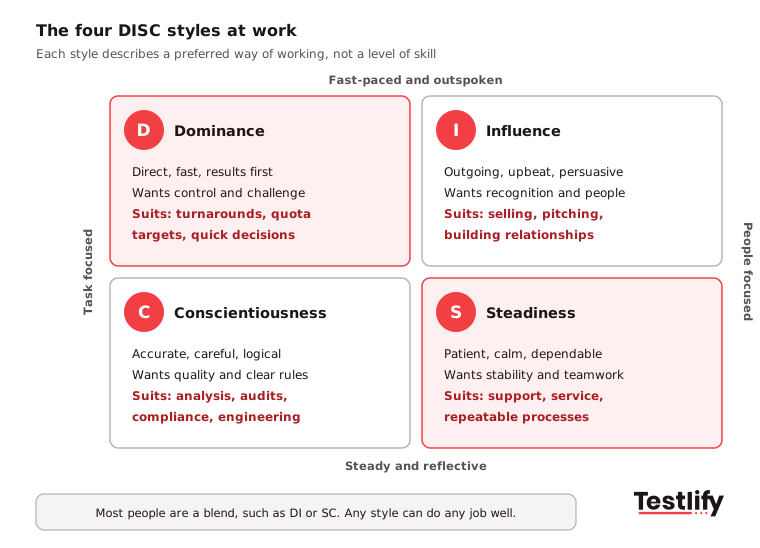
A DISC personality test for jobs is a behavioral questionnaire that places a candidate's preferred work style on four scales: Dominance, Influence, Steadiness and Conscientiousness. The model comes from psychologist William Moulton Marston's 1928 book Emotions of Normal People. Employers use it to understand pace, communication and decision style.
Most people score high on one or two styles, so profiles are often written as blends such as DI, SC or CD. Every style has strengths and blind spots. Testlify's own DISC personality assessment uses the labels Decisiveness, Impact, Support and Certainty for the same four ideas.
Style | What it describes | How it often shows at work | Common blind spot |
|---|---|---|---|
D (Dominance) | Drive for results and control | Makes fast calls, takes on hard targets, pushes back | Can rush people and skip detail |
I (Influence) | Energy from people and persuasion | Builds rapport, pitches ideas, lifts team mood | Can lose focus on follow-through |
S (Steadiness) | Need for stability and cooperation | Patient with customers, reliable on routine work | Can resist sudden change |
C (Conscientiousness) | Focus on accuracy and quality | Checks the facts, follows process, spots errors | Can slow decisions down |
DISC sits in the personality group of psychometric tests, next to the Big Five. DISC is simpler to read, which is a big part of why hiring teams like it.

How does a DISC test work for job candidates?
A DISC test works by asking candidates to react to short statements about how they act at work. Commercial versions take about 15 to 25 minutes, are usually untimed and have no right answers. The scoring adds up which style each choice points to and turns the totals into a profile.
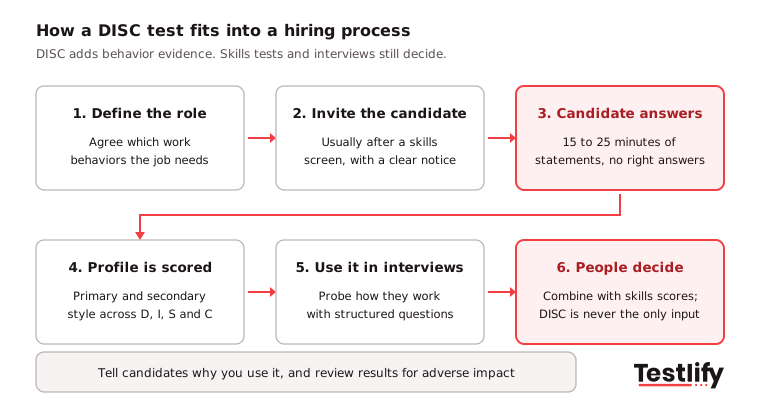
Two answer formats are common:
- Forced choice: The candidate sees a group of four statements and picks the one most like them and the one least like them. According to a 2026 career test prep guide, most commercial DISC versions use this format.
- Rating scale: The candidate rates each statement on a scale from "strongly disagree" to "strongly agree". Testlify's DISC test uses a four-point scale plus short work situations, and takes about 25 minutes.
A typical forced-choice item looks like this. Pick the statement most like you and the one least like you:
- I make quick decisions and move on.
- I enjoy meeting new people at work.
- I like a steady routine I can rely on.
- I check my work twice before I share it.
Each line maps to one style (D, I, S and C, in that order here). After 20 or more items, the pattern shows which styles the candidate leans on most.
Pro tip: Send the DISC test after a skills test, not before. Candidates who already passed the skills stage are more likely to finish it, and you only spend credits on people you would interview.
What does a DISC report show employers?
A DISC report shows the candidate's primary and secondary styles on a simple graph, a short narrative of how they tend to work, and tips for communicating with them. A DISC report does not show a pass or fail result, an intelligence score or a ranking against other applicants.
Most hiring reports include:
- Style graph: the strength of D, I, S and C for this person.
- Natural vs adapted style: some tools compare how the person works by default with how they think the job wants them to work. A big gap can mean the candidate feels a lot of pressure to act differently.
- Work preferences: pace, decision style, need for detail, comfort with conflict.
- Interview prompts: questions to explore the areas where the style and the job demands may clash.
For a step-by-step guide to reading the graph, see how to interpret DISC results.
How do employers use a DISC personality test for jobs?
Employers use a DISC personality test for jobs at four points: before interviews to plan questions, in final rounds to discuss team fit, after the offer to plan onboarding, and later for team building. Using DISC as an early knock-out screen is the one use most guidance warns against.
Hiring stage | Good use of DISC | Misuse to avoid |
|---|---|---|
Early screen | None; screen on skills first | Rejecting applicants for the "wrong" style |
Before the interview | Pick follow-up questions on areas where style and role may clash | Deciding before you meet the person |
Final round | Discuss how the candidate would work with this manager and team | Picking the profile that matches the manager |
After the offer | Plan onboarding, first projects and how feedback is given | Labeling people for the long term |
Team building | Help a team agree how it will communicate and decide | Using styles as excuses ("I'm just a D") |
The onboarding and team uses matter more than many hiring teams think. The Gallup State of the Global Workplace report found global employee engagement fell to 20% in 2025, from a peak of 23% in 2022, and only 22% of managers are engaged. A shared language for work styles gives new managers a quick way to adjust how they run one-to-ones and feedback.
Which DISC styles fit which jobs?
DISC styles fit jobs through the behaviors a role demands most, not through job titles. Fast, target-driven roles often draw on D, people-facing roles on I, steady service roles on S, and accuracy-heavy roles on C. Any style can succeed in any job; the profile only shows where a person will need to stretch.
Start from the job, not the profile. The US Department of Labor's O*NET Work Styles list rates every occupation on work styles such as attention to detail, cooperation, stress tolerance and initiative. Pick the three or four that matter most for your role, then check how a candidate's DISC profile lines up with them.
What can a DISC test not tell you about a candidate?
A DISC test cannot tell you whether a candidate has the skills, knowledge or ability to do the job. DISC describes preferences, and preferences change with context, so the same person may show a different style under stress or in a new team. Treat DISC as one input among several.
Even DISC publishers say this. TTI Success Insights, a long-standing DISC provider, notes that DISC was not originally designed as a pre-employment screening tool and should be used alongside interviews and other methods.
Hiring teams also put skills first. The LinkedIn Future of Recruiting 2025 report found that 93% of talent acquisition professionals believe accurately assessing a candidate's skills is crucial for improving quality of hire. DISC adds context to that skills evidence; it does not replace it.
Other limits to keep in mind:
- Self-report: candidates describe themselves, and some answer the way they think the employer wants.
- No ideal profile: there is no "best" DISC style for a job, so setting a target profile invites bias.
- Context: a profile taken during a stressful job search may differ from one taken a year into the role.
The scientific debate around DISC is covered in our separate article on the DISC personality test and whether it is science or astrology.
Is it legal to use a DISC test in hiring?
Using a DISC test in hiring is legal in the US when it is applied the same way to every candidate, is relevant to the job and does not screen out a protected group. The EEOC treats personality tests like any other selection procedure under Title VII, the ADA and the Age Discrimination in Employment Act.
Three rules matter most:
- Title VII and disparate impact: The EEOC guidance on employment tests and selection procedures says a neutral test that disproportionately excludes people by race, sex, religion or national origin must be job-related and consistent with business necessity. Track pass-through rates by group, the adverse impact check, even when DISC is only advisory.
- ADA and medical exams: According to the EEOC's ADA guidance on pre-employment questions, a test "designed and used to measure only things such as honesty, tastes, and habits" is not a medical exam. A test that could reveal a mental disorder is, and cannot be used before a job offer. Standard DISC tests measure work preferences, so they sit on the safe side of that line.
- Notice and data: Tell candidates what the test is for, who will see the results and how long you keep them. In the EU and UK, GDPR treats a DISC profile as personal data, so you need a lawful basis and a retention period.
This is general information, not legal advice. Check local rules with your employment counsel, especially if an AI tool scores or ranks candidates.
How should hiring teams run a DISC test fairly?
Hiring teams run a DISC test fairly by deciding in advance what it is for, using it after a skills screen, telling candidates how results are used, and never letting a profile decide on its own. The six steps below fit most mid-market and enterprise hiring processes.
- Define the work behaviors: Use a job analysis and O*NET work styles to pick the three or four behaviors the role really needs.
- Screen on skills first: Send role-specific skills tests to everyone, then add DISC for candidates who pass.
- Give a clear notice: Explain in the invite that DISC has no right answers and is one input among several.
- Use the report to plan questions: Turn each possible clash between style and role into a structured interview question asked of every finalist.
- Decide on combined evidence: Weigh skills scores and interview ratings first; use DISC to explain them, not to overrule them.
- Review results by group: Check pass-through rates by stage at least once a quarter and fix any step that drops one group more than others.
Key takeaway: DISC works best as a conversation starter about how someone works. The moment it becomes a filter, it adds legal risk and removes good candidates whose style simply differs from the team's.
How does Testlify run DISC alongside skills tests?
Testlify runs DISC as one test inside a multi-test assessment, so candidates take a skills test and a personality test in one sitting and hiring teams see both results side by side. Teams can pick DISC, the Big Five personality test or PicOCEAN from the same library.
- One assessment, several tests: Combine DISC with role-specific, cognitive and situational judgment tests from a library of 3,500+ tests.
- Fair conditions: 20+ proctoring checks run on every assessment, including full-screen enforcement, tab tracking and copy/paste blocking.
- Results where you work: Scores sync to 100+ ATS and HRIS tools such as Workday, Greenhouse and SAP SuccessFactors.
Testlify's AI matching model also completed a third-party NYC Local Law 144 bias audit on June 16, 2023.
Ready to see how candidates really work?
Add the DISC test to a skills assessment and see behavior and ability for every finalist in one report. Browse the Testlify test library or start a 7-day free trial, no credit card needed. Hiring at scale? Book a demo and we will help you set it up.
Frequently asked questions

Content Writer
Yashika Khandelwal is a Content Writer with 3+ years of experience creating research-backed content on hiring, talent assessment, and HR technology. She is a registered Organizational Psychologist and subject matter expert who combines behavioral science with practical recruitment insights to produce accurate, evidence-based content.
LinkedInRelated resources
View all
HR & recruitment
Case studies of companies with successful talent pools
HR & recruitment
How to hire restaurant hospitality staff?
HR & recruitment
How to hire hotel hospitality staff?
HR & recruitment
How to interpret the results of an Emotional Intelligence test

HR & recruitment
Using Emotional Intelligence test for Hiring – Astrology or Science?
HR & recruitment
Why an emotional intelligence test can help you find the best talent
Get started.
Hire on proof, not resumes.
Run your first skills-based assessment free — no credit card required.