
How to build an employer brand: 9 steps for hiring teams
A 9-step guide to building an employer brand: audit your reputation, define a true EVP, fix the hiring process and track what changes.

Candidates form a view of what it is like to work for you long before they speak to a recruiter. They read reviews, scan your careers page and ask people who already work there.
If what they find does not match your job ad, the best candidates quietly drop out. You see the result as declined offers, early leavers and a pipeline that never fills.
Knowing how to build an employer brand fixes that: say what is true about working for you, then prove it at every step. This guide gives you nine steps, from the audit and employee value proposition (EVP) to the metrics that show whether it works.
TL;DR:
- To build an employer brand, audit your reputation, define a true EVP, fix the hiring process, publish the story on your careers page and channels, turn employees into advocates and measure the results.
- An employer brand is your reputation as a place to work. Employer branding is the work you do to shape it.
- A strong brand lowers hiring costs. SHRM's 2025 benchmarks put the average cost per hire at $5,475 for nonexecutive roles.
- The hiring process is part of the brand. Survale's 2025 benchmark found a record 15% of North American candidates would not engage an employer again after a poor experience.
- Pay is now part of the EVP by law in many places. From 7 June 2026, EU employers must share the pay range before the interview.
- Track awareness, attraction and experience with a few numbers: qualified applicants, offer acceptance, 90-day retention and review ratings.
- Expect about 90 days to set up the basics and 12 months before the numbers move clearly.
 ChatGPT
 Gemini
 Claude
 Grok
 Perplexity
What is an employer brand?
An employer brand is the reputation your company has as a place to work, in the minds of candidates, employees and former employees. Every business has one, whether it manages it or not.
Employer branding is the deliberate work of shaping that reputation so the people you want to hire choose you, and the people you have choose to stay.
Your employer brand sits next to your consumer brand but answers a different question. Customers ask whether the product is good, while candidates ask "Will I do good work here, be paid fairly and grow?"
A company can have a well-loved product and still struggle to hire because its reputation as an employer is weak. For a short definition you can share with your team, see the employer brand glossary entry.
Aspect | Employer brand | Employer branding | Corporate brand |
|---|---|---|---|
What it is | Your reputation as a place to work | The work of shaping that reputation | Your reputation for products and services |
Audience | Candidates, employees, alumni | Same, plus hiring managers and leaders | Customers, investors, the public |
Core message | Pay, culture, growth, purpose, flexibility | The EVP and the proof behind it | Quality, value, service |
Who owns it | Everyone who hires or manages | HR, TA and marketing together | Marketing |

Why does an employer brand matter for hiring teams?
An employer brand matters because it changes how much each hire costs, how many good candidates apply and how long new hires stay. A strong brand brings in qualified applicants who already want the job.
A weak brand forces you to pay more, chase passive candidates harder and accept more offer declines.
The numbers are large enough to matter in any budget. SHRM's 2025 benchmarking reports put the average cost per hire at $5,475 for nonexecutive roles and $35,879 for executive roles.
Every offer a candidate declines, and every new hire who leaves in the first 90 days, repeats part of that cost.
Candidates also do more research than they used to. Survale's 2025 Candidate Experience Benchmark, based on more than 66,000 candidate surveys, found that company career sites were the top research channel (used by 46% of candidates), ahead of employer review sites (26%).
Before applying, candidates most wanted content about company values (51%), culture (36%) and employee testimonials (32%).
A weak employer brand rarely shows up as one problem. It shows up as symptoms across the funnel:
Symptom | What it looks like | Metric to check |
|---|---|---|
Few qualified applicants | Plenty of applications, few worth interviewing | Qualified application rate |
Offers declined | Finalists take other offers or ask for a large premium | Offer acceptance rate |
Early leavers | New hires quit within three months | 90-day retention |
Silent reviews | Old or unanswered reviews on Glassdoor and Indeed | Rating, response rate |
Few referrals | Employees do not recommend friends | Share of hires from referrals |
The most expensive symptom is invisible: the good candidates who never apply. A company with a low offer acceptance rate usually has a perception problem, not a sourcing problem, and more job ads will not fix it.
How to build an employer brand: what are the 9 steps?
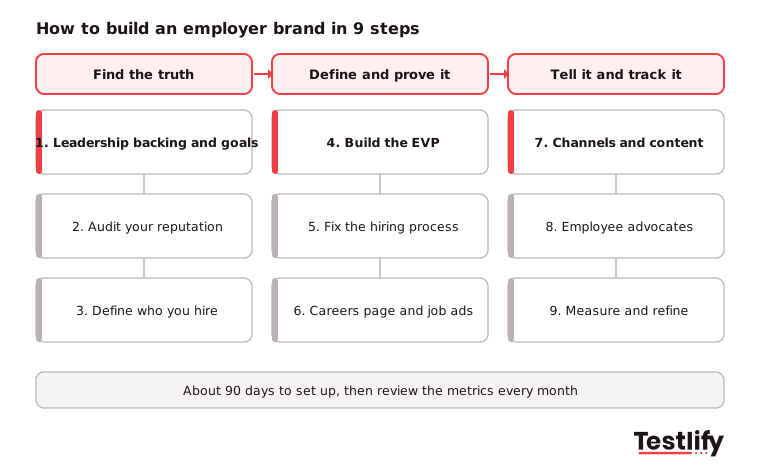
Building an employer brand takes nine steps in three phases. First, find the truth: secure leadership backing, audit your reputation and define who you want to hire.
Next, define and prove it: write the EVP, fix the hiring process and rewrite your careers page and job ads. Finally, tell it and track it: pick channels, activate employees and measure.
1. Get leadership backing and set goals
Start with the people who can make the brand true. An employer brand that leaders do not support turns into a slogan that managers ignore.
Ask your CEO and leadership team to agree on what the company should be known for as an employer, and to act on it in public: in all-hands meetings, on LinkedIn and in how they talk to candidates in final interviews.
Then set two or three goals tied to hiring outcomes, not to brand awareness alone. Good examples:
- More qualified applicants: Raise the share of applicants who pass screening for your hardest roles.
- Better offer acceptance: Close more finalists without raising pay above your bands.
- Earlier retention: Keep more new hires past their first 90 days.
- A more diverse pipeline: Reach groups that are under-represented in your applicant pool today.
Each goal should name a metric, a baseline and an owner. Without a baseline, you will never be able to show leadership that the work paid off.
2. Audit how candidates and employees see you
An employer brand audit measures the gap between how you describe yourself and how people actually experience you. Run it before you write anything, or your EVP will rest on leadership assumptions.
- Read your reviews: Pull Glassdoor and Indeed reviews from the last 24 months. Note the overall rating, the most repeated pros and cons, and patterns by team or tenure. Older reviews describe a company that may no longer exist.
- Survey current employees: Ask what they value most, what they would change, and whether they would recommend the company to a friend. An eNPS calculator turns that last answer into a score you can track.
- Interview recent hires: Ask 10 people who joined in the last year why they chose you over other offers, and what surprised them after joining. Both answers expose gaps that internal surveys miss.
- Ask people who left or said no: Exit interviews and declined candidates tell you which part of the promise broke. If most cite the same reason, that is your first priority.
- Check your public presence: Search your company name with "jobs", "careers" and "reviews". Look at your careers page, LinkedIn page and social channels as a candidate would.
- Benchmark three competitors for talent: Compare ratings, how often they post, and what they promise in job ads. You do not need to beat them on everything, only on the two things your target candidates care about most.
For a large organisation, an outside firm can run surveys and track perception over time. Smaller teams can do the same with a simple survey tool and a spreadsheet.
3. Define who you want to hire
Write a short profile for each group you hire most: for example, early-career software engineers, contact center agents or senior finance leaders. For each one, note what they care about, where they look for jobs, which employers they compare you with and what makes them say no.
Your audit data and recent hire interviews are the best inputs.
Candidate personas keep the brand focused. A message that tries to appeal to everyone usually appeals to no one.
The same company might lead with learning and mentoring for graduates, and with flexibility and decision rights for senior hires.
4. Build an employee value proposition people recognise
Your employee value proposition is the promise at the center of your employer brand: what people get in return for their skills, time and effort. A credible EVP covers five dimensions.
EVP dimension | What to define | What candidates look for |
|---|---|---|
Pay and benefits | Pay bands, bonus, equity, health and retirement benefits, time off | Pay ranges in job ads, clear benefits |
Culture | How teams work, values in action, how decisions get made | Employee stories, review themes |
Growth | Promotion paths, learning budget, internal moves | Career paths, tenure of leaders hired from inside |
Purpose | Mission, customer impact, social commitments | Customer stories, what the company actually does |
Flexibility and wellbeing | Remote and hybrid policy, hours, leave, support | The policy stated plainly in the job ad |
Before writing the EVP, name what candidates cannot get from a competing offer: a specific growth path, a mission they care about, unusual flexibility, or the chance to work with a strong team. That is the angle your EVP should lead with.
Then write it in plain language, in two or three sentences, with proof points underneath each claim.
Pro tip: Test your draft EVP with five employees who joined in the last 12 months and five who have been there three years or more. If both groups recognise it, it is honest. If only leadership likes it, candidates will see through it in reviews and reference calls.
5. Fix the hiring process so it proves the promise
Every step of hiring is part of your employer brand: the job ad, the application form, the assessment, the interviews, the offer, the rejection and the first week. A candidate who waits three weeks for a reply, or sits a test with nothing to do with the job, learns more about your culture than any careers video can tell them.
Poor experiences cost more than one hire. Survale's 2025 benchmark measured record "candidate resentment", the share of candidates who will not engage an employer again after a poor experience: 15% in North America and 17% in EMEA.
Those candidates are also customers, referrers and future applicants.
Walk through your process as a candidate and check:
- Clarity: Does the candidate know every step, how long it takes and when they will hear back?
- Relevance: Is every assessment and interview question tied to the job? Job-related skills assessments give candidates a realistic preview and a fair chance to show what they can do.
- Speed: How many days pass between application, first contact and offer?
- Respect: Does everyone who is rejected after an interview hear back, ideally with something useful?
- Onboarding: Does the new hire get what they need before day one?
A good candidate experience is the cheapest employer branding there is, because it turns every applicant into a messenger, including the ones you do not hire.
6. Rewrite your careers page and job descriptions
Your careers page and job ads are where candidates check your promise against the details. Most job descriptions list what the company needs and say little about what the candidate gets.
Flip that: open with the EVP points that matter to this persona, then describe the role, the team and how you hire.
- Careers page: State the EVP plainly, show real employees and teams, explain the hiring steps, and list open roles that are easy to filter.
- Job descriptions: Lead with the impact of the role and what the person will learn. Replace "great culture" and "passionate team" with specifics: team size, tools, how success is measured, the flexibility policy. More ideas can be found in our guide to employer branding on job sites.
- Pay ranges: Put the range in the ad. In the EU, the Pay Transparency Directive requires employers to give candidates the starting pay or range in the vacancy notice or before the interview from 7 June 2026, and bans questions about pay history. Several US states and cities, including New York City and California, already require ranges in job postings. See our guide to pay transparency.
7. Choose channels and content that fit your candidates
Pick channels by persona, not by habit. Each channel reaches candidates at a different point in their decision, so each needs different content.
Channel | Who it reaches | Content that works | How often to update |
|---|---|---|---|
Careers site | Candidates making a final decision | EVP, team stories, career paths, hiring steps, open roles | Whenever roles or policies change |
LinkedIn company page | Passive candidates doing research | Culture posts, employee spotlights, leader posts, hiring news | Several times a week |
Glassdoor and Indeed | Active candidates checking you out | Replies to reviews, updated salary and benefits data | Monthly |
Job boards | Active candidates scanning roles | EVP in the first paragraph, clear role details, pay range | Every role |
Instagram, TikTok, YouTube | Younger and early-career candidates | Short day-in-the-life videos made by employees | Weekly or fortnightly |
Internal channels | Current employees | Recognition, growth stories, referral updates | Weekly |
Vary the format as well: a blog series on your company site builds search visibility over time, short employee interviews or a podcast add a voice that is hard to fake, and the same logo, colors and tone across every profile help candidates recognise you as they move between channels. Some well-known examples: Buffer built its reputation on a public blog about its own experiments with remote work and a four-day week, HubSpot publishes its culture code on its careers page, and ADT uses video testimonials from its field technicians in ads, emails and job postings.
8. Turn employees into advocates
Employees are the most believable voice of your employer brand, because candidates trust people in the job more than the company's own claims. A simple advocacy program makes it easy for them to speak up:
- Find your natural advocates: Start with 15 to 20 engaged employees across teams and levels. They already like working here; give them a platform.
- Give them content, not scripts: Share stories, photos, key facts and brand assets, and let them write in their own words. Scripted posts read as fake.
- Make referrals easy: One-click submission, status updates and a reward people actually want. A well-run employee referral program is often a company's best source of hire.
- Recognise people in public: Thank employees who share content or refer candidates in all-hands meetings and team channels.
- Launch internally first: When you roll out a new EVP or campaign, show it to employees before the outside world. If they do not believe it, candidates will not either.
When the financial trading platform MarketAxess built its employer brand from scratch, SHRM reported that the team launched it to employees first, with a global town hall, lunch-and-learns and new LinkedIn banners for staff, before updating the careers site and candidate emails.
9. Measure, learn and refine
An employer brand is never finished. Review your metrics every month, ask candidates and new hires for feedback, and change what does not work. The next section explains what to measure.
How do you measure an employer brand?
Measuring an employer brand means tracking three things: awareness (do the right people know you?), attraction (do they apply and accept?) and experience (does the reality match the promise?). Record a baseline before you launch anything, then review a small set of metrics on a fixed schedule with HR and leadership together.
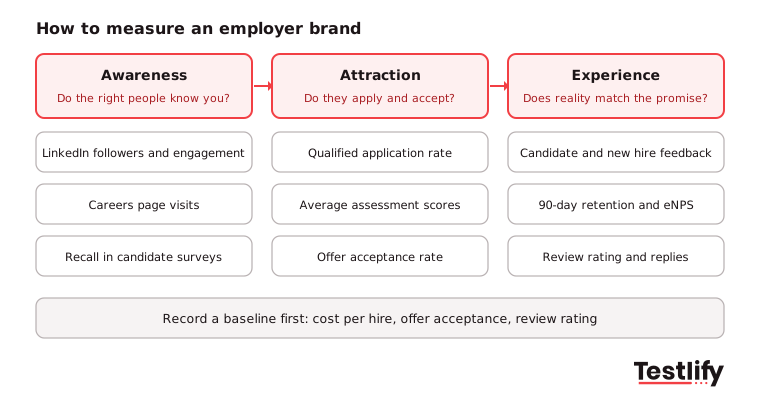
- Awareness: How many people in your target audience know you as an employer. Track follower growth and engagement on LinkedIn, careers page visits, and recall in candidate surveys ("Which three companies would you most like to work for?").
- Attraction: How many qualified people apply and accept. Track applications per role, the share that pass screening, average assessment scores and offer acceptance. Compare by channel to see where your best candidates come from.
- Experience: Whether the reality matches the promise. Track candidate feedback, new hire surveys, 90-day retention, eNPS and review ratings.
KPI | Formula | Review |
|---|---|---|
Qualified application rate | Applicants who pass screening / total applicants | Monthly |
Offer acceptance rate | Offers accepted / offers made | Monthly |
Cost per hire | Total internal and external hiring costs / hires | Quarterly |
Time to fill | Days from job opened to offer accepted | Monthly |
90-day retention | New hires still employed at 90 days / new hires | Quarterly |
Referral share | Hires from referrals / total hires | Quarterly |
Review rating and response rate | Average rating; replies / reviews | Monthly |
Free calculators help you set the baseline: the cost per hire calculator and the offer acceptance rate calculator.
Key takeaway: Record cost per hire, offer acceptance and your review rating before you start. Those three numbers are your proof of return in 12 months. Without them, leadership will always ask whether the work mattered.
Who should own the employer brand?
The employer brand is usually owned by HR or talent acquisition, with marketing as a close partner and leaders as its most visible voices. In small companies the CEO or head of people often runs it.
Mid-sized companies tend to place it in TA or HR. Large companies often have a dedicated employer brand or recruitment marketing team, sometimes supported by an agency.
Investment is moving this way too. LinkedIn's Future of Recruiting 2024 found that employer branding was the recruiting area expected to get the biggest increase in spend for the second year running, with 57% of recruiting professionals predicting more investment.
Whoever owns it, treat employer brand, EVP and employee experience as one piece of work. A single owner with input from HR, TA, marketing and line managers keeps the promise and the reality in step.
Hiring managers matter most of all: they write the job ads, run the interviews and decide how new hires are treated.
How long does it take to build an employer brand?
Building an employer brand takes about 90 days to set up and 6 to 12 months before the metrics move clearly. The first quarter is research, the EVP and quick fixes to the hiring process.
After that, the brand grows through steady content, employee stories and a hiring process that keeps the promise.
Period | Focus | Outputs |
|---|---|---|
Days 1 to 30 | Leadership backing, goals, audit | Baseline metrics, audit summary, 2 to 3 goals |
Days 31 to 60 | Personas and EVP | Candidate personas, tested EVP with proof points |
Days 61 to 90 | Hiring process, careers page, launch | Fixed process gaps, new careers page and job ad template, internal launch |
Months 4 to 12 | Channels, advocates, measurement | Content calendar, advocacy and referral program, monthly dashboard |
How to build an employer brand on a small budget?
Building an employer brand on a small budget is possible because most of the work costs time, not money. Fix your job descriptions, reply to every review, ask employees to share real stories, speed up candidate replies and make sure every rejected candidate hears back.
These steps cost little and change how candidates talk about you.
- Start with what you own: Your careers page, job ads and LinkedIn page are free to improve.
- Use your people: A phone, a quiet room and a willing employee are enough for a short day-in-the-life video.
- Fix the process first: Faster replies and fair assessments do more for your reputation than paid campaigns.
- Measure with free tools: A short survey and a spreadsheet are enough for a baseline.
What mistakes weaken an employer brand?
The mistakes that weaken an employer brand most are promising what the job does not deliver, using a generic EVP, leaving employees out, ignoring feedback and measuring the wrong things. Each one widens the gap between what candidates hear and what employees live, and that gap shows up in reviews quickly.
- Overpromising: Content that shows a culture your teams do not recognise. New hires notice in the first month and say so in reviews.
- A generic EVP: "Great culture, competitive pay, room to grow" could describe any employer. Specific proof beats adjectives.
- Leaving employees out: An EVP written by leadership alone. With engagement low, this matters more: Gallup's State of the Global Workplace reports that global employee engagement fell to 20% in 2025, its lowest level since 2020.
- Ignoring the hiring process: Spending on campaigns while candidates wait weeks for replies or sit irrelevant tests.
- Vanity metrics: Counting followers and likes instead of qualified applicants, offer acceptance and retention.
- Hiding problems: Be honest about what you have not fixed yet, such as diversity goals or a slow promotion cycle, and say what you are doing about it. Candidates trust a company that admits a gap more than one that claims to have none.
How do skills assessments strengthen your employer brand?
Skills assessments strengthen an employer brand by making hiring feel fair, fast and tied to the job. Candidates see that they are judged on what they can do, not on where they studied or who they know.
That proves claims about fairness and growth that an EVP can only make in words.
Hiring teams agree that skills matter. LinkedIn's Future of Recruiting 2025 found that 93% of talent acquisition professionals say accurately assessing skills is crucial to improving quality of hire, yet only 25% feel highly confident in how their organisation measures quality of hire.
Testlify is built for this step of the brand:
- Job-related tests: 3,500+ validated tests across technical and non-technical roles, so each candidate sees questions that match the job.
- A good candidate experience: Testlify reports 94% candidate satisfaction, and assessments run in 15+ languages.
- Your brand on every screen: Basic logo and colors are free on all plans, and full white labeling is available as an add-on. See how white-labeled assessments shape candidate experience.
- Fair, explainable results: Automated scoring with a per-skill breakdown, so every decision can be explained to the candidate and the hiring manager.
Ready to make your hiring process part of your employer brand?
Show candidates a fair, job-related process from the first step. Book a Testlify demo to see it in action, or browse the Testlify test library and start a 7-day free trial, no credit card required.
Frequently asked questions (FAQs)

Director of Marketing
Akash Patange is the Director of Marketing at Testlify, where he works closely with HR leaders and recruiters to help organizations improve hiring outcomes. He writes about talent assessment, recruitment technology, and data-driven hiring practices.
LinkedInRelated resources
View all
HR & recruitment
10 skills every recruiter should look for

HR & recruitment
How to craft effective job descriptions

HR & recruitment
What is the purpose of capturing screenshots while testing?

HR & recruitment
How to simplify candidate screening with AutoCAD test

HR & recruitment
How to hire top talent using the AutoCAD test

HR & recruitment
Automated scoring for custom questions in assessments
Get started.
Hire on proof, not resumes.
Run your first skills-based assessment free — no credit card required.