
Pre-hire talent assessment: how to tailor it to every role
How to build a pre-hire talent assessment for each role: which tests to pick, how to tailor them, and how to keep results fair and useful.

A pre-hire talent assessment is a set of tests and tasks candidates complete before an offer, so the hiring team can see whether they have the skills, judgment and work habits the job needs. The best results come from tailored talent assessments: a short, consistent core for everyone in the role, plus tasks built around the work the person will actually do.
TL;DR / Key Takeaways
- Yes, a pre-hire talent assessment should be tailored to the role. Keep a small standard core for fairness, then add tasks that mirror the job.
- Start every assessment with a job analysis: list the five or six skills that separate strong performers from average ones, then test only those.
- Most roles need two or three test types, not ten. A support role might get a communication test, a situational judgment test and a typing test.
- Keep the candidate side to 30 to 45 minutes for early screening. Save longer work samples for the shortlist.
- Every test must be job-related. The EEOC expects employers to show that a test which screens people out measures skills the job requires.
- Judge the assessment by results: pass rates by stage, drop-off, hiring manager agreement and 90-day performance.
 ChatGPT
 Gemini
 Claude
 Grok
 Perplexity
What is a pre-hire talent assessment?
A pre-hire talent assessment is a structured set of skills tests, work samples, situational questions or interviews that every candidate for a role completes before the hiring decision. Each candidate gets the same tasks and the same scoring rules, so the team compares people on evidence instead of resumes and gut feel.
Employers lean on assessments because resumes say less every year. Candidates polish them with AI, and many roles now need skills that a job title does not prove. Hiring is still hard too: SHRM's 2025 Talent Trends report found that 69% of organizations are still struggling to fill roles.
An assessment usually sits right after the application, before the first interview. Strong candidates move forward faster, and interviewers spend their time on people who have already shown they can do the core of the job.

Should a pre-hire talent assessment be tailored to the role?
A pre-hire talent assessment should be tailored to the role, with one condition: keep a small standard core so candidates stay comparable. Generic tests measure general ability. Tailored talent assessments measure the actual work, such as handling an angry customer, cleaning a messy spreadsheet or debugging a function.
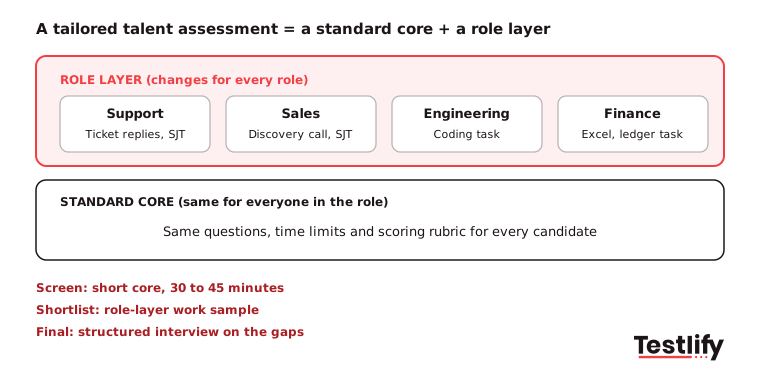
The case for tailoring is simple. A sales hire and a data analyst both need reasoning and communication, but the evidence that predicts success in each job is very different. One general test cannot show both.
Hiring teams already know this. LinkedIn's Future of Recruiting 2025 found that 93% of talent acquisition professionals say accurately assessing a candidate's skills is crucial to improving quality of hire. Companies running the most skills-based searches were 12% more likely to make a quality hire.
Tailoring does not mean a different test for every candidate. Everyone applying for the same role gets the same assessment. The tailoring happens between roles, not between people.
Which tests should a role-based assessment include?
A role-based assessment is built from a few test types, chosen for what the role needs. Most assessments combine one or two skill tests with one test of judgment or work style. Using every type at once only makes the assessment longer without adding much signal.
- Role-specific skills tests: Knowledge and tasks for a named job, such as accounts payable, nursing or digital marketing. See role-specific tests.
- Software skills tests: Hands-on use of Excel, Google Sheets, Salesforce or design tools, often as live simulations.
- Coding tests: Real programming tasks in a code editor, scored on correctness and quality.
- Cognitive ability tests: Numerical, verbal and logical reasoning for roles that need fast learning. More in cognitive ability tests.
- Situational judgment tests: Realistic work scenarios where the candidate picks the best response. See situational judgment tests.
- Personality and culture tests: Work style and preferences, such as Big Five or DISC profiles. Use them to guide interviews, not as a pass or fail gate.
- Language and typing tests: CEFR-level language checks from A1 to C2, plus speed and accuracy tests for data entry or support roles.
- AI and video interviews: Structured questions answered by video, voice or chat, scored against the same criteria for every candidate.
What do tailored talent assessments look like for different roles?
Tailored talent assessments for different roles share the same shape, a short screen followed by a deeper task, but the content changes completely. The table below shows a starting mix for six common role families. Adjust the skills to your own job analysis.
Role family | Skills that matter most | Suggested test mix | Deeper task for the shortlist |
|---|---|---|---|
Customer support | Written communication, empathy, product learning | Communication test, situational judgment, typing | Reply to three real support tickets |
Sales | Persuasion, objection handling, resilience | Sales aptitude, situational judgment, personality profile | Recorded discovery call by video |
Software engineering | Problem solving, code quality, debugging | Coding test in the main language, cognitive reasoning | Take-home or live pair-programming task |
Finance and accounting | Accuracy, accounting rules, spreadsheets | Role-specific accounting test, Excel simulation | Reconcile a sample ledger |
Operations and admin | Organization, software use, attention to detail | Office software test, typing, situational judgment | Plan a week from a messy request list |
People managers | Coaching, prioritizing, fair decisions | Situational judgment, cognitive reasoning, personality profile | Structured interview on real team scenarios |
For roles you hire less often, the O*NET OnLine occupation database lists the tasks, skills, knowledge and software for more than 900 occupations. It is a quick way to check that your skills list is complete. Testlify's guide to job roles that need assessments covers more examples, including the communication test for support roles and the office administrator test for admin roles.
How do you tailor a pre-hire talent assessment to a role?
Tailoring an assessment to a role takes six steps: analyze the job, pick the few skills that matter, match a test to each skill, set the scoring rules, pilot it, and decide where it sits in the process. Most teams can build a first version in a day and refine it after the first hiring round.
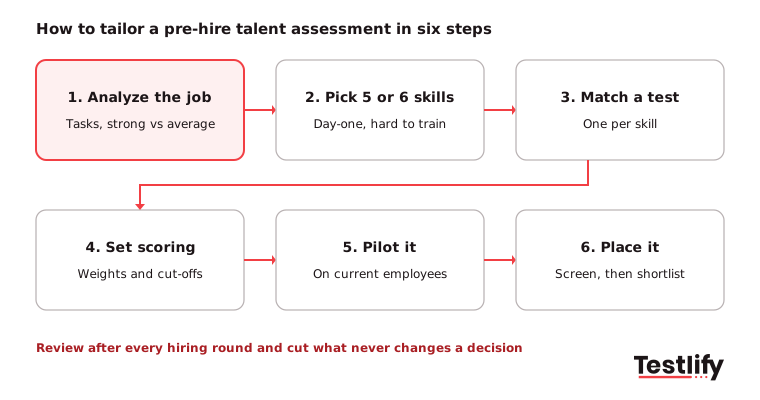
- Analyze the job: Talk to the hiring manager and two strong performers. List the tasks the person does every week and what separates great from average. The US Office of Personnel Management calls job analysis "the foundation for all assessment and selection decisions". Testlify's job analysis guide walks through it.
- Pick five or six skills: Keep the skills that are needed on day one and hard to train. Leave out skills the team will teach in onboarding.
- Match a test to each skill: Use a skills test or work sample for hard skills, a situational judgment test for judgment, and a structured interview for things a test cannot show. An AI test builder can draft this from the job description, as covered in using AI to tailor assessments to job descriptions.
- Set scoring and weights: Decide before anyone takes the test which skills count most and what score moves a candidate forward.
- Pilot on current employees: Ask a few strong and average performers to take it. If the scores do not separate them, change the questions.
- Place it in the process: Put a short version right after the application and the longer work sample at shortlist stage.
Pro tip: Write down what each result will change before you launch. If a test score would not change who moves forward or what you ask in the interview, drop that test and shorten the assessment.
When should you use a standard test instead of a tailored one?
A standard test works best when you hire large numbers into the same role, need to compare candidates across locations, or are screening very early with little time per candidate. A tailored assessment works best for specialist, senior or hands-on roles where the work itself is the best evidence. Most teams use both, in that order.
Standard test | Tailored assessment | |
|---|---|---|
Best for | High-volume roles, early screening | Specialist, senior and hands-on roles |
What it shows | General ability and baseline skills | How the person handles the real work |
Setup time | Minutes, from a test library | Hours, from a job analysis |
Comparing candidates | Easy, same benchmark everywhere | Easy within the role, harder across roles |
Candidate experience | Can feel generic | Feels relevant, shows the job |
Main risk | Misses role-specific skills | Drifts into subjective scoring without clear rules |
The safest design for volume hiring is a standard core at the screening stage and a tailored work sample for the shortlist. That keeps the first cut fast and fair, then spends real effort only on people who are likely to get an offer.
How do you keep selective hiring assessments fair and legal?
Selective hiring assessments stay fair and legal when every test is clearly tied to the job, every candidate in the role gets the same test and scoring, results are checked for unfair impact on any group, and candidates who need adjustments can ask for them. Tailoring helps here, because a test built from a job analysis is easier to defend.
- Job-related content: The EEOC's guidance on employment tests says a test that screens out people in a protected group must be job-related and consistent with business necessity. A test harder than the job itself is a risk.
- Same test, same rules: Give everyone in the role the same tasks, time limits and scoring rubric.
- Check pass rates by group: Review pass rates at each stage. A big gap between groups means the test or cut score needs a closer look.
- Accommodations: Offer extra time or another format to candidates who need it under disability law.
- AI scoring rules: New York City's Local Law 144 requires a yearly bias audit and candidate notice when an automated tool scores candidates. Keep a person in the loop for every rejection.
Testlify's guide to the legal risks of assessments covers these rules in more depth.
How do you know a tailored assessment is working?
A tailored assessment is working when it changes decisions for the better: fewer interviews per hire, hiring managers who agree with the shortlist, candidates who finish the test, and new hires who perform well after 90 days. If none of those numbers move, the assessment is adding steps without adding value.
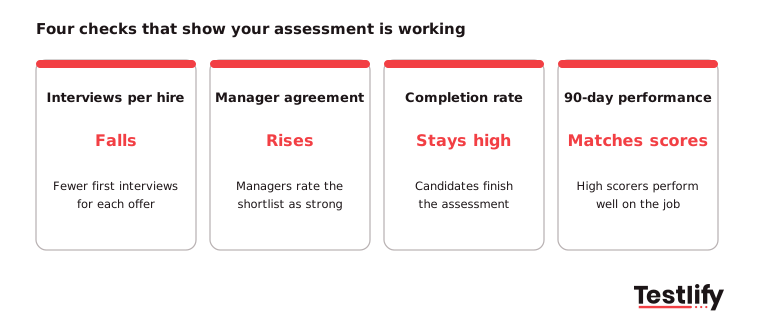
- Interviews per hire: A good assessment means fewer first interviews for each offer.
- Hiring manager agreement: Ask managers to rate the shortlist. Low ratings point to the wrong skills or weights.
- Completion rate: A sharp drop-off usually means the test is too long or feels unrelated to the job.
- Performance at 90 days: Compare assessment scores with early performance reviews. Keep the parts that line up and cut the parts that do not.
Speed matters as well. Well-run pre-hiring assessments cut time-to-hire because recruiters stop screening every resume by hand. Quality is harder to track: LinkedIn found that only 25% of talent acquisition professionals are highly confident they can measure quality of hire, so set up these checks before the first candidate takes the test.
Key takeaway: Review the assessment after every hiring round. Remove questions that never change a decision and add tasks where new hires struggled.
How does Testlify help you tailor each assessment?
Testlify helps hiring teams build a tailored assessment from a job description, then run and score it on one platform. The AI test builder suggests skills, tests and scoring criteria for the role in under a minute, and recruiters can edit every part before sending it.
- Large test library: 3,500+ validated tests across role-specific, software, coding, cognitive, situational judgment, language, typing and personality, browsable in the Testlify test library.
- Custom questions and simulations: 25+ question types, including coding, file upload, Excel and Google Sheets tasks, and Video AI, Voice AI and Chat AI questions.
- Weighted scoring and benchmarks: Set weights per skill, auto-shortlist by score and compare candidates against global and assessment-level benchmarks.
- Integrity and fairness: 20+ proctoring checks, explained in anti-cheating and proctoring, plus a third-party NYC bias audit of the matching model completed on June 16, 2023.
- Fits your stack: Assessments run in 15+ languages and connect with 100+ ATS and HRIS tools, including Workday, Greenhouse and Lever.
To pair test results with consistent interviews, see how to run a structured interview.
Ready to build a role-specific assessment?
Pick one open role, list its five most important skills and build your first tailored assessment from the job description. Start a 7-day free trial of Testlify, no credit card required, and see your first ranked shortlist from real candidate work.
Frequently asked questions

Wordpress Developer
Yash Patel is a Wordpress and SEO Specialist at Testlify with 3+ years of experience in technical SEO, on-page optimization, and content strategy. He works on improving Testlify's organic presence and produces content focused on hiring, talent assessment, and HR technology.
LinkedInRelated resources
View all
HR & recruitment
Is it necessary to verify educational qualifications

HR & recruitment
Employee referrals: how they work and how much weight to give them

HR & recruitment
How to incorporate aptitude assessment into your recruitment strategy

HR & recruitment
How to overcome a limited budget for recruiting in 2026

HR & recruitment
Are pre-hiring assessments scalable for high volume hiring?

HR & recruitment
Pre-hiring assessments compliance with regulations: a 2026 guide for HR
Get started.
Hire on proof, not resumes.
Run your first skills-based assessment free — no credit card required.