
How to evaluate software architecture skills in 2026
A practical way to test software architects: which skills matter, how to run the design interview, how to score it and what to avoid.

Knowing how to evaluate software architecture skills is what separates a confident senior hire from an expensive mistake. A software architect makes the decisions that are hardest to undo: how a system is split, where data lives, what it costs to run and how it fails. Resumes and job titles say little about that judgment, so the evaluation has to test it directly.
TL;DR / Key Takeaways
- To evaluate software architecture skills, define the architect type you need, screen with a short design test, run a live design interview, review a real decision record or take-home, and score everyone on one weighted scorecard.
- Trade-off judgment is the strongest signal: a good architect names the cost of each option and what would change the decision.
- TA teams can run screening, logistics and the scorecard, but an architect or senior engineer must judge the design rounds.
- A weighted scorecard with six areas (design, trade-offs, scale and reliability, communication, hands-on depth, delivery record) keeps senior hiring consistent.
- Red flags include microservices before any question about load, no failure story and "we" for every decision.
- With 84% of developers using or planning to use AI tools, test judgment and review skills, not recall of patterns.
 ChatGPT
 Gemini
 Claude
 Grok
 Perplexity
What are software architecture skills?
Software architecture skills are the abilities to design how a software system is structured and to make the decisions that shape it: service boundaries, data flow, technology choices, scalability, reliability, security and cost. They also include explaining those decisions to engineers and business owners and keeping them documented as the system changes.
Architecture is less about drawing boxes than about choosing between imperfect options. Two candidates can draw the same diagram. The stronger one can say why each box exists, what it costs and what breaks first. Concept knowledge, such as when to use design patterns or microservices, can be checked with a short test. Judgment needs a conversation with someone who has made the same calls.

Which software architecture skills should you evaluate?
Software architecture skills worth evaluating fall into eight areas: system design, trade-off judgment, scalability and performance, reliability and security, patterns and modularity, documentation, communication and influence, and hands-on technical depth. Each needs a different test, so map every skill to the step where you will check it before the first interview.
Skill | What good looks like | Best way to test it |
|---|---|---|
System design | Clear boundaries, data flow and interfaces that fit the problem | Live design interview |
Trade-off judgment | Names the cost of each option and what would flip the choice | Design interview follow-ups |
Scalability and performance | Measures before optimizing, knows what breaks first at 10x load | Design scenario with growth |
Reliability and security | Designs for failure and builds security in, not on | Incident and threat questions |
Patterns and modularity | Picks patterns for a reason, avoids over-building | Short skills test, code review |
Documentation | Decisions recorded with context, options and consequences | ADR or take-home review |
Communication and influence | Explains a design plainly to a non-technical owner | Stakeholder role-play |
Hands-on depth | Recent, specific code or review work | Code review task, references |
Start from the role, not a generic list. The software architect job description template is a useful baseline for agreeing which of these eight matter most for your team.
How to evaluate software architecture skills step by step
The way to evaluate software architecture skills is a five-step process: define the architect type and must-have skills, screen with a short skills test, run a live system design interview, review a real decision record or a take-home, then score every candidate on the same weighted scorecard before a joint debrief.
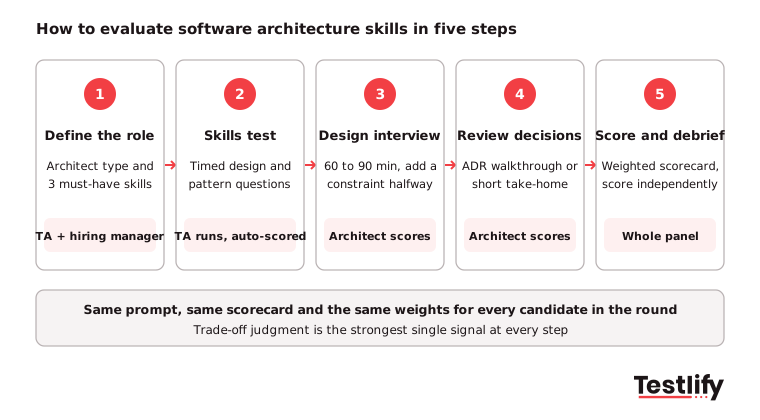
- Define the role: Agree whether you need an application, solution or enterprise architect, how much hands-on coding the job involves and which three skills are non-negotiable. A startup architect who still ships code and an enterprise architect who runs governance are different hires.
- Screen with a skills test: Use a short, timed test on system design, architectural patterns and the cloud or language stack you run. This filters out candidates who know the vocabulary but not the concepts, before any senior engineer spends an hour on them.
- Run a live design interview: Give a realistic problem from your domain and watch how the candidate gathers requirements, sketches a design and handles new constraints.
- Review real decisions: Ask for an anonymized architecture decision record (ADR) or set a short take-home, then have the candidate defend it.
- Score and debrief: Each interviewer scores independently on the same scorecard with one line of evidence per score, then the panel compares.
This order matters. Skills data from LinkedIn's Future of Recruiting 2025 report shows 93% of TA professionals believe accurately assessing a candidate's skills is crucial for improving quality of hire. For architects, that means evidence from tests and exercises, not impressions from a chat. The same logic is covered more broadly in this guide on how to assess technical skills.
Pro tip: Decide who judges what before you start. TA can own the screen, scheduling and scorecard. An architect or principal engineer from your team must run and score the design and ADR rounds.
How do you run a system design interview for an architect?
A system design interview for an architect works best as a 60 to 90 minute collaborative session on a problem close to your business. The interviewer gives a short brief, lets the candidate ask questions, adds a constraint halfway through and scores how the candidate reasons, not whether the final diagram matches a model answer.
A good session has four parts:
- Requirements (10 to 15 minutes): Strong candidates ask about users, load, data and budget before drawing. Weak ones start with a favorite technology.
- High-level design (20 to 30 minutes): Main components, data stores and how requests flow. Ask why each boundary sits where it does.
- Deep dive and change (20 to 30 minutes): Add a twist, such as 10x peak traffic during a sale, a new region with data residency rules or a cut in the cloud budget. Watch whether the design bends or breaks.
- Wrap-up (5 to 10 minutes): Ask what they would build first, what they would leave out and what they are least sure about.
Good prompts are concrete: a notification service sending millions of messages a day, a payments flow that must never double-charge, or moving one module out of a monolith without downtime. Keep the same prompt for every candidate in a hiring round, which is the core idea behind any structured interview.
What should an architecture take-home or ADR review include?
An architecture take-home or ADR review should include a real decision, the context behind it, the options considered, the trade-offs accepted and the consequences. Reviewing one shows how a candidate thinks when nobody is prompting them, and how clearly they write for the engineers who will live with the decision.
Microsoft's guidance on how to maintain an architecture decision record lists what a good record holds: a problem statement with context, the options considered, the decision with its important trade-offs and a confidence level, and a status such as proposed, accepted or superseded. That anatomy doubles as a review checklist.
Two formats work well:
- ADR walkthrough (45 minutes, no prep): The candidate brings an anonymized decision they made and walks the panel through it. Push on the options they rejected and what would make them change their mind.
- Short take-home (2 to 3 hours, capped): Give a small system and ask for a one-page design note or a critique of an existing design. Keep it short. Long unpaid take-homes cause senior candidates to drop out, and the best ones have the most options.
Key takeaway: Always follow a take-home with a live discussion. The write-up shows the thinking; the defense shows whether it is the candidate's own.
How do you score a software architect candidate?
A software architect candidate is best scored on a weighted scorecard with six areas: system design, trade-off judgment, scalability and reliability, communication and influence, hands-on depth and delivery record. Each interviewer rates every area from 1 to 5 with one line of evidence, independently, before the panel discusses.
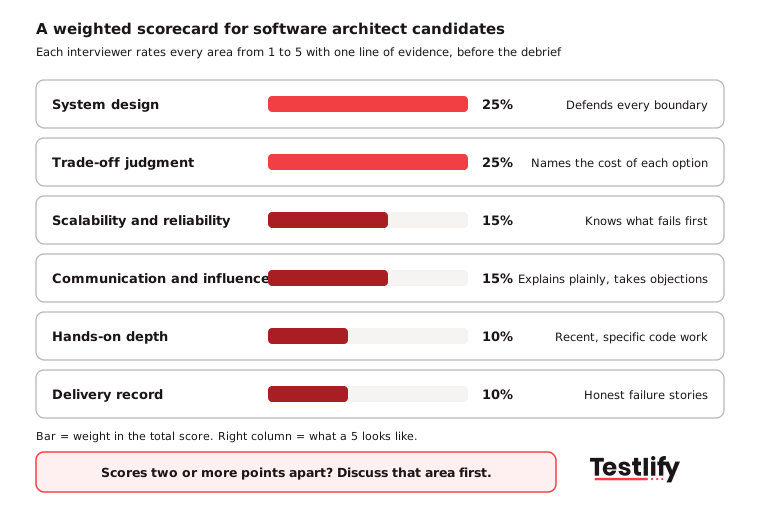
Area | Weight | What a 5 looks like | What a 2 looks like |
|---|---|---|---|
System design | 25% | Clear boundaries fitted to the problem, defends each one | Generic diagram, cannot say why parts are split |
Trade-off judgment | 25% | Names cost of each option and what would flip it | One "right" answer, no alternatives |
Scalability and reliability | 15% | Knows what fails first, prices availability as a business choice | Adds caching and replicas by reflex |
Communication and influence | 15% | Explains plainly, changed a design after a good objection | Jargon, defensive when challenged |
Hands-on depth | 10% | Recent, specific code or review work | Has not touched code in years |
Delivery record | 10% | Systems still running, honest about what aged badly | No failure story, vague ownership |
Adjust weights by role: an enterprise architect might move weight from hands-on depth to communication and influence. When two interviewers differ by two points or more on one area, discuss that area first. The gap usually shows where the real information is.
What questions reveal real architecture judgment?
Questions that reveal real architecture judgment ask candidates to choose, explain a cost or describe a decision that went wrong. Definition questions ("What is the CAP theorem?") belong in the skills test. In the interview, ask for decisions and their consequences:
- Walk me through the last system you designed end to end. Which decisions were yours?
- When did you choose a monolith over services, or the reverse? What would have changed your mind?
- Tell me about a technical bet that turned out wrong. What did it cost and what did you do?
- What breaks first in your current system at ten times the load?
- How do you decide between building a component and buying one?
- Explain a recent design to me as if I owned the budget, not the code.
- Describe a time an engineer disagreed with your design. What happened?
- What did you build or review in the last three months?
Listen for the singular. "I chose" and "I was wrong about" tell you more than a polished story told entirely in "we".
What red flags show weak architecture skills?
Red flags that show weak architecture skills are patterns named without their costs, distributed designs proposed before asking about load or team size, no failure stories, no recent hands-on work, and every past decision described as a team effort. One flag deserves a closer look; two or more together usually mean a poor fit.
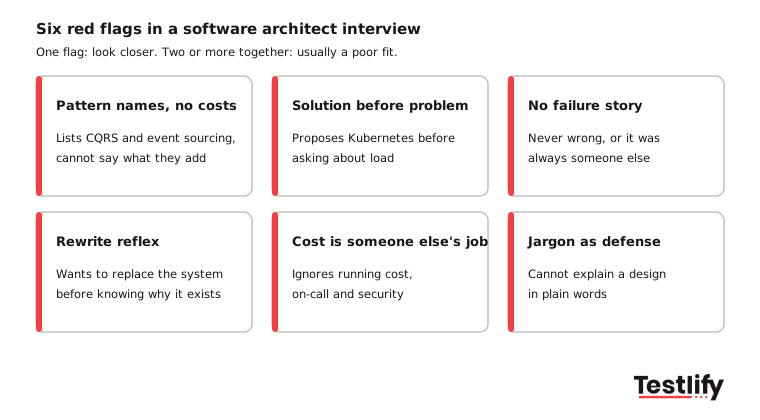
- Pattern names without costs: Can list microservices, event sourcing and CQRS but cannot say what each adds in complexity or running cost.
- Solution before problem: Proposes Kubernetes and a message bus before asking how many users there are.
- No failure story: Has never been wrong, or every failure was someone else's fault.
- Rewrite reflex: Wants to replace the existing system before understanding why it looks the way it does.
- Cost and security are someone else's job: Treats running cost, on-call and security reviews as another team's problem.
- Jargon as defense: Cannot explain a design in plain words when asked twice.
How to evaluate software architecture skills in the age of AI
AI changes how you evaluate architects by shifting weight from recall to judgment and review. Coding assistants can draft boilerplate designs and explain patterns, so knowing definitions proves little. What matters is whether a candidate can spot what a generated design gets wrong, and decide when to trust it.
Adoption is already the norm. The Stack Overflow Developer Survey 2025 found 84% of respondents use or plan to use AI tools in development, up from 76% the year before, while more developers distrust the accuracy of those tools (46%) than trust it (33%). An architect is the person who has to make that call for a whole team.
Practical changes for your process:
- Add a review task: Give a plausible design with two or three hidden flaws (a single point of failure, a data residency gap, an unbounded queue) and ask the candidate to critique it.
- Ask about guardrails: How would they let a team use AI assistants without eroding the architecture?
- Protect integrity in remote rounds: Use proctoring for timed screening tests, and keep design discussions live so the reasoning is visibly the candidate's own.
How do you adjust the evaluation by architect type?
The evaluation changes with the architect type: application architects need the most hands-on depth, solution architects the most integration and trade-off work, and enterprise architects the most governance and stakeholder influence. Keep the five-step process, but change the design prompt and the scorecard weights for each.
Architect type | Focus of the role | Design prompt to use | Shift weight toward |
|---|---|---|---|
Application architect | Structure of one product or service | Split a module out of a monolith | Hands-on depth, patterns |
Solution architect | One business problem across several systems | Integrate a new payments or ATS system | Trade-offs, integration, cost |
Enterprise architect | Standards and roadmap across the company | Rationalize three overlapping platforms | Communication, governance |
Cloud architect | Platform, reliability and cost on a cloud | Multi-region design within a fixed budget | Reliability, cost, security |
Demand for these skills keeps growing. The US Bureau of Labor Statistics projects employment of software developers, QA analysts and testers to grow 10% from 2025 to 2035, with about 106,100 openings a year. Senior design talent will stay contested, so a fast, fair process is part of winning the hire.
How can Testlify help you evaluate software architects?
Testlify helps you evaluate software architects by running the screening step for you, with consistent scoring, so senior engineers only spend time on candidates who already showed real design knowledge. You can combine architecture tests with coding and interview steps in one assessment.
- Ready-made architecture tests: The Software System Design test and tests on microservices, design patterns and cloud architecture sit in a library of 3,500+ tests.
- Custom questions: Add your own design scenarios with 25+ question types, including file upload, video and coding questions, through Testlify's coding tests in 45+ programming languages.
- Structured interviews: One-way video and AI interviews ask every candidate the same questions, so the first conversation is comparable across candidates.
- Integrity and fit with your stack: 20+ proctoring checks protect timed tests, and results sync to 100+ ATS and HRIS tools such as Workday, Greenhouse and Lever.
Ready to hire your next software architect?
Screen architects on real design knowledge before the first panel interview. Browse the architecture tests in the Testlify test library or start a 7-day free trial, no credit card required.
Frequently asked questions

Senior SEO Specialist
Soham is a senior SEO specialist specializing in B2B HR tech. He covers search, answer, and generative engine optimization (SEO/AEO/GEO) for talent acquisition, skills-based hiring, and assessment-driven recruiting audiences.
LinkedInRelated resources
View all
Skill assessment
5 tips to evaluate email marketing skills

Skill assessment
5 tips to evaluate risk management skills

Skill assessment
Search engine marketing skills: what to test and how in 2026

Skill assessment
How to evaluate UI UX designers: a 6-step process for hiring teams

Skill assessment
Brand Management Skills: How to Evaluate Them Before You Hire

Skill assessment
How to evaluate data validation skills in candidates
Get started.
Hire on proof, not resumes.
Run your first skills-based assessment free — no credit card required.