
Signs of a bad hire: 12 red flags and what to do next
The 12 warning signs of a bad hire, when they show up, why bad hires happen, what they cost and what to do once you have made one.

A bad hire is a new employee who cannot do the job to the standard the role needs, does not fit how the team works, or leaves soon after joining, so the hire costs more than it returns. Most bad hires show their signs within the first 90 days, and most trace back to a skill or behavior the hiring process never tested.
 ChatGPT
 Gemini
 Claude
 Grok
 Perplexity
TL;DR
- A bad hire is someone who lacks the skills for the role, clashes with how the team works, or was put in the wrong role, so the hire costs more than it delivers.
- The clearest signs are missed targets, repeated mistakes, frequent conflict, poor attendance, blaming others and a refusal to learn.
- Managers in a 2025 Robert Half survey took 4 weeks on average to spot a hiring mistake, so plan formal check-ins at 30, 60 and 90 days.
- Rule out your own side first: unclear goals, missing tools and weak onboarding produce the same signs as a bad hire.
- The top causes are skills that were never properly tested (54% of US managers who made a mistake) and culture fit that was never checked (46%).
- Once you have a bad hire, document the gap, agree a short written plan, then reassign or part ways if nothing changes.
- Skills tests, structured interviews and real reference checks catch most bad hires before the offer goes out.

What is a bad hire?
A bad hire is a person whose skills, behavior or fit fall far enough short of the role that keeping them costs the business more than it gains. The term covers three different problems, and each one needs a different fix, so name the type before you decide what to do.
Type of bad hire | What it looks like | Usual root cause | Usual fix |
|---|---|---|---|
Wrong skills | Cannot do core tasks after a fair ramp-up | Skills were taken from the resume, not tested | Training plan, or part ways if the gap is large |
Wrong fit | Can do the work but clashes with how the team operates | Values and work style were never discussed | Clear expectations, coaching, honest conversation |
Wrong role | Strong person, mismatched job | Vague job description or a role that changed after the offer | Reassign to a role that fits |
A bad hire is also different from a bad start. A new employee who struggles in week two because nobody gave them system access is not yet a bad hire. A new employee who still cannot do the job at day 90, after clear goals, tools and support, probably is.
What are the most common signs of a bad hire?
The most common signs of a bad hire are consistent underperformance, repeated mistakes, missed deadlines, conflict with colleagues, resistance to change, poor attendance and a habit of blaming others. One bad week proves nothing. A pattern that lasts several weeks, after you have given clear goals and support, is the real warning sign.
The 12 signs fall into three groups.
Performance signs:
- Consistent underperformance: The person keeps missing targets or quality standards well past a normal learning curve. Tasks stay half done and performance metrics stay flat.
- Repeated mistakes: The same error comes back after it has been explained, which points to a skills gap or a lack of care.
- Missed deadlines: Work arrives late, often without warning, and colleagues start to plan around the delay.
- A skills gap the resume hid: Tasks the resume listed as strengths turn out to be things the person has only read about.
Behavior signs:
- Frequent conflict: The person is often at the center of workplace conflicts, or refuses to work as part of the team.
- Unwillingness to adapt or learn: New tools, processes and feedback meet resistance, and training gets skipped.
- Lack of accountability: Every miss is someone else's fault: the brief, the tools, the client, a colleague.
- Misalignment with company culture: Behavior clashes with how the team works. A team that runs on open communication notices quickly when someone withholds information.
Engagement signs:
- Frequent absenteeism: Unexplained absences, late starts and early finishes, or a vacation request in the first weeks.
- Minimal initiative: The person does exactly what is asked and nothing more, and never raises a problem before it lands.
- Poor communication: Messages go unanswered, updates are vague, and instructions are misunderstood more than once.
- A negative attitude: Constant complaining, comparing everything to the last job, or disrespect toward managers and peers.
Pro tip: Write down each sign with a date and a specific example as it happens. A list of dated examples is what makes the later conversation fair, and what protects you if you end up parting ways.
When do the signs of a bad hire usually show up?
The signs of a bad hire usually show up in a predictable order: behavior and attendance signs in the first two weeks, skill gaps by day 30, and performance and fit problems by days 60 to 90. In Robert Half's 2025 survey of more than 1,500 Canadian hiring managers, managers took 4 weeks on average to recognize a hiring mistake.
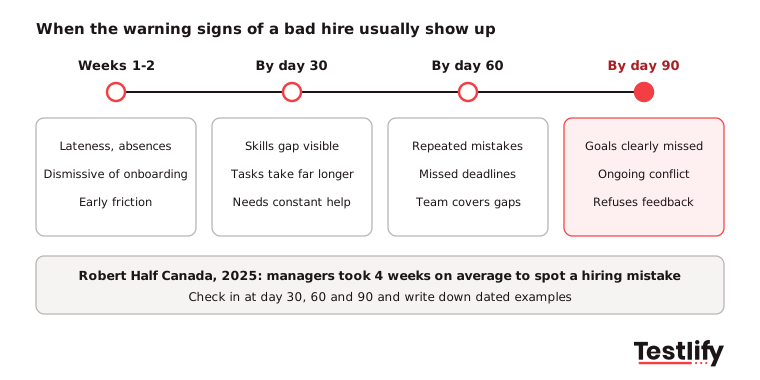
- Weeks 1 and 2: Lateness, unexplained absences, a dismissive attitude toward onboarding, early friction with colleagues.
- By day 30: The skills gap becomes visible. Tasks the resume promised take far longer than they should, or need constant help.
- By day 60: Repeated mistakes and missed deadlines form a pattern. Colleagues start to cover the gaps.
- By day 90: Performance against agreed goals is clear. Fit problems, such as constant conflict or refusing feedback, are hard to miss.
That timeline is why a structured probation period with check-ins at 30, 60 and 90 days works better than a single review at the end. Each check-in either confirms the hire is on track or gives you dated evidence that it is not.
Is it a bad hire or a bad onboarding?
A bad hire and a bad onboarding look the same from the outside: slow output, mistakes and low energy. The difference is the cause. Before you label someone a bad hire, check four things on your own side: whether the role was clear, whether the person had the tools and access, whether anyone trained them, and whether they got feedback early.
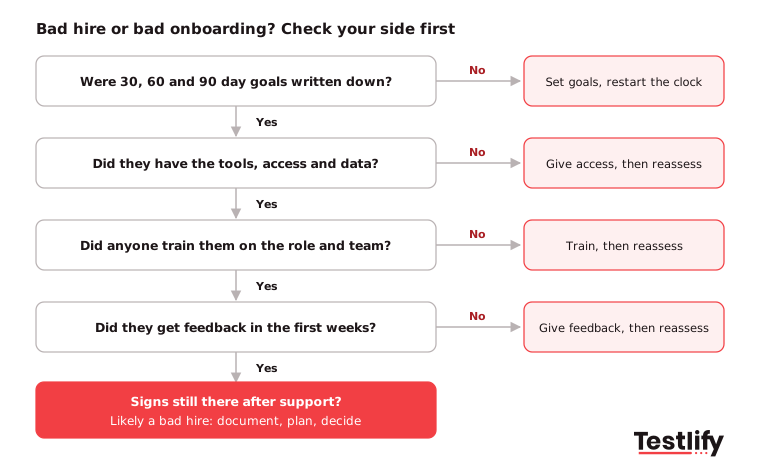
Ask these questions in order:
- Were the goals written down? If the person never got clear 30, 60 and 90 day goals, fix that first and restart the clock.
- Did they have what they needed? Missing system access, tools or data can make a strong hire look weak for weeks.
- Did anyone train them? A well-run onboarding process covers the role, the team's ways of working and who to ask for help.
- Did they get early feedback? Problems raised in week two are easy to fix. Problems saved for the probation review are not.
If the answer to all four is yes and the signs remain, you are most likely looking at a bad hire. If any answer is no, fix your side before you judge theirs. We have seen teams save hires they were ready to let go simply by putting goals in writing.
Why do bad hires happen?
Bad hires happen mostly because the hiring process never tested what the job actually needs. In Robert Half's 2025 survey of more than 2,200 US hiring managers, 30% admitted a hiring mistake in the past two years. The most common errors were not properly assessing technical skills (54%) and not evaluating cultural fit (46%).
The Canadian edition of the same survey points the same way: 50% of managers who made a mistake failed to consider soft skills and culture fit, 49% did not properly assess technical skills, and 33% did not give the candidate a clear job description.
The usual root causes are:
- Hiring in a rush: Pressure to fill a seat leads to skipped steps and lower standards. Robert Half found 93% of US managers say hiring takes longer than it did two years ago, which adds to that pressure.
- A vague job description: If the role is unclear, nobody can test for it, and the candidate cannot judge whether it suits them. Start with an effective job description.
- Trusting the resume: Resumes list skills. They do not prove them, and AI writing tools make polished resumes easy to produce.
- Unstructured interviews: When every interviewer asks different questions, the decision comes down to gut feel and likability.
- Skipping real reference checks: Confirming dates and job titles tells you nothing about how the person actually works.
How much does a bad hire cost?
A bad hire costs the recruiting spend, the salary paid for weak output, the manager's time, the extra work for the team and the cost of hiring again. Robert Half's 2025 Canadian survey found bad hires wasted more than 15 hours of productivity per week across teams, and 56% of managers said the bad hire led to more turnover on the team.
Cost | What it includes |
|---|---|
Hiring spend | Job ads, recruiter and interviewer hours, assessments, background checks |
Salary for weak output | Pay and benefits for months of below-standard work |
Manager time | Extra supervision, coaching, documentation, HR meetings |
Team impact | Colleagues covering gaps, lower morale, good people leaving |
Rehiring | A second search, plus another ramp-up period for the replacement |
Reputation | Unhappy clients, missed deadlines, faulty work, poor reviews from ex-employees |
Time matters too. SHRM's recruiting benchmarking puts the median time to fill a nonexecutive role at 39 calendar days, which is roughly how long the seat stays empty again once a bad hire leaves. Use SHRM recruiting benchmarking for your own cost-per-hire comparison.
You will often see the claim that a bad hire costs 30% of first-year earnings, attributed to the US Department of Labor. We could not find a primary Department of Labor source for it, so treat it as a rough rule of thumb, not a statistic. For a real number, add up the six lines in the table above for one past hire. Our guide to the cost of a bad hire walks through the math.
How do you identify a bad hire before you make an offer?
You identify a bad hire before the offer by testing the skills and behaviors the job needs instead of trusting the resume and a friendly interview. Five hiring stages each catch a different set of warning signs, and a process that uses all five leaves very little to chance.
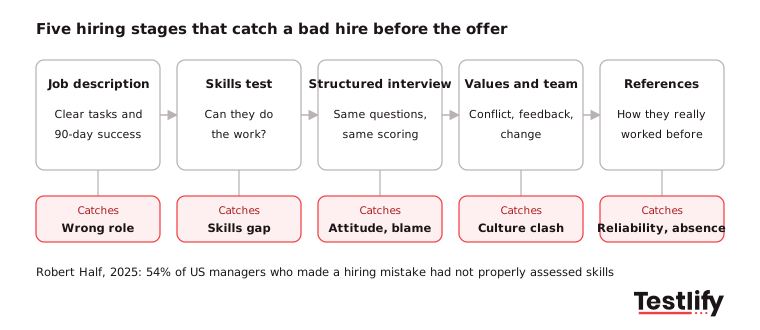
- Write a precise job description: List the core tasks, the must-have skills and how success will be measured in the first 90 days. Leave out wish-list criteria that only scare off good candidates.
- Test skills before the interview: A role-based skills test shows whether the person can actually do the work. Choose from the Testlify test library or build a test from your job description, and use situational judgment tests to see how candidates handle realistic work problems.
- Run structured interviews: Ask every candidate the same questions and score answers against the same criteria. A structured interview with behavioral questions, such as "Tell me about a time you had to learn a new tool fast", shows how people acted in real situations.
- Check values and work style: Ask how candidates handle conflict, feedback and change, and let them meet the team. The goal is people who add to the culture, not clones of the current team. See how to determine a candidate's cultural fit.
- Run real reference and background checks: Ask former managers about reliability, teamwork and how the person handled a hard moment. A proper reference check goes well beyond confirming dates, and a background check confirms education and certifications.
Watch for red flags during the process too: excuses for gaps nobody asked about, little knowledge of the company or role, last-minute cancellations, slow replies and a focus only on pay and perks.
What should you do after making a bad hire?
After making a bad hire, act early: document the gaps, talk to the person, agree a short written improvement plan and review it on a fixed date. If nothing changes, reassign them to a better-fitting role or part ways. Waiting rarely helps. Every extra month adds cost and puts more strain on the team.
- Document the gaps: Use your dated examples. Separate skill problems from behavior problems.
- Diagnose the cause: Run the four onboarding questions above. Fix anything that is your side's fault.
- Talk early and privately: Explain the gap with specific examples and listen to their side. Some problems have causes you cannot see from outside.
- Agree a written plan: Set two or three measurable goals, the support you will give, and a review date 30 to 60 days out.
- Consider reassignment: A person with a good work ethic but the wrong skills may thrive in a different role, if one is open.
- Part ways fairly: Follow your policy, keep the documentation, and make sure the decision rests on performance and conduct. The EEOC's guidance on prohibited employment practices covers what a termination decision must never be based on.
For a full playbook, read how to recover from a bad hire.
How can you stop making bad hires?
You stop making bad hires by treating each one as data: find the stage that should have caught the problem, fix that stage, and track whether the fix works. Teams that review every failed hire and measure quality of hire make fewer of the same mistakes, because they stop guessing about what went wrong.
- Run a short post-mortem: For each bad hire, note which sign appeared first and which hiring stage should have caught it. A skills gap points to testing. A fit problem points to interviews and references.
- Track the right metrics: Quality of hire, first-year attrition, time to productivity and hiring manager satisfaction tell you whether the process works. The quality of hire calculator gives you a starting score.
- Train interviewers: Calibrate scores so two interviewers rate the same answer the same way.
- Build feedback loops: Regular check-ins in the first months catch small problems before they grow. See effective employee feedback mechanisms.
- Watch engagement: Gallup's latest data shows global engagement fell to 20% in 2025, and low engagement cost an estimated $10 trillion in lost productivity. Gallup's State of the Global Workplace is a reminder that a disengaged new hire is a cost long before anyone calls it a bad hire.
Across the teams we work with, the biggest single change is moving skills checks to the start of the process, before anyone spends interview time. For the wider case, see the benefits of skills-based hiring.
Key takeaway: Most bad hires are a process problem, not bad luck. Test the skills the job needs, structure the interviews, check references properly, and review every miss.
Ready to hire on proof instead of resumes?
Testlify helps hiring teams catch the skills gap before the offer, not at day 60. Turn any job description into a role-specific assessment, choose from 3,500+ tests and 25+ question types, run structured AI interviews, and rank candidates on scored, explainable results, with 20+ proctoring checks keeping the results honest. Browse the test library or start a 7-day free trial, no credit card needed.
Frequently asked questions (FAQs)

Content Writer
Yashika Khandelwal is a Content Writer with 3+ years of experience creating research-backed content on hiring, talent assessment, and HR technology. She is a registered Organizational Psychologist and subject matter expert who combines behavioral science with practical recruitment insights to produce accurate, evidence-based content.
LinkedInRelated resources
View all
HR & recruitment
How to recover from a bad hire

HR & recruitment
I made a bad hire at work how do I fix it? A manager's guide

HR & recruitment
How to use data to drive talent management decisions

HR & recruitment
7 strategies recruiters use to recognize top talent

HR & recruitment
How to discover top talent beyond the resume?

HR & recruitment
How to Build a User-Friendly Application Process for a Better Candidate Experience
Get started.
Hire on proof, not resumes.
Run your first skills-based assessment free — no credit card required.