
What is remote proctoring? Ultimate guide
Learn what remote proctoring is, how it works, key features such as AI monitoring and browser lockdown, and tips for secure, fair online exams with Testlify.

Remote assessments have become a permanent part of hiring, certification, and education. As organizations increasingly evaluate candidates and learners online, ensuring assessment integrity has become just as important as improving accessibility and scale.
This shift has fueled rapid growth in the remote proctoring market. According to Business Research Insights, the remote proctoring market reached approximately $0.85 billion in 2026, reflecting how completely online assessment has shifted from pandemic contingency to permanent infrastructure.
Today, organizations use a combination of webcam monitoring, browser security controls, identity verification, and AI-powered oversight to protect exam integrity without requiring physical test centres. The challenge is no longer whether to use remote proctoring, but how to select the right approach for different assessment scenarios.
This guide covers how remote proctoring works across its four-layer security model, the four main types available, and the key features enterprise HR and assessment teams should evaluate. Every section addresses the specific requirements of organizations running assessments at scale.
 ChatGPT
 Gemini
 Claude
 Grok
Grok Perplexity
What is remote proctoring?
Remote proctoring is the practice of supervising online exams through webcams, screen-sharing, and browser-lockdown tools, allowing proctors (human, AI, or both) to verify identity and preserve test integrity without the test-taker entering a physical exam hall.
It converts any internet-connected device into a secure assessment environment, enabling universities, certification bodies, and employers to run high-stakes exams for thousands of candidates simultaneously without the logistical overhead of a physical test centre.

Remote proctoring vs traditional proctoring
Traditional proctoring required a physical room, paper materials, and an invigilator watching each candidate directly throughout the session. Remote proctoring transfers those safeguards to an online environment through webcam video, browser lockdown, and real-time AI monitoring.
Both models target the same outcome: credible test integrity. The comparison below shows where they diverge on cost, scale, and candidate experience.
Aspect | Test-Centre / Paper-Based | Remote Proctoring |
|---|---|---|
Average cost per exam | US$15–30+ (venue, staff, materials) | Routinely US$10–25 with AI monitoring |
Location & scheduling | Candidates travel; fixed slots | 24/7 availability, take the exam anywhere |
Scale | Limited by seats & proctor headcount | Automated proctoring lets one reviewer audit hundreds of sessions |
Security tools | Physical checks, in-person watch | Browser lockdown, screen sharing, AI proctoring, dual-camera proctoring, real-time flags |
Identity verification | Manual ID check at the desk | Photo ID, biometric facial recognition, and keystroke match |
Exam monitoring style | One proctor per ~25 students | Mix of live proctoring and AI; alerts escalate only if needed |
Data trail | Paper incident log | Time-stamped video, screen, and audio evidence stored in a secure test environment |
Candidate experience | Travel stress, rigid slots | Familiar device, fewer logistics, lower anxiety for many test-takers |
The cost advantage of remote proctoring grows at scale because AI monitoring does not require additional proctor headcount as candidate volume increases. Organizations running hundreds of sessions simultaneously absorb that volume with the same reviewer count needed for a cohort of ten.
How does remote proctoring work?
A remote proctoring system runs as a four-layer security stack across the full exam lifecycle. Each layer addresses a different vulnerability: identity fraud before the session, unauthorized resource access during it, behavioral anomalies in real time, and evidence compilation for post-exam review.
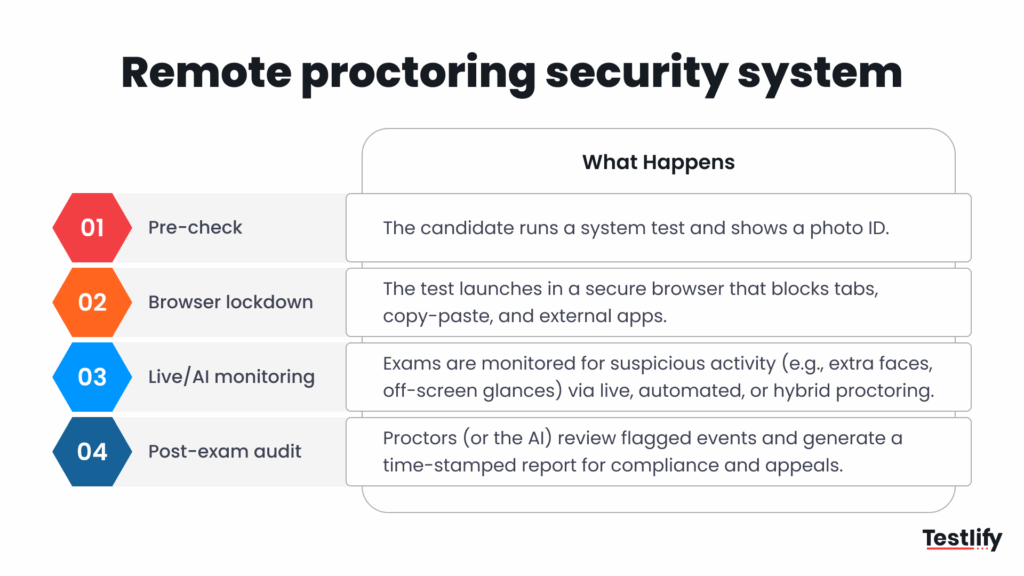
Testlify incorporates all four layers directly into the assessment flow without requiring a separate proctoring tool. The exam begins, identity is confirmed, webcam and secondary camera scan the environment, and the AI engine records behavior throughout the session.
1. Pre-check: “Are you who you say you are?”
When a candidate clicks Start, Testlify runs a device compatibility check to confirm the test environment will not fail mid-exam. The candidate then confirms their identity through photo-ID submission followed by live face recognition matched against the submitted image.
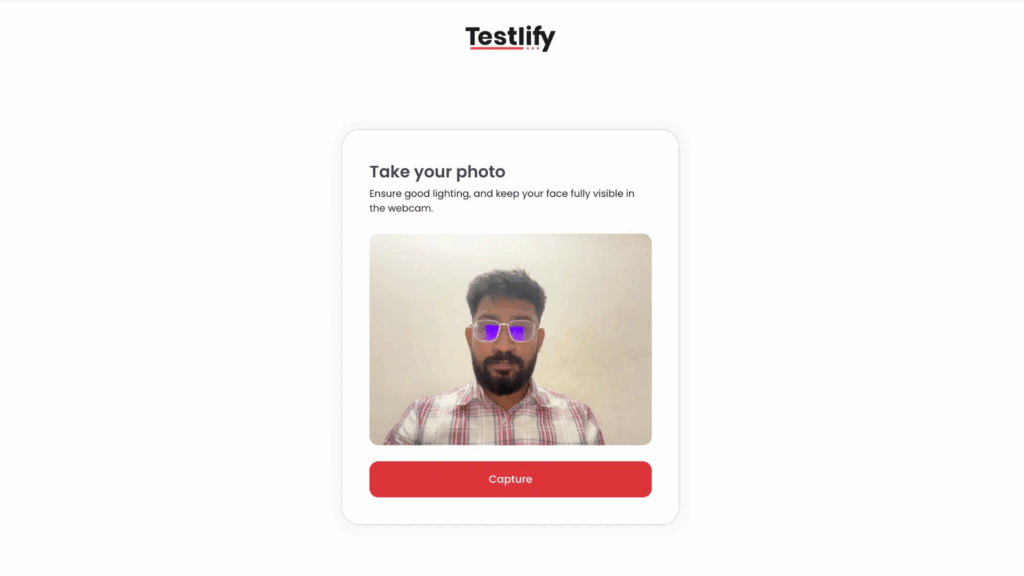
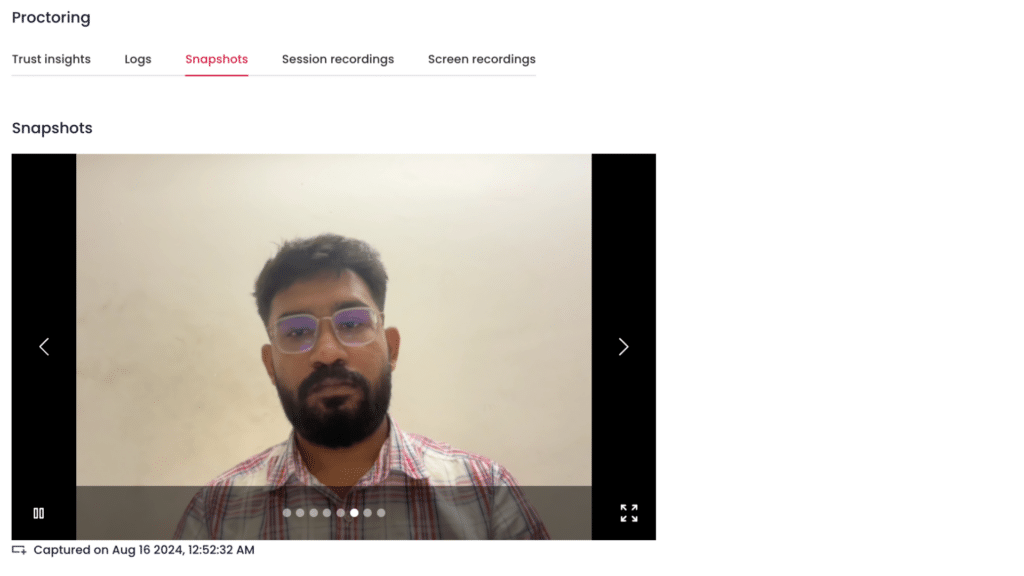
Face detection and snapshot proctoring capture time-stamped photographs at regular intervals throughout the session. If a different face appears on camera or the candidate steps away, the system raises a flag automatically without requiring a manual reset from the recruiter.
2. Browser lockdown
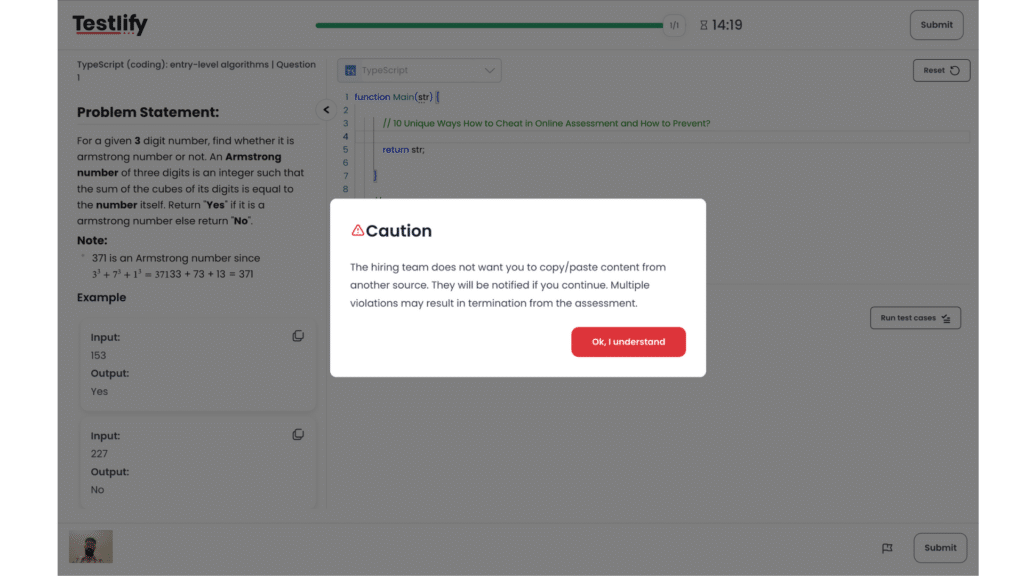
Once identity is confirmed, the screen enters mandatory full-screen mode and the lockdown browser activates. Tab proctoring and copy-paste tracking log every attempt to access another website, application, or clipboard resource from that point forward.
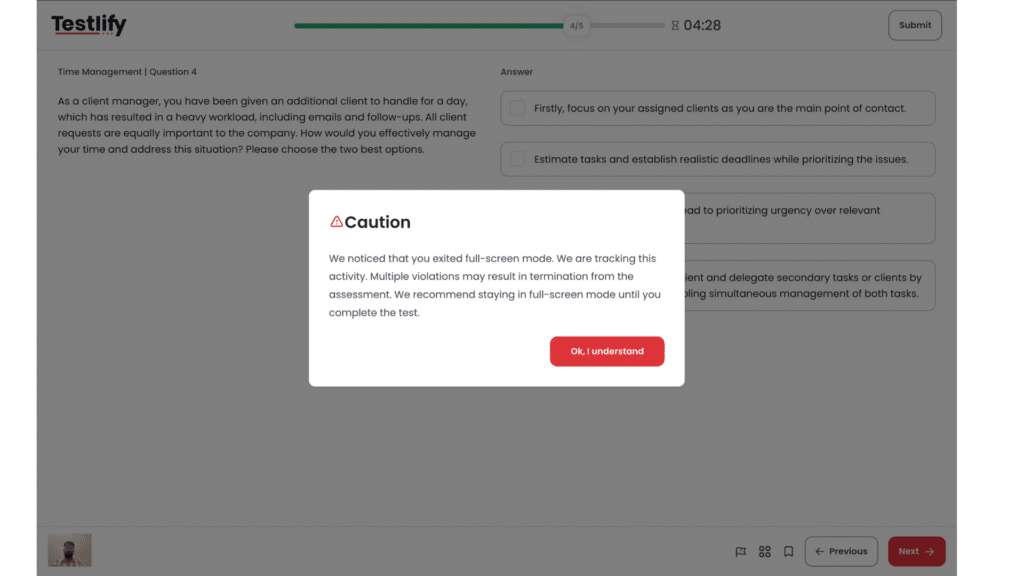
If a candidate exits full-screen during the test, a warning appears on screen immediately. Repeat violations accumulate against a configurable threshold set in Standard, Strict, or Custom mode, with the session suspended automatically when the defined limit is reached.
3. Live / AI monitoring
The AI proctoring engine monitors behavior throughout the session, flagging gaze direction, microphone activity, and typing patterns that deviate from the baseline established at session start. Each flag is timestamped and linked to the specific question the candidate was answering at that moment.
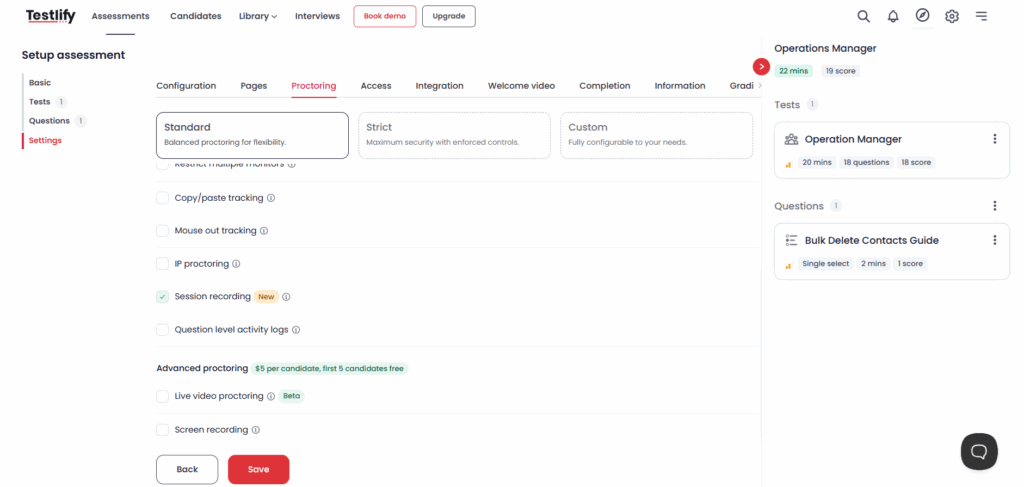
When a human proctor is required, dual-camera proctoring provides a full room view through both the laptop camera and a secondary phone camera simultaneously. Screen sharing and session recording capture all on-screen activity for post-exam review without any additional setup from the candidate.
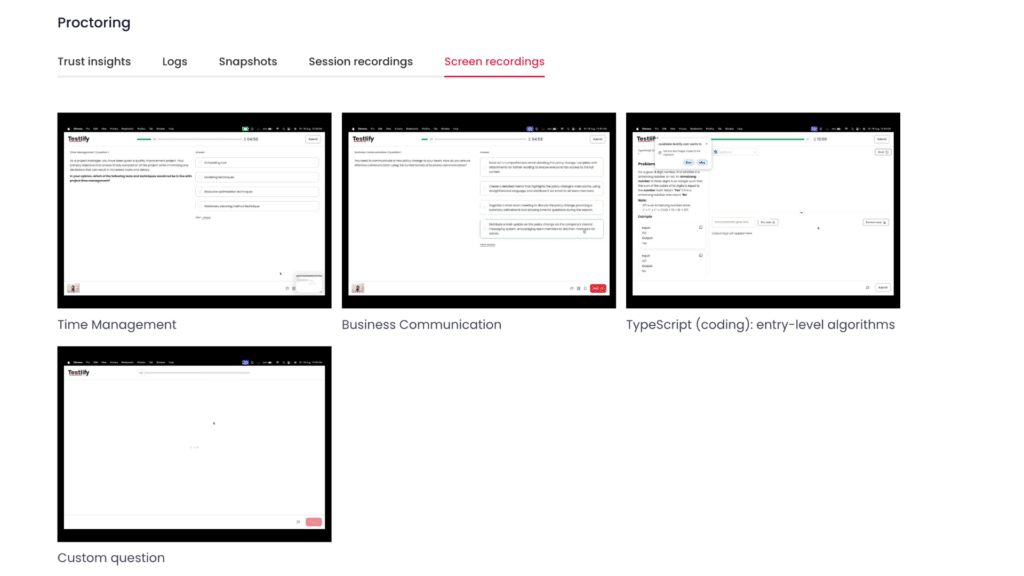
Live proctoring lets a single proctor monitor multiple sessions simultaneously, stepping in only when the AI raises a flag that warrants direct human judgment. This model reduces the proctor-to-candidate ratio significantly compared to in-person invigilation at equivalent security levels.
4. Post-exam audit
When the exam timer ends, the recruiter dashboard surfaces question-level activity logs, IP addresses, and video clips timestamped to the exact moments a tab switch or second face appeared on camera. Each flagged event is linked to the specific question in progress at the time it occurred.
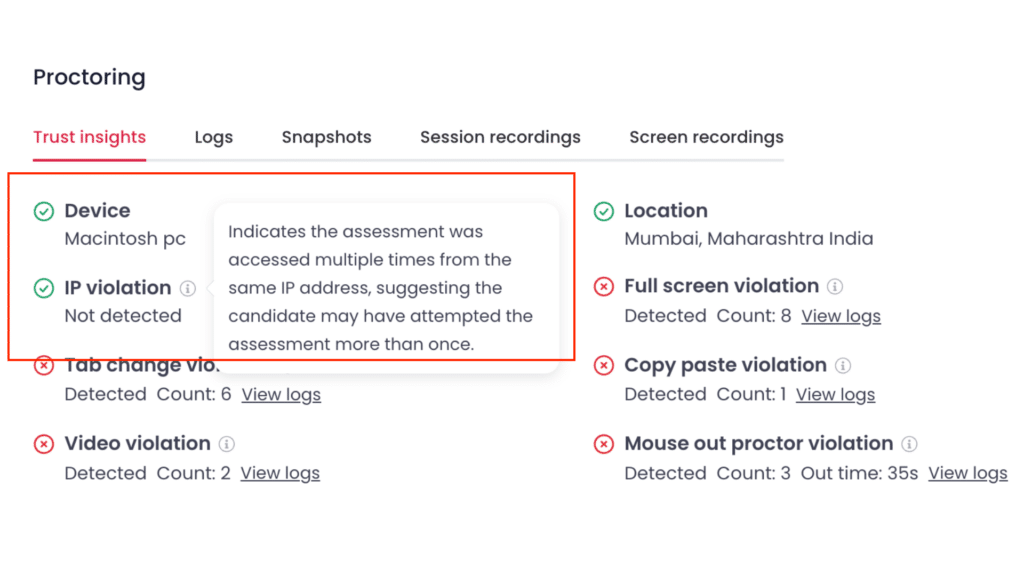
All flagged evidence is compiled into a single incident report within the dashboard. No separate file downloads or manual log searches are required to review a session, investigate a specific flag, or present evidence to a review committee.
Types of remote proctoring
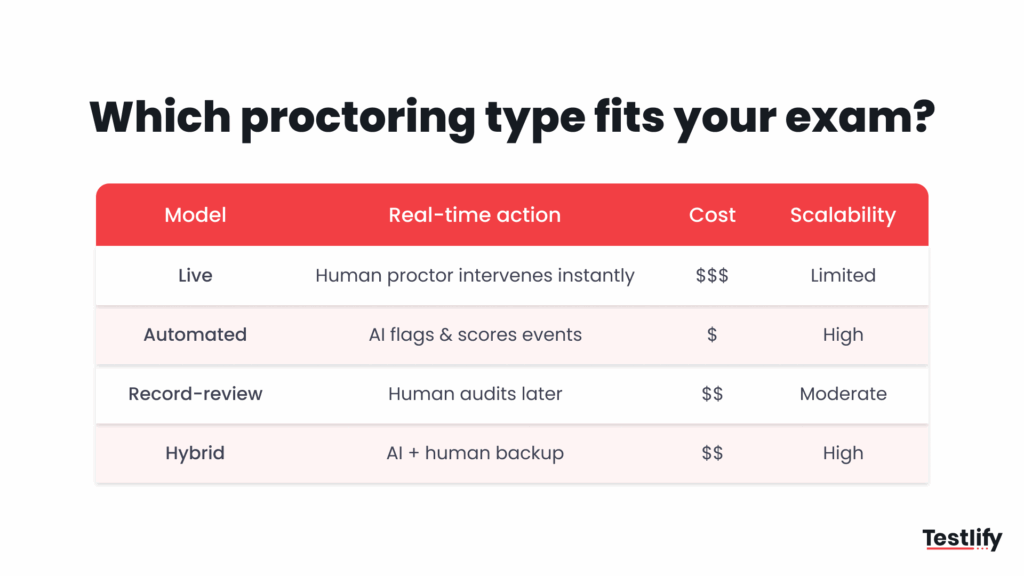
Four proctoring models exist, each calibrated to a different balance of oversight intensity, cost, and scale. The right choice depends on the stakes of the exam and the operational resources available to the assessment team.
1. Live proctoring
A human proctor observes the session in real time through webcam and shared screen, with the ability to flag misconduct, pause the test, or communicate directly with the candidate. This model works best for oral components, high-stakes professional exams, or small cohorts where a personalized level of oversight is a requirement.
2. Automated proctoring
AI handles all exam monitoring: browser lockdown enforcement, gaze tracking, and facial recognition checks run continuously without a human watching live. Only flagged clips are reviewed by human proctors afterward, making this model viable for large certification programs or corporate upskilling initiatives where session volume exceeds what live oversight can cover at reasonable cost.
Automated proctoring accounts for approximately 40% of the online proctoring market in the United States, per 2024 industry data. It is the default choice for organizations running hundreds or thousands of concurrent exam sessions where live oversight would not be cost-effective at that scale.
3. Record and review
The platform records video, audio, and screen activity throughout the session, but no one watches in real time. Human reviewers audit the footage afterward at playback speeds of 5 to 10 times the original, making this model cost-effective for mid-stakes courses that still require human validation of suspicious behavior.
4. Hybrid (Live & AI)
AI flags suspicious behavior in real time while a human proctor monitors multiple feeds simultaneously, stepping in only when the AI identifies an event that warrants direct intervention. Testlify integrates this approach by combining dual-camera proctoring for full room coverage with instant risk scores, so a single proctor can oversee dozens of concurrent sessions without missing a flagged event.
Who uses remote proctoring and why?
Remote exam invigilation has expanded well beyond the university setting. Six distinct groups now rely on it to meet the security and scale requirements their assessment programs demand.
User Group | Why They Rely on Remote Proctoring |
|---|---|
Universities & Colleges | Maintain the degree value, as 65% of institutions now administer at least one major exam online. |
Professional Certification Bodies | Candidate demand for flexible testing increased remote sittings by 58% in IT, finance, and healthcare exams. |
Corporate L&D Teams | 48% of training programs assess staff skills remotely, reducing travel costs and accelerating results. |
Licensing & Government Boards | High-stakes credentials (such as nursing and law) require airtight test integrity across regions. |
EdTech & MOOC Platforms | Massive enrolments demand friction-free, 24/7 testing that scales on demand. |
Recruiters & Pre-Employment Testing | Tools like Testlify embed AI proctoring inside skills assessments, assuring fair scores before a hire. |
Each group shares three operational requirements regardless of context:
- Scalable security
- User-friendly technology
- Regulatory confidence
Around 45% of universities upgraded to AI-powered proctoring tools in 2024, and adoption among certification bodies and enterprise HR teams continues to grow at a similar rate. Secure proctoring is now standard infrastructure for any organization that issues grades, licenses, or employment decisions based on remote assessments.
Benefits of remote proctoring
Remote proctoring delivers six measurable benefits over traditional exam invigilation. Each one addresses a real operational cost or security gap, not a marginal convenience improvement.
- Stronger test integrity: Cheating rates drop from approximately 70% on unproctored exams to 15% when active proctoring is in place, per published research. AI flagging and browser lockdown close most vulnerabilities before answers can be shared or referenced during the session.
- Significant cost and time savings: Organizations skip venue rental, printed materials, and invigilator travel entirely. Candidates test on their own device, and administrators review flagged incidents from a single dashboard in a fraction of the time required for paper-based review.
- Unlimited scale:Automated proctoring lets one reviewer validate hundreds of concurrent sessions, a volume that would require dozens of in-person proctors at equivalent security coverage.
- Better candidate experience: 87% of students rated remote proctoring positively because it removed travel requirements and allowed them to test on a device they already know. Lower logistical stress typically produces stronger performance from candidates who are otherwise well-prepared.
- Faster, data-rich results: AI engines score behavior in real time, tagging suspicious eye movements, off-screen glances, and irregular typing patterns as they occur. Administrators receive time-stamped evidence and a full analytics summary within minutes of exam completion rather than waiting for manual review.
- Flexible, configurable security: Security settings are adjustable per exam type, from a standard configuration for low-stakes skill checks to strict enforcement for professional licensing assessments. GDPR-ready storage covers organizations operating across multiple jurisdictions without requiring separate compliance tooling for each region.
With these advantages, remote exam invigilation has moved from a pandemic contingency into a permanent operating model for institutions and organizations that assess candidates at any meaningful scale.
Key features to look for in a proctoring tool
Six features separate a dependable proctoring platform from one that creates more administrative overhead than it resolves. Testlify includes all six in its standard assessment flow without requiring separate tools or manual integrations.
(Testlify incorporates every capability listed below directly into its assessment flow, so there is no need to manage multiple tools or configure separate systems for each proctoring layer.)
1. Browser lockdown & smart screen sharing
- A lockdown browser blocks new tabs, copy-paste actions, and screen-capture tools from the moment the exam clock starts.
- Continuous screen sharing identifies unauthorized applications the moment they appear, not after the session ends.
2. Multi-layer identity verification
- Photo-ID submission and live facial recognition confirm the right candidate is at the keyboard before the exam begins.
- Snapshot proctoring re-checks identity automatically if the face disappears mid-test, without requiring a manual reset from the administrator.
3. AI & live proctoring working together
- AI proctoring flags gaze direction, muted microphones, and irregular typing patterns throughout the session without interrupting the candidate.
- A human proctor can step in via live proctoring only when the AI flags an event that requires direct intervention, keeping the proctor-to-candidate ratio manageable at scale.
4. Dual-camera & 360° environment scans
- A primary camera covers the screen-facing view while a secondary camera on a phone or tablet provides a wider room angle simultaneously.
- The wider view closes the gap when candidates attempt to reference materials or devices that fall outside the primary camera frame.
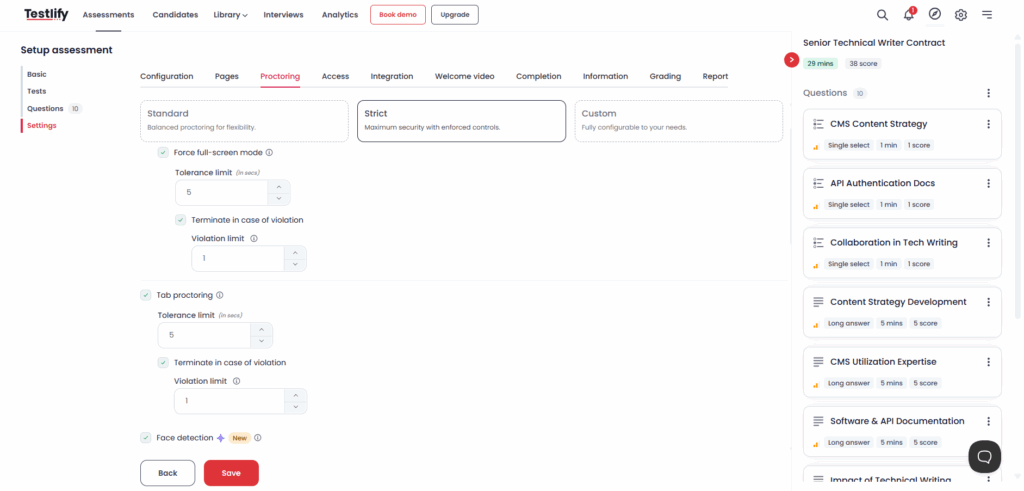
5. Configurable security modes
- Standard, Strict, or custom rule sets let assessment teams match the security level to the actual stakes of each exam type.
- A low-stakes coding quiz can run on automated settings while a licensure test uses full strict enforcement, with no separate platform setup required for each configuration.
An effective proctoring platform is invisible to candidates who are complying and precise only when a genuine violation occurs. Platforms that generate excessive false positives erode candidate trust without producing any measurable improvement in actual exam security.
Also Read: How proctored exams work and the best proctoring features from Testlify
Final thoughts
Remote proctoring has moved from a temporary workaround into standard assessment infrastructure for organizations that run exams at scale. Browser lockdown, real-time AI monitoring, and post-exam audit trails now deliver the same integrity guarantees as a physical examination hall, at a fraction of the logistical cost.
The organizations getting the most from remote proctoring in 2026 are those that calibrate security intensity to exam stakes rather than applying maximum settings across every test type. Testlify’s configurable modes, integrated AI monitoring, and human oversight layer allow that calibration without requiring a new system setup for each exam.
Book a no-strings demo to see Testlify’s integrated online proctoring suite in action and decide whether it fits the guardrail your next remote assessment needs.
Frequently asked questions (FAQs)

B2B SaaS Content Writer
Rishav Kumar is a B2B SaaS content writer with 4 years of experience. He loves crafting engaging content. Always exploring fresh ideas, he's passionate about helping businesses grow through impactful writing.
LinkedInRelated resources
View all
Proctoring
AI-powered proctoring: how it works and where it fits
Proctoring
What is automated proctoring? Explained simply

Proctoring
What is online proctoring? A simple guide
Proctoring
How to set up a proctored exam: A simple guide for secure online assessments
Proctoring
Online proctoring services compared: top 5 tools vs Testlify

Proctoring
Lockdown browser: Features, benefits & limitations
Get started.
Hire on proof, not resumes.
Run your first skills-based assessment free — no credit card required.