
Proctored Exams: How They Work and Key Proctoring Features
Learn how proctored exams work, the technology behind them, and the best proctoring features to maintain test integrity and prevent cheating.
Proctored exams are monitored assessments: software (or a live invigilator) watches the test-taker through their webcam, screen, and browser to confirm who is answering and that they are doing it without unauthorized help. For hiring teams, that monitoring is the difference between a score you can trust and one you cannot.
The pressure is real. In a 2025 Gartner survey of 3,000 job candidates, roughly 4 in 10 (39%) used AI somewhere in the application process, and 6% admitted to interview fraud, posing as someone else or having a stand-in take their place. Gartner expects that by 2028, 1 in 4 candidate profiles worldwide could be fake. Resumes are no safer either: in a 2024 survey of 9,133 US applicants, 63% of people who lied on a resume still received a job offer. When candidates can fake the inputs, a proctored skills test is one of the few signals left that actually holds up.
This guide explains what a proctored exam is, how proctoring works, and the proctoring features Testlify ships, from full-screen lockdown to AI assistance detection. If you want the wider context first, start with how online proctoring works.
 ChatGPT
 Gemini
 Claude
 Grok
Grok Perplexity
TL;DR
- A proctored exam verifies identity and monitors the webcam, screen, and browser so a test score reflects the real candidate’s own work.
- Proctoring matters more in 2026 because more candidates use AI and stand-ins, so unmonitored scores are easier to fake.
- Testlify groups its controls into five integrity layers: identity, environment, behavior, AI-assistance detection, and reviewable evidence.
- Three modes (Standard, Strict, Custom) let you match proctoring strictness to the role instead of over-policing every test.
- Flags are evidence for a human reviewer, not an automatic reject. People make the hiring call.

What is a proctored exam?
A proctored exam is a secure assessment that uses a human proctor, software, or both to monitor a test-taker and keep the testing environment fair. The system confirms the candidate’s identity, then watches for anything that breaks the rules: a second screen, a phone, a copied question, or another person in the room. The point is simple. Everyone sits the same test under the same conditions.
Online proctoring usually combines webcam monitoring, screen recording, and a secure browser such as Safe Exam Browser. Together those controls verify identity, enforce the rules, and flag behavior that needs a closer look, so the result is both accurate and defensible.
How do proctored exams work?
Proctored exams work in three steps: verify, monitor, review. First the candidate confirms their identity, often with a photo or ID check. During the test, the tool records the webcam, screen, and browser activity and watches for rule-breaking. After the test, recruiters review any flags in context and decide what they mean.
- Verify. Confirm the right person is taking the test before the first question loads.
- Monitor. Track the camera, screen, tabs, and copy or paste actions while the test runs.
- Review. Surface flagged moments to a human, who reads them in context, not as a verdict.
Some setups lean on automated software, some on a live person, and many blend the two. For a side-by-side of the trade-offs, see human and AI proctoring and the full breakdown of types of online exam proctoring.
Why do proctored exams matter for hiring?
Proctored exams matter because a hiring decision is only as good as the evidence behind it. If a candidate can quietly paste an answer from a chatbot or hand the test to a friend, the score tells you nothing about them. Proctoring protects the one thing assessments are supposed to give you: a true read on what this person can do.
This is where the Testlify Assessment Integrity Framework comes in. It treats integrity as five layers working together, identity assurance, environment control, behavior monitoring, AI assistance detection, and reviewable evidence, with strictness you can dial up or down per role. The framework is deliberately human-led: the tooling gathers evidence, but a recruiter or hiring manager makes the call. Testlify does not auto-reject candidates, and a flag is never proof of cheating on its own.
Pro tip: Match the level of proctoring to the importance of the assessment. Use lighter monitoring for early-stage screening and stricter proctoring for high-stakes or final-round evaluations. This reduces candidate friction while maintaining assessment integrity.
What are the key proctoring features?
Testlify ships proctoring as 19 configurable controls, not a single on/off switch. The table below maps each feature to the integrity layer it serves and the risk it reduces. Detailed notes and screenshots follow.
Feature | Integrity layer | What it reduces |
|---|---|---|
Face detection and snapshots | Identity | Impersonation, stand-ins |
Full-screen and tab proctoring | Environment | Tab-switching to outside help |
Copy and paste tracking | Environment | Pasting answers from external sources |
Restrict multiple monitors | Environment | Hidden second screens |
Webcam monitoring | Identity | Unauthorized assistance during the assessment |
Browser lockdown | Environment | Opening unauthorized applications or websites during the test |
Question randomization | Assessment design | Answer sharing between candidates |
IP and mouse-out tracking | Behavior | Location spoofing, leaving the assessment window |
Session and screen recording | Reviewable evidence | Disputes with no audit trail |
AI assistance detection | AI assistance | Unauthorized chatbot or AI tool usage |
Identity assurance
Face detection. Confirms a real human face is present throughout the test, not an empty chair or a swapped person.
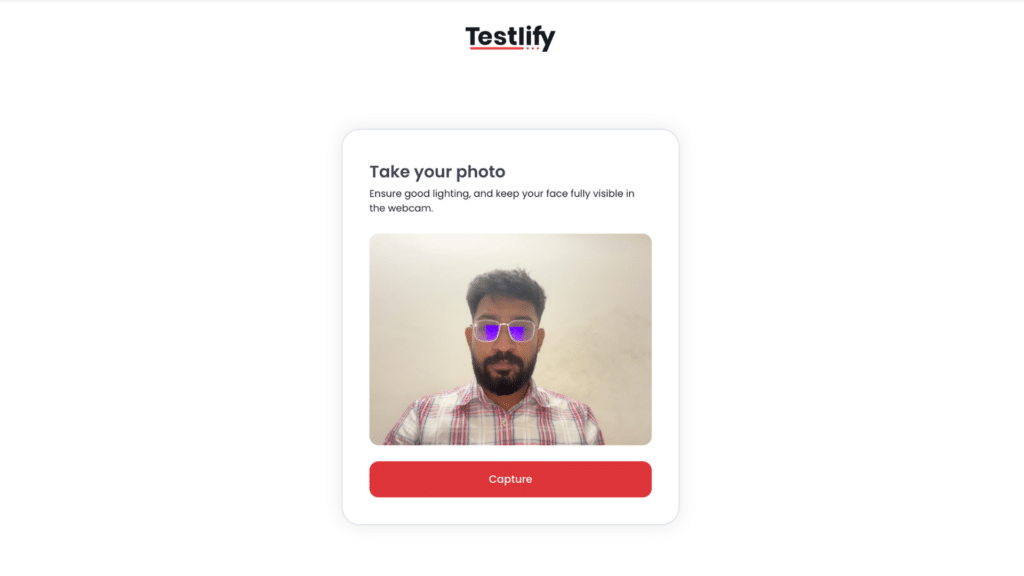
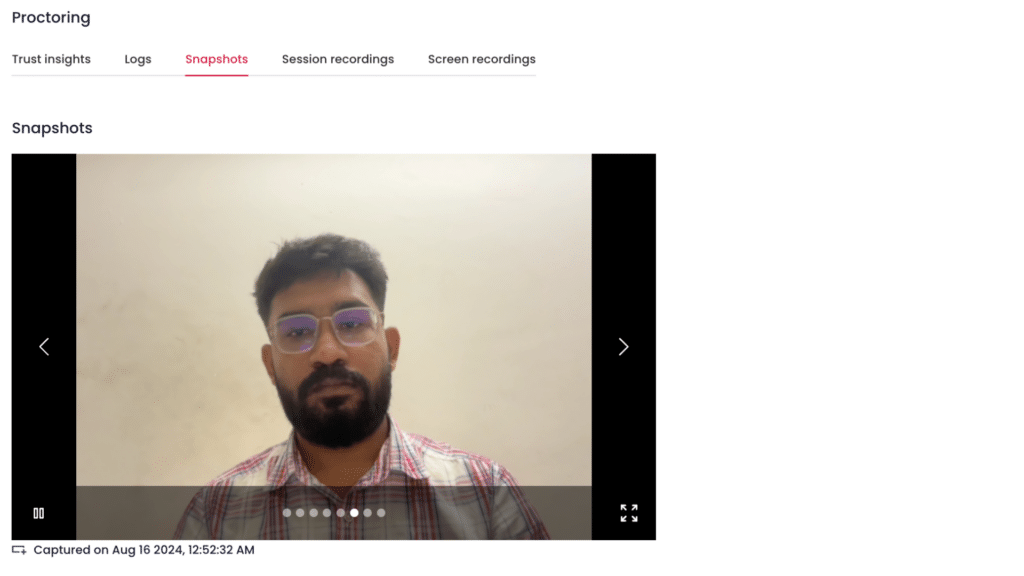
Snapshot proctoring. Captures periodic webcam stills so reviewers can confirm the same candidate stayed for the whole test.
Environment control
Full-screen mode. Forces the test into full screen so the candidate cannot quietly work in another window.
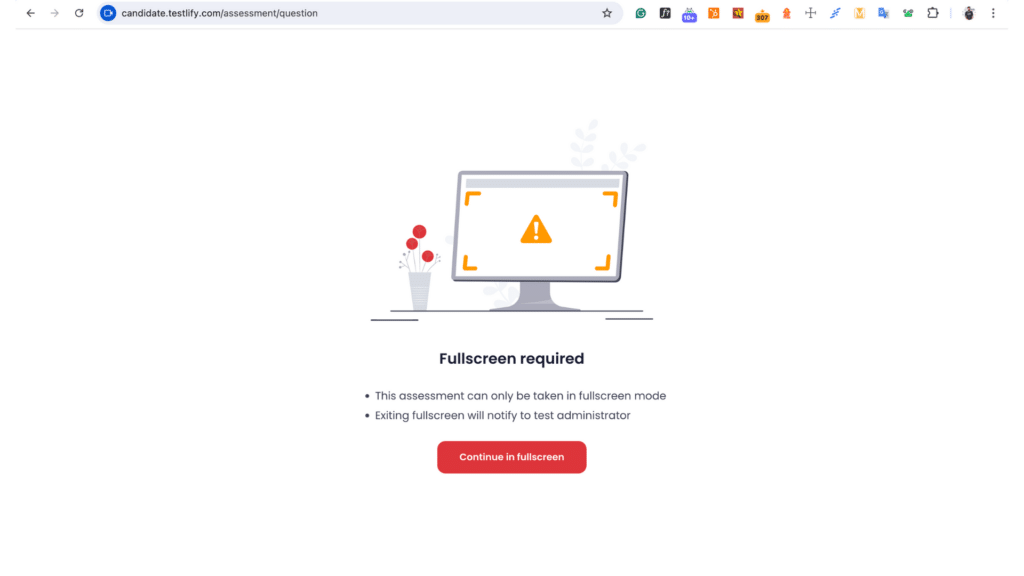
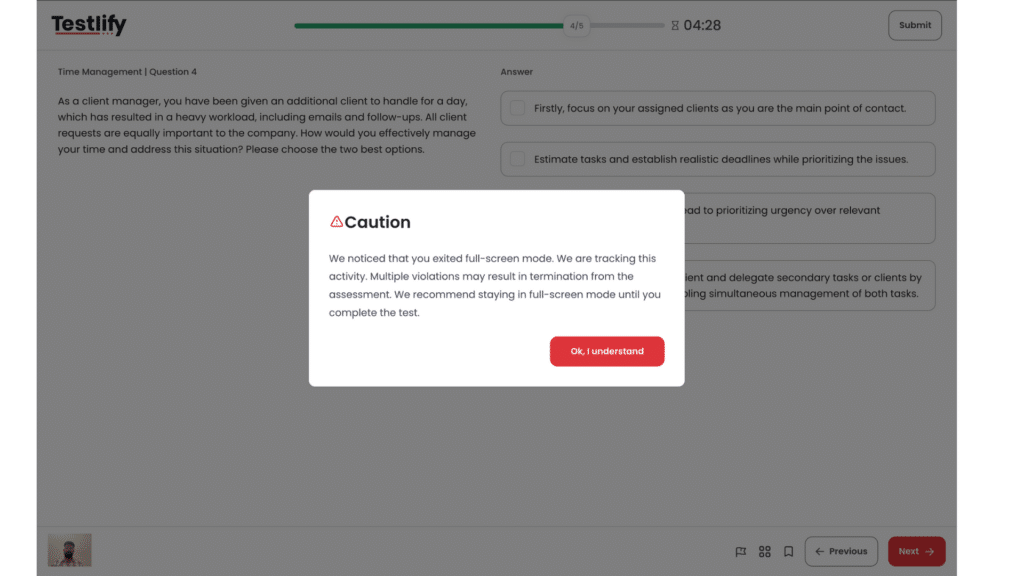
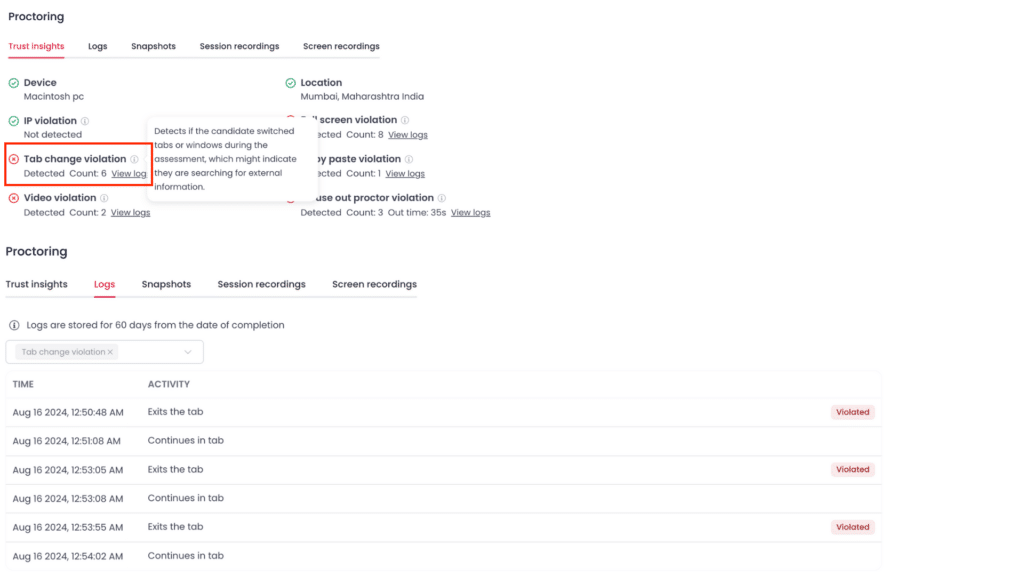
Tab proctoring. Logs every time the candidate leaves the test tab, a common tell for outside lookups.
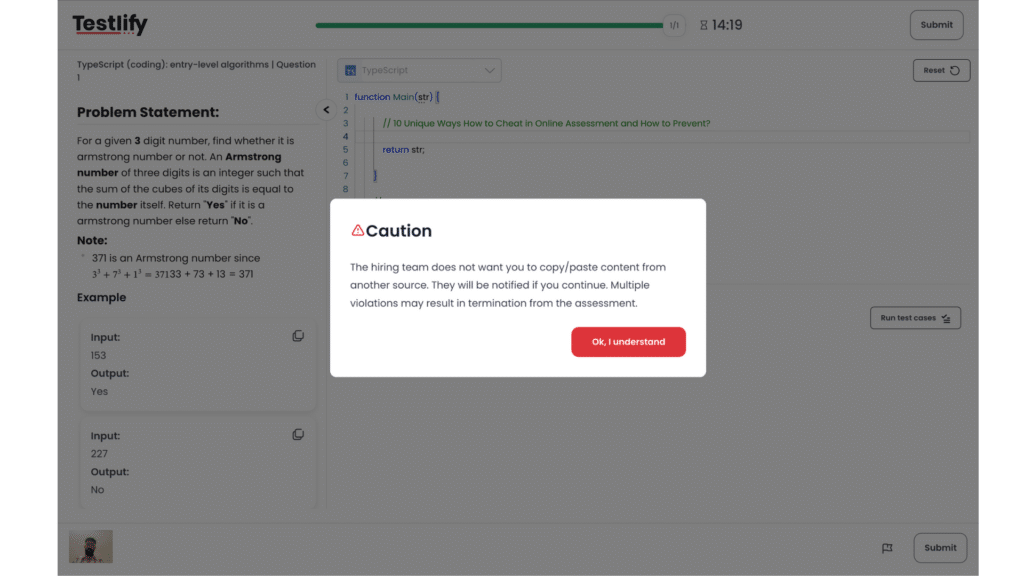
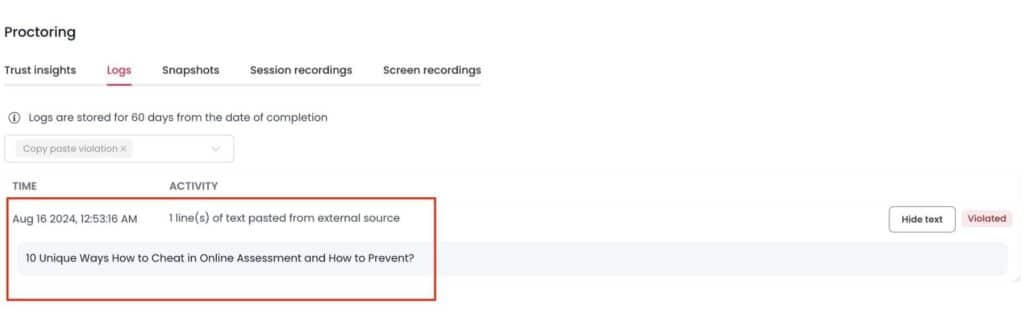
Copy and paste tracking. Records copy and paste actions so pasted answers from a chatbot or doc stand out.
Restrict multiple monitors. Detects and blocks extra displays that could hide notes or a second person feeding answers.
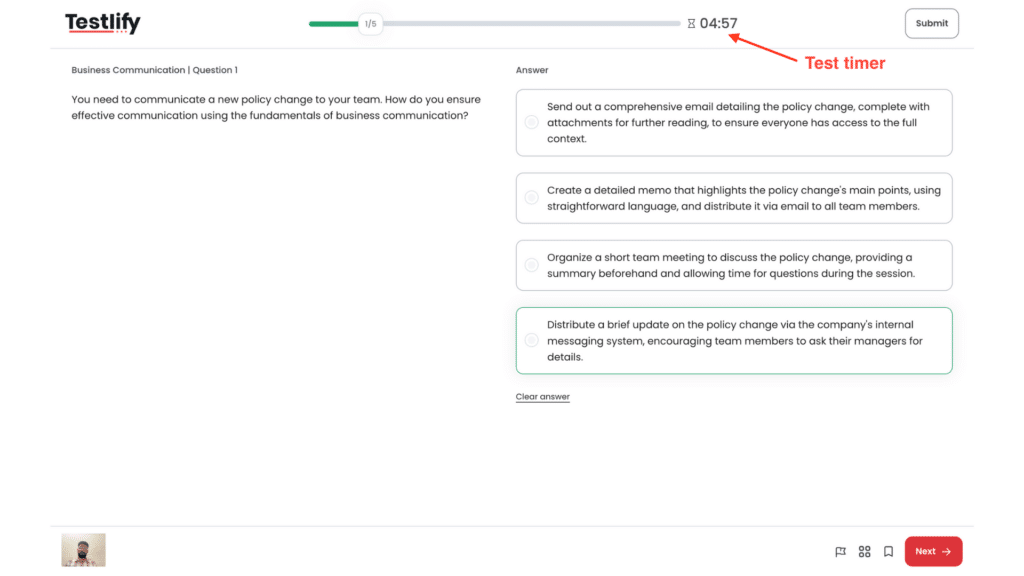
Timed tests. Caps the time per test, which limits how much a candidate can look things up mid-question.
Behavior monitoring
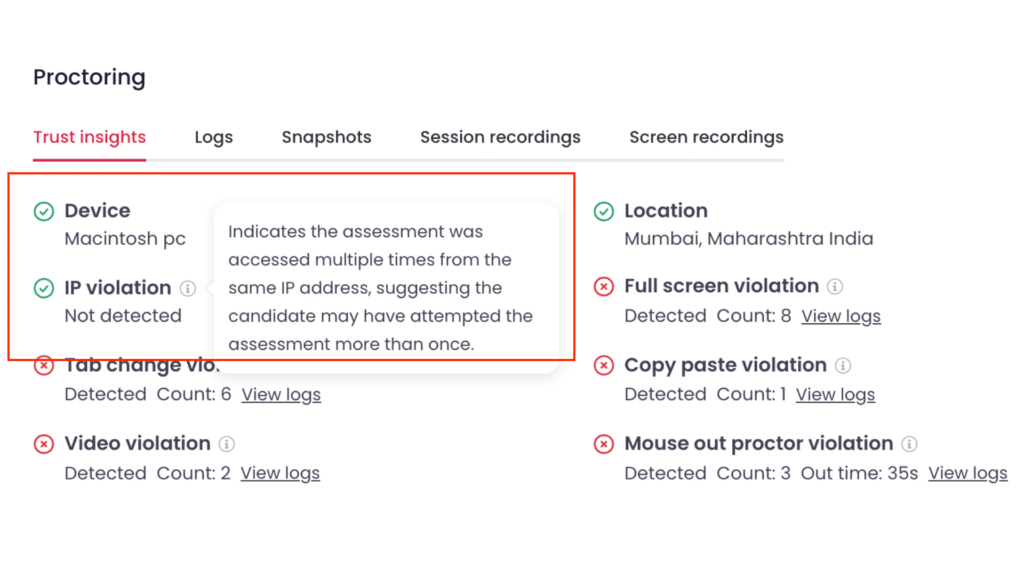
IP proctoring. Tracks the candidate’s IP so a test taken from an unexpected location gets a second look.
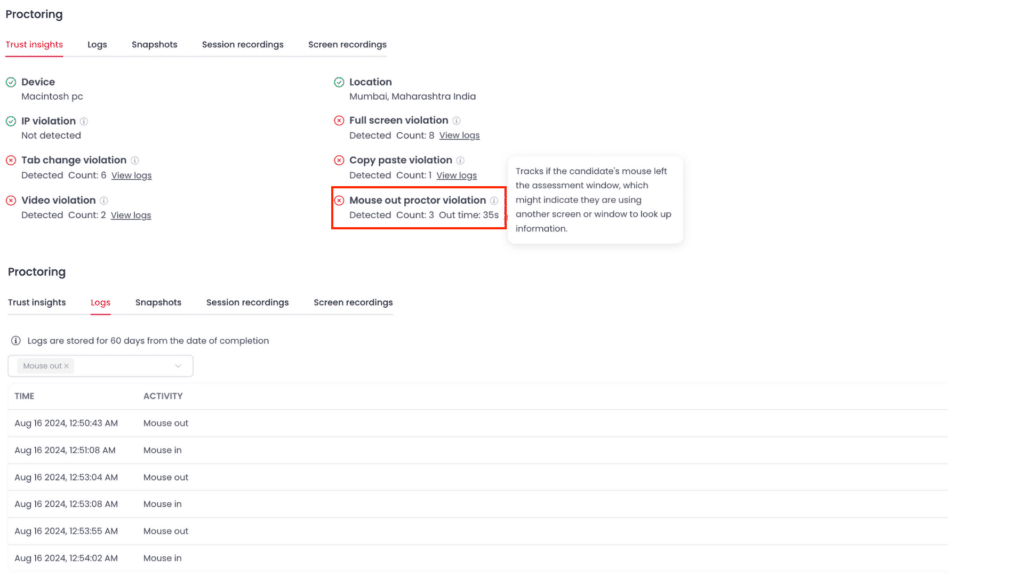
Mouse-out tracking. Flags when the cursor leaves the test window, often paired with tab switches.
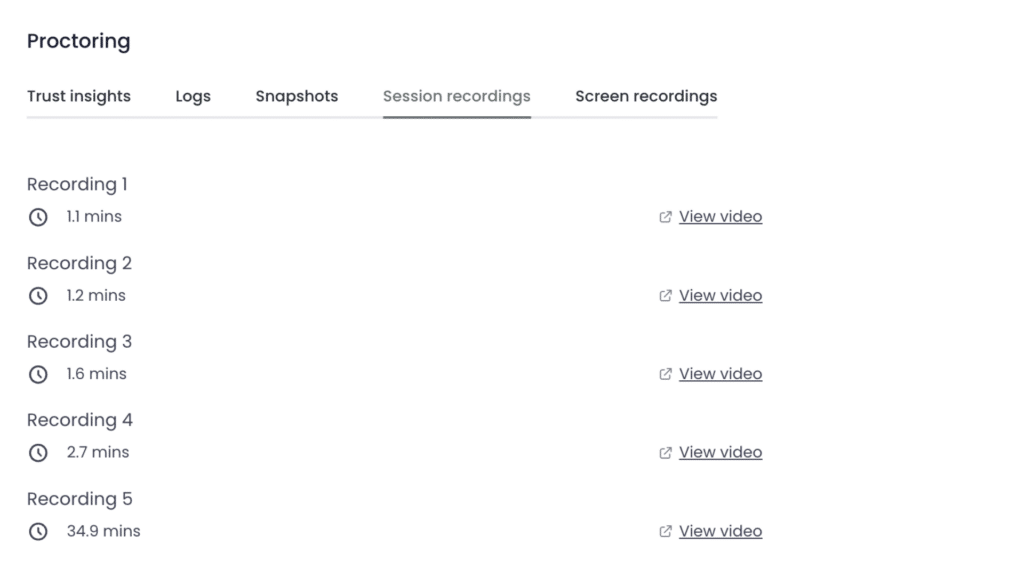
Session recording. Records the full session as a reviewable timeline for any later dispute.
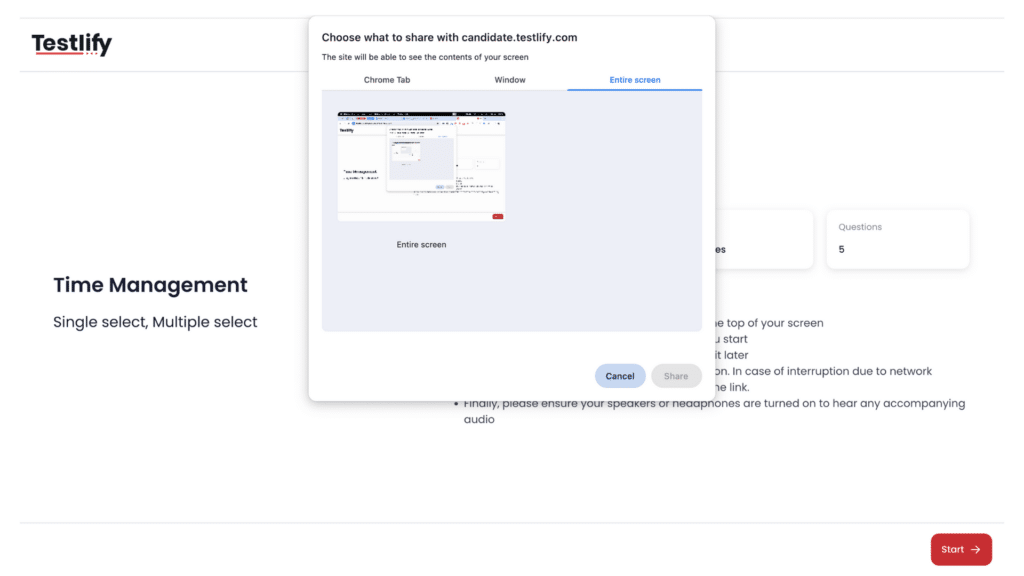
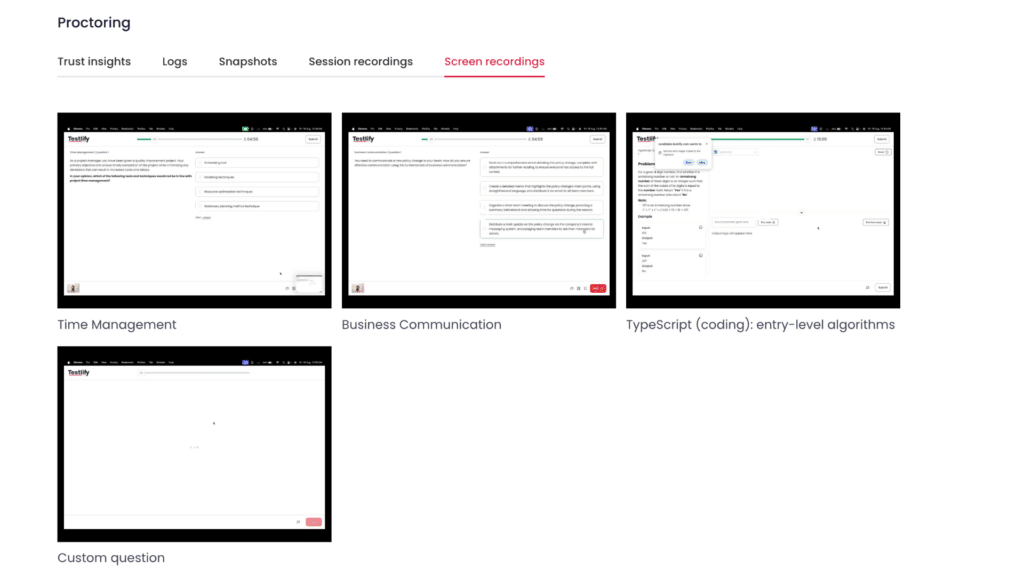
Screen recording: Captures on-screen activity so reviewers see exactly what the candidate did, not just that something happened.
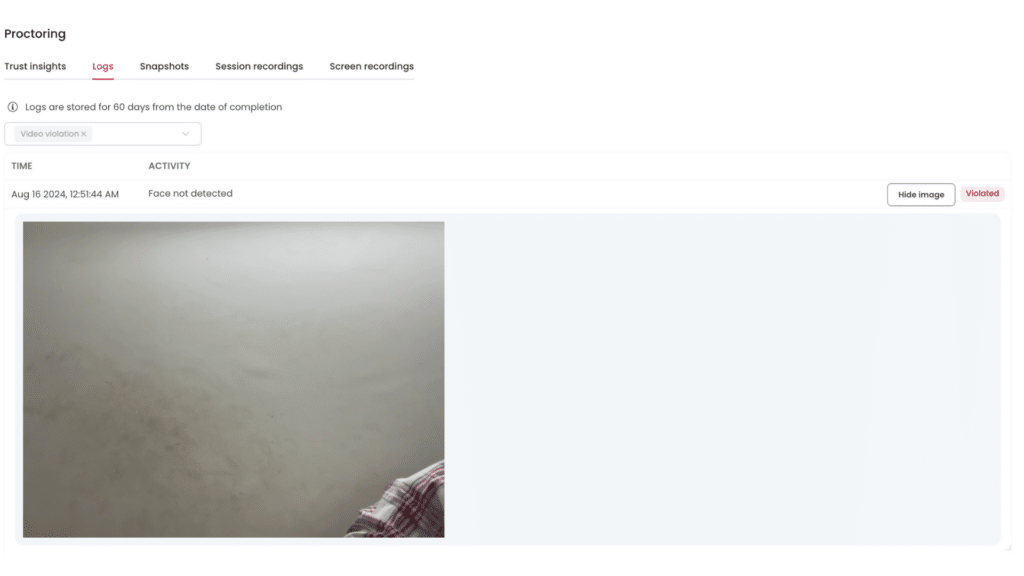
Video violation: Bundles webcam and on-screen flags into clear, reviewable clips instead of raw footage.
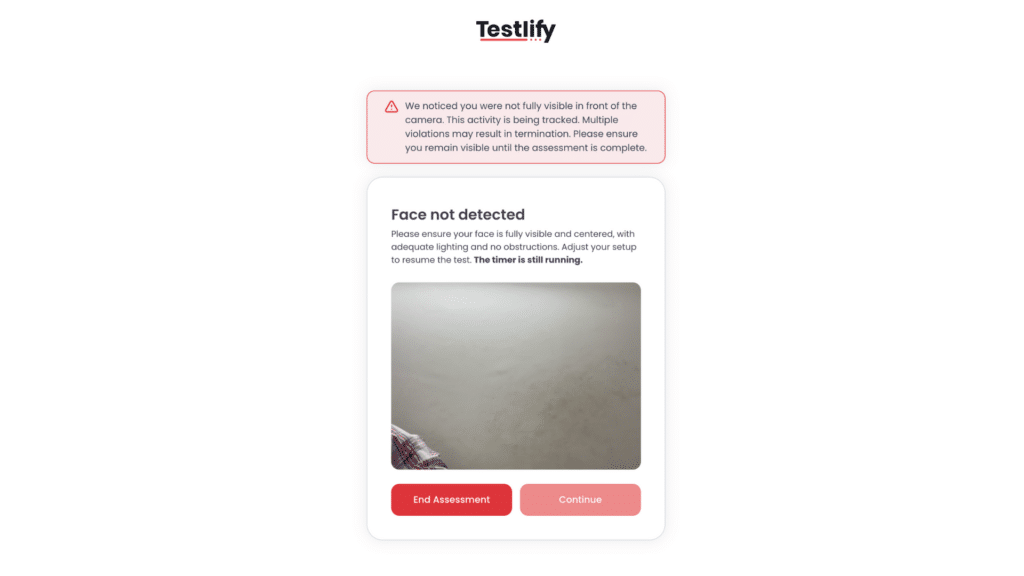
AI assistance detection and other controls
Beyond the controls above, Testlify adds AI assistance detection to flag likely unauthorized chatbot use, dual-camera proctoring (laptop plus phone) for a wider view of the room, question-level activity logs, random question shuffling so no two candidates see the same order, logout on environment exit, and study prevention. Live video proctoring is available in beta for teams that want a human watching in real time.
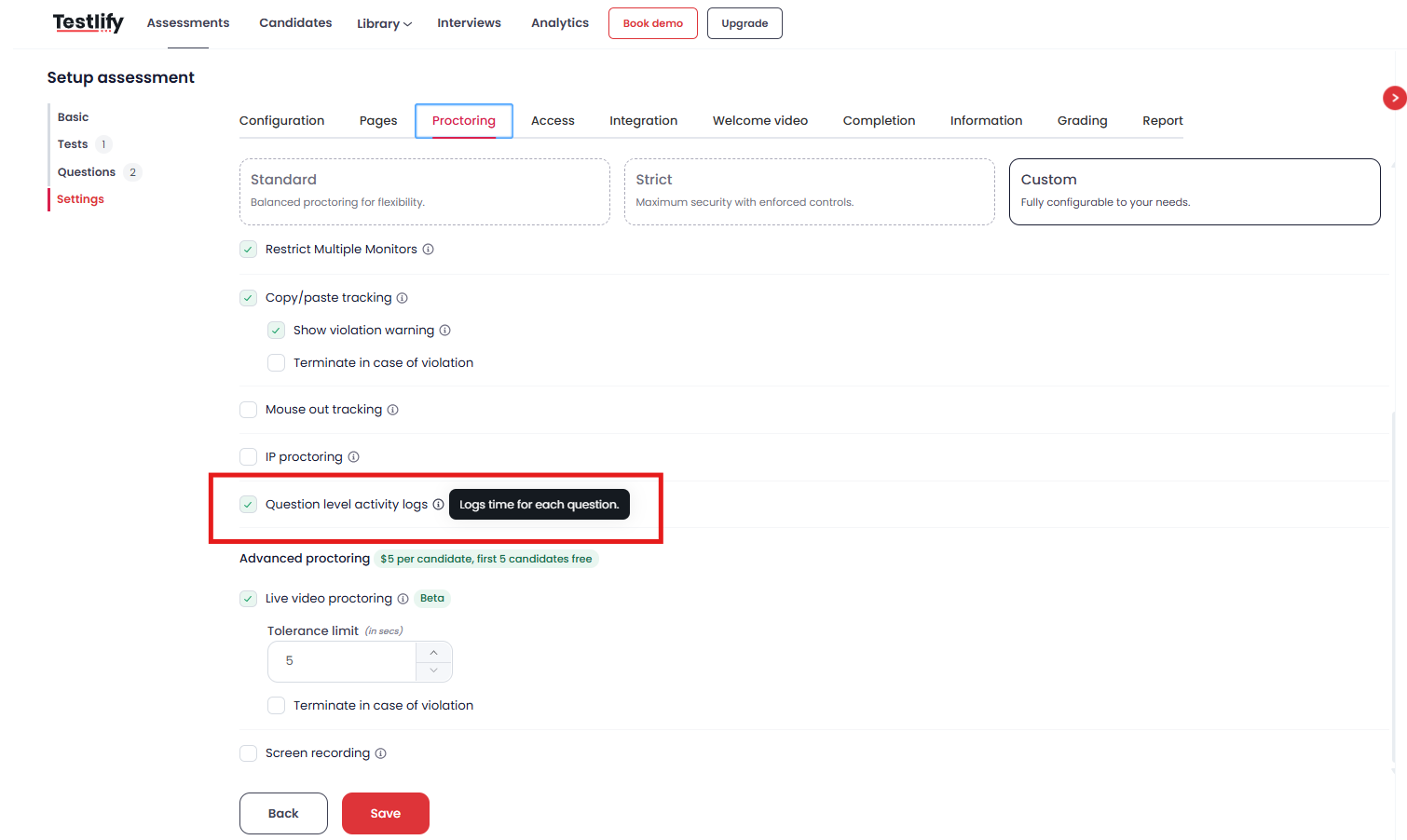
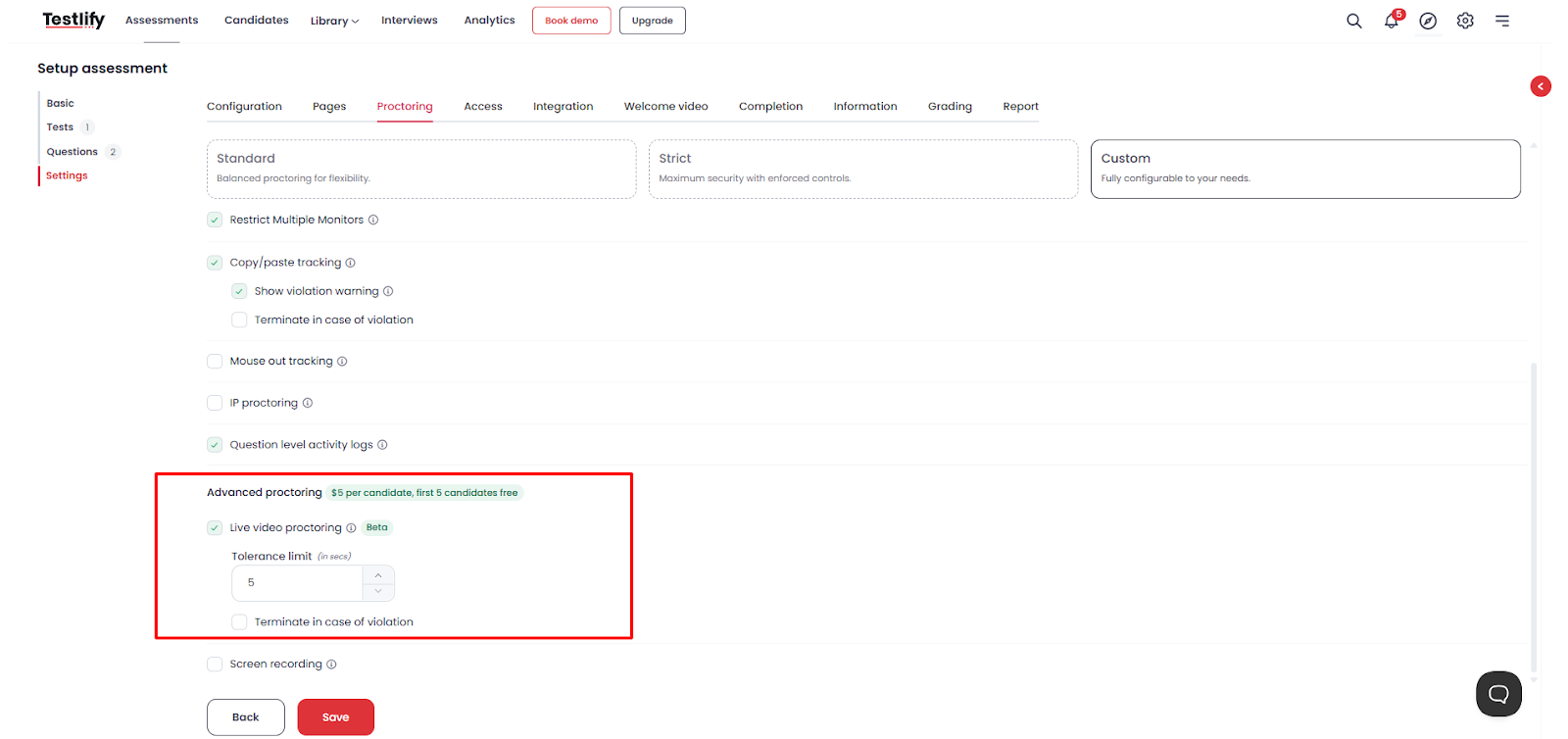
All of these comply with EEOC guidance on fair, non-discriminatory testing, and they sit alongside Testlify’s wider anti-cheating controls.
What proctoring modes does Testlify offer?
Testlify offers three proctoring modes so strictness fits the role, not a one-size policy. Standard balances monitoring with candidate comfort, Strict enforces the full set of controls, and Custom lets you pick exactly which signals run.
Mode | Best for | Common controls | How it behaves |
|---|---|---|---|
Standard | Early-stage screening, campus hiring, high-volume recruitment | Face detection, tab switching, copy/paste tracking | Balances assessment integrity with a smooth candidate experience. |
Strict | Final interviews, technical assessments, leadership or sensitive roles | Browser lockdown, multiple monitor restriction, screen recording, webcam monitoring | Applies stricter controls with minimal flexibility to reduce the risk of misconduct. |
Custom | Role-specific or compliance-driven assessments | User-selected combination of proctoring controls | Lets recruiters tailor proctoring settings based on the role, risk level, or assessment requirements. |
How do you choose the right proctoring level?
Choose your proctoring level by weighing the stakes of the role against the friction for the candidate. The higher the cost of a bad or faked result, the more controls are worth it. For a quick first-round screen, lighter monitoring keeps good candidates moving; for a final technical test, strict lockdown earns its keep.
- Map the risk: how damaging is a fake or assisted score for this specific role?
- Start light on early, high-volume steps and tighten as candidates advance.
- Tell candidates what is monitored and why. Transparency cuts anxiety and drop-off.
- Treat every flag as a prompt to review, never as an automatic rejection.
Key takeaways
- Proctoring protects decision quality. A score is only useful if it reflects the real candidate’s own work, so monitoring is what makes an assessment worth acting on. Skip it on a high-stakes role and you are hiring on data you cannot trust.
- The threat is growing, not shrinking. With about 4 in 10 candidates using AI in applications, 6% admitting interview fraud, and 63% of resume liars still landing offers, unmonitored tests get easier to game every year. That is why integrity controls belong on senior and remote assessments by default.
- Integrity is layered, not a single feature. Identity, environment, behavior, AI detection, and reviewable evidence each cover a different gap. Relying on one control (webcam alone, say) leaves the others wide open.
- Match strictness to stakes. Over-proctoring a first screen frustrates honest people and raises drop-off; under-proctoring a final round invites fraud. The right level is role-specific, which is why modes exist.
- Humans decide, tools inform. Every flag is evidence for a reviewer to read in context, not a verdict. Auto-rejecting on a flag is both unfair and legally risky, so keep a person in the loop.
- Transparency is part of integrity. Telling candidates what is monitored and why reduces anxiety, lowers abandonment, and makes your process defensible if a decision is ever questioned.
Frequently asked questions

Director of Marketing
Akash Patange is the Director of Marketing at Testlify, where he works closely with HR leaders and recruiters to help organizations improve hiring outcomes. He writes about talent assessment, recruitment technology, and data-driven hiring practices.
LinkedInRelated resources
View all
Candidate assessment
How to assess candidates for cultural fit within your organization?
Candidate assessment
How to use excel assessments to test virtual collaboration

Candidate assessment
How advanced excel assessments help you with hiring
Candidate assessment
Combining SJTs with other skills assessments for holistic hiring
Candidate assessment
How to adapt SJTs for global recruitment
Candidate assessment
How situational judgment tests eliminate hiring bias
Get started.
Hire on proof, not resumes.
Run your first skills-based assessment free — no credit card required.