
AI vs human proctoring: What works best?
AI vs human proctoring: learn the key differences, where each fits, and why hybrid proctoring often works best for online assessments.
AI vs human proctoring is not about picking one winner. It is about choosing the right setup for the assessment you are running. Some online tests need scale and consistency. Others need closer supervision and human judgment.
AI proctoring helps teams watch many sessions at once. It can flag suspicious activity in real time and keep the review process consistent. Human proctoring brings context. A human proctor can step in, ask for a check, and decide whether a flag points to real misconduct or a harmless issue.
In many cases, the best choice is a mix of both. This guide breaks down how each model works, where it fits, and how to choose the right one for your needs.
 ChatGPT
 Gemini
 Claude
 Grok
Grok Perplexity
TL;DR – Key takeaways
- AI proctoring is useful when you need to monitor many candidates quickly and consistently.
- Human proctoring is better when the exam is high stakes and needs live judgment or intervention.
- AI flags can help spot risk, but they should not be treated as final proof on their own.
- Hybrid proctoring works well when you need both scale and fair human review.
- The best proctoring setup depends on the stakes, candidate volume, and level of oversight you need.

What is AI proctoring?
AI proctoring is software-led monitoring for remote exams and online assessments. Instead of a human watching every session live, the system checks identity, tracks browser and screen behavior, records key evidence, and flags moments that look unusual. That can include tab switching, extra faces in frame, phone use, or repeated off-screen looking.
The real value of AI proctoring is speed and coverage. It can watch many sessions at once and surface risky moments faster than a manual review process.
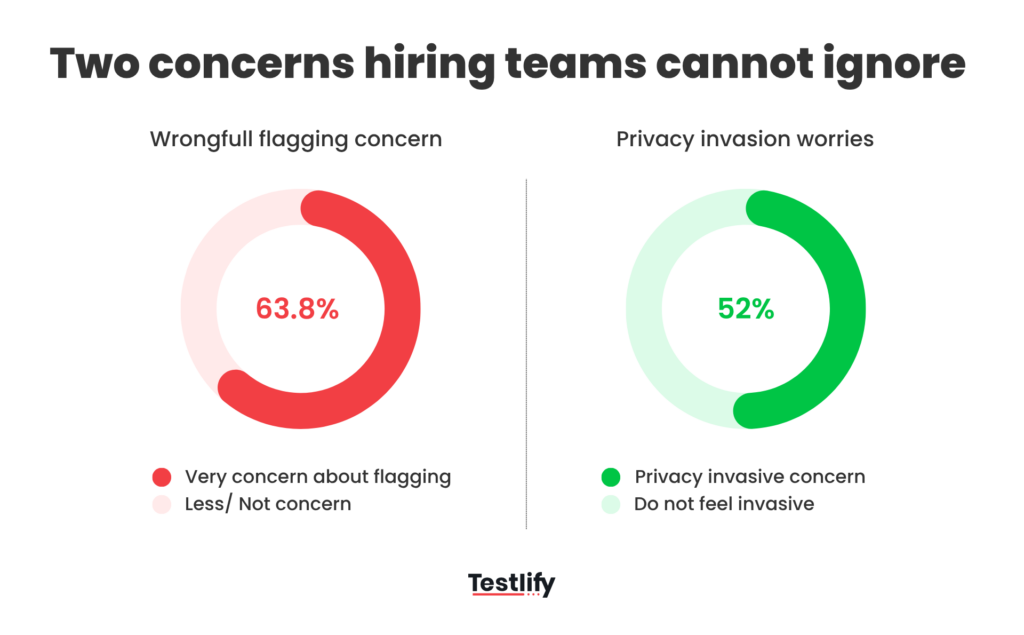
But it should not be treated like an automatic verdict. One 2023 study found that 68.3% of students were very concerned about being wrongfully flagged by proctoring software, which is exactly why AI flags need review and context.
Advantages of AI proctoring
AI proctoring helps most when hiring teams go for volume hiring. It is especially useful for remote hiring, campus drives, and other online assessments where many people may be testing across different locations.
- It scales well: Teams can monitor many sessions without assigning a live proctor to each one.
- It keeps rule checks more consistent: The same monitoring logic runs across all candidates.
- It flags issues in real time: Suspicious activity can be logged as it happens, not only after the test ends.
- It makes review faster: Instead of watching full recordings, reviewers can jump to flagged moments.
- It creates a usable trail: Screen logs, webcam clips, and time-stamped events make later review easier.
Limitations of AI proctoring
AI proctoring is useful, but it has limits that matter. Software can spot patterns, but it cannot always understand context. A candidate looking away for a moment may be distracted, not cheating. A weak internet connection may look suspicious when it is just a technical issue.
Privacy is another reason teams need to be careful. In one survey, 52% of students said online proctoring felt too privacy invasive. That does not mean AI proctoring should be avoided. It means the setup has to be explained clearly, matched to the stakes of the exam, and backed by fair review.
- It can create false positives: Normal behavior can still get flagged as suspicious.
- It lacks human judgment: Software can detect patterns, but it cannot judge intent well on its own.
- It depends on the setup: Poor lighting, weak internet, or a bad camera angle can affect what the system sees.
- It can hurt candidate trust: If the rules feel too strict or unclear, the experience can feel unfair.
- It is weaker in live intervention: AI can flag a moment, but it cannot handle a situation like a human proctor can.
What is human proctoring?
Human proctoring means a real person supervises the assessment instead of leaving the session entirely to software. In a live setup, the proctor watches the candidate during the exam and can step in if something looks wrong. They may ask for a room scan, warn the candidate, pause the session, or end it based on the rules in place.
What makes human proctoring different is not just live presence. It is human judgment. A person can read context, ask follow-up questions, and decide whether unusual behavior points to real misconduct or something harmless. That is why, even in modern remote testing, major providers still keep human review close to the center when serious decisions are involved.
Advantages of human proctoring
Human proctoring is strongest when the assessment needs closer oversight and a fair decision in the moment, not just a flag for later review.
- It adds context: A human proctor can tell the difference between suspicious behavior and a normal interruption.
- It allows live intervention: If something looks wrong, the proctor can respond right away.
- It works well for high-stakes exams: This matters when the cost of a bad decision is high.
- It supports fairer review: A person can weigh the full situation instead of relying only on rule-based alerts.
- It can improve trust in the outcome: When used well, human judgment can make the final decision easier to defend.
Limitations of human proctoring
Human proctoring is useful, but it is not the easiest model to run at scale. It asks for more time, more people, and more coordination.
- It is harder to scale: Monitoring every session live takes more operational effort.
- It can be expensive: More human involvement usually means higher delivery cost.
- It may be less consistent: Different proctors may not read the same situation in the same way.
- It can slow the process down: Scheduling, supervision, and review can add friction.
- It may feel more intrusive: Some candidates may feel more pressure when a person is watching live.
What is the real difference between AI flags and human judgment?
This is where the comparison becomes clear. AI proctoring and human proctoring do not do the same job. AI is better at watching many signals at once and applying the same rules across every session. Human review is better at understanding context, intent, and whether a flagged moment actually matters.
Factor | AI proctoring | Human proctoring |
|---|---|---|
Speed | Fast | Slower |
Scale | High | Limited |
Consistency | Strong | Varies by proctor |
Context | Limited | Strong |
Real-time intervention | Limited or rule-based | Strong |
False-positive handling | Needs review | Better judgment |
Cost and operations | Lower at scale | Higher |
AI can flag suspicious activities, but it cannot explain intent on its own. Human judgment is what turns those AI flags into a fair decision.
How should you choose between AI proctoring and human proctoring?
Choose between AI proctoring and human proctoring based on the risk and scale of the assessment. If you need to monitor many candidates across locations, AI proctoring is usually the better fit because it is faster and easier to scale. If the exam is high stakes and needs live judgment or human intervention, human proctoring makes more sense.
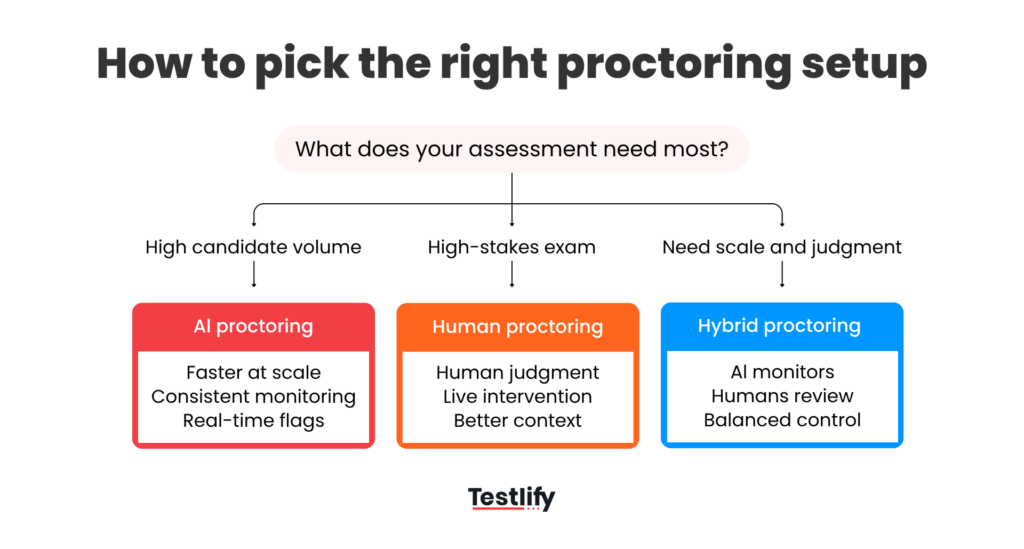
The best choice depends on how serious the decision is, how much oversight you need, and how much friction candidates can reasonably handle. If you need both, a hybrid often works best.
When is hybrid proctoring the better option?
Hybrid proctoring works best when you need both scale and judgment. AI can monitor sessions in real time, apply the same rules across candidates, and flag suspicious activity fast. Human reviewers can then step in where context matters.
Why do hybrid proctoring often work better than AI-only or human-only setups?
Hybrid proctoring solves the main weakness of both extremes. AI-only setups are faster, but they can create false positives or miss context. Human-only setups bring better judgment, but they are harder to scale. A hybrid model uses AI for coverage and people for fair review, which is often a better fit for mid to high-stakes online assessments.
- AI handles the routine monitoring: It can watch more sessions than a live team can.
- Humans review what matters most: Serious flags get context before action is taken.
- It scales better than live-only setups: Teams get wider coverage without fully giving up human oversight.
- It is fairer than automation alone: Reviewers can separate harmless behavior from real misconduct.
- It fits real hiring needs better: Many teams need speed and consistency, but not at the cost of judgment.
Final thoughts
There is no single winner in AI vs human proctoring. The right choice depends on the stakes of the assessment, the number of candidates, and how much human judgment the process needs.
For some teams, AI proctoring will be enough. For others, human review or a hybrid setup will be the better fit. What matters most is choosing a model that protects integrity without adding unnecessary friction. If you want a setup that gives you that flexibility, Book a demo today!
Frequently asked questions (FAQs)

B2B SaaS Content Writer
Rishav Kumar is a B2B SaaS content writer with 4 years of experience. He loves crafting engaging content. Always exploring fresh ideas, he's passionate about helping businesses grow through impactful writing.
LinkedInRelated resources
View all
Proctoring
AI Proctoring Solution: A 2026 Buyer Guide for Hiring Teams
Proctoring
What is proctoring-as-a-service, and how does it work
Proctoring
Types of online exam proctoring: Which one’s right for you?
Proctoring
Human proctors with AI alerts: Best of both sides?
Proctoring
What is live proctoring? Secure online exam guide
Proctoring
What is remote proctoring? Ultimate guide
Get started.
Hire on proof, not resumes.
Run your first skills-based assessment free — no credit card required.