
Pros and cons of pre-hire assessments
Pre-hire assessments can either save your hiring process or quietly break it. The difference lies in understanding their real pros and hidden cons.

Talent shortages are hitting hard. 69% of employers report difficulty finding qualified candidates.
At the same time, companies that make poor hiring choices lose an average of 30% of a salary on a bad hire, dramatically impacting productivity and costs. Hence relying on resume screening and unstructured interviews alone is no longer enough to identify the right talent.
Pre‑hire assessments help bridge this gap by objectively measuring skills that matter most for the role. This will be helpful only if you know the pros and cons of pre-hire assessments.
Validated assessments like cognitive ability tests, job simulations, and behavioral tests help hiring teams compare candidates using real data.
However, to utilize them effectively, it’s essential to understand both their benefits and limitations, as well as how to achieve the best results from them. Here are the top pros and cons of pre-employment testing.
 ChatGPT
 Gemini
 Claude
 Grok
Grok Perplexity
Why use pre-employment assessments: Pros
Pre-employment assessments allow recruiters to evaluate skills, aptitude, and behavior early in the funnel. This leads to better screening, fewer interviews, and stronger hires.
Below are the top benefits of online pre-hire testing.
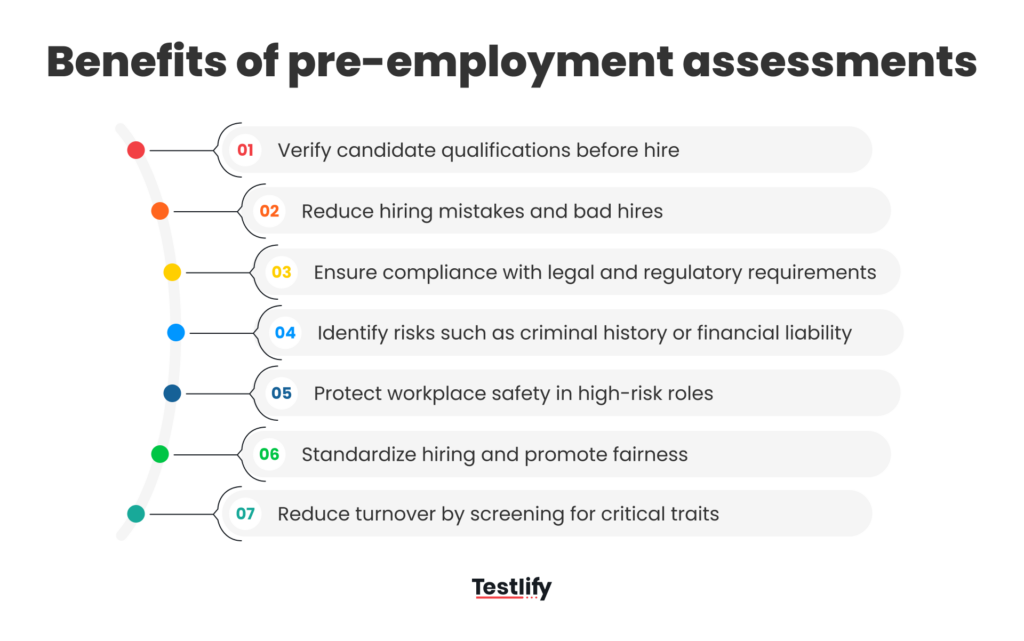
Tests are role-specific and predictive of job performance
Interviews can easily drift off-topic unless they’re carefully structured. Pre-employment tests, on the other hand, can be designed to focus only on what actually matters for success in the role.
Evidence-based assessments such as cognitive ability tests, work-sample tests, or validated personality tools like 16PF, offer far stronger links to on-the-job success.
When tests are aligned with real job requirements, they help companies hire based on capability, not charisma.
You can assess candidates more effectively using real-world simulation tasks, such as Chat simulations for sales, situational judgment tests for marketing or other roles, etc.
Objective tests rather than subjective
Resume screening, unstructured interviews, and pre-screening calls are often ineffective predictors of job performance. Mainly because hiring managers and recruiters usually judge candidates based on subjective correlations.
Hiring managers are human, and in the end, bias creeps into the hiring process, knowingly or unknowingly. A few well-known biases that occur during the hiring process are heuristics, cognitive biases, halo, and horn effects.
Such a route will only lead to subjective results rather than job-related ones. Pre-employment tests are well-designed, scientifically backed questionnaires that help you draw more objective conclusions based on candidates’ real skills.
Skills assessments help identify candidates’ knowledge and skills gaps and evaluate their hard and soft skills, supporting more data-backed decision-making.
Pre-employment assessments speed up the hiring process
When you’re hiring at scale, interviews become the biggest bottleneck. It’s simply not possible for recruiters to speak with hundreds, let alone thousands, of candidates in a short time. Pre-employment assessments remove that constraint entirely.
With online assessments, 2,000+ candidates can take the same test at the same time, from anywhere, without requiring recruiter involvement. Results are generated in real time, allowing hiring teams to see who meets the bar and who doesn’t instantly.
According to LinkedIn’s Global Talent Trends report, companies that use skills-based screening early in the funnel reduce time-to-hire by up to 40%.
This is especially important for global hiring teams. When you work with a pre-employment assessment provider that supports multiple languages, candidates can complete assessments in their preferred language.
That removes language barriers, improves candidate experience, and eliminates the need to manage separate tools or platforms for different regions.
Screen skills before you schedule interviews
Skills tests help recruiters evaluate job-relevant capabilities upfront before investing time in interviews.
Research shows that hiring managers typically spend 15–60 minutes per interview, with phone screens alone taking 15–30 minutes and in-person interviews often stretching to an hour.
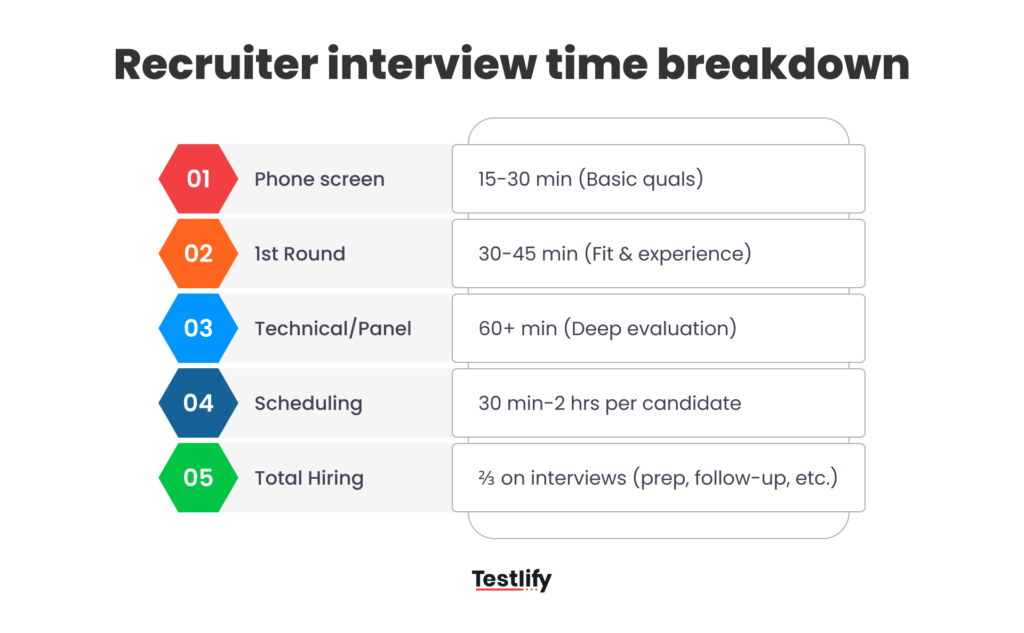
Using skills tests earlier in the process helps filter out unqualified candidates, so recruiters don’t waste hours interviewing people who aren’t the right fit.
Core areas such as job knowledge, problem-solving, written communication, reasoning ability, and technical skills can be accurately assessed through standardized tests.
This means recruiters aren’t spending hours interviewing candidates who look good on paper but lack the skills to do the job. SHRM research shows that early skills screening reduces late-stage rejections and significantly improves recruiter efficiency.
Same test questions for everyone
Different interviewers ask different questions, evaluate answers subjectively, and rely heavily on intuition rather than consistent criteria, making outcomes hard to compare and justify.
Google’s People Analytics research team has shown that unstructured interviews are significantly less predictive of job performance than structured, job-related assessments.
Pre-hire assessments, on the other hand, are standardized and administered uniformly to every candidate.
When they’re built around clearly defined, job-relevant skills, they measure what actually matters for performance, not how confident, articulate, or familiar a candidate is with interview norms.
In fact, a meta-analysis published in Personnel Psychology found that structured assessments are nearly twice as predictive of job success as unstructured interviews.
By applying the same criteria and giving every applicant the same opportunity to demonstrate capability, tests create a fairer, more defensible hiring process.
Pre-employment tests can save you hours of interviews
Trying to assess 15–20 different traits in a single interview is exhausting and unrealistic. Both candidates and interviewers end up drained, and important signals get missed. Pre-employment tests help you evaluate many of these traits upfront, before anyone hops on a call.
Job knowledge, in particular, is far more efficiently assessed through tests.
Skills such as typing speed, written communication, logical reasoning, and problem-solving can be measured accurately in a fraction of the time.
According to research by the Society for Human Resource Management (SHRM), companies that use skills-based assessments reduce time-to-hire by up to 30% while improving hiring quality.
Evaluate candidates faster and more fairly
This is by far the most important pros of having a pre-employment test in the recruiting process. Pre-hire tests allow you to screen candidates at scale without sacrificing fairness. This ensures that everyone gets the same questions, the same criteria, and the same opportunity to perform.
Modern pre-employment assessments like Testlify are built on validated research and designed to measure real job skills, not guesswork.
Studies published in Personnel Psychology show that structured assessments are nearly twice as predictive of job performance as unstructured interviews. This results in better hiring decisions, made faster, and backed by evidence rather than opinion.
Tests give you data you can actually rely on
Even experienced hiring managers aren’t immune to gut instinct. While intuition can feel reliable, it often carries unconscious bias, and it’s rarely defensible.
If a rejected candidate challenges a hiring decision, “it didn’t feel right” won’t hold up.
Tests, such as structured interviews, provide clear, measurable data to support your choices. They help you explain why a candidate moved forward or was rejected, using consistent and job-related evidence. This not only improves decision quality but also strengthens compliance and reduces legal risk.
Also read: Types of pre-hire testing

Cons of pre-employment assessments
There aren’t many disadvantages of pre-hire assessments; even the few that exist can be easily overcome strategically.
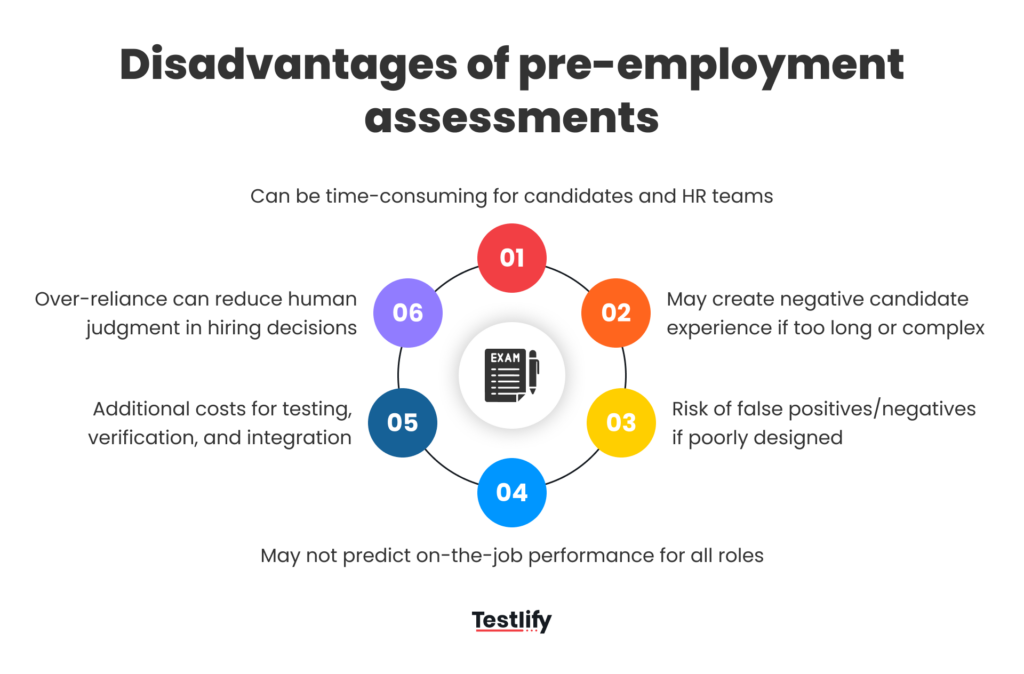
Using one skills test will not give you a full picture
This is probably the most commonly thought disadvantage of hiring assessments. Most tests are designed to measure a narrow set of traits at a time. A skills test might tell you what someone knows, but it won’t always show how quickly they can learn or adapt tomorrow.
This is why combining hard skills with soft skills evaluations, such as adaptability, willingness to learn, etc., is crucial.
To combat this issue, assess the technical and non-technical skills required to excel in the role. Make sure there is plenty of rest time in between, and the tests don’t run longer than 30-60 minutes.
How to overcome: Use a balanced assessment approach that combines technical and soft-skill tests in short, well-paced sessions to get a complete, job-relevant view of each candidate.
Discrepancy in compliance concerns
All pre-employment assessments must comply with applicable federal and state laws. Tests should align with Equal Employment Opportunity (EEO) standards and the Uniform Guidelines on Employee Selection Procedures (UGESP).
Employers that fail to ensure their assessment platforms meet these legal requirements risk facing discrimination claims and costly lawsuits.
How to overcome: Combat this by using only job-related, scientifically validated assessments from vendors that actively ensure compliance with federal and state hiring regulations.
Tests can still lead to discrimination if misused
People often assume tests are objective, but that doesn’t always mean they’re fair. When cognitive or knowledge tests don’t closely match the actual job, they can unfairly screen out candidates from underrepresented groups.
This isn’t just a theory; it has real consequences.
Dial Corp rolled out a strength test that dropped the percentage of women hired from 46% to 15%. The court ruled the test discriminatory and ordered the company to pay $3.4 million in damages, a decision later upheld by the Eighth Circuit Court of Appeals.
Courts and regulators are clear on this point: hiring tests must directly relate to the job and serve a real business need.
Some personality and physical ability tests cross legal lines when they measure traits that don’t actually affect job performance. When a test starts evaluating mental or physical characteristics rather than job skills, it quickly becomes a legal risk.
How to overcome: Use only job-related, validated assessments, regularly auditing the questions by SME, and removing any tests that aren’t clearly tied to real on-the-job performance.
Candidates don’t always answer honestly
Not all tests can be gamed, but some are easier to fake than others. Integrity, ethics, and personality tests are especially vulnerable to what psychologists call social desirability bias. People naturally want to present themselves in the best possible light, especially when a job is on the line.
Studies in the Journal of Applied Psychology show that candidates frequently adjust responses to match what they believe employers value.
For example, if extraversion or teamwork is seen as desirable, few candidates will openly rate themselves as introverted or socially reserved, even if that’s closer to the truth.
This doesn’t mean these tests are useless, but it does mean results should be interpreted carefully and never in isolation.
How to overcome: Combine multiple randomized assessment methods, use advanced proctoring and anti-cheating features, and validate results through structured interviews and real-world work simulations.
Some test results are hard to interpret
Some tests use vague or abstract questions that people interpret differently. For example, an integrity test might ask if someone agrees that “morality is important,” but candidates may interpret that very differently.
One person may think of honesty and fairness as matters of principle, while another may link them to religion or personal beliefs.
When questions leave room for interpretation, results become less reliable. Research from the American Psychological Association shows that unclear test questions reduce accuracy and make it harder to justify hiring decisions.
How to overcome: Use clearly defined, job-specific questions with standardized scoring, AI summaries, and real-time, validated global benchmarks.
So, are pre-hire assessments worth it?
Yes, pre-hire assessments or pre-employment tests definitely offer clear advantages, especially in today’s market where skills gaps and labor shortages are real challenges.
According to the World Economic Forum, nearly 44% of workers’ skills will be disrupted by 2027, making it harder to rely solely on resumes.
At the same time, employers aren’t just hiring for technical ability; soft skills matter more than ever. LinkedIn’s Global Talent Trends report shows that 92% of hiring professionals say soft skills are just as important, or more important, than hard skills.
The problem is that traditional resumes and interviews have limits. They’re subjective, inconsistent, and don’t reliably measure things like problem-solving, communication, or decision-making.
Pre-employment tests, on the other hand, are data-backed, scientifically validated, and proven to measure real job-relevant skills at scale. They also help reduce subconscious bias that can creep into resume screening or interviews.
Research from Harvard has shown that bias can influence hiring decisions even when candidates have identical qualifications.
For high-volume hiring, pre-hire assessments are especially powerful. They standardize questions, objectively evaluate every candidate, and show how different people approach the same problems.
So, there you have it. Now you know the pros and cons of pre-hire assessments, time to test them yourself. Try Testlify for free.
Or just book a quick 10 min demo, our team will help you navigate, answer all your questions, and explain why Testlify beats all other pre-hire tools.
Frequently asked questions (FAQs)

Related resources
View all
HR & recruitment
11 different types of pre-hire testing for screening
HR & recruitment
6 real soft skills case studies every HR leader should study
HR & recruitment
Top 13 types of hiring bias and how to avoid them

HR & recruitment
Cross-cultural recruiting strategies for remote teams
HR & recruitment
How recruiters can find top talent with skills-based hiring tools

HR & recruitment
Quiet firing: Signs it’s happening and how to prevent it
Get started.
Hire on proof, not resumes.
Run your first skills-based assessment free — no credit card required.