
11 different types of pre-hire testing for screening
Companies using pre-hire testing see up to a 74% boost in hiring efficiency and higher-quality hires compared to resumes and interviews alone.

Pre-hire testing is one of the simplest ways to filter out unqualified candidates before they reach the final stages of the hiring process.
Rather than relying solely on resumes or interviews, employers use pre-employment or pre-hire assessments to evaluate what candidates can actually do, including technical ability and job-relevant practical skills. This has become increasingly important, especially when 63% of employers say skill gaps are the biggest barrier to business success.
The challenge is only growing. By 2030, nearly 59% of the global workforce will need reskilling or training, and around 39% of skills are expected to become outdated or undergo significant transformation.
Understanding the different types of pre-hire testing can help employers make more informed hiring decisions.
 ChatGPT
 Gemini
 Claude
 Grok
Grok Perplexity
Why do companies use pre-employment assessments?
Pre-employment testing plays a critical role in modern hiring because it helps companies make better decisions earlier, when mistakes are cheaper and easier to correct.
Hiring is already an expensive and time-consuming process; SHRM estimates that the average cost per hire in the U.S. is around $4,700, and roles can remain open for 40-50 days or more, directly affecting productivity.
When organizations rely only on resumes and early interviews, hiring managers often spend this time evaluating candidates who look good on paper but lack job-ready skills.
Pre-hire assessment tests change that dynamic by introducing objective, role-specific data upfront, allowing teams to eliminate irrelevant candidates early and focus their time on applicants who are genuinely capable of performing the work.
Beyond speed and cost, testing matters because it improves decision quality and fairness at scale.
Research from the U.S. The Department of Labor shows that structured assessments can reduce hiring bias and increase workforce diversity by shifting decisions away from subjective impressions toward measurable performance indicators.

Are pre-hire assessments and pre-employment tests the same?
Pre-hire and pre-employment tests are the same, but the differences are mostly about timing and language, not function.
Pre-hire tests are assessments conducted at any point before a hiring decision is made, including early screening stages, to evaluate skills, behavior, or job readiness. The term is commonly used in modern, skills-based hiring conversations because it emphasizes decision-making before extending an offer.
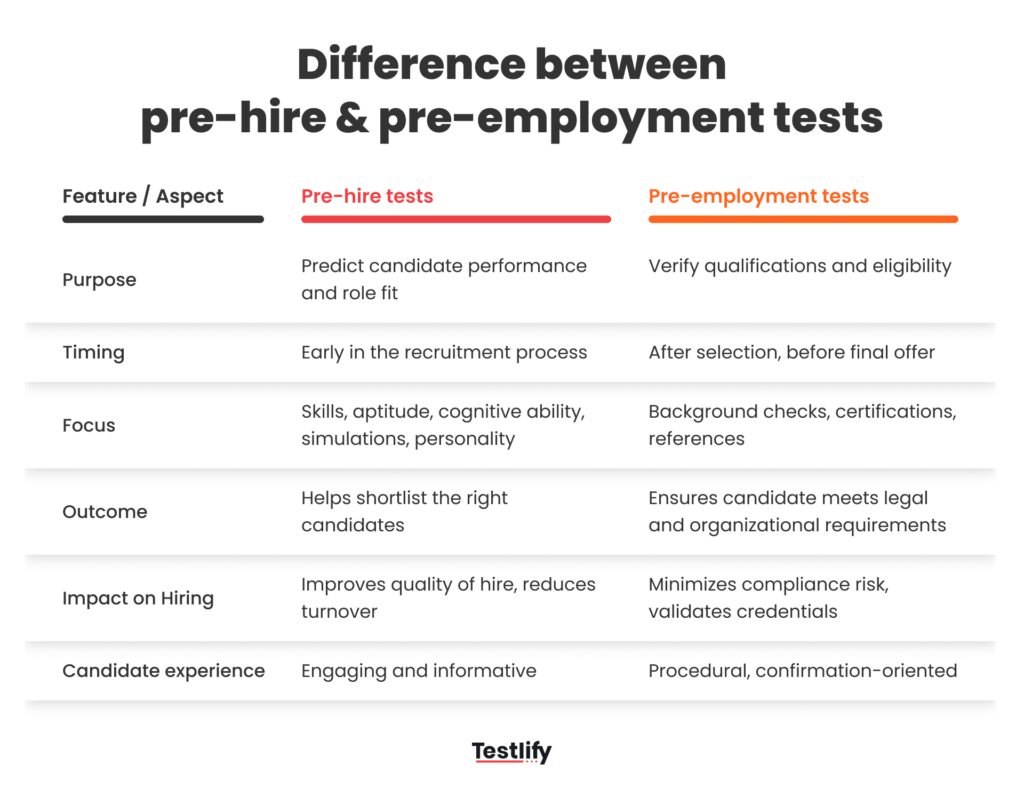
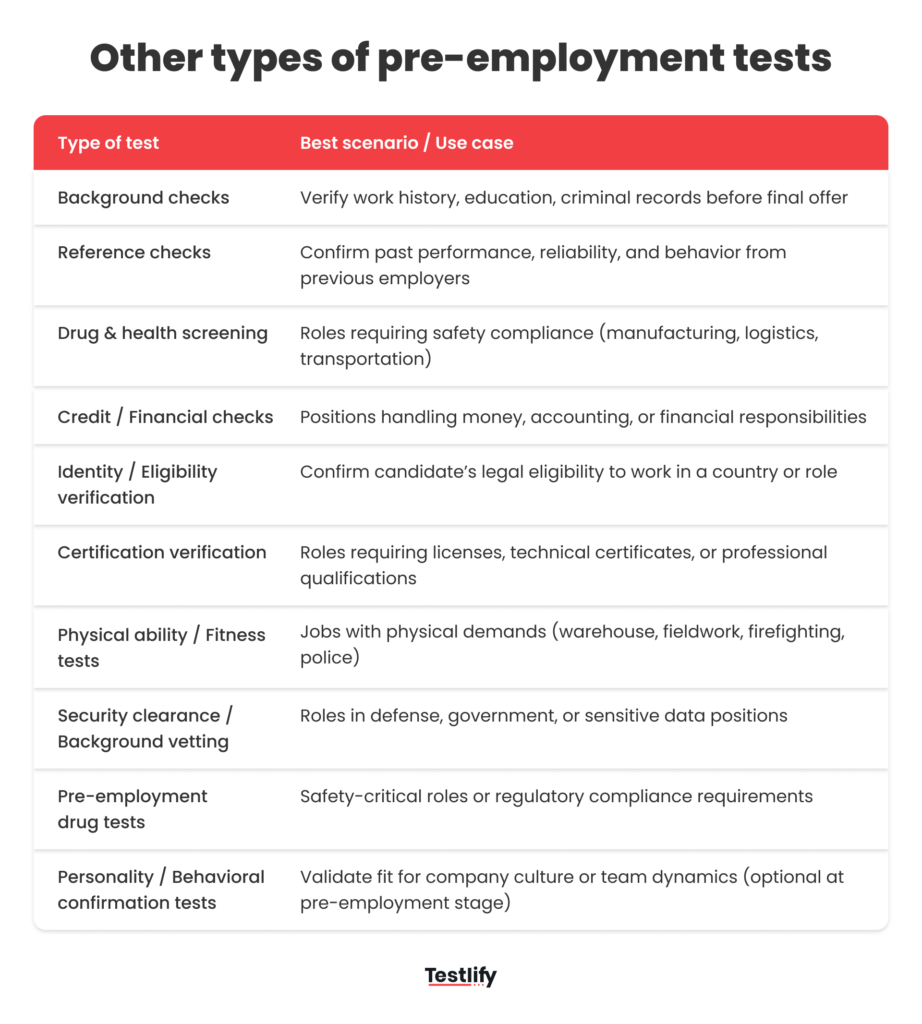
Pre-employment tests typically describe assessments administered after a candidate is shortlisted or given a conditional offer, and the term is more traditional and compliance-focused.
Both test the same things, soft skills like, cognitive ability, personality, or job fit, but “pre-hire” reflects a broader, earlier-stage approach. At the same time, “pre-employment” is HR terminology tied to later-stage validation.
Types of pre-hire testing for candidate screening
To choose the right pre-hire assessments, you first need to understand the different types and what each one is best suited to measure. Here are the top pre-employment test types:
Cognitive ability tests
Cognitive ability tests measure general intelligence and mental agility through timed exercises such as numerical reasoning, verbal comprehension, logical problem-solving, and pattern recognition. They assess how quickly candidates can process new information, learn unfamiliar concepts, and solve complex problems.
Because cognitive ability is one of the strongest predictors of job performance across industries, these tests are highly effective for identifying high-potential candidates early, often outperforming resumes alone.
Typically lasting 20-45 minutes, these tests use multiple-choice or pattern-based questions and benchmark results against role-specific norms. They are especially valuable in addressing widespread gaps in critical thinking and adaptability, which remain top priorities for employers in fast-changing environments.
To ensure fairness and legal compliance, best practices include validating tests against actual job requirements and minimizing cultural bias.
When to use & best-fit roles: Use cognitive ability tests early in the hiring process for roles that require strong analytical thinking and learning agility. Best suited for engineers, analysts, consultants, finance professionals, product managers, and data-driven roles.
Skills-based tests
Skills-based or role-specific tests evaluate a candidate’s ability to perform specific job-related tasks by simulating real work scenarios.
Examples include coding challenges, Excel modeling exercises, design mockups, writing tasks, or typing tests. These assessments verify whether candidates can apply their technical knowledge in practice, reducing reliance on self-reported skills and shortening onboarding time.
Delivered through interactive platforms, these tests are often timed and scored on accuracy, efficiency, and quality.
Specifically, these pre-hire assessments for hiring are particularly effective in high-volume hiring and can significantly reduce training costs by ensuring candidates are job-ready from day one. To minimize test anxiety, clear instructions and optional practice tasks are recommended.
When to use & best-fit roles: Use skills-based tests when immediate task competence is critical. Ideal for software developers, marketers, designers, accountants, operations staff, administrative roles, and skilled trade positions.
Personality and cultural tests
Personality and cultural tests assess behavioral traits, work styles, and motivational drivers using scientifically validated frameworks such as the Big Five or DISC.
Rather than measuring ability, they help predict how candidates will interact with others, handle stress, and align with team dynamics. These insights are valuable for improving cultural fit, leadership potential, and long-term retention.
Most personality assessments take 15-30 minutes and rely on self-report questionnaires, often using forced-choice formats to reduce response manipulation.
Ethical and effective use requires focusing strictly on job-related traits and avoiding interpretations that could lead to bias or discrimination.
When to use & best-fit roles: Use personality tests to evaluate team fit and behavioral tendencies, especially after skill qualification. Best for leadership roles, sales, customer success, people managers, and collaborative or high-interaction positions.
Situational judgment tests (SJTs)
Situational Judgment Tests present candidates with realistic workplace scenarios and ask them to choose or rank the most appropriate responses. These tests evaluate practical decision-making, ethics, adaptability, and problem-solving under pressure, skills that are difficult to assess through resumes or interviews alone.
SJTs are commonly delivered as text-based or video-based scenarios and typically take 30-60 minutes. Responses are scored against expert-defined benchmarks, making them effective for predicting real-world performance.
While highly inclusive and role-relevant, they work best when combined with technical or cognitive assessments.
When to use & best-fit roles: Use SJTs when judgment, ethics, and people’s decisions matter. Ideal for supervisory roles, healthcare professionals, frontline managers, customer service, and service-oriented positions.
Integrity tests
Integrity tests evaluate honesty, dependability, and ethical judgment through questions and scenarios that address rule-following, accountability, and risk-taking.
They are designed to predict counterproductive behaviors, such as theft, misconduct, or policy violations, making them valuable in roles that involve trust and responsibility.
These tests usually take 20-40 minutes and come in two formats: overt (direct questions about attitudes) and veiled (indirect personality-linked measures). To remain legally compliant, integrity tests must focus strictly on job-related behavior and avoid intrusive personal inquiries.
When to use & best-fit roles: Use integrity tests for roles where trust, safety, or financial responsibility is critical. Best suited for retail, finance, security, logistics, law enforcement, and roles handling sensitive data or assets.
Emotional intelligence (EI) tests
Emotional intelligence tests measure how well individuals understand and manage their own emotions and navigate interpersonal relationships.
Core dimensions include self-awareness, empathy, emotional regulation, and social skills. High EI is closely linked to effective leadership, collaboration, and conflict resolution.
EI assessments typically take 30-45 minutes and may combine self-reports with scenario-based evaluations. While powerful, they are most effective when paired with cognitive or skills-based tests to provide a balanced candidate profile.
Some emotional intelligence tests assess teamwork, adaptability, empathy, and related skills.
Teamwork tests
Teamwork tests assess how well a candidate collaborates with colleagues, communicates ideas, and contributes to group problem-solving. They are most useful for roles that require close collaboration, such as project teams, cross-functional roles, or customer-facing positions.
These tests can be used early in the hiring process to filter for candidates who naturally work well in teams, or after initial screening to identify how candidates will fit into existing team dynamics.
Adaptability tests
Adaptability tests measure a candidate’s ability to adjust to change, learn quickly, and stay effective when priorities, tools, or situations shift. They are especially relevant for fast-paced environments, startups, or roles where processes and requirements evolve frequently.
These tests can be administered during mid-stage assessments to see how candidates respond to realistic scenarios, or before final interviews to evaluate potential for growth and resilience in dynamic roles.
Empathy tests
Empathy testing evaluates how well a candidate understands others’ perspectives, responds appropriately to emotions, and builds positive working relationships.
When to use & best-fit roles: Use EQ tests for people-centric and leadership roles. Ideal for managers, HR professionals, team leads, client-facing roles, coaches, and executives.
Job knowledge tests
Job knowledge tests assess a candidate’s understanding of specific subject matter or professional standards through structured questions. These tests confirm whether candidates possess the foundational expertise required to perform effectively in regulated or specialized roles.
Typically lasting 30-60 minutes, they are benchmarked against industry or professional standards. To maintain relevance, test content should be regularly updated and paired with applied assessments to avoid over-reliance on memorization.
When to use & best-fit roles: Use job knowledge tests when formal expertise is mandatory. Ideal for healthcare professionals, legal roles, engineers, accountants, and compliance-driven positions.
Work sample tests
Work sample tests require candidates to complete tasks that closely mirror real job responsibilities, such as writing reports, debugging code, conducting role-plays, or preparing presentations.
They offer the highest predictive validity because they demonstrate actual performance rather than potential.
These tests typically run 30-90 minutes and are evaluated using standardized rubrics focused on quality, efficiency, and problem-solving. While resource-intensive, they are especially effective for high-impact or final-stage hiring decisions.
When to use & best-fit roles: Use work sample tests for high-stakes or creative roles where performance matters most. Best suited for designers, developers, writers, sales professionals, product roles, and senior individual contributors.
How can Testlify help with pre-hire testing?
Online pre-hire testing can be a powerful tool which can be used across different hiring needs, but its impact depends heavily on how well assessments are designed, delivered, and interpreted. That’s where platforms like Testlify add value.
Testlify helps organizations run structured, role-relevant 3,500+ pre-hire assessments for assessing over 4,500 roles, without adding complexity to the hiring process.
With Testlify, employers can access a wide range of pre-hire screening tests, including skills tests, cognitive ability tests, behavioral evaluations, and job-simulation-based tasks designed to reflect real work scenarios.
These assessments can be customized to match specific roles and hiring goals, allowing teams to evaluate candidates on what actually matters for performance rather than generic criteria.
Testlify also simplifies test administration by handling delivery, scoring, and reporting in a consistent and standardized way. This ensures hiring teams receive clear, objective insights while maintaining fairness and scalability across candidates.
By using data-driven assessments early in the hiring process, organizations can reduce bias, improve interview quality, and focus time on candidates most likely to succeed in the role.
Book a free demo and see it for yourself.
Frequently asked questions (FAQs)

Related resources
View all
HR & recruitment
6 real soft skills case studies every HR leader should study

HR & recruitment
Top 13 types of hiring bias and how to avoid them

HR & recruitment
Cross-cultural recruiting strategies for remote teams
HR & recruitment
How recruiters can find top talent with skills-based hiring tools

HR & recruitment
Quiet firing: Signs it’s happening and how to prevent it
HR & recruitment
AI upskilling guide for HR teams
Get started.
Hire on proof, not resumes.
Run your first skills-based assessment free — no credit card required.