
Are hiring assessments fair to all candidates? How to spot assessment bias
Hiring tests are fair only when assessment bias is controlled. Learn where bias creeps in, how to measure it and how to fix it step by step.

Assessment bias is when a hiring test gives different results to groups of candidates for reasons that have nothing to do with the skill being measured. A well-built skills test is usually fairer than a resume screen or an unstructured interview, but only when assessment bias is checked at every stage: design, delivery, scoring and the final decision.
TL;DR:
- Hiring assessments can be fair to all candidates, but fairness is not automatic. A test is fair when it measures only job skills, everyone can access it, and everyone is scored the same way.
- A score gap between groups is not proof of bias. A gap that comes from wording, format, timing or scoring that the job does not need is.
- Use the four-fifths check after every hiring round: if one group passes at less than 80% of the rate of the top group, look closer.
- US rules already expect this: federal selection guidelines use the four-fifths rule, the ADA requires test accommodations, and NYC Local Law 144 requires a yearly bias audit for automated hiring tools.
- Candidates are skeptical. Greenhouse found only 8% of US job seekers believe AI makes hiring more fair, so explain your process and keep a human in the loop.
- Start with job-based skills tests, a fixed scoring rubric, an accommodations process and pass-rate checks by group.
 ChatGPT
 Gemini
 Claude
 Grok
 Perplexity
What is assessment bias in hiring?
Assessment bias in hiring is a systematic difference in test results between groups of candidates that is caused by something other than the skill the job needs. Common causes are unfamiliar idioms, culture-bound examples, formats some candidates cannot use, unnecessary time pressure and inconsistent scoring.
The key word is systematic. One candidate having a bad day is noise. A whole group scoring lower because a question assumes knowledge of a sport, a regional phrase or a costly hobby is assessment bias. Education researchers writing for ASCD make the same point: different average scores alone do not prove a test is biased. Bias is present when the gap remains after you account for real differences in the skill being tested.
For hiring teams, this distinction matters. Your goal is not equal scores. Your goal is a test where the only thing that moves a candidate's score is how well they can do the job. You can read more about related traps in our guide to common types of hiring bias.

Are hiring assessments fair to all candidates?
Hiring assessments are fair to all candidates when three conditions hold: the test measures only skills the job needs, every candidate can access it on equal terms, and every answer is scored against the same rubric. When any of those breaks, the test can screen out capable people as easily as a biased interviewer.
Done well, a skills test is often the fairest step in a hiring process. Resumes reward pedigree, polished writing and keyword matching. Unstructured interviews reward rapport. A job-based test asks every candidate the same questions and scores them the same way, which is why so many TA teams now lead with skills. In LinkedIn's Future of Recruiting 2025 report, 93% of talent acquisition professionals said accurately assessing a candidate's skills is crucial for improving quality of hire.
The catch is that a test can look neutral and still be unfair in practice. A timed reading test for a warehouse role, a coding test that only runs well on a fast laptop, or a personality quiz scored against a narrow "ideal" profile can all exclude people for reasons unrelated to the work.
Where does assessment bias come from?
Assessment bias comes from four stages of the hiring test: how it is designed, how it is delivered, how it is scored and how the results are used to decide. Each stage needs its own check, because a test that is clean on paper can still become unfair when it is delivered or scored badly.
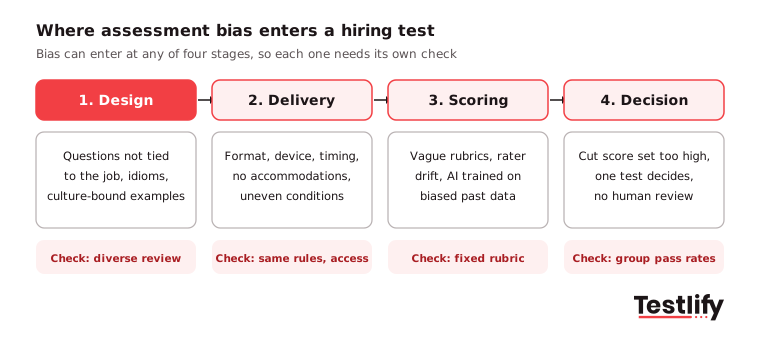
- Design: Questions measure things the job does not need, or use idioms, examples and references that some groups know better than others.
- Delivery: The format, device, connection, time limit or lack of accommodations gives some candidates a harder test than others.
- Scoring: Open answers are scored by different reviewers with different standards, or an AI model learns from biased past hiring data.
- Decision: A cut score is set higher than the job needs, a single test decides alone, or nobody checks who passes and who does not.
What are the main types of assessment bias?
The main types of assessment bias in hiring are content bias, language and cultural bias, format and access bias, technology bias, scoring bias, cut-score bias and algorithmic bias. Most of them can be fixed with better test design and a few checks, without making the test easier.
Type of bias | What it looks like | Hiring example | How to reduce it |
|---|---|---|---|
Content bias | Questions test knowledge the job does not use | A customer support test full of finance jargon | Map every question to a skill in the job description |
Language and cultural bias | Idioms, regional references, culture-bound scenarios | "Hit it out of the park" in a reading item | Plain language, diverse reviewers, tests in the candidate's language |
Format and access bias | A format some candidates cannot use | A timed visual test for a candidate with low vision | Alternative formats and extra time on request |
Technology bias | Results depend on device or connection quality | A video task that fails on a mobile connection | Device checks, mobile-friendly tests, retake rules |
Scoring bias | Different raters, different standards | One reviewer marks harder than the rest | A fixed rubric, calibration and blind review |
Cut-score bias | The pass mark is higher than the job needs | 85% required when 70% predicts success in the role | Set cut scores from job needs and check pass rates |
Algorithmic bias | An AI score repeats patterns from past hiring | A model that rewards one school or one writing style | Explainable scores, bias audits, human review |
Language deserves special attention for global teams. Our guide on language fairness in assessments covers when to translate a test and when the language itself is the skill.
What are the most common issues with hiring assessments?
The most common issues with hiring assessments are tests that are not tied to the job, tests that are too long, unnecessary time limits, unclear instructions, no route to request accommodations, uneven protection against cheating and decisions made on a single score. Each one can hurt fair candidate evaluation even when the questions themselves are sound.
- Generic tests: An off-the-shelf aptitude test used for every role measures something, just not always what the job needs.
- Length: Long tests push out candidates with less free time, such as caregivers and people already in full-time work.
- Speed for its own sake: A strict timer is fair only when speed is part of the job.
- Unclear instructions: Candidates who have never taken an online test lose points to confusion, not skill.
- No accommodation route: If candidates cannot ask for extra time or another format, the test quietly screens them out.
- Uneven integrity: If some candidates get outside help and others do not, honest candidates are the ones treated unfairly.
- One score decides: A single test result should inform a decision, not make it alone.
Fixing these issues also pays off in speed. Well-run pre-hiring assessments shorten time to hire because recruiters spend their time on candidates who have already shown the skills.
How do you check a hiring test for adverse impact?
You check a hiring test for adverse impact by comparing the pass rate of each group of candidates with the pass rate of the group that passes most often. If a group's rate is below four-fifths (80%) of the top group's rate, the result is generally treated as evidence of adverse impact and the test deserves a closer look.
The rule comes from the US federal Uniform Guidelines on Employee Selection Procedures. According to Section 1607.4(D), a selection rate for any race, sex or ethnic group that is less than four-fifths of the rate for the group with the highest rate is generally regarded as evidence of adverse impact.
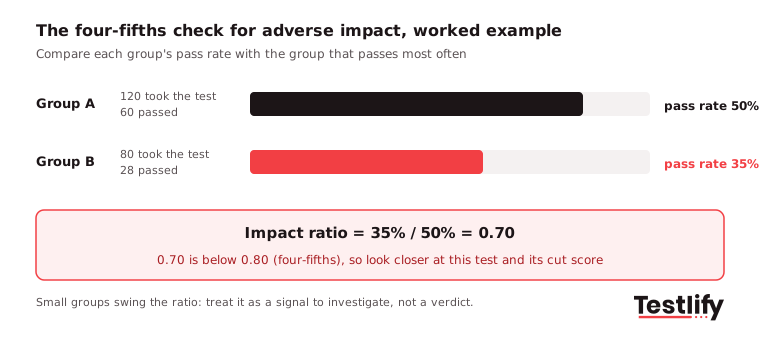
Here is the math with simple numbers:
- Group A: 120 candidates took the test and 60 passed, a pass rate of 50%.
- Group B: 80 candidates took the test and 28 passed, a pass rate of 35%.
- Impact ratio: 35% divided by 50% is 0.70.
- Result: 0.70 is below 0.80, so review the test content and the cut score for that role.
Pro tip: Run the check at each stage and at each cut score, not only on the final hire. A test can look fine overall and still create most of the gap at one pass mark. With small groups, two people passing or failing can swing the ratio, so treat it as a prompt to investigate. Our glossary entry on adverse impact explains the term in more detail.
What do the laws require for fair candidate evaluation?
Laws on fair candidate evaluation require employers to show that a test that screens out a protected group is tied to the job, to offer reasonable accommodations, and in some places to audit and disclose automated hiring tools. The exact duties depend on where you hire, so check with your legal team before you change a process.
- US federal rules: Title VII and the Uniform Guidelines expect tests that create adverse impact to be job-related, and the four-fifths rule is the usual first check.
- Disability: According to the EEOC, the ADA requires employers to give application tests in a format that does not require an impaired skill, unless the test is designed to measure that skill.
- New York City: Local Law 144 bars employers from using an automated employment decision tool unless it had an independent bias audit within the past year. The audit must report impact ratios by sex, race and ethnicity and their intersections, a summary must be posted publicly, and candidates must get notice 10 business days before the tool is used. The NYC Department of Consumer and Worker Protection publishes the rules and FAQs.
- European Union: The EU AI Act lists AI systems used to recruit, filter applications or evaluate candidates as high-risk, which brings duties on risk management, human oversight and transparency.
Key takeaway: Every one of these rules rewards the same habits: job-based tests, documented accommodations, consistent scoring and regular pass-rate checks.
How do you make a hiring assessment fair to every candidate?
You make a hiring assessment fair to every candidate by building it from the job, removing anything the job does not need, giving everyone equal access and checking the results by group after every round. A process that ensures fair assessment for all candidates usually follows seven steps.
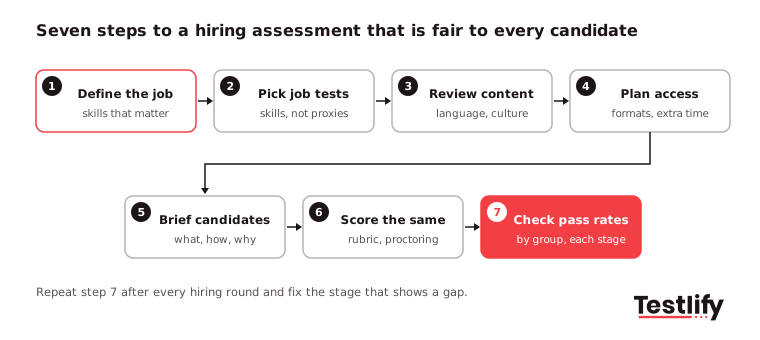
- Define the job: List the four to six skills that separate good performance from poor performance in the role, with the hiring manager.
- Pick job-based tests: Choose skills tests, work samples and job simulations over broad proxies. Our guide on using skills assessments to reduce bias shows how to match tests to roles.
- Review the content: Ask reviewers from different backgrounds to flag idioms, culture-bound examples and jargon the job does not use.
- Plan access: Offer alternative formats and extra time on request, support mobile devices and tell candidates how to ask. The EEOC guidance for job applicants explains what the ADA expects.
- Brief candidates: Tell every candidate what the test covers, how long it takes, how it is scored and how the result is used.
- Score the same way: Use a fixed rubric for open answers, calibrate reviewers and apply the same integrity rules to everyone.
- Check pass rates: Run the four-fifths check after every hiring round, fix the stage that shows a gap and keep a record of what you changed.
How do you keep AI-scored assessments fair?
You keep AI-scored assessments fair by scoring every candidate against criteria set by people, making each score explainable, auditing results by group and keeping a human reviewer in the decision. AI can apply a rubric more consistently than a tired interviewer, but it can also copy bias from past hiring data at scale.
Trust is the bigger gap right now. A November 2025 Greenhouse survey of 4,136 job seekers and hiring professionals in the US, UK, Ireland and Germany found that only 8% of US candidates believe AI makes hiring more fair, and 35% think AI has shifted bias from humans to algorithms. In the same survey, 87% said it is important for employers to be transparent about their AI use.
Regulators are moving in the same direction. The EU AI Act classes recruitment and candidate evaluation systems as high-risk. In practice, that means four habits for any AI-scored test:
- Human-set criteria: People decide the skills and the scoring rubric. The model applies them.
- Explainable scores: Every score shows the answer and the reason behind it, so a reviewer can challenge it.
- Regular audits: Pass rates are checked by group, and an independent bias audit is run where the law asks for one.
- Candidate notice: Candidates are told when AI scores their answers and who reviews the result.
How does Testlify support fair candidate evaluation?
Testlify supports fair candidate evaluation by building role-specific skills assessments from the job description, scoring every response against the same criteria and keeping results explainable with human oversight. The aim is simple: every candidate gets the same questions, the same rules and a score you can explain.
- Job-based tests: A library of 3,500+ tests across technical and non-technical roles, plus an AI test builder that creates a custom assessment from a job description.
- Independent bias audit: The Matching Model used in Testlify passed a third-party NYC Local Law 144 bias audit, completed on June 16, 2023.
- Language access: Assessments in 15+ languages, with candidate-side question translation, through multilingual assessments.
- Same rules for everyone: 20+ anti-cheating and proctoring checks, including question randomization and custom violation tolerance, so honest candidates are not outscored by outside help.
- Structured AI interviews: Every answer is scored against the same criteria, with a per-skill breakdown a reviewer can check before deciding.
Candidates notice the difference: Testlify reports 94% candidate satisfaction.
Want to check your own assessments for bias?
Start with one role you hire for often. Map its test questions to the job's skills, run the four-fifths check on your last hiring round and note where the gap appears. If you want job-based tests to compare against, browse the Testlify test library or book a demo to see how scoring, proctoring and reporting work together.
Frequently asked questions

Wordpress Developer
Yash Patel is a Wordpress and SEO Specialist at Testlify with 3+ years of experience in technical SEO, on-page optimization, and content strategy. He works on improving Testlify's organic presence and produces content focused on hiring, talent assessment, and HR technology.
LinkedInRelated resources
View all
HR & recruitment
How to negotiate competitive salary and benefits packages within budget constraints

HR & recruitment
How to attract passive candidates who are not actively seeking employment.
HR & recruitment
Pre-hire talent assessment: how to tailor it to every role

HR & recruitment
Is it necessary to verify educational qualifications

HR & recruitment
Employee referrals: how they work and how much weight to give them

HR & recruitment
How to incorporate aptitude assessment into your recruitment strategy
Get started.
Hire on proof, not resumes.
Run your first skills-based assessment free — no credit card required.