
How to create a positive candidate experience in 2026
Learn the candidate experience best practices top recruiters use in 2026 to reduce drop-offs, improve engagement, and hire faster.

Today’s skilled professionals are looking for more than just a competitive salary and a generous benefits package.
During the hiring process, while you are discerning whether they are a good fit for your company, they are deciding whether your workplace is a good fit for their lifestyle.
In this article, we will explore what candidate experience means, why it matters in modern hiring, and the practical strategies companies can use to create positive candidate experiences/
 ChatGPT
 Gemini
 Claude
 Grok
Grok Perplexity
What is candidate experience?
Candidate experience covers every interaction a job seeker has with your company during the hiring journey. The journey spans the job posting, application form, assessment, interviews, communication, and final decision.
A positive candidate experience strengthens your employer brand and grows your talent pipeline. A poor experience drives qualified people straight to your competitors within days.

Why does candidate experience matter more in 2026?
The talent market shifted permanently in favor of candidates. Workers now expect speed, respect, and clarity at every stage of the hiring process.
SHRM data places the average cost per hire above $4,700, which makes every drop-off expensive. IBM research connects strong candidate experience to a 70% lift in hire quality across roles.
Gartner finds that 60% of candidates abandon applications because of friction or poor communication. Recruiters who close these gaps win measurable business outcomes within one hiring cycle.
Three outcomes separate top recruiters from the rest:
- Offer acceptance rates climb above 85%.
- Time to hire drops below 20 days.
- Quality of hire scores rise across every team.
Related resources: For deeper analysis, see our breakdown of recruitment metrics that matter.
How do you create a positive candidate experience in 2026?
Each step below maps to a measurable improvement in hiring outcomes. Recruiters can deploy most of these tactics in under 30 days.
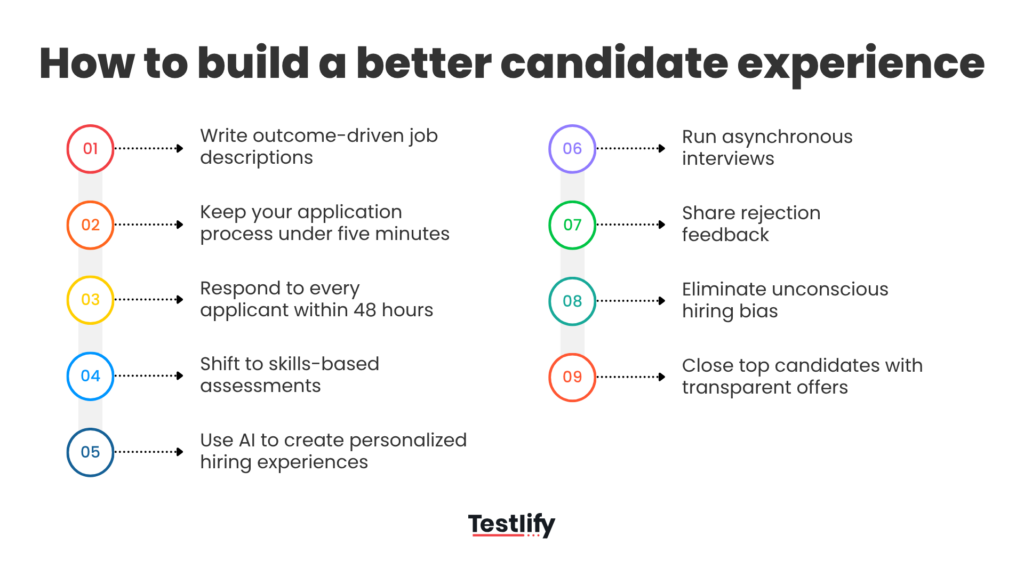
1. Write job descriptions that respect candidates’ time
Long, vague job posts drive top candidates away within seconds. Top recruiters now write outcome-driven job descriptions that clearly define responsibilities, expectations, and growth opportunities
Keep job descriptions under 400 words whenever possible. In the first 100 words, explain the role’s purpose, business impact, core responsibilities, must-have skills, and salary range.
This helps candidates quickly decide whether the opportunity aligns with their career goals.
Related resources: Use our guide on creating effective job descriptions, and try our free job description generator to create inclusive job descriptions
2. Shorten your application to under five minutes
Korn Ferry research shows that applications longer than five minutes lose 40% of qualified candidates. Top recruiters strip their applications down to name, contact, resume, and one signal question.
Ask candidates only what you need to make an initial decision. Save deep questions for the assessment stage.
3. Reply to every applicant within 48 hours
Silence destroys candidate experience faster than rejection. A simple acknowledgment within 48 hours signals respect and keeps candidates engaged.
Build automated workflows that confirm receipt, share next steps, and set timeline expectations. Manual follow-up never scales, and modern automation now feels personal when designed well.
Pair this with recruitment automation tools to scale your candidate outreach efforts.
4. Replace resume screening with skills-based assessments
Resume screening introduces bias, slows hiring, and rewards keyword stuffing over real ability. Skills-based assessments evaluate what candidates can actually do.
Top recruiters deploy short, role-specific tests early in the funnel. The assessments save hiring managers time and surface hidden talent that resumes miss.
Related resources: Explore our test library of pre-employment assessments to get started.
5. Personalize the hiring journey with AI
AI now personalizes the candidate journey at scale. Recruiters tailor messaging, assessments, and interview questions to each candidate’s profile in seconds.
Personalization signals that your company sees the candidate as an individual. Generic outreach signals the opposite and pushes top candidates toward competitors.
Related resources: Learn how to deploy AI in recruitment without losing the human touch.
6. Run structured, async-first interviews
Async interviews give candidates flexibility and remove scheduling friction. Structured questions reduce bias and improve fairness across every interview.
Combine async video interviews with one short live conversation for finalists. This format respects candidate time while still building a human connection.
Related resources: Read our complete guide on how to conduct a structured interview
7. Share rejection feedback with every candidate
Candidates rank feedback as the most-wanted improvement in hiring. A short note explaining the decision turns rejected applicants into future hires, referrals, and customers.
Recruiters who share feedback report 40% higher referral rates from rejected candidates. The cost takes minutes, and the return compounds for years.
Related resources:How to give constructive feedback to candidates
8. Eliminate bias at every stage
Hiring bias damages both candidate experience and team performance. Bias-free hiring requires structured interviews, blind assessments, and diverse panels.
Audit your hiring funnel every quarter for drop-off patterns by demographic. Patterns reveal hidden bias that needs immediate attention.
Related resources: Read our deep dive on reducing unconscious bias for tactical steps.
9. Close with a fast, transparent offer
Long offer delays kill enthusiasm and open the door to competitor offers. Top recruiters move from final interview to signed offer in under five days.
Share the compensation, role scope, growth path, and start date in a single, clear document. Transparency at this stage closes more candidates than aggressive negotiation tactics ever will.
Connect this approach to your broader talent acquisition strategy.
Common candidate experience mistakes that cost you top talent
Recruiters lose qualified candidates to the same mistakes year after year. Most mistakes cost nothing to fix once leaders see them clearly.
The most damaging mistakes include:
- Ghosting applicants after interviews
- Requiring account creation before assessment access
- Asking duplicate questions across the application and interview stages
- Using outdated, generic skills tests
- Delaying decisions beyond two weeks
- Hiding salary ranges until the offer stage
- Running unstructured, biased interviews
Each mistake compounds the next one. Fix the top three, and your offer acceptance rate jumps within one hiring cycle.
What is the candidate experience like on Testlify?
Testlify designs every feature around candidate respect and recruiter speed. Candidates never create an account, which removes the single biggest source of drop-off in modern hiring.
The platform combines AI assessment generation, advanced proctoring, deep analytics, and 100+ ATS integrations. Recruiters move from job posting to hire in days, and candidates move through a clean, mobile-friendly journey.
Six features define the Testlify candidate experience.
1. Create tailored assessments
Recruiters choose from a library of 3500+ pre-built tests or use AI to generate custom questions in seconds. The platform supports multiple-choice, open-ended, and coding question formats.
Testlify also generates conversational AI-powered interviews that simulate on-the-job scenarios. These simulations run across chat, voice, and video formats for any role.
2. Send candidate invitations with no account creation needed
Recruiters invite candidates through a single email link once the assessment is ready. Candidates click the link and start the assessment immediately, with zero account creation required.
This single design choice removes the largest friction point in pre-employment assessment. Candidates start the assessment in under 30 seconds.
3. Apply advanced anti-cheating and proctoring measures
Testlify protects assessment integrity through advanced proctoring features. These features include webcam monitoring, screen recording, browser lockdowns, and location tracking.
Recruiters trust assessment results, and honest candidates compete on a level playing field. Cheating attempts trigger automatic flags for review by the hiring team.
4. Score candidates with AI-powered analytics
Testlify automatically scores assessments and delivers detailed candidate performance reports. Reports break down scores by skill, question type, and overall performance.
Recruiters spot top performers in minutes instead of hours. Comprehensive insights drive faster, more confident hiring decisions across every role.
5. Integrate with 100+ applicant tracking systems
Testlify integrates seamlessly with over 100 ATS platforms, including Greenhouse, Lever, and Recruitee. The integrations import candidate profiles automatically and sync results in real time.
Recruiters compare candidates without leaving their existing workflow. Data-driven hiring decisions become the default, not the exception.
Read more about selecting the right applicant tracking system for your team.
6. Protect data with enterprise-grade compliance
Testlify holds GDPR compliance and prioritizes the security of every customer’s recruitment data. GDPR refers to the General Data Protection Regulation, the European Union’s data privacy law.
The platform features advanced admin management, strong security integrations, rigorous data governance, comprehensive audits, and robust privacy protections.
SOC 2 Type II, AICPA, and ISO 27001 certifications back every layer of the platform, and enterprise security teams approve Testlify without long compliance reviews.
How do you measure candidate experience in 2026?
Recruiters cannot improve what they fail to measure. Three metrics now define candidate experience performance.
The three metrics include:
- Candidate Net Promoter Score: Ask every applicant to rate the experience after each stage. This metric is also called CNPS.
- Application completion rate: Measure how many candidates finish what they start.
- Offer acceptance rate: Track how often top candidates say yes to your offers.
Track each metric monthly and segment by source, role, and recruiter. Patterns reveal exactly where your hiring funnel leaks the most candidates.
Final thoughts
Candidate experience in 2026 separates the companies that win talent from the ones that watch it walk away. The fixes cost less than most recruiters expect, and the returns compound every hiring cycle.
Speed, transparency, skills-based assessment, and AI personalization form the foundation. Recruiters who build on this foundation outperform their peers on every metric that matters to the business.
Testlify gives your team every tool to deliver this experience at scale. The platform turns candidate experience into a measurable competitive advantage within 30 days of deployment.
Ready to deliver the candidate experience top talent expects in 2026?
Book a demo today and see how your team can transform hiring outcomes in under 30 days. Join 3,500+ companies that already use Testlify to win the talent war.

Wordpress Developer
Yash Patel is a Wordpress and SEO Specialist at Testlify with 3+ years of experience in technical SEO, on-page optimization, and content strategy. He works on improving Testlify's organic presence and produces content focused on hiring, talent assessment, and HR technology.
LinkedInRelated resources
View all
HR & recruitment
Power BI Test: What It Assesses and How to Hire in 2026

HR & recruitment
What makes a good problem-solving assessment to test candidates?

HR & recruitment
Must Know Data Engineer Interview Questions

HR & recruitment
Top 35 data scientist interview questions

HR & recruitment
40 Interview questions to ask while hiring a cloud engineer

HR & recruitment
Contrast bias: Definition, examples, and how to prevent It in hiring
Get started.
Hire on proof, not resumes.
Run your first skills-based assessment free — no credit card required.