
What is counterproductive work behavior & how to fix it?
Counterproductive Work Behavior (CWB) harms productivity, morale, and profits. Learn its causes, impact, and proven strategies to fix and prevent it.

Counterproductive work behavior is any voluntary action by an employee that works against the organization or the people in it. Showing up late on purpose, slowing down, taking supplies home, freezing out a colleague, fiddling an expense claim. Researchers call it CWB, and the word voluntary is the whole point: this is choice, not incapacity.
That distinction matters because it changes the fix. A person who cannot do the work needs training. A person who has decided not to needs something else, and most of the time that something else sits in the job, the manager or the process rather than in the person.
 ChatGPT
 Gemini
 Claude
 Grok
Grok Perplexity
TL;DR
- CWB is deliberate employee behavior that harms the employer or coworkers. It is separate from poor performance, which is about capability.
- Researchers sort it two ways: by what is hit (the organization or a person) and by how it shows up (production, property, political, aggression).
- Most of the cost never shows up in the accounts. SHRM put the daily bill for workplace incivility alone at more than 2.7 billion dollars in lost productivity and absence.
- It is a base-rate problem, not a few-bad-apples problem. In one study only 14 percent of employees reported almost no counterproductive behavior at all.
- Fix the conditions first (workload, fairness, supervision), keep discipline predictable, and use behavioral signals at the hiring stage instead of waiting for the first incident.

What does counterproductive mean?
Dictionaries define counterproductive as having the opposite effect to the one you intended. An all-nighter before an exam is counterproductive. So is a bonus scheme that rewards speed on a job where mistakes are expensive.
Some people write it as two words, counter productive. The single-word spelling is the one used in research and in HR policy, and the meaning does not change either way.
How researchers define counterproductive behavior
In work psychology the term is narrower than the everyday one. It covers acts an employee chooses, that break workplace norms, and that harm the employer or its people. Robinson and Bennett's 1995 typology and the Counterproductive Work Behavior Checklist (CWB-C) are the two reference points most studies still build on. British English spells it counterproductive work behaviour, and the research means the same thing by both spellings.
What is counterproductive work behavior (CWB)?
Counterproductive work behavior (CWB) is voluntary employee behavior that violates workplace norms and harms the organization, its members, or both. It ranges from small withdrawal (long breaks, quiet slowdowns) through property damage and theft to bullying and aggression. The common thread is intent, not size.
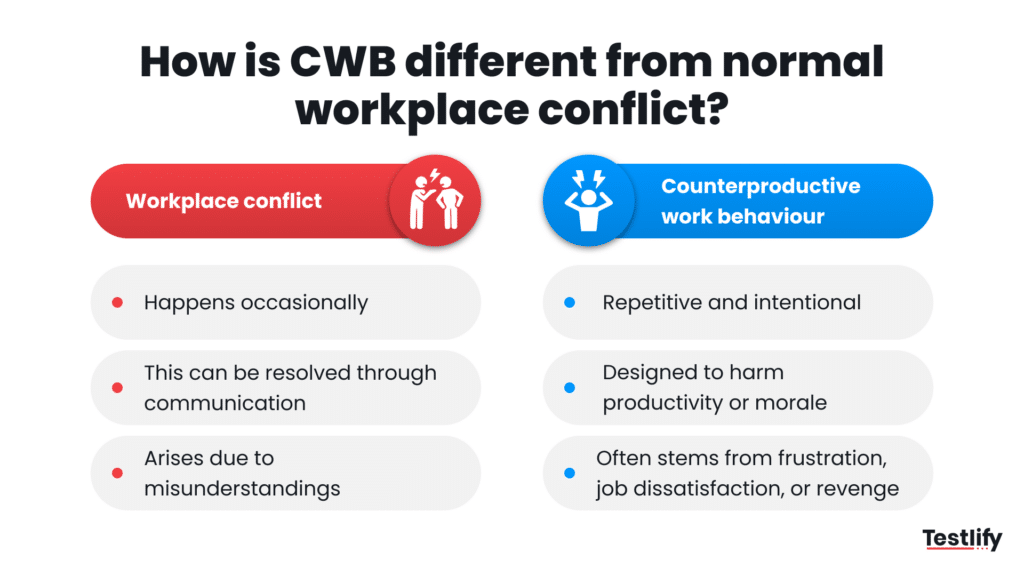
Two things it is not. It is not underperformance: a new hire missing targets while learning the role has a skills gap, not a behavior problem. And it is not disagreement. A person who argues hard in a meeting and then delivers is doing their job. The research taxonomy of CWB draws the line at norm-violating acts done on purpose.
Counterproductive workplace behavior shows up in three places long before anyone files a complaint: in attendance data, in quality and rework data, and in who quits. Those three signals are usually sitting in systems you already run.
What are the main types of counterproductive behavior?
Two lenses are worth knowing. The first sorts by target: CWB-O is aimed at the organization (sabotage, theft, slacking), CWB-I is aimed at individuals (insults, exclusion, threats). The second sorts by form, which is the version most managers find easier to act on.
Type | What it looks like | Target | Early signal in your data |
|---|---|---|---|
Production deviance | Working slowly on purpose, long breaks, leaving tasks unfinished, ignoring procedure | Organization | Output gap between similar roles on the same shift |
Property deviance | Theft of stock or supplies, padded expenses, damaging equipment, misusing accounts | Organization | Shrinkage, expense exceptions, unexplained asset loss |
Political deviance | Gossip, blame-shifting, favoritism, withholding information a colleague needs | People | Engagement scores that fall in one team only |
Personal aggression | Verbal abuse, intimidation, harassment, sabotaging someone's work | People | Grievances, sudden resignations from one reporting line |
Withdrawal | Absence without cause, lateness, early leaving, disengaged presence | Organization | Absence clustered around specific days or managers |
Most real cases are mixed. Someone who feels underpaid may pad an expense claim (property), stop volunteering for the hard shifts (production), and tell the new starter not to bother trying (political). Treating those as three separate incidents is how the root cause gets missed.
What does CWB actually cost employers?
The honest answer is that nobody can price CWB as a single line item, because most of it never reaches a report. What can be priced are the pieces.
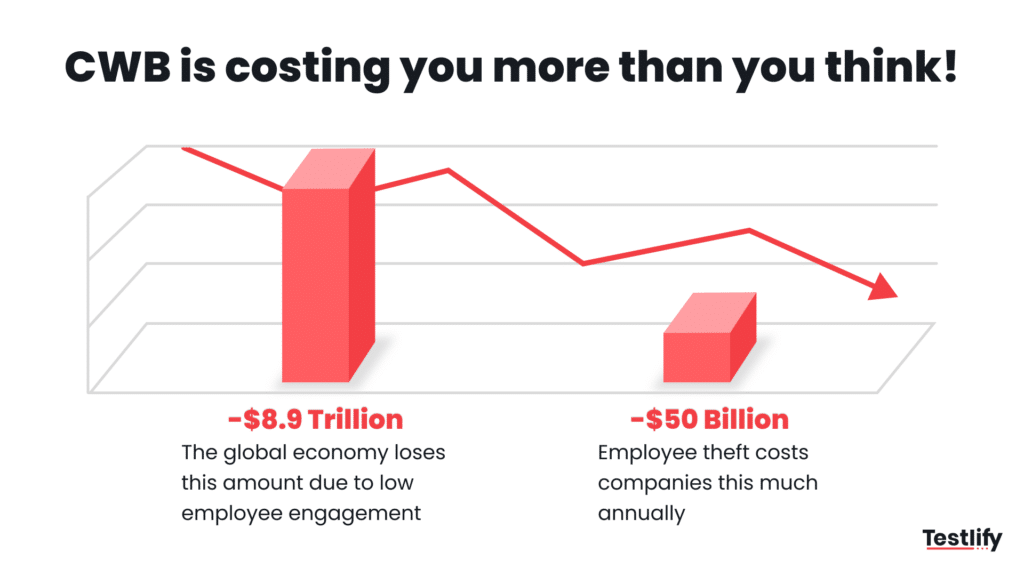
Start with the rude end of the spectrum. SHRM's Civility Index counted more than 81 million acts of incivility a day across the US workforce in the fourth quarter of 2024, costing employers over 2.7 billion dollars a day in lost productivity and absence, with workers losing an average of 37 minutes of productivity per incident. Thirty-seven minutes sounds trivial until it is multiplied by 81 million.
At the criminal end, the Association of Certified Fraud Examiners studied 2,402 occupational fraud cases in its 2026 Report to the Nations and found losses above 3.4 billion dollars, with a median loss of 104,000 dollars per case. Median matters more than the average here: a typical case is not a headline heist, it is a mid-level person quietly taking six figures over a couple of years.
Then there is the slow drain. Gallup's State of the Global Workplace put global engagement at 20 percent in 2025 and the cost of low engagement at roughly 10 trillion dollars, or 9 percent of global GDP. Disengagement is not CWB, but the two travel together: withdrawal is the cheapest form of protest available to someone who has stopped caring.
Add the second-order costs that never get attributed: employee turnover among the people who stayed late to cover, the customer who met the rude employee, the manager hours spent on investigation. None of it lands in a line item called CWB, which is why the problem almost never gets a budget to fix.
Why do employees engage in CWB?
Mostly because of the situation, not the person. The reliable triggers are perceived unfairness (see organizational justice), a workload that cannot be met honestly, a manager who plays favorites, job insecurity, and no safe way to complain. Personality matters too, but it is the constant. The workplace is the variable you control.
It is also more common than most policies assume. A person-centered study of CWB published in 2023 sorted employees into profiles and found only 14 percent reported almost no counterproductive behavior at all, while another 14 percent reported high levels across the board. The majority sat in between: ordinary people who occasionally cut a corner.
That middle group is the one worth designing for. A policy built only to catch the worst 14 percent leaves most of the cost untouched, and it reads to everyone else as surveillance, which is itself a trigger. Meta-analyses do link lower agreeableness, conscientiousness and emotional stability to more CWB, so the trait signal is real. It just does not tell you which of two similar candidates will act on it.
Pro Tip: before you investigate a person, check whether the behavior clusters. If lateness, absenteeism and quality slips all spike in one team and nowhere else, you are looking at a management or workload problem wearing a discipline costume.
How do you fix counterproductive work behavior?
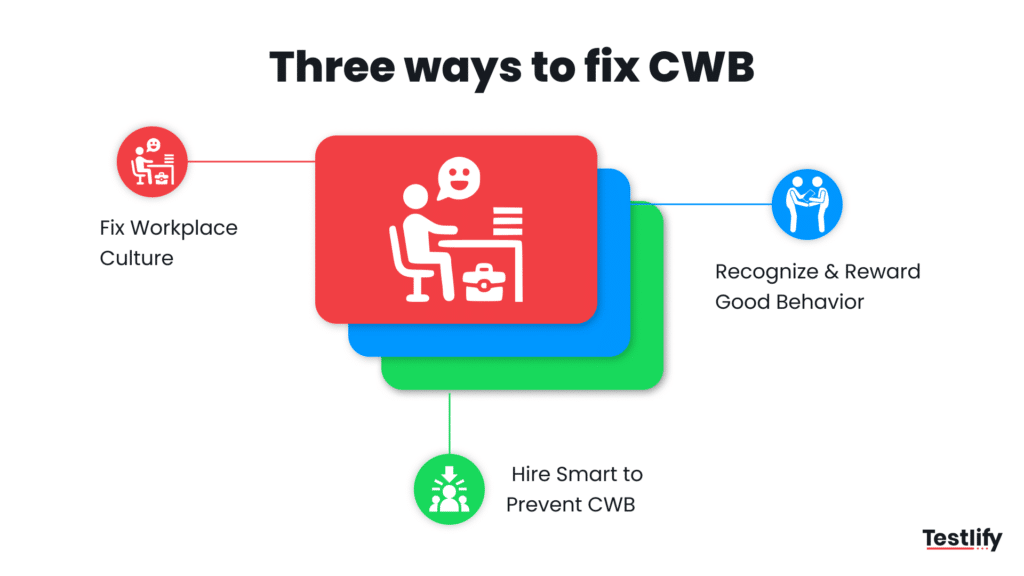
Fixing CWB is mostly unglamorous. It is not a poster campaign. It is four steps, done in order, and the order is the part teams get wrong.
- Find the pattern before the person. Pull absence, rework, shrinkage and exit data by team and by manager, not by individual. Anonymous employee feedback surveys fill the gap for anything that does not leave a data trail, like exclusion or gossip.
- Remove the trigger you can actually remove. If a rota makes honest attendance impossible, fix the rota. If one manager generates most of the grievances, that is a coaching or removal decision, not a training-for-everyone decision. Workplace negativity spreads down a reporting line faster than it spreads across one.
- Make consequences predictable and equal. Uneven enforcement is itself a cause of CWB: people who watch a favorite get away with it stop believing the rules apply. Document the steps (conversation, written warning, performance improvement plans, exit), apply them the same way to everyone, and keep the record.
- Give people somewhere to take the pressure. Employee assistance programs, a real grievance route, and managers trained to handle conflict early stop small resentments turning into discrimination claims and resignations.
The caveat nobody puts on the slide: some of this is slow, and a portion of CWB will survive every fix. Serious dishonesty and repeated aggression are exit decisions, and treating them as culture problems is unfair to the people who have to work alongside them.
How can you screen for CWB risk before hiring?
Prevention is cheaper than correction, but it has to be done honestly. No assessment predicts whether one named person will steal or bully. What well-built assessments do is shift the odds across a lot of hires, and they are strongest when no single signal is asked to carry the decision.
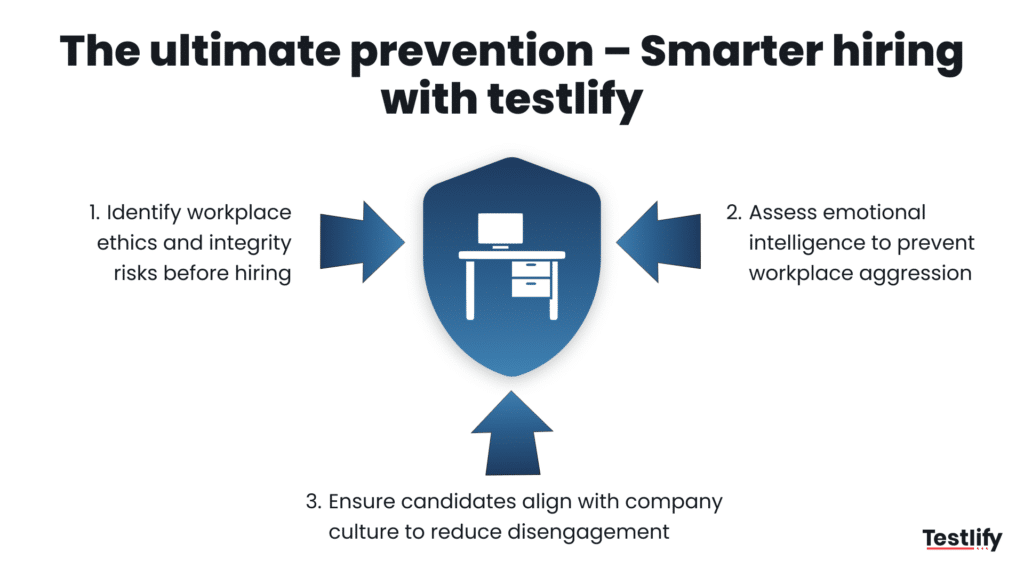
That is the idea behind the Testlify Multi-Signal Talent Evaluation Model: combine several role-relevant signals (assessments, interviews, simulations, references, structured reviewer feedback) rather than trusting one strong resume or one polished interview. One signal is fragile. Several pointing the same way is evidence.
Signals worth adding for behaviorally sensitive roles
- Personality test for the traits the research links to CWB, read as a prompt for interview questions rather than a verdict.
- Emotional intelligence test for roles where the pressure lands on customers or teammates.
- Situational judgment tests, which put the candidate in the awkward scenario (a colleague cutting corners) and score the response.
- Structured reference checks, where referees answer the same questions rather than writing free-form praise.
Three rails on all of this. Use assessments to inform a human decision, never to auto-reject. Pick tests tied to the actual job, because an unrelated trait score is both weak evidence and a fairness risk. And check your local rules on automated decisions before you deploy anything at volume. A fuller map of the options sits in this rundown of pre-hire testing types and in how behavioral assessments shape hiring decisions.
Hire for behavior you can actually observe
If CWB keeps surfacing in the same roles, the shortlist is the cheapest place to intervene. Testlify's test library covers personality, psychometric, situational judgement and cognitive assessments, with multi-reviewer scoring so the decision stays with your team. Start a free trial or book a demo and try it on one role where turnover has been ugly.
Frequently asked questions (FAQs)

B2B SaaS Content Writer
Rishav Kumar is a B2B SaaS content writer with 4 years of experience. He loves crafting engaging content. Always exploring fresh ideas, he's passionate about helping businesses grow through impactful writing.
LinkedInRelated resources
View all
HR & recruitment
How AI-powered education tools help HR improve employee retention and performance

HR & recruitment
All you need to know about direct sourcing

HR & recruitment
What Is Job Design? Elements, Approaches, and Best Practices (2026)

HR & recruitment
Phased return to work: a complete guide for HR teams

HR & recruitment
What Is Adaptive Leadership? Definition, Principles, and HR Applications (2026)

HR & recruitment
Inclusive succession planning: promoting diversity in leadership roles
Get started.
Hire on proof, not resumes.
Run your first skills-based assessment free — no credit card required.