
How enterprises can reduce candidate drop-off with smarter assessments
Discover how smarter, faster assessments help enterprises reduce candidate drop-off, improve completion rates, and hire top talent with confidence.

An empty seat is expensive, but an unfinished job application is worse.
Across large hiring funnels, candidate drop-off spikes the moment a skills test appears: almost half of applicants (47%) bail the instant the assessment feels “too long” or irrelevant.
Most enterprises have spent years refining their job ad copy, perfecting job postings, and optimizing career page flows, yet the assessment step remains stubbornly leak-prone.
Lightcast estimates that every month, a key role that stays unfilled drains roughly $25,000 in lost productivity. The good news is that the exodus at the assessment stage is preventable.
In the pages ahead, you’ll see precisely where the funnel springs a leak, why innovative, adaptive assessments plug it, and how teams are cutting candidate drop-off by double digits.
 ChatGPT
 Gemini
 Claude
 Grok
Grok Perplexity
Where does candidate drop-off happen?
A modern job posting might attract tens of thousands of eyeballs, but the river narrows fast. Look at a typical enterprise recruitment process in 2025:
Funnel stage | Typical pass-through | What it means |
|---|---|---|
Job ad click to job application form | 6% of visitors begin the form | Even a slick career page converts only a slice of curious traffic. |
From the start of the application to submitting an application | Up to an 80% drop before hitting “Submit” | “Too many fields” is the most significant application drop trigger. |
From the application submitted till the online assessment started | 53 % | Nearly half of the overall candidate pool never even opens the test link. |
From the start of the evaluation to the completion of the assessment | An additional 47% quit mid-test | Long, generic tests fracture the candidate experience. |
From the assessment passed to the first interview | Varies by role (20-40%) | Screening thresholds filter out unqualified candidates. |
Interview to a job offer | 10-15 % | Manager delays compound attrition. |
Let’s start with 10,000 views on a job ad. About 600 visitors have launched the job application. Only 120 finish it. When the skills test appears, roughly 64 begin, yet barely 34 cross the finish line.
That “assessment cliff” is where candidate drop-off rates hit their costliest slope. Every mid-test exit means fewer prospects moving toward a job offer.
Industry wrinkles
- High-volume retail & BPO roles see the steepest assessment exits (time-pressed hourly talent).
- Tech & analytics jobs suffer more from relevance complaints—candidates abandon when questions feel disconnected from real work.
- Global markets with mobile-first talent pools magnify friction: a non-responsive test results in an instant bounce.
Knowing precisely where the leak occurs lets TA leaders patch it with role-tuned assessments before qualified talent slips out of the funnel.

Why do candidates abandon assessments?
A slick job application can still miss out on talent if the test that follows feels like a chore. Surveys and funnel analytics point to five repeat offenders:
Drop-off trigger | What happens in the real world | |
|---|---|---|
1. It takes too long | 47 % of job-seekers say pre-hire tests are simply too time-consuming | Hour-long quizzes clash with busy lives; attrition soars after the 15-minute mark. |
2. Mobile friction | Roughly one-third of mobile applicants quit outright when the assessment isn’t phone-friendly | More than half of all traffic to enterprise career pages now comes from mobile devices; a non-responsive test equals an instant application drop. |
3. “Why am I doing this?” | 37 % leave when instructions or purpose are unclear | When candidates struggle to connect their questions to the role, they often assume the hiring process is merely a matter of box-ticking, rather than talent-seeking. |
4. Poor relevance | 30 % feel assessments don’t relate to the real job | Generic puzzles tell qualified candidates you didn’t read their resumes. They bail and head back to tight labor markets. |
5, Radio silence & respect gaps | One in four applicants now reject offers after a negative or silent process. | A lack of feedback erodes trust; the overall candidate journey feels transactional, so they often ghost before the job offer stage. |
Benchmarks from Sapia.ai show that while only 18% of applicants drop out during interviews, the assessment step alone eliminates a matching 18%, often the best-fit talent.
The solution is not “ditch testing.” It’s to make assessments smarter: shorter, role-specific, mobile-native, and communicative.
What makes an assessment smart?
Think back to those early 2010s hiring portals that ambushed every job application with an hour-long cognitive quiz. You could almost hear talent scattering. We now know why: once a test drifts past the 30 to 40 minute mark, completion plummets.
Criteria Corp tracked the curve and found that while sub-40-minute tests keep about 80 percent of applicants engaged, drop-off accelerates fast beyond that point.
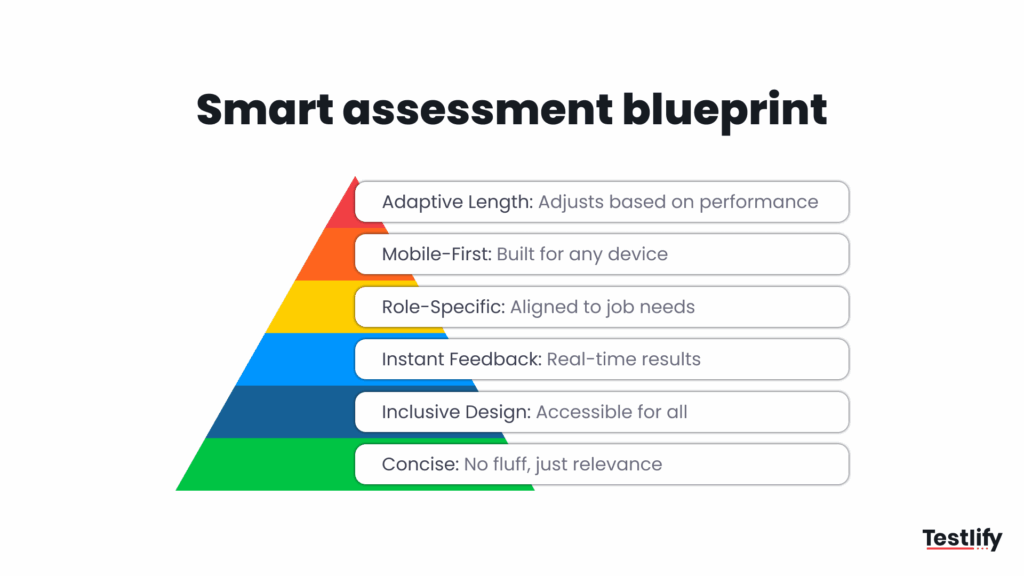
A smart assessment retains the best aspects of measurement science while designing every detail around the modern candidate experience. Here’s the anatomy, in plain language.
Adaptive, not marathon-length
Innovative platforms monitor performance in real-time and end the test the moment they’re statistically confident.
Corvirtus’ longitudinal data shows that abandonment “clusters right at the start, then rises sharply after the 10 to 15 minute mark,” proving that brevity is the cheapest solution for soaring candidate drop-off rates.
Mobile-native from screen one
Over half of all traffic to an enterprise career page now comes from phones. If a test forces pinch-zoom or desktop log-ins, an instant application drop follows, and the number of candidates in play shrinks before you even score them.
A mobile-first layout keeps the application process moving, especially in emerging labor markets where phones outnumber laptops three to one.
Focused on the role
Developers hate multiple-choice trivia on pivot tables; sales reps groan at abstract logic grids. An innovative engine pulls tasks from a job-specific bank, so every question feels like work they’ll actually do.
Feedback
Traditional tests go silent after the last click. More innovative tools provide a quick snapshot of strengths or a percentile band right away.
Even a two-line summary (“Your data-wrangling speed ranks in our top 20%”) lifts trust and nudges candidates to stick around for the interview and, hopefully, the job offer.
Inclusive by default
Accessibility tags, alt-text, colour-safe palettes, low-bandwidth modes, and multi-language packs widen the funnel without extra advertising spend.
More voices reach the finish line, enriching your overall candidate pool and demonstrating that your brand walks its talk on diversity, equity, and inclusion (DEI).
When the test feels like an invitation rather than an obstacle, talent keeps walking the bridge you built instead of diving off the side.
Where Testlify fits in the puzzle
Testlify was built for the exact moment most funnels spring a leak, the hand-off from job application to assessment, where candidate drop-off rates quietly gut the hiring process.
Short by design, more brilliant under the hood
Instead of a one-hour slog, Testlify’s adaptive engine trims the average test to about twelve minutes. That single change keeps far more qualified candidates in play and turns the dreaded application drop into a completed test.
Role-relevant question banks
Whether the job ad is for a Java engineer or an enterprise SDR, Testlify pulls tasks specific to that role, so every question feels like work they’ll actually do. Relevance builds trust and keeps the overall candidate pool engaged.
Instant, respectful feedback
The moment the last task ends, candidates get a strengths snapshot. That transparency enhances the candidate experience and encourages talent to progress further in your recruitment process.
Plug-and-play for TA teams
With 100-plus ATS integrations, async video responses scored by AI, and WCAG-compliant design out of the box, Testlify quietly inserts itself without tearing up your existing application process.
Dashboards surface real-time candidate drop-off metrics so you can see, week to week, how many people finish, where they stall, and how each tweak moves the needle.
Metrics that matter
Before you change platforms or rewrite a job ad, lock in the numbers that prove candidate drop-off rates are falling and keep proving it quarter after quarter.
Start with the six indicators below. Track them by role, country, and campaign so you can spot leaks in the recruitment process long before they hit your revenue line.
Metric | Why it matters | Typical enterprise benchmark | Target with smart assessments |
|---|---|---|---|
Assessment Completion Rate (ACR)(% who start and finish the test) | Direct pulse on where the application process bleeds talent. | “Healthy” range sits 65-85% | ≥ 80 %—anything lower flags friction. |
Median Test Duration | Long tests drive application drop; shorter yet predictive tests improve the candidate experience. | Drop-off risk soars past 20-25 min | ≤ 15 min (adaptive engine ends when it has enough data). |
Candidate NPS (cNPS) | Word-of-mouth marker for the overall candidate journey; influences the reach of future job postings. | Avg. cNPS ≈ 40; leaders hit 59 | 60+ shows that the hiring process feels fair and seamless. |
Offer Acceptance Rate (OAR) | Final proof that your funnel (and assessment step) lands talent, not just applications. | Global mean ≈ 81% | 85-90 % once trust is built early. |
Time to Hire(Application → signed offer) | Every extra day increases vacancy costs and bonus spending. | Cross-industry avg. 44 days | ≤ 30 days when drop-off shrinks and decisions accelerate. |
Drop-Off Delta(ACR before vs after rollout) | Measures the exact lift from smarter testing. | Baseline varies; 30% drop-off is common after optimisation | Aim for ≥ 30 % reduction within two hiring cycles. |
How to collect them?
- Pull raw counts from your ATS—number of candidates invited, started, and completed each assessment.
- Sync Testlify dashboards to auto-export daily Assessment Completion Rate (ACR) and cNPS.
- Set a rolling 90-day window to avoid seasonal surges in labor markets from skewing trends.
Track these six KPIs and you’ll know, in absolute numbers, whether your shiny new assessment is plugging leaks or just adding polish to a bucket with holes.
Enterprise playbook: 8-Step roll-out to cut drop off
Picture Monday’s staffing call. The CFO is staring at a slide that shows forty-seven open requisitions and the cost ticker rolling upward. Everyone nods, yet no one can pinpoint where the candidates disappear.
The culprit is almost always the assessment hand-off. Here’s how seasoned talent acquisition leaders address it.
Benchmark the funnel, not the tech
Pull the last six months of raw numbers from your ATS, how many people moved from job application to test link, how many actually finished, how long the assessment took, and what percentage accepted the eventual job offer. You need that baseline before you can brag about improvement.
Shadow the candidate’s first ten minutes
Sit with three recent applicants on Zoom and have them share their screen to walk you through the application process.
Watch where they hesitate, scroll, or switch devices. Those micro-frictions cost more qualified candidates than any ad budget can replace.
Start small and visible
Pick one high-volume, business-critical role (say, a contact-centre agent) and run the new assessment there first. Everyone can see the lift quickly, and you avoid polluting wider funnel data while you’re still tuning the engine.
Tune for relevance, not novelty
Kill every question that doesn’t tie directly to day-one work. If you wouldn’t quiz your own star employee on it, candidates shouldn’t see it either. Relevance alone can halve the application drop without touching the test length.
Thread it straight through the tech stack
Integrate the assessment with your ATS before the pilot goes live. Recruiters should stay in one window; candidates should never re-enter their name. Double entry is silent attrition.
Communicate like a concierge
Trigger an SMS or WhatsApp nudge two hours after the invitation, and another 24 hours later. Thank people immediately after they hit “Submit,” and tell them what happens next. Silence feels like rejection and drives up candidate drop-off rates in the shadows.
Read the numbers—then A/B ruthlessly
After the first hiring sprint, compare your pilot’s Assessment Completion Rate and Time to Hire with the baseline. If completion is still below 80 percent, shorten instructions, clarify the timer, or chunk long coding tasks into two-minute bites and test again.
Broadcast the win before scaling
Package the results into a one-pager for the CHRO and the line leaders who own head-count budgets. When they see real money back on the table, you’ll have the political capital to roll the programme across every job posting on the career page.
Eight steps, one quarter, and the leak is patched. From here on, every rupee spent on sourcing stays in the funnel until the contract is signed, and that’s how you turn a smarter assessment into a genuine hiring advantage.
Final thoughts
Vacancies will always cost you, but unnecessary candidate drop-off is a self-inflicted wound. When assessments are brief, relevant, and transparent, the funnel flows smoothly, interviews start sooner, and offers are secured before the competition even blinks.
The switch isn’t complex; it’s a choice to value a stranger’s time as much as your own. Ready to see the numbers move?
Spin up a 14-day Testlify sandbox, invite ten real applicants, and watch completion rates jump—no code, no credit card, just proof. Your next great hire is probably still in the funnel; let’s make sure they stay there.
Frequently asked questions (FAQs)

B2B SaaS Content Writer
Rishav Kumar is a B2B SaaS content writer with 4 years of experience. He loves crafting engaging content. Always exploring fresh ideas, he's passionate about helping businesses grow through impactful writing.
LinkedInRelated resources
View all
Enterprise hiring
How are chat simulations shaping the future of enterprise hiring?

Enterprise hiring
How to craft effective coding skills tests for tech recruitment?

Enterprise hiring
Enterprise Recruitment: Process, Challenges and Software in 2026

Enterprise hiring
Return migration: Hiring strategies targeting professionals reshoring to Asia

Enterprise hiring
Culture-first hiring: Why engagement is becoming the #1 hiring criterion for U.S. firms

Enterprise hiring
Conversational AI audio interviews for call center hiring: Faster, fairer, and more scalable recruitment
Get started.
Hire on proof, not resumes.
Run your first skills-based assessment free — no credit card required.