
Assessing interpersonal skills: A recruiter’s guide
Learn what interpersonal skills are, why they matter in the workplace, and how to effectively assess them during the hiring process.

Interpersonal skills are some of the most important qualities that a candidate can offer. Whether dealing with a team, conflict resolution, customer service, or simply interacting with colleagues in the daily office environment, interpersonal skills affect productivity, morale, and company culture as a whole.
An SHRM study found that 89% of hiring failures are due to a lack of soft skills, not technical ability. Yet, many companies still don’t have a reliable selection process for assessing them.
Though they are important, interpersonal skills are notoriously hard to quantify in the hiring process. Technical skills or hard skills, unlike interpersonal qualities, tend to be obvious, context-specific, and easier to measure.
This blog discusses interpersonal skills, why they are essential to business success, and most importantly, how to effectively evaluate them in job applicants.
 ChatGPT
 Gemini
 Claude
 Grok
Grok Perplexity
What are interpersonal skills?
Interpersonal skills, or people skills or soft skills, denote the capability to effectively relate to people in personal and/or professional life. Interpersonal skills include communication, emotional intelligence, empathy, teamwork, and conflict management, among others
Key interpersonal skills include:
- Communication: Expressing thoughts clearly and listening actively.
- Empathy: Understanding others’ emotions and perspectives.
- Teamwork: Collaborating effectively toward shared goals.
- Conflict resolution: Managing and resolving disagreements constructively.
- Emotional intelligence: Regulating emotions and navigating social situations.
- Active listening: Truly hearing what others say without interrupting.
- Persuasion and influence: Convincing others in a respectful and ethical manner.
- Adaptability: Adjusting one’s interaction style based on the context or person.

Why do interpersonal skills matter in the workplace?
1. Build stronger teams
Interpersonal skills are essential for fostering collaboration and mutual respect within teams. Employees who communicate effectively, listen actively, and respect diverse perspectives create an environment of trust and cooperation.
This leads to stronger collaboration, fewer misunderstandings, and a unified approach to achieving team goals. By reducing interpersonal friction, these individuals help maintain morale and ensure smooth team dynamics, which are crucial for productivity, innovation, and long-term success.
2. Boost leadership effectiveness
Strong interpersonal skills are the foundation of effective leadership. Leaders must inspire, guide, and influence others’ tasks that require empathy, clear communication, and emotional intelligence. Even leaders with top-tier technical skills can fall short if they struggle to build trust or manage team relationships.
Those who listen well, provide constructive feedback, and adapt their communication style foster loyalty and motivation among their teams, ultimately driving performance and achieving organizational objectives more effectively.
Related: 5 tips to evaluate leadership skills
3. Enhance customer experience
Customer-facing employees need excellent interpersonal skills to deliver high-quality service. The ability to listen actively, show empathy, and communicate clearly helps build rapport with customers and resolve issues gracefully.
Employees who manage difficult conversations with patience and professionalism leave a positive impression, leading to greater customer satisfaction and retention. Businesses that prioritize interpersonal skills in customer service roles gain a strong advantage in building long-term customer relationships and brand loyalty.
Check out Testlify’s Customer Service Test and hire candidates with top-notch skills to serve your customers with great experience.
4. Reduce workplace conflicts
Misunderstandings and personality clashes are common causes of workplace tension. Employees with strong interpersonal skills can navigate these situations more effectively by using empathy, diplomacy, and open communication.
They are less likely to jump to conclusions or escalate conflicts and more likely to find common ground. This proactive approach to conflict resolution leads to a healthier work environment, improves team morale, and saves time and energy that would otherwise be spent dealing with disputes.
5. Drive employee retention
Workplace culture heavily influences employee satisfaction and retention. When interpersonal relationships are strained, even talented employees may choose to leave. Individuals who build positive, respectful relationships contribute to a supportive environment where others feel valued and included.
This sense of belonging and collaboration can increase engagement, loyalty, and long-term commitment to the company. Prioritizing interpersonal skills in hiring helps create a culture that retains top talent and minimizes costly turnover.
For further reading, explore Finance Business Partner.
Challenges in measuring interpersonal skills
Most businesses use resumes, technical tests, or credentials none of which are reliable predictors of interpersonal strengths. Why is it so hard to measure these skills?
Subjectivity
Interpersonal skills are subjective by nature what one individual deems “great communication” can be perceived as aggressive or inadequate by another. Since there is no one standard definition, hiring managers will frequently use individual judgments based on their own background, values, and assumptions.
Due to the subjective nature, it is challenging to consistently assess candidates, resulting in inconsistent hiring and even passing over top candidates whose interpersonal approach simply doesn’t vibe with the interviewer’s style.
Lack of standardization
In contrast with technical skills that can be benchmarked using coding challenges or certification, interpersonal skills do not have a standard and widely accepted metric for measurement. There is no one test, for instance, that accurately scores empathy, communication style, and teamwork skills.
This absence of structure makes it difficult for an organization to equate candidates impartially or maintain consistent standards. Consequently, selections become uneven and important interpersonal skills may not get noticed or appraised during assessment.
Bias in interviews
Interviewers frequently judge interpersonal skills through their own biased eyes, which are driven by unconscious stereotypes and cultural expectations. For example, a quiet candidate may be mistaken for being unfriendly when a more extroverted candidate will be regarded as charismatic, although both candidates have equal competence.
Interviewers may unfairly judge the candidate due to such biases when they confuse personality characteristics with interpersonal competence
Performance vs. authenticity
Interviews are high-stakes situations in which respondents present an idealized self. Most prepare answers or adopt roles they think interviewers wish to observe, making it difficult to measure real interpersonal skills.
One may come across as friendly, empathetic, and collaborative during a 30-minute interview but act quite otherwise on the job. The difference between performance and reality makes it difficult to make hiring decisions and can cause miscalculation of a respondent’s actual interpersonal potential.
So how do we do it? With a structured, multi-method solution! Read next to get into the details.
Top methods to assess interpersonal skills in hiring
To effectively assess interpersonal skills, it’s important to combine multiple strategies that evaluate a candidate’s communication style, emotional intelligence, and behavior in real-world scenarios.
1. Skills assessment
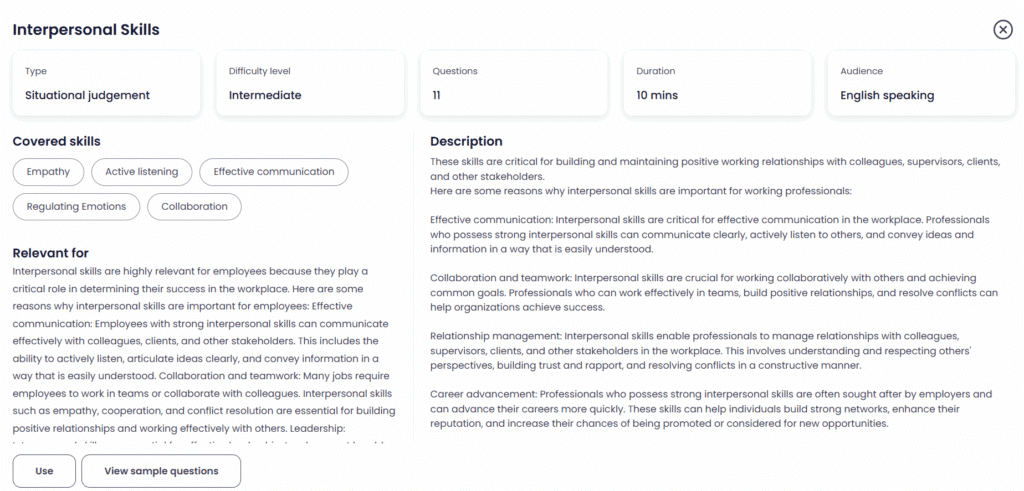
Interpersonal skills test: Interpersonal skills are the foundation of effective workplace relationships. This broad skill area includes collaboration, empathy, respect, diplomacy, and the ability to build rapport. Testing these skills helps assess how well a candidate will navigate team dynamics and contribute to a positive work culture.
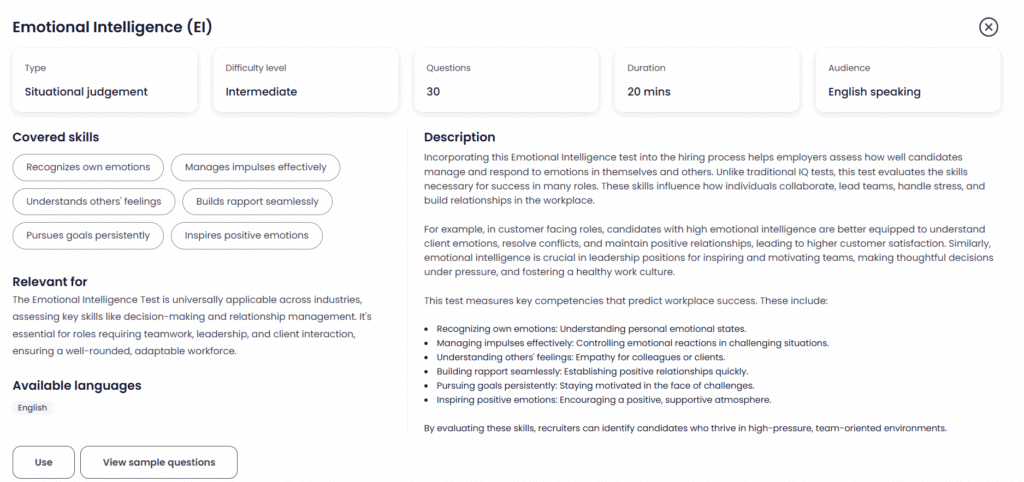
Emotional Intelligence (EI) test: Emotional intelligence involves the ability to recognize, understand, and manage one’s own emotions, as well as respond effectively to the emotions of others. High EI is strongly linked to leadership, resilience, conflict resolution, and workplace harmony.
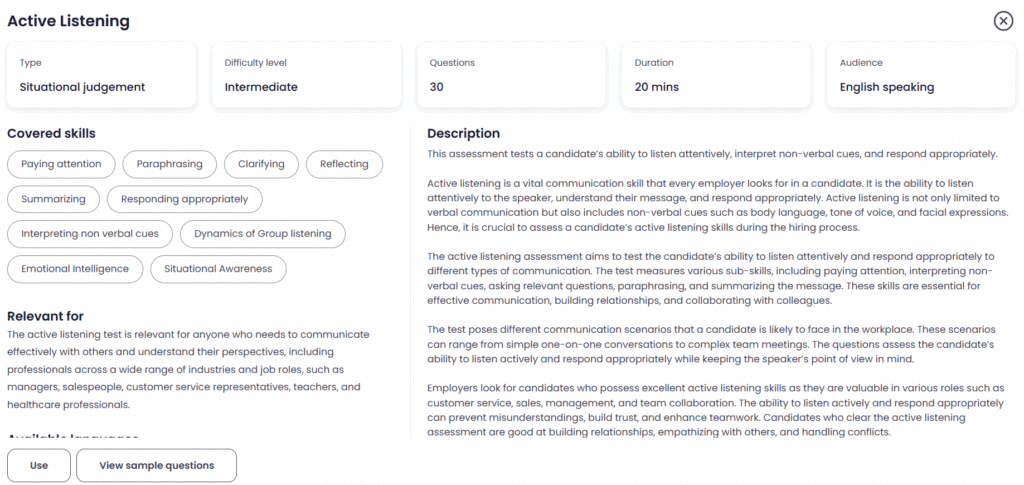
Active listening test: Active listening is crucial for building trust, resolving conflict, and collaborating efficiently. It involves full attention, processing what’s being said, and responding meaningfully, skills often overlooked in typical interviews.
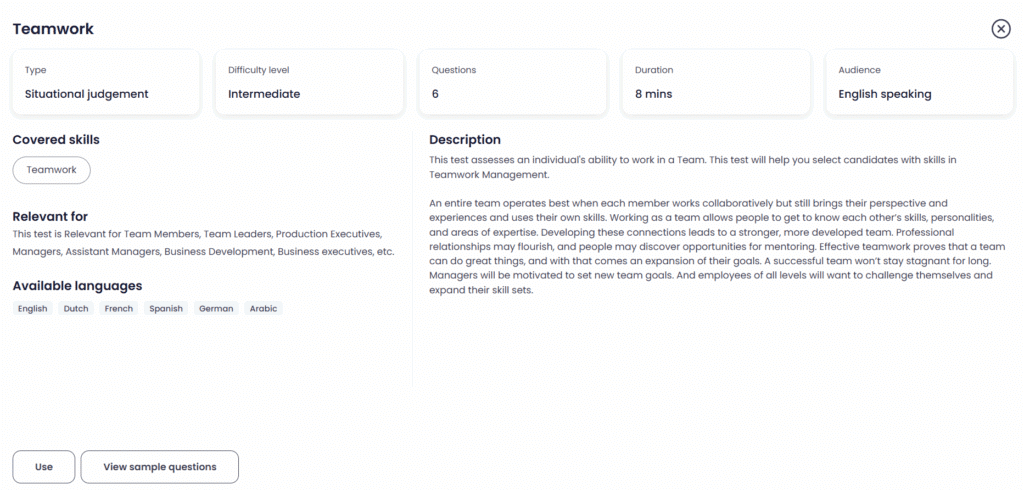
Teamwork test: Teamwork isn’t just about working in a group; it’s about contributing actively, respecting differing views, and sharing accountability. Candidates who excel in teamwork help cultivate inclusive, high-performing environments.
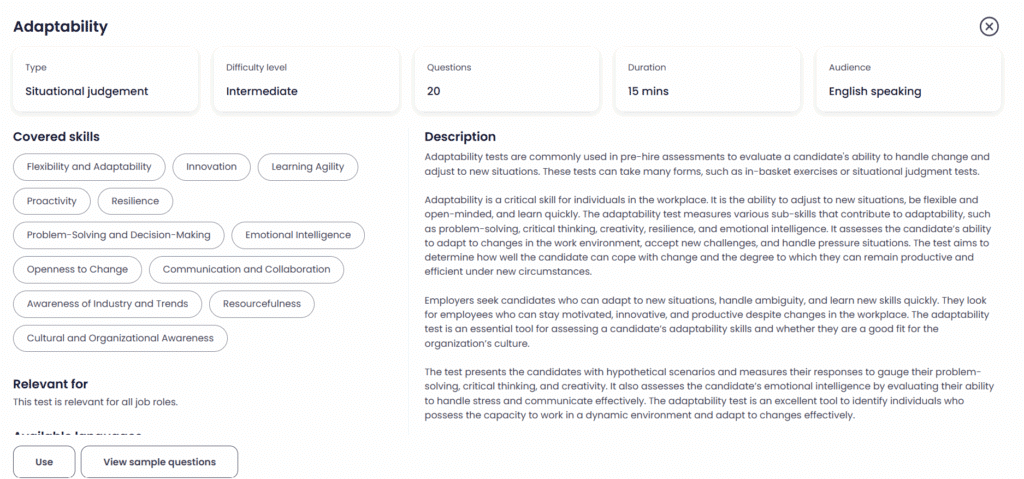
Adaptability test: The ability to pivot, learn, and respond flexibly is vital. Adaptability is not just about tolerating change, it’s about navigating it effectively and maintaining performance.
2. Personality assessments
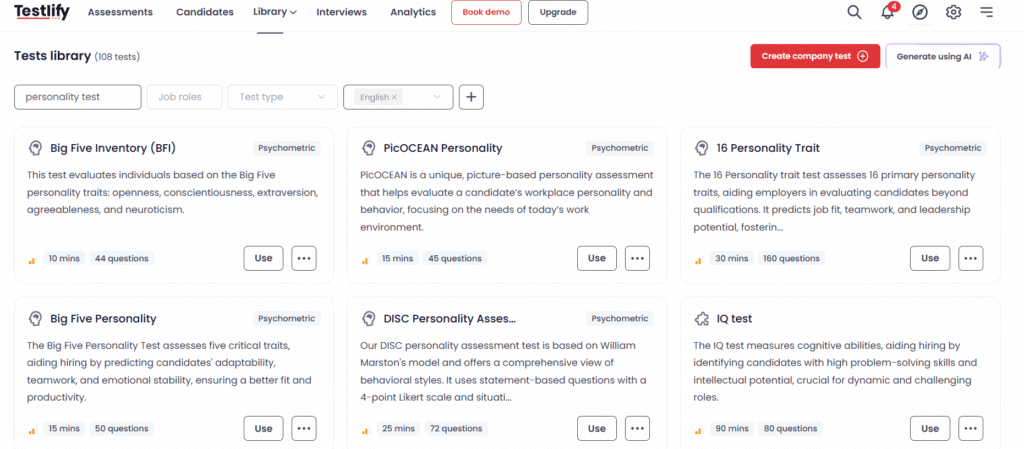
Testlify’s personality assessments, like the big five personality test, DISC personality test, can offer insights into how a candidate may interact with others.
Look for:
- High agreeableness (cooperation, compassion)
- Low neuroticism (emotional stability)
- Extroversion (sociability)
3. Behavioral interviews
Behavioral-based interviews are a goldmine for assessing interpersonal traits. These questions ask candidates to describe past experiences, which often reflect real patterns of behavior.
Examples:
- “Tell me about a time when you had to deal with a difficult colleague. How did you handle it?”
- “Describe a time you had to explain a complex concept to someone. What approach did you use?”
- “Give an example of a situation where you had to build rapport with someone quickly.”
- “Tell me about a disagreement you had at work. What was the outcome?”
4. Peer feedback and references
Talking to past colleagues or reading 360-degree reviews can reveal insights that interviews cannot.
Ask references:
- How did the candidate handle team dynamics?
- Were they approachable and empathetic?
- How did they handle disagreements or feedback?
While not definitive, these can be complementary tools in your hiring process.
Best practices for assessing interpersonal skills
A customer service representative might need conflict resolution and empathy. A project manager might need communication and assertiveness. Tailor your assessment to the role.
Define what “good” interpersonal skills mean for the role
Interpersonal skills appear differently for different jobs. Empathy, patience, and conflict resolution may be needed in a customer service position, but assertiveness, leadership communication, and stakeholder coordination might be necessary.
Identifying how interpersonal success is defined in each job enables you to target your assessments and pose specific questions. Customizing the assessment criteria helps you hire the most applicable and effective soft skills for a given job situation.
Use multiple evaluation tools
No single method can fully capture a candidate’s interpersonal capabilities. Combining behavioral interviews, role-plays, situational judgment tests, peer references, and even personality assessments offers a more complete and accurate picture.
Each assessment type reveals different facets of interpersonal behavior, from communication style to emotional intelligence. A multi-method approach reduces reliance on subjective impressions, minimizes unconscious bias, and ensures you’re making well-rounded hiring decisions that reflect real-world interactions.
Train interviewers
Even well-crafted questions are ineffective if interviewers do not have the ability to interpret responses objectively. Training hiring managers to identify positive interpersonal behaviors, eliminate unconscious bias, and craft follow-up questions is necessary to ensure fair and unbiased assessment.
With proper targeted training, interviewers can better identify rehearsed and genuine responses. Regular training ensures more consistent evaluations and assists organizations in maintaining fairness and equity in hiring.
Create structured rubrics
Subjective judgments can differ greatly among interviewers. Standard rubrics offer specific, predetermined standards for measuring interpersonal characteristics such as empathy, teamwork, or communication. With the aid of rating scales and behavior anchors, interviewers can mark applicants more reliably and minimize the role of personal bias.
Rubrics not only enhance the reliability of the measurement but also increase the transparency and defensibility of the hiring process, essential for fairness, particularly when hiring from mixed backgrounds.
Look for growth mindset
Interpersonal skills can be developed, particularly in individuals who are open to learning and change. Look for evidence of a growth mindset individuals who ask for feedback, look back on previous experiences, and use adversity as an opportunity to learn.
Self-aware candidates who want to get better will be more likely to develop more effective interpersonal skills over time. Bringing people with a growth mindset into the workforce helps to create a resilient, coachable, and adaptable workforce that can excel in changing work environments.
Conclusion
Technology is automating most technical work, interpersonal skills are more crucial than ever. Recruiting people who can establish effective relationships, negotiate complex social systems, and create collaboration results in healthier cultures and better-performing teams.
Evaluating people skills is time-consuming. By integrating skills assessments, behavior-based questions, live simulations, and reflective feedback gathering, you can be confident that you’re employing individuals who will not only get the task done but make everyone around them better.
Keep in mind, it’s not just about hiring a “people person.” It’s about hiring a person who establishes trust, communicates effectively, and assists in creating a work environment where all individuals can succeed.
Frequently asked questions (FAQs)

Content Writer
Yashika Khandelwal is a Content Writer with 3+ years of experience creating research-backed content on hiring, talent assessment, and HR technology. She is a registered Organizational Psychologist and subject matter expert who combines behavioral science with practical recruitment insights to produce accurate, evidence-based content.
LinkedInRelated resources
View all
Candidate assessment
Flexibility skills: How to assess candidates for the modern workplace

Candidate assessment
How do you assess and develop team collaboration skills?

Candidate assessment
Importance of assessing negotiation skills in recruitment for successful business deals

Candidate assessment
Importance of assessing active listening skills in recruitment for effective communication

Candidate assessment
Importance of assessing empathy in recruitment for enhanced employee engagement

Candidate assessment
Importance of assessing conflict resolution skills in recruitment for harmonious work environment
Get started.
Hire on proof, not resumes.
Run your first skills-based assessment free — no credit card required.